

Several well-ranked comparison sites currently list EQ Bank’s TFSA savings account at 4.00 percent. EQ Bank’s own site tells a different story, listing its actual current TFSA Savings Account rate at 1.50 percent tax-free, a gap of 250 basis points between what gets repeated across aggregator content and what the institution itself is actually paying. This comparison is built from research directly against each institution’s own current rate pages rather than secondhand blog listings, and that discrepancy is exactly why going straight to the source matters more in this specific category than almost any other financial comparison on this site. Our broader roundup of the best TFSA accounts in Canada covers the full picture beyond interest rate alone, including fees, investment options, and account flexibility.
Where The High Interest Actually Sits Right Now
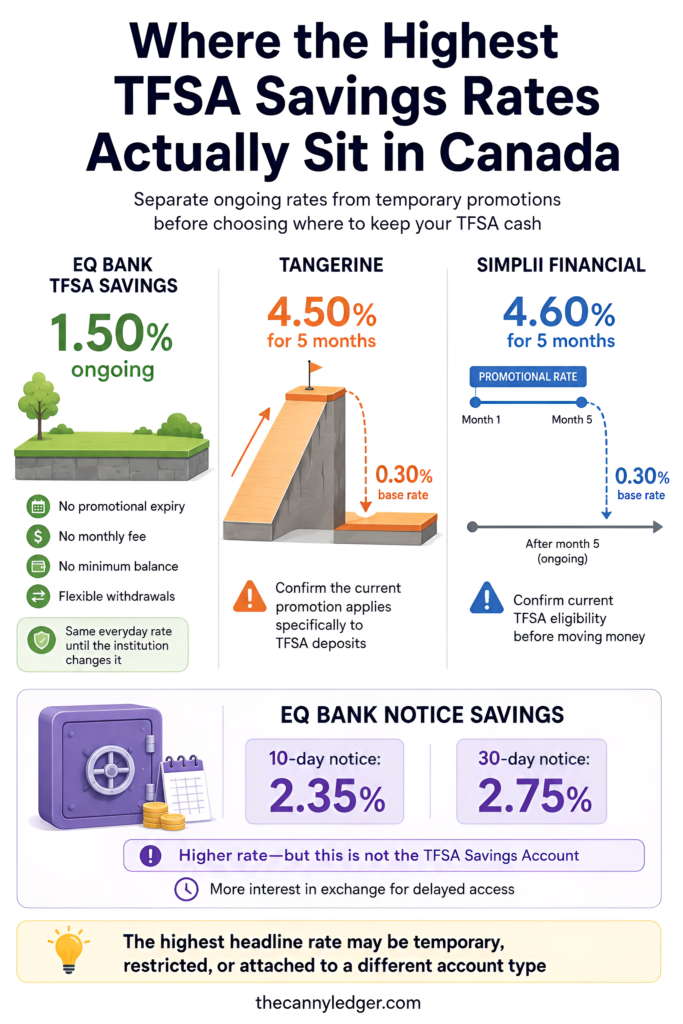
EQ Bank’s TFSA Savings Account pays 1.50 percent tax-free on every dollar, with no minimum balance, no monthly fee, and free flexible withdrawals, a straightforward everyday rate rather than a promotional one that quietly drops after a few months. The bank’s separate Notice Savings Account pays meaningfully more, 2.35 percent with a 10-day withdrawal notice or 2.75 percent with a 30-day notice, though that higher rate applies to the non-registered product rather than the TFSA specifically, and the tradeoff is losing same-day access to your money. Choosing between locking in a rate this way and keeping full flexibility is worth weighing against your own TFSA withdrawal habits before committing either way.
Tangerine and Simplii both run the opposite structure, an aggressive introductory rate that reverts sharply once the promotional window closes. Tangerine’s Savings Account advertises 4.50 percent for new clients over the first five months before dropping to a 0.30 percent base rate, while Simplii runs a comparable 4.60 percent five-month introductory offer before falling to the same 0.30 percent afterward, a pattern independently confirmed by other current comparison sources. Both institutions have historically extended similar promotional pricing to TFSA deposits during active campaigns, though the promotional terms and eligibility change often enough that confirming the current offer applies to a TFSA specifically, not just the regular savings product, is worth doing before moving money based on the advertised headline number.
Why The Big Five Banks Barely Register In This Comparison
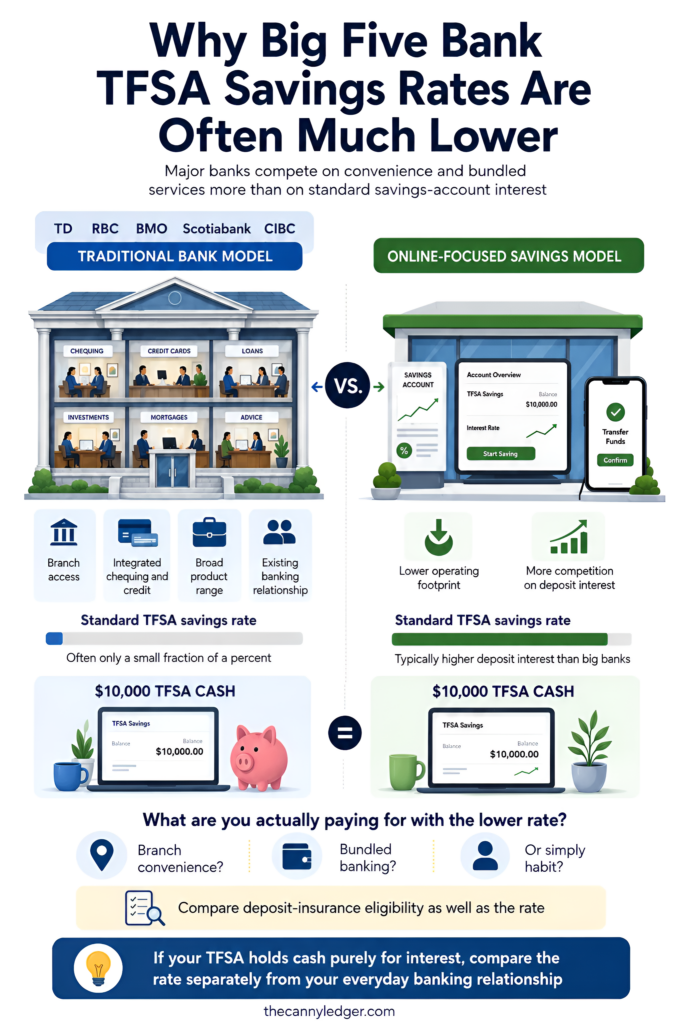
The major chartered banks, TD, RBC, BMO, Scotiabank, and CIBC, have historically paid a small fraction of a percent on standard TFSA savings balances, a rate structure that hasn’t meaningfully changed regardless of where the Bank of Canada’s overnight rate sits. That gap exists because these institutions compete on branch access, integrated banking relationships, and product bundling rather than on savings rate, and a TFSA held at a major bank purely for its interest rate is leaving real, ongoing money on the table compared to an online-only bank offering the same CDIC protection, a comparison worth running against your own TFSA versus regular savings account math directly.
Where GICs Fit Into A TFSA Rate Comparison
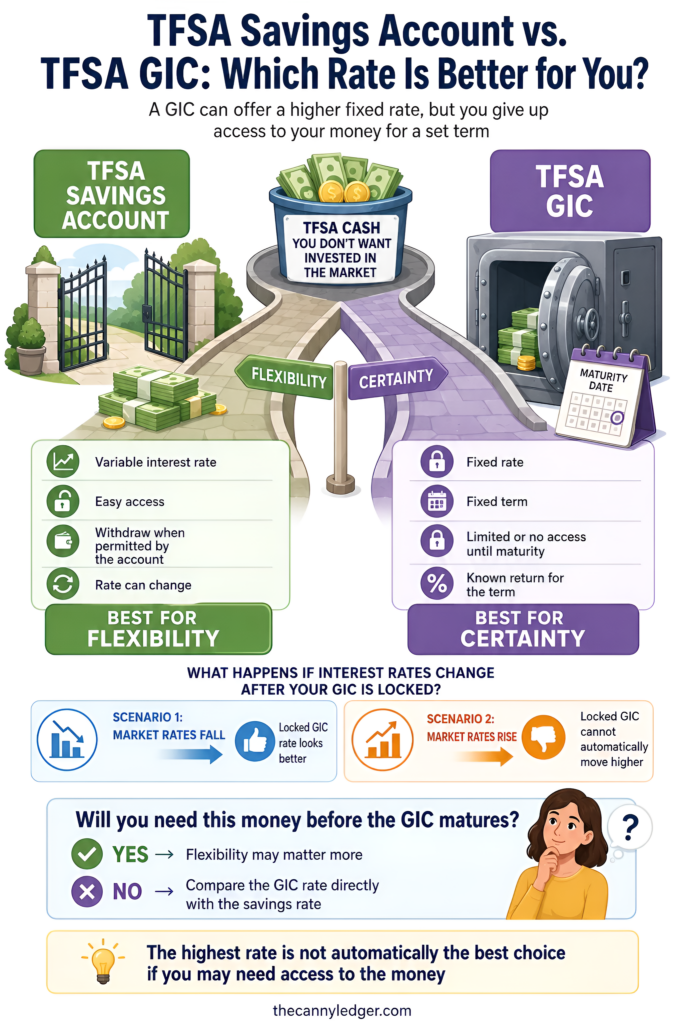
A TFSA GIC locks in a fixed rate for a set term in exchange for giving up access to the money until maturity, and that certainty typically comes with a materially higher rate than a comparable daily-interest savings account offers, particularly at longer terms. Our dedicated look at TFSA GICs covers how these locked-in terms actually work alongside the current rate landscape in more depth. The tradeoff is straightforward, a GIC rate is fixed for its full term regardless of what happens to broader interest rates afterward, which can work against you if rates rise after you’ve locked in, or work in your favour if they fall. For anyone holding TFSA cash they genuinely won’t need for a defined period, comparing the current GIC rate directly against the best available savings account rate for the same institution is worth doing before defaulting to whichever product feels more familiar.
Comparing What’s Actually On Offer
| Institution | Product | Rate structure |
|---|---|---|
| EQ Bank | TFSA Savings Account | 1.50 percent ongoing, no promotional drop |
| Tangerine | TFSA Savings Account | 4.50 percent for 5 months, then 0.30 percent base |
| Simplii Financial | TFSA Savings Account | 4.60 percent for 5 months, then 0.30 percent base |
| Big Five banks | Standard TFSA Savings | A small fraction of a percent, largely unchanged over time |

Making The Actual Decision
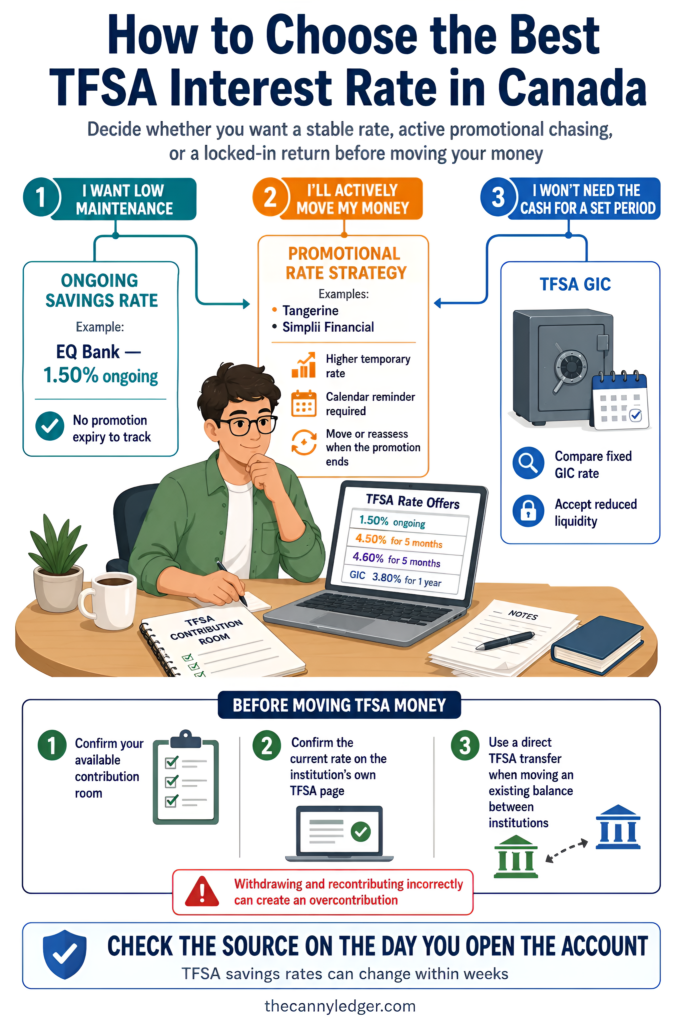
If you want a rate you don’t have to think about again after opening the account, EQ Bank’s ongoing structure is the more predictable choice, since there’s no promotional cliff to track and no calendar reminder needed. If you’re comfortable actively managing the account, rotating between Tangerine and Simplii’s introductory offers as each promotional window opens can capture a meaningfully higher rate for extended stretches, provided you’re actually willing to do the legwork of moving the balance when a promotion ends. Confirm your available contribution room before moving a large balance between institutions too, since a transfer handled incorrectly can trigger the same overcontribution issues covered in our guide to TFSA tax traps. Whichever institution you’re leaning toward, pull the current rate directly from that institution’s own TFSA product page before opening anything, not from a comparison article, including this one, since the rate landscape shifts often enough that even a genuinely careful comparison can be outdated within weeks.
What The Rate Comparison Actually Comes Down To
Why do so many comparison sites list EQ Bank’s TFSA rate incorrectly? Rate aggregator content often gets built once and updated infrequently, so a number that was accurate at some earlier point can keep circulating across secondary sites long after the institution itself has changed it, which is exactly the gap this comparison found between EQ Bank’s own page and several third-party listings.
Does a promotional rate at Tangerine or Simplii ever apply automatically to an existing TFSA balance? No, promotional rates are structured around new deposits within a defined window, so an existing balance sitting in the account generally doesn’t start earning the higher rate without a fresh qualifying deposit or a new account opening, depending on the specific offer’s terms.
Is chasing the highest advertised rate actually worth the effort for a typical TFSA balance? The dollar difference scales directly with your balance, so the effort of tracking and rotating promotional rates matters far more for a large TFSA balance than a small one, and for many people the simpler, consistently competitive option is worth more than the extra percentage points an active rotation strategy might capture.