

A regular savings account has no contribution limit at all. Deposit $500,000 tomorrow and the CRA has nothing to say about it. Try that in a TFSA without the room to support it, and you’ll owe a real penalty within the month. That asymmetry alone explains a lot about when each account actually makes sense, since the two aren’t simply competing for the same job the way their similar day-to-day function might suggest.
- What Actually Stays The Same Between Them
- The Contribution Limit A Regular Savings Account Doesn’t Have
- What The Tax Difference Actually Costs You
- Where A Regular Savings Account Still Earns Its Place
- Comparing What The Rates Actually Look Like
- Sequencing Your Own Money Correctly
- Where People Get These Two Accounts Confused
What Actually Stays The Same Between Them
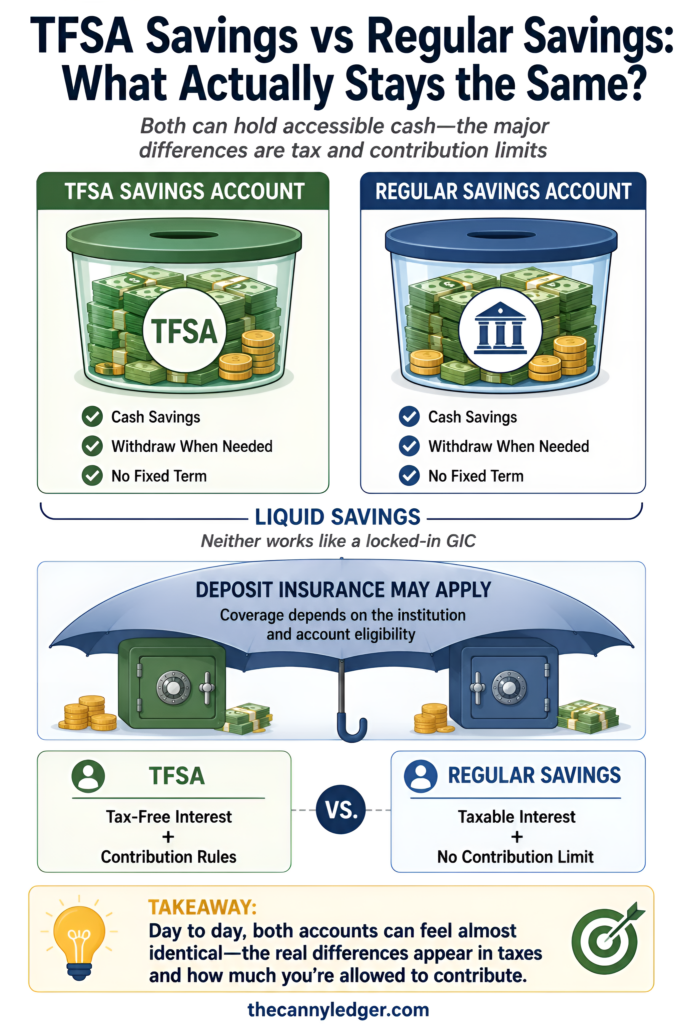
Both are liquid deposit accounts holding cash, both let you withdraw whenever you want without penalty, and both are typically covered by CDIC deposit insurance up to $100,000 per institution. Day to day, moving money in and out feels identical regardless of which one you’re using, since neither locks your funds the way a GIC or a term deposit would. The genuine differences sit entirely in what happens to the interest and how much you’re allowed to put in, not in how the account behaves as a place to park cash.
The Contribution Limit A Regular Savings Account Doesn’t Have
A TFSA’s annual dollar limit and cumulative room are tracked by the CRA specifically because the account carries a tax benefit the government is rationing. A regular savings account carries no such benefit, so there’s no reason for a limit to exist, and none does. This becomes genuinely relevant the moment a large sum shows up outside your normal cash flow, an inheritance, the proceeds from selling a home, a business payout, since a TFSA can only absorb whatever room you’ve actually accumulated, while a regular savings account absorbs the entire amount without restriction. Someone receiving $150,000 from a home sale with only $40,000 in available TFSA room still needs somewhere to hold the remaining $110,000, and a regular savings account is exactly that overflow destination.

What The Tax Difference Actually Costs You
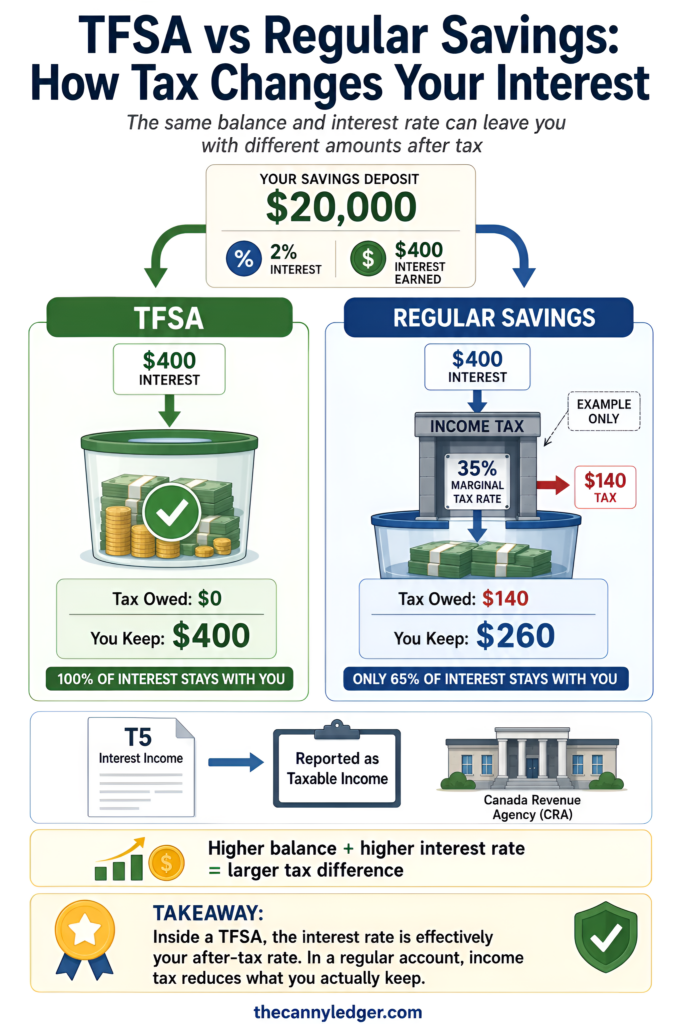
Interest earned in a regular savings account gets reported on a T5 slip and taxed as ordinary income at your full marginal rate, the same treatment any other interest income receives on line 12100 of a personal tax return. A $20,000 balance earning 2 percent over a year produces $400 in interest, and a saver at a 35 percent marginal rate keeps $260 of it after tax. The identical $20,000 at the identical 2 percent rate held inside a TFSA keeps the full $400, since interest earned inside a TFSA generates no tax liability regardless of the amount or how long it sits there. That gap only grows as the balance and the rate climb higher, which is exactly why filling available TFSA room before parking money in a regular account makes mathematical sense in nearly every situation.
Where A Regular Savings Account Still Earns Its Place
Beyond the overflow scenario above, a regular savings account genuinely still matters for money tied to a business rather than personal finances, since TFSAs are strictly personal accounts with no business-use equivalent. It also suits anyone who has already maxed out their available TFSA room and simply has more cash than the account can currently hold, a real situation for higher earners with substantial savings rates, one our broader introduction to how the TFSA works covers in more depth if the room mechanics themselves feel unfamiliar. And for money you’re managing jointly with someone you’re not married to or in a registered partnership with, a regular joint savings account remains the more straightforward structure, since TFSAs are individually owned and can’t be held jointly the way a standard bank account can.

Comparing What The Rates Actually Look Like
EQ Bank’s TFSA Savings Account pays 1.50 percent tax-free on every dollar, an everyday rate rather than a promotional one that quietly reverts after a few months. The bank’s own regular Personal Account pays a 1.00 percent base rate, rising to 2.75 percent for customers maintaining qualifying recurring direct deposits of at least $2,000 a month. Comparing the two rates directly without accounting for tax misses the real picture, since the regular account’s higher headline rate still gets taxed away at your marginal rate while the TFSA rate doesn’t, narrowing or even erasing the gap depending on your tax bracket.

Sequencing Your Own Money Correctly
Fill your available TFSA contribution room before routing new savings into a regular account, since the tax-free treatment makes the TFSA the mathematically better home for nearly any deposit up to your limit. If a large lump sum genuinely exceeds your room, split it deliberately, the amount your room can absorb into the TFSA and the remainder into a regular high-interest savings account, rather than defaulting the whole amount into whichever account feels simpler to manage. And if you’re unsure how much room you actually have before making that split, checking your contribution room directly beats guessing, since an overcontribution penalty on the TFSA side erases whatever advantage you were trying to capture in the first place.

Where People Get These Two Accounts Confused
Can a TFSA and a regular savings account be held jointly with a spouse? No, a TFSA is always an individually owned account regardless of marital status, while a regular savings account can be structured jointly, a real practical difference for couples managing shared cash.
Does moving money from a regular savings account into a TFSA count as a new contribution? Yes, transferring cash from any outside account into a TFSA, including your own regular savings account at the same bank, consumes contribution room exactly the same way a fresh deposit from your paycheque would.
Is there ever a reason to keep money in a regular savings account even with unused TFSA room available? Genuinely rare, since the tax-free treatment almost always wins mathematically, though a business account, a joint account with someone you’re not married to, or money you specifically want kept separate from your personal registered accounts are the main legitimate exceptions.