

Asking which TFSA account is best is a bit like asking which container is best without saying what you’re putting in it. A TFSA isn’t a single product, it’s a tax wrapper that different institutions fill in completely different ways, a self-directed brokerage account holding stocks and ETFs, a robo-advisor managing a portfolio for you, or a plain high-interest savings account holding cash. The right pick depends entirely on which of those three things you actually need, not on which name shows up first in a generic ranking.
- Three Different Things People Mean by TFSA Account
- Wealthsimple, the Simplest Entry Point
- Questrade, Better for a Specific Kind of Investor
- Qtrade, Worth Knowing About for a Narrower Reason
- High-Interest Savings TFSAs Deserve a Different Kind of Caution
- Good Stuff and Bad Stuff, By Account Type
- Matching the Account to How You Actually Invest
- A Few Things Worth Checking Before You Sign Up
This comparison is based on published rates, fees, and terms from each institution’s own current pages rather than personal use of every account listed, since the point here is comparing what’s publicly available and verifiable right now, not a first-hand review of each platform’s day-to-day experience.
For self-directed investing inside a TFSA, Wealthsimple and Questrade are the two accounts most Canadians actually compare, with Wealthsimple charging zero commissions on Canadian stock and ETF trades and Questrade charging between $4.95 and $9.95 per stock trade while offering commission-free ETF purchases. Which one actually costs less depends heavily on how you trade, and the two platforms end up favouring different kinds of investors once you look past the headline commission-free claim.
Three Different Things People Mean by TFSA Account
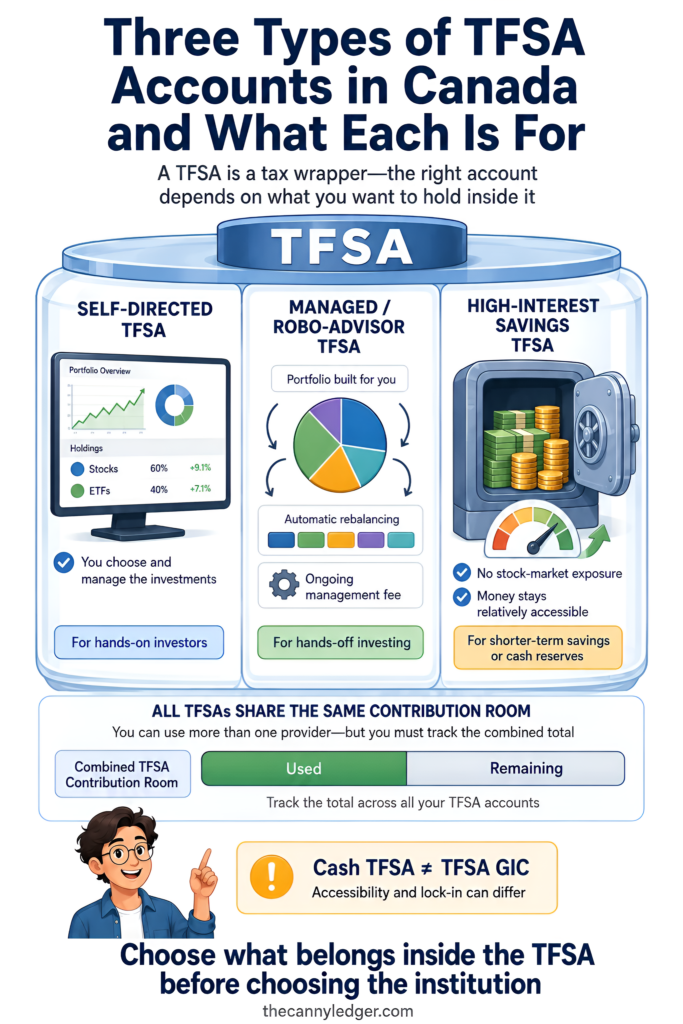
Before comparing specific institutions, it’s worth being clear about which category actually applies to your situation, since the comparison changes entirely depending on the answer. A self-directed brokerage TFSA lets you buy and sell individual stocks and ETFs yourself, and it’s the right category if you want to build your own portfolio. A managed or robo-advisor TFSA has the platform build and rebalance a diversified portfolio for you based on your risk tolerance, charging an ongoing percentage fee for that service. A high-interest savings TFSA holds cash rather than investments, paying interest with no market risk at all, functioning closer to a regular savings account than an investment platform, distinct from a TFSA GIC specifically in how accessible your money stays.
Nothing stops you from holding more than one type at once, and plenty of people do, a cash TFSA for a shorter-term goal or an emergency cushion, alongside a self-directed or managed TFSA for long-term growth. All of them draw from the exact same contribution room regardless of which institution or account type holds the money, so splitting your TFSA across providers costs nothing extra in terms of eligibility, just extra bookkeeping to track your total contributions against one shared limit.
Wealthsimple, the Simplest Entry Point
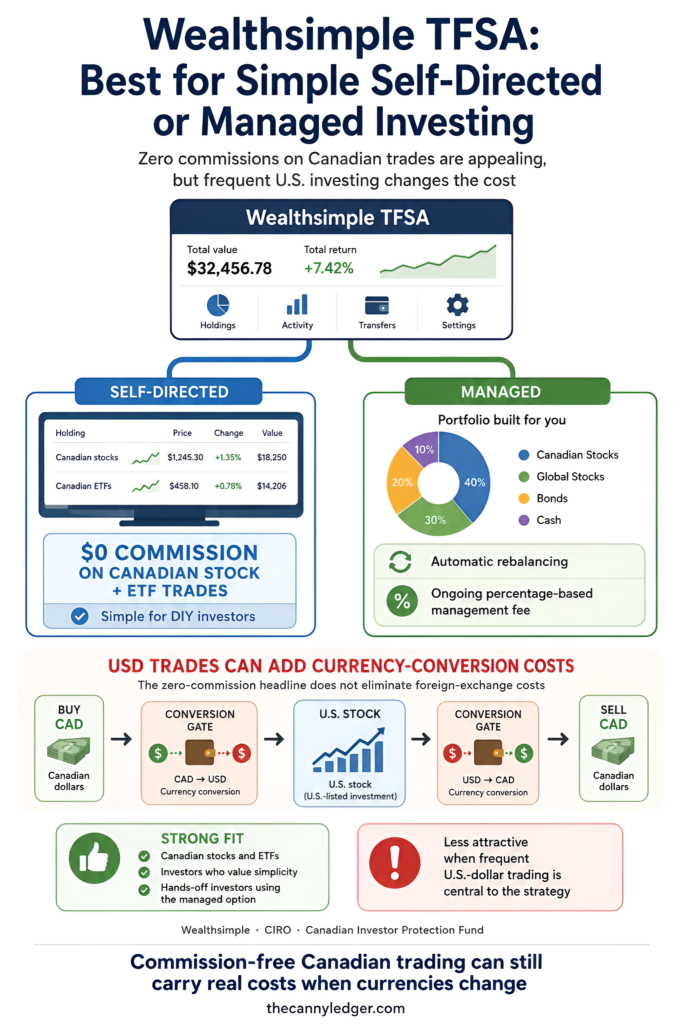
Wealthsimple charges no commission on Canadian stock and ETF trades inside a TFSA, and offers both a fully self-directed platform and a managed robo-advisor option under the same account. According to a direct comparison of Wealthsimple and Questrade’s current fee structures, the cost that actually matters for Wealthsimple users trading US-listed stocks is a currency conversion spread applied on every USD trade, since the platform doesn’t offer a true US-dollar account the way some competitors do. On a meaningful US stock position, that conversion cost applied on both the buy and the sell can add up to a real expense that a zero-commission headline doesn’t capture.
Wealthsimple’s managed option charges an ongoing percentage fee on assets under management rather than per-trade commissions, which suits someone who wants a diversified portfolio built and rebalanced automatically rather than picking individual investments themselves. Both the self-directed and managed sides of Wealthsimple operate under CIRO regulation and Canadian Investor Protection Fund coverage, confirmed directly in an independent broker comparison, the same regulatory protection any legitimate Canadian brokerage carries.
Questrade, Better for a Specific Kind of Investor
Questrade flips the fee structure Wealthsimple uses, charging no commission on ETF purchases specifically but applying a per-trade fee, typically between $4.95 and $9.95 depending on trade size, on individual stock purchases and on every ETF sale. That structure makes Questrade meaningfully cheaper than a percentage-based robo-advisor for someone building a simple, buy-and-hold ETF portfolio and rarely trading, but it stacks up real cost for anyone trading individual stocks frequently.
Questrade’s clearest advantage over Wealthsimple shows up specifically for investors holding a significant amount of US-listed stock, since it offers an actual US-dollar account rather than converting every trade at the platform’s own exchange rate. For a large, long-term US equity position, avoiding a currency spread on every single transaction can outweigh years of a competitor’s commission-free trading on the Canadian side alone.

Qtrade, Worth Knowing About for a Narrower Reason
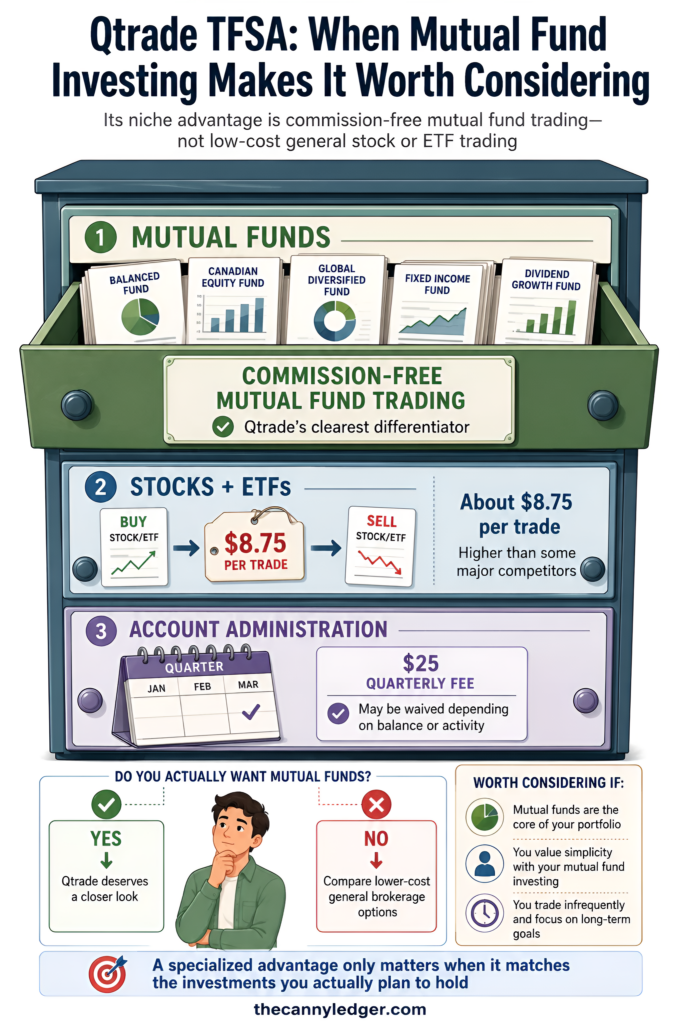
Qtrade doesn’t come up as often in casual TFSA comparisons, but it fills a specific gap the two bigger names don’t cover as well. According to MoneySense’s own current comparison of Canadian TFSA providers, Qtrade charges $8.75 per stock or ETF trade along with a $25 quarterly administrative fee, both higher than Wealthsimple or Questrade’s structure, though the quarterly fee can be waived depending on account balance and trading activity. What sets Qtrade apart is that it allows commission-free mutual fund trading, a feature neither Wealthsimple nor Questrade offers at all.
That specific feature makes Qtrade worth a look only for someone whose TFSA strategy actually centres on mutual funds rather than ETFs or individual stocks, since the higher per-trade cost on everything else makes it a worse general-purpose choice than either bigger competitor for most other investing styles.
High-Interest Savings TFSAs Deserve a Different Kind of Caution
This category works differently from the investing platforms above, and it comes with a specific warning worth taking seriously. Promotional interest rates on cash TFSAs at digital banks like EQ Bank change frequently, sometimes month to month, and the specific percentage advertised today has no reliability as a number to quote weeks or months later. Rather than repeat a rate here that could already be stale by the time you’re reading this, the honest advice is to check the institution’s own current rate page directly before assuming any figure you’ve seen elsewhere, including in other articles, still applies.
What does stay relatively stable across these accounts is the structure, no monthly fees, no minimum balance requirements, and CDIC deposit insurance through the underlying regulated bank, which for EQ Bank specifically runs through Equitable Bank as a federally regulated Schedule I institution. That structural stability is worth more than the headline rate in most comparisons, since the rate itself is the one number in this entire piece guaranteed to look different by the time you check it yourself.

Good Stuff and Bad Stuff, By Account Type
Wealthsimple’s good stuff includes zero commissions on Canadian trades, an actually simple account-opening process, and both self-directed and managed options in one platform. Its bad stuff is the currency conversion spread on US trades and the absence of a true US-dollar account for anyone trading American stocks regularly.
Questrade’s good stuff is commission-free ETF purchases and an actual US-dollar account option, making it the stronger pick for anyone with meaningful US equity exposure. Its bad stuff is a real per-trade cost on individual stock purchases that adds up quickly for anyone trading often rather than buying and holding.
Qtrade’s good stuff is commission-free mutual fund trading, a real gap in what the two bigger platforms offer. Its bad stuff is a higher cost structure on everything else, making it a poor general choice outside that specific use case.
Matching the Account to How You Actually Invest
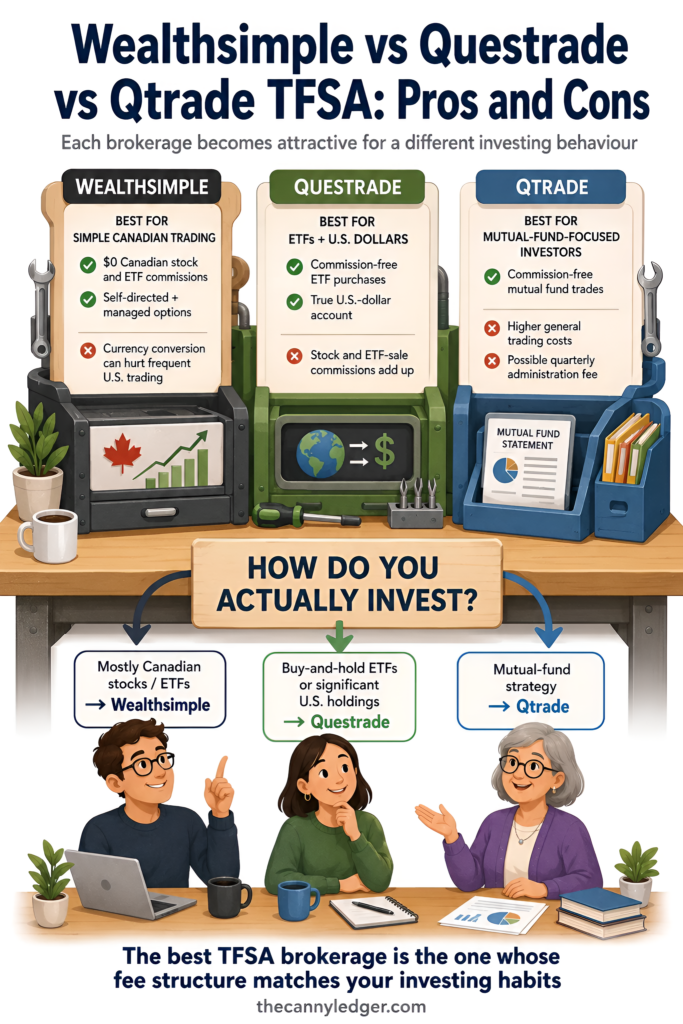
Match the account type to your actual behaviour first, a self-directed brokerage if you want to pick your own stocks and ETFs, a managed option if you’d rather not, and a cash TFSA if the money needs to stay liquid and safe rather than invested. The actual steps for getting any of these accounts open are covered separately, since choosing the right type matters more than the mechanics of the application itself. If US stocks make up a meaningful part of your strategy, weigh Questrade’s US-dollar account against Wealthsimple’s simpler interface before assuming commission-free trading alone makes the decision for you. And whatever cash TFSA rate you’re comparing right now, verify it directly on the institution’s own current page rather than trusting any number, including the ones in this article, without checking it fresh.

A Few Things Worth Checking Before You Sign Up
Does it matter which institution actually holds my TFSA for tax purposes? No, the tax treatment is identical regardless of which institution holds your TFSA, since the tax-free status comes from the account type itself under federal rules, not from anything a specific bank or brokerage does differently.
Can I transfer an existing TFSA from one institution to another without losing contribution room? Yes, a direct institution-to-institution transfer preserves your contribution room and doesn’t count as a withdrawal and new contribution, though understanding how a withdrawal versus a proper transfer actually works matters if you’re moving money yourself rather than requesting a direct transfer.
Is a higher-fee platform ever worth it despite the extra cost? Sometimes, particularly if a specific feature you actually need, like Qtrade’s free mutual fund trading or Questrade’s US-dollar account, saves you more than the extra fees cost over your actual trading pattern, rather than a theoretical worst case.