
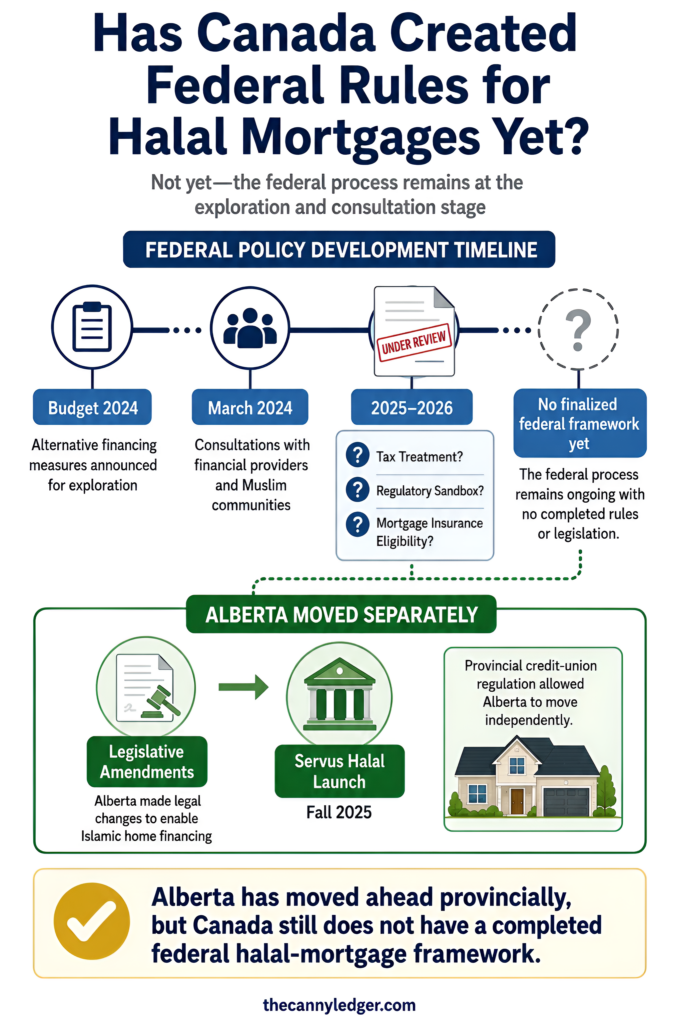
In the fall of 2025, Servus Credit Union began offering Alberta’s first provincially regulated halal mortgage, built through a working group that included the Government of Alberta’s Treasury Board, the Canadian Islamic Finance Board, and the province’s credit union deposit insurer. It took legislative amendments in Alberta to make it possible, because a genuinely Shariah-compliant mortgage isn’t a conventional mortgage with a different label. It’s a completely different legal structure, built around ownership and sale rather than borrowing and interest, and that difference shapes everything from your monthly payment to your closing costs to which lenders can even offer one.
- The three structures actually in use
- What it actually costs compared to a conventional mortgage
- The down payment reality most people don’t expect
- Where you can actually get one right now
- The federal government is still just exploring this, not regulating it
- A caution worth knowing before you sign anything
- What to actually do next
Halal mortgages exist because Islamic law prohibits riba, a term that covers interest of any kind, on any loan, for any reason. A conventional Canadian mortgage runs entirely on interest, so it doesn’t work for a borrower trying to follow that principle, no matter how low the rate gets. Halal home financing solves this by restructuring the transaction itself. Instead of a bank lending you money and charging interest on the balance, the financier either buys the home and resells it to you at a set profit, or buys it and leases it to you, or buys it jointly with you and sells you its share over time. None of these structures involve a loan in the conventional sense at all.
The three structures actually in use
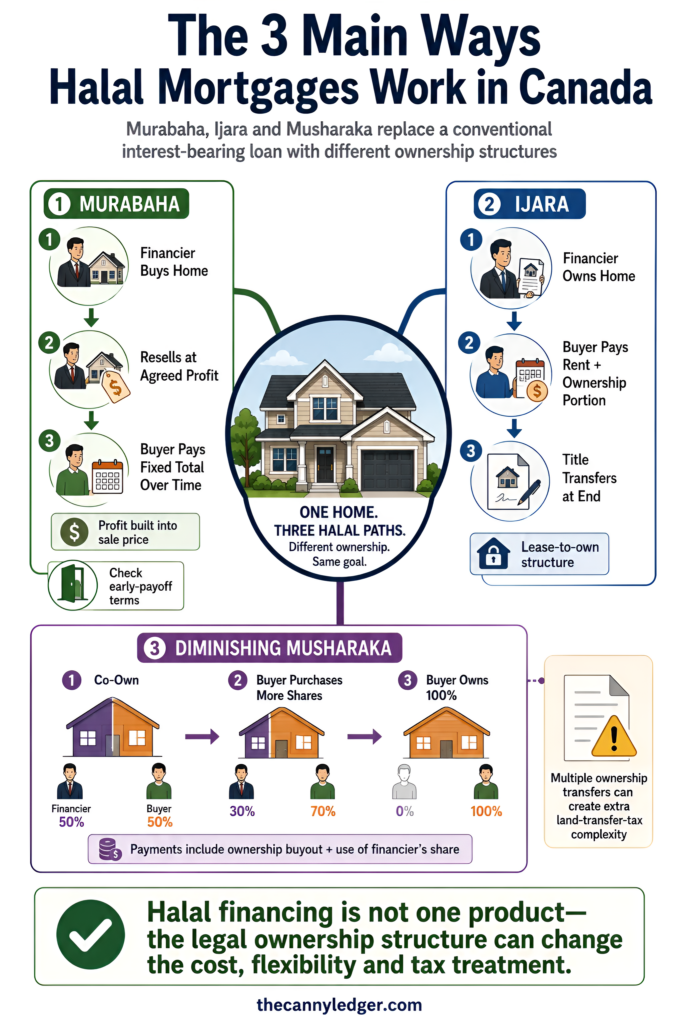
Murabaha is the most common structure offered in Canada right now, as NerdWallet’s own breakdown of the model explains. The financier purchases the property, then immediately resells it to you at a higher price that includes their profit margin, agreed upon and fixed at the outset. You repay that total price in installments over the term, and because the profit is baked into the sale price rather than accruing as interest on a balance, there’s technically no interest changing hands at any point. Early Murabaha products in Canada applied the full markup regardless of when you paid off the balance, which made paying early extremely expensive since you owed the full agreed price. Newer monthly Murabaha structures from providers like Eqraz have moved away from that rigid version specifically to fix this problem, allowing early payoff for close to the remaining principal plus a smaller exit cost instead of the entire original markup.
Ijara works more like a lease-to-own arrangement. The financier buys the home outright and rents it to you, with your monthly payment covering rent plus a portion that builds toward ownership. Title transfers to you once the full term is complete. This is the least common structure among Canadian providers today, largely because it requires the financier to hold and manage the property as a landlord for the full term, which ties up more capital than the other two approaches.
Musharaka, sometimes called diminishing Musharaka, sets up a genuine co-ownership arrangement. You and the financier both go on title as joint owners, and your monthly payments do two things at once, buying out a growing share of the financier’s ownership stake while also covering something equivalent to rent on the portion you don’t yet own. Over the term, the financier’s share shrinks to zero and you end up holding the property outright. Because this structure involves two ownership transfers, an initial purchase and a final transfer, some Musharaka arrangements in Canada have triggered land transfer tax twice, once when the co-ownership is established and again at the final transfer, adding a real cost most conventional buyers never have to think about.
What it actually costs compared to a conventional mortgage
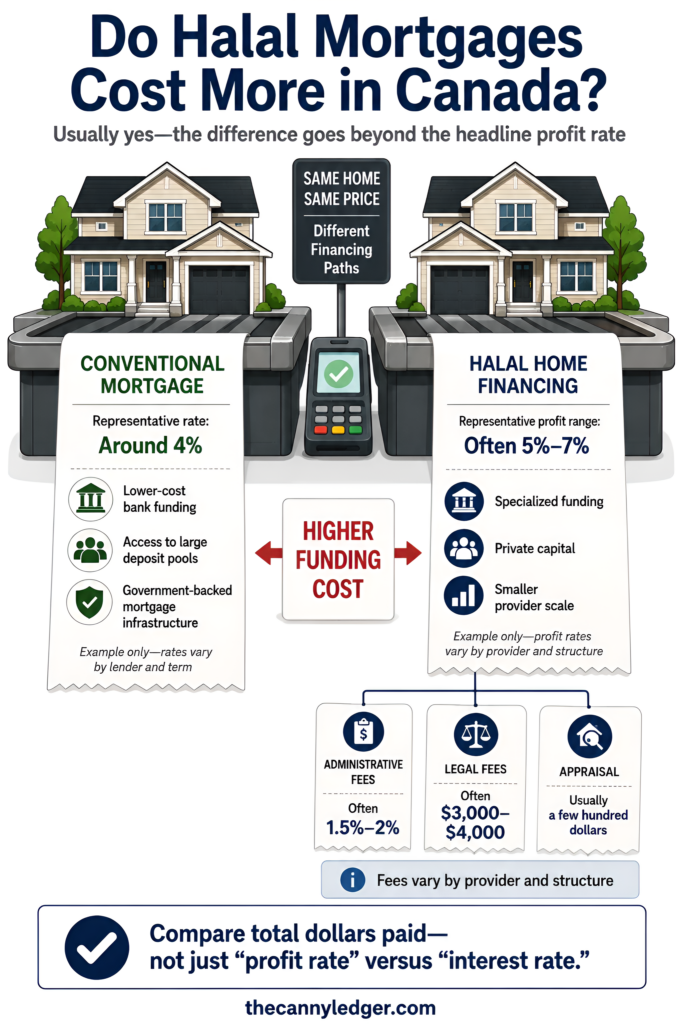
The honest answer is that halal mortgages generally cost more, and it’s worth saying that plainly rather than softening it. Providers report profit rates commonly running in the 5 to 7 percent range, compared to conventional five-year fixed rates sitting closer to 4 percent as of mid-2026, a gap you can check for yourself against today’s best conventional rates. That gap comes down to how these providers fund their business. Conventional banks draw on enormous, cheap pools of deposits and can access government-backed insurance and securitization to lower their own funding costs. Halal financiers largely rely on private capital and specialized funding structures like Wakala agreements, which cost more to arrange and don’t benefit from the same scale.
On top of the profit rate itself, expect provider-specific fees that don’t always have a direct conventional-mortgage equivalent. Administrative fees in the 1.5 to 2 percent range are common, and legal fees tend to run higher too, often $3,000 to $4,000, because these transactions require legal structuring conventional mortgage lawyers don’t typically handle. Appraisal fees land in a similar range to conventional mortgages, generally a few hundred dollars.
The down payment reality most people don’t expect
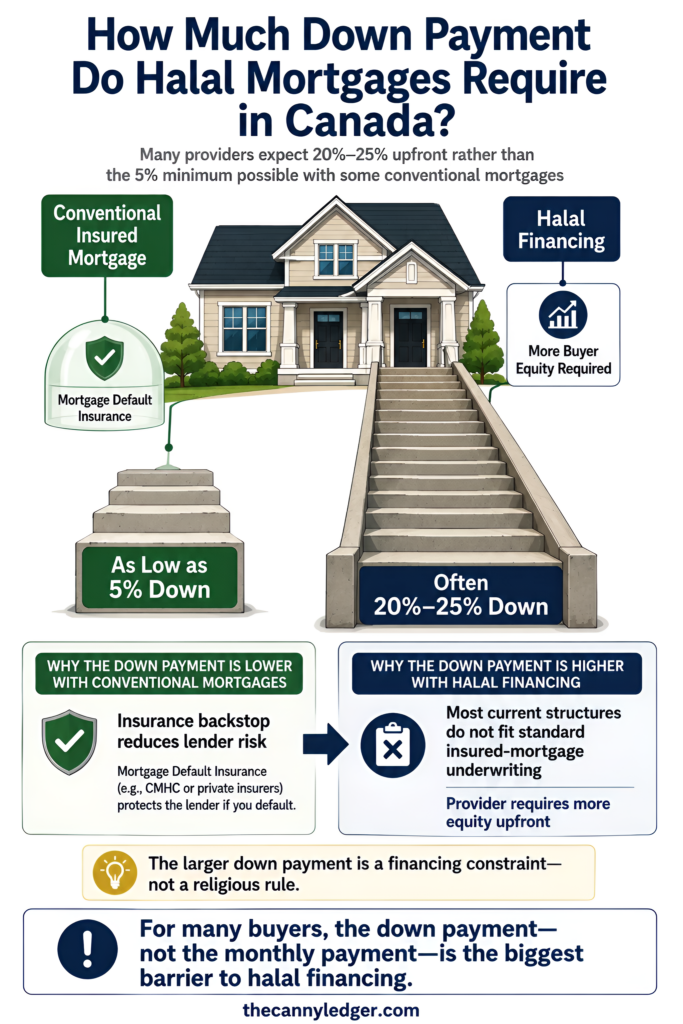
Here’s the detail that catches a lot of buyers off guard. Most halal mortgage providers require a down payment of 20 to 25 percent, well above the 5 percent minimum available on a conventional insured mortgage. This isn’t a religious requirement, it’s a practical one. CMHC mortgage default insurance, the program that lets conventional buyers put down as little as 5 percent, generally isn’t available for these products, since most current halal financing structures fall outside the underwriting criteria CMHC insures against. A 2010 CMHC research report on Islamic housing finance in Canada found no fundamental legal conflict between Shariah principles and Canadian property law, but the report also noted at the time that CMHC had no plans to extend its insurance program to these structures, and that’s largely still the practical reality for buyers today. Without that insurance backstop, providers protect themselves by requiring more equity from the borrower up front instead.
Where you can actually get one right now
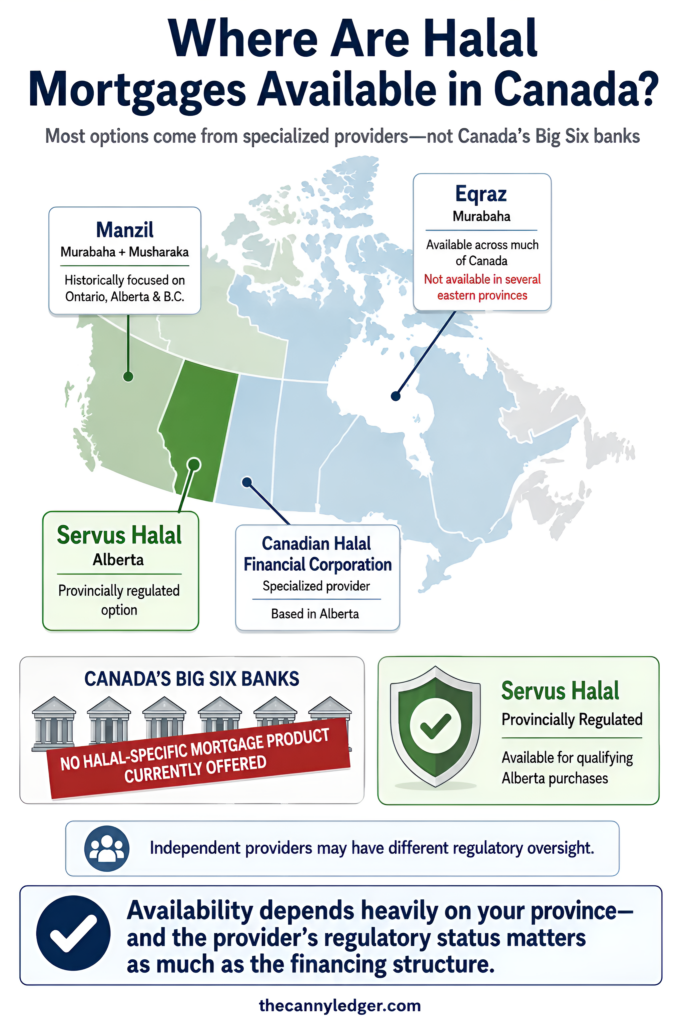
No Canadian Big Six bank currently offers a halal mortgage, a gap CBC’s own reporting on the sector has documented as specialized providers step in instead. What exists instead is a small set of specialized providers, each covering different parts of the country. Eqraz offers Murabaha-based financing across most of Canada, though notably not in Quebec, New Brunswick, Nova Scotia, Prince Edward Island, or Newfoundland and Labrador. Manzil offers both Murabaha and Musharaka structures, historically concentrated in Ontario, Alberta, and British Columbia. The Canadian Halal Financial Corporation, based in Alberta, offers both structures as well with a faster typical processing window. And as of fall 2025, Servus Halal, a subsidiary of Servus Credit Union created specifically for this purpose, became the first provincially regulated option, available to anyone purchasing in Alberta who meets the standard income and down payment requirements, not limited to Muslim buyers.
That regulatory distinction matters more than it might seem. Servus’s product went through legislative amendments in Alberta specifically permitting a provincially regulated financial institution to offer a cost-plus-profit structure alongside conventional interest-based products, overseen by the same Credit Union Deposit Guarantee Corporation that backs Servus’s conventional accounts. The independent, non-bank providers operating elsewhere in the country don’t carry that same level of prudential oversight, which is worth factoring into how much diligence you do before signing with one.
The federal government is still just exploring this, not regulating it
Budget 2024 announced that the federal government was exploring new measures to expand access to alternative financing products like halal mortgages, including possible changes to how these products are taxed and a potential regulatory sandbox for providers. Consultations with financial services providers and Muslim community groups began in March 2024. As of mid-2026, this remains at the exploration and consultation stage federally, not a finalized regulatory framework, and no changes to CMHC’s insurance eligibility for these products have been confirmed at the federal level. Alberta’s provincial move with Servus happened independently of this federal process, through Alberta’s own legislative authority over its provincially regulated credit unions, which is why it was able to move faster than anything at the federal level so far.
A caution worth knowing before you sign anything
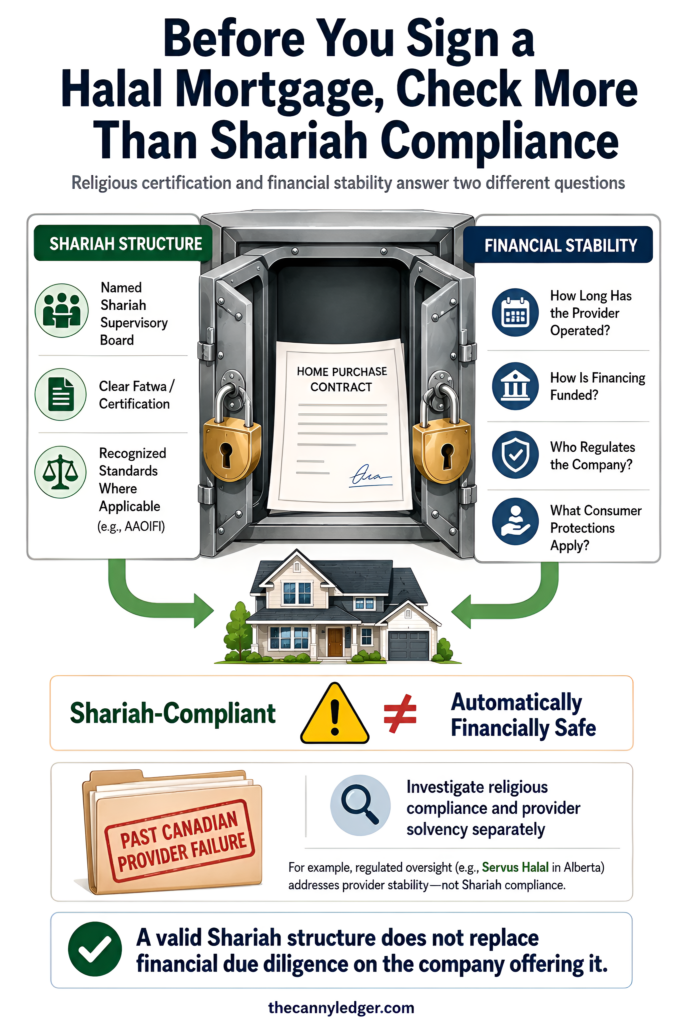
Canada’s Islamic finance sector is still young, and it’s had at least one serious stumble. An early Toronto-based Islamic financial company that offered Shariah-compliant home financing starting in 2005 was placed into court-ordered receivership in 2011 after running into serious financial difficulty. It’s a useful reminder that “Shariah-compliant” and “financially stable” are two separate questions, and a genuine fatwa or Shariah board certification on a product’s structure says nothing about the underlying company’s financial soundness. Before committing to any provider, verify their Shariah compliance certification independently (AAOIFI membership or a named Shariah Supervisory Board are the two most common credentials Canadian providers point to), and separately look into how long the company has operated, how its financing is actually funded, and whether it’s subject to any government or credit union regulatory oversight the way Servus Halal now is in Alberta.
What to actually do next
If you’re weighing a halal mortgage, start by getting a written breakdown of the total cost over the full term from at least two providers, not just the headline profit rate, since fees and early-payoff terms vary enough between Murabaha, Ijara, and Musharaka products to change the real comparison significantly. Confirm which structure a given provider uses and ask directly whether early payoff triggers the full original markup or a reduced amount, since that single term can be the difference between a manageable exit and a very expensive one. If you’re in Alberta, compare Servus Halal’s regulated product against the independent providers directly, since the regulatory backing is a real, measurable difference in consumer protection, not just a marketing point. If you’re in Manitoba and weighing a Musharaka or Murabaha product against what’s on offer from a local credit union, our comparison of Winnipeg’s credit unions is a useful starting point even though none currently offer a halal-specific product the way Servus now does. And whichever structure you’re considering, a mortgage broker familiar with alternative financing can help you sanity-check the total cost against what a conventional insured mortgage would actually cost for the same home using a mortgage calculator, since that comparison is the clearest way to know exactly what the halal structure is costing you in real dollars.