

In the same rate filing, MPI once requested a 0.4 percent decrease for private passenger vehicles while asking for a 1.6 percent increase on motorcycles, a 3.7 percent increase on commercial vehicles, and an 8.6 percent decrease on trailers, all at once, all from the same insurer, in the same year. Taxi and rideshare vehicles have faced 20 percent annual increases for three consecutive years in a separate ruling, while the average Manitoba driver saw a historic 8.8 percent rate cut that same season. There is no single “MPI rate.” There’s a rate calculation built from your specific vehicle, your specific territory, your specific driving record, and whichever vehicle class you fall into, and pretending a flat average number applies to your situation is exactly how a lot of unofficial “MPI calculator” websites mislead people.
- There’s No Single “Average” MPI Premium
- MPI’s Real Official Rate Calculator
- The Four Factors the Calculator Actually Uses
- How Much Your Driving Record Alone Can Save You
- Real Examples of How Differently Rates Move by Vehicle Type
- Why You Shouldn’t Trust Third-Party “MPI Calculator” Websites
- When Your Actual Bill Might Differ From the Calculator Estimate
- Common Questions About Manitoba Car Insurance Rates
Direct answer: the only way to get an accurate Manitoba car insurance estimate is through MPI’s own official Insurance Rate Calculator (IRC), a free tool covering passenger vehicles, trucks, motorcycles, motorhomes, trailers, and rental vehicles, built around your actual territory, vehicle use, vehicle type, and Driver Safety Rating. Third-party sites offering instant MPI premium estimates aren’t using MPI’s real rate tables, and their numbers shouldn’t be trusted as accurate.
There’s No Single “Average” MPI Premium
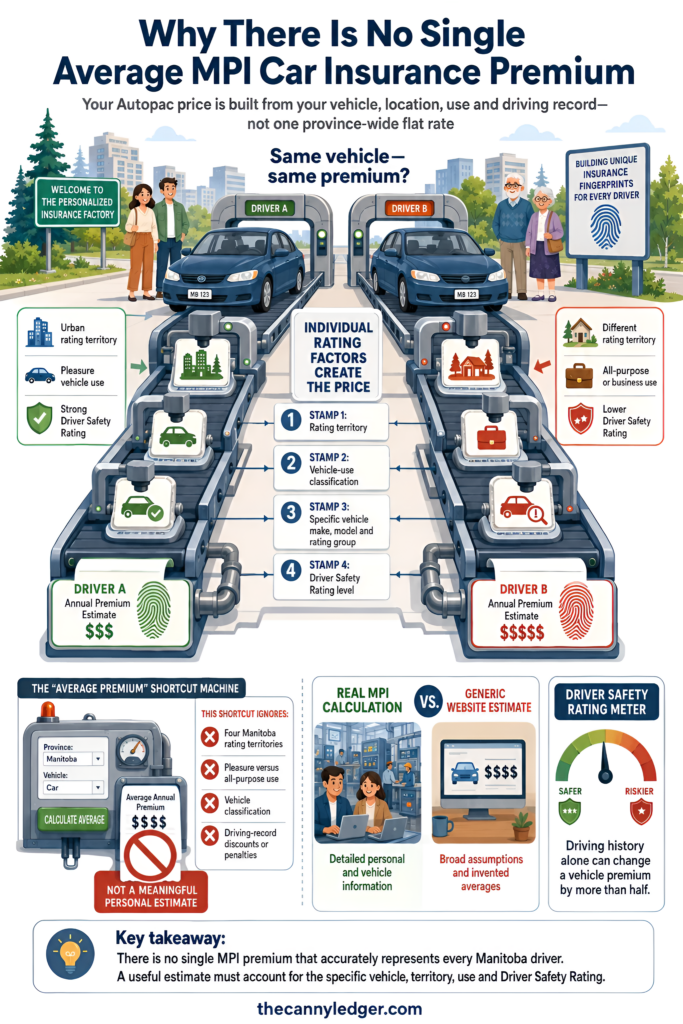
This is worth stating plainly before anything else, because a lot of search results for Manitoba car insurance rates will confidently hand you a specific dollar figure as though it applies broadly. It doesn’t. Manitoba’s rate-setting system is built entirely around individual rating factors, not a flat baseline that gets adjusted slightly per person, which means a “typical” premium genuinely doesn’t exist in any meaningful sense. Two drivers with the same vehicle can pay very different amounts depending on which of Manitoba’s four rating territories they live in, whether their vehicle is used for pleasure or business, and where they sit on the Driver Safety Rating scale, a factor capable of swinging a bill by well over half. Any website offering an instant, generic MPI quote without asking about all of these specifics is guessing, not calculating.
MPI’s Real Official Rate Calculator
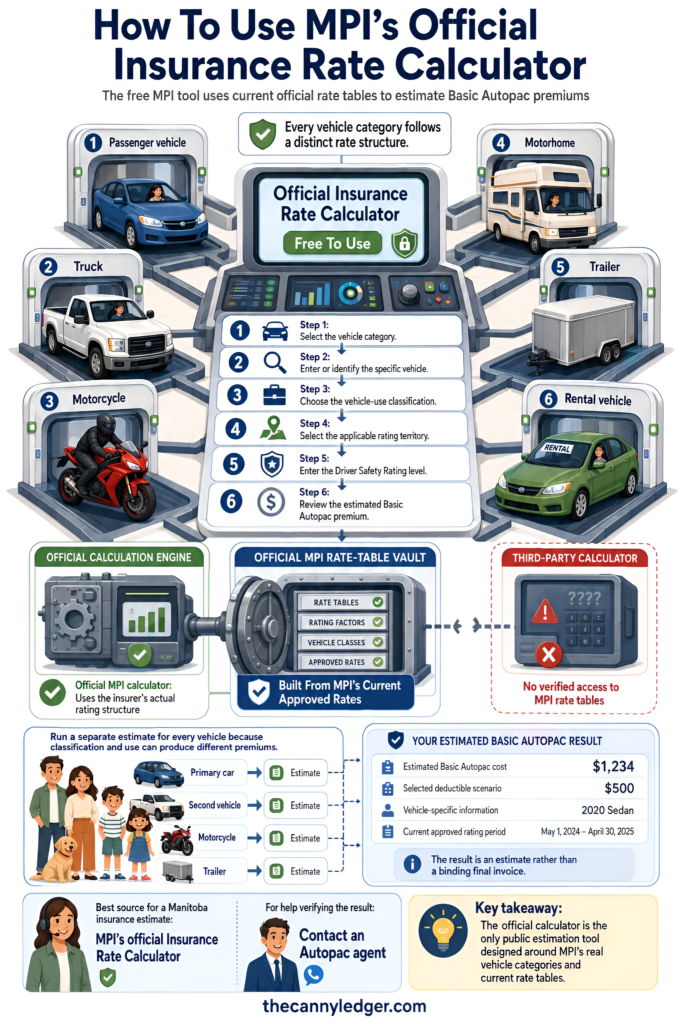
The tool that actually reflects MPI’s real rate tables is the Insurance Rate Calculator, free and available directly on MPI’s own website. It covers six distinct vehicle categories separately, passenger vehicle, truck, motorcycle, motorhome, trailer, and rental vehicle, since each carries its own distinct rate structure rather than one generic car-insurance formula. The tool walks through your specific details step by step, vehicle type first, then vehicle use and rating information, before generating an actual estimate built from MPI’s real current rate tables rather than an approximation. Anyone insuring more than one vehicle can run each one through as a separate calculation, useful for comparing how a second vehicle’s classification or use might affect a household’s total insurance cost differently than the first.
The Four Factors the Calculator Actually Uses
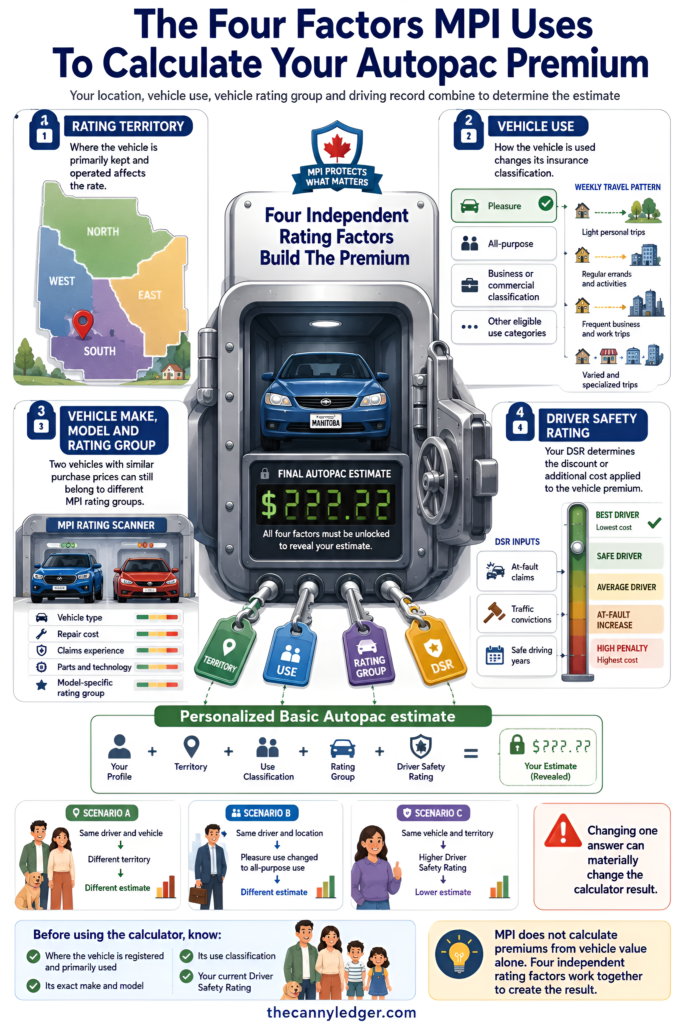
The IRC pulls from the same four core rating factors that determine every Manitoba Autopac premium: which of the province’s rating territories you live in, how your vehicle is classified for use, whether that’s pleasure, all-purpose, or a specific commercial classification, your vehicle’s specific make and model rating group, and your current Driver Safety Rating level. The full mechanics behind each of these factors, including exactly how territory boundaries are drawn and how vehicle use classifications work, are covered in depth separately, since understanding what’s actually driving the calculator’s output matters as much as running the numbers themselves.
How Much Your Driving Record Alone Can Save You
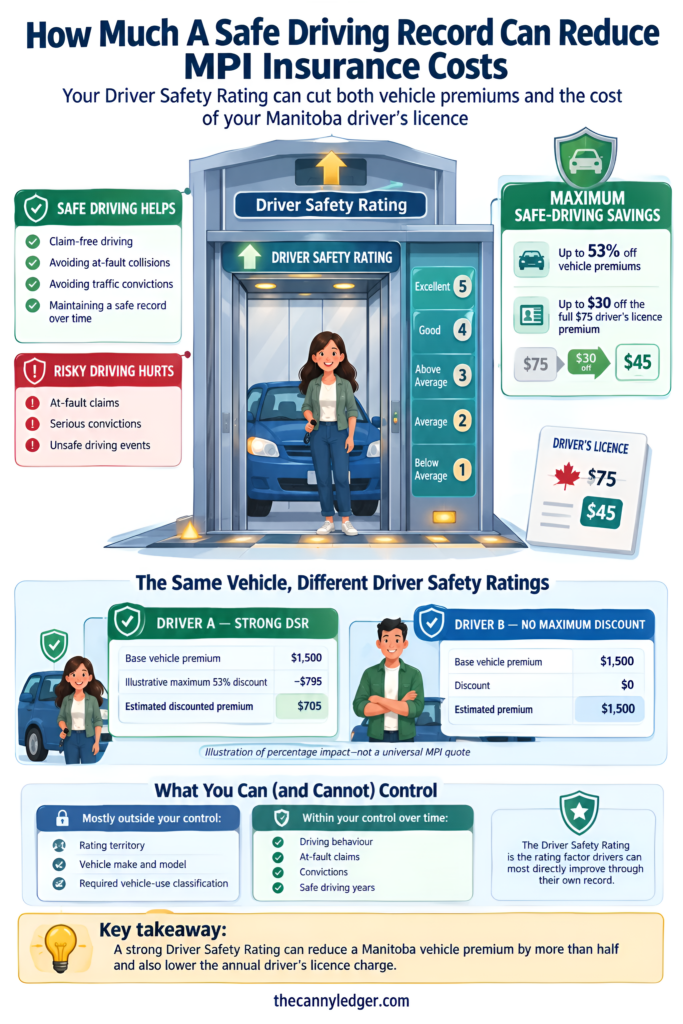
Of every factor in the calculation, your own driving history moves the needle furthest. MPI’s own rating guidance confirms that a strong safe-driving record can save up to 53 percent on vehicle premiums, the maximum available at the top of the Driver Safety Rating scale, plus up to $30 off the full $75 cost of your driver’s licence premium on top of that. This is the one factor genuinely within a driver’s own control over time, unlike territory or vehicle type, which are fixed by where you live and what you drive, your DSR level moves specifically based on your own record of at-fault claims, convictions, and safe years behind the wheel.
Real Examples of How Differently Rates Move by Vehicle Type
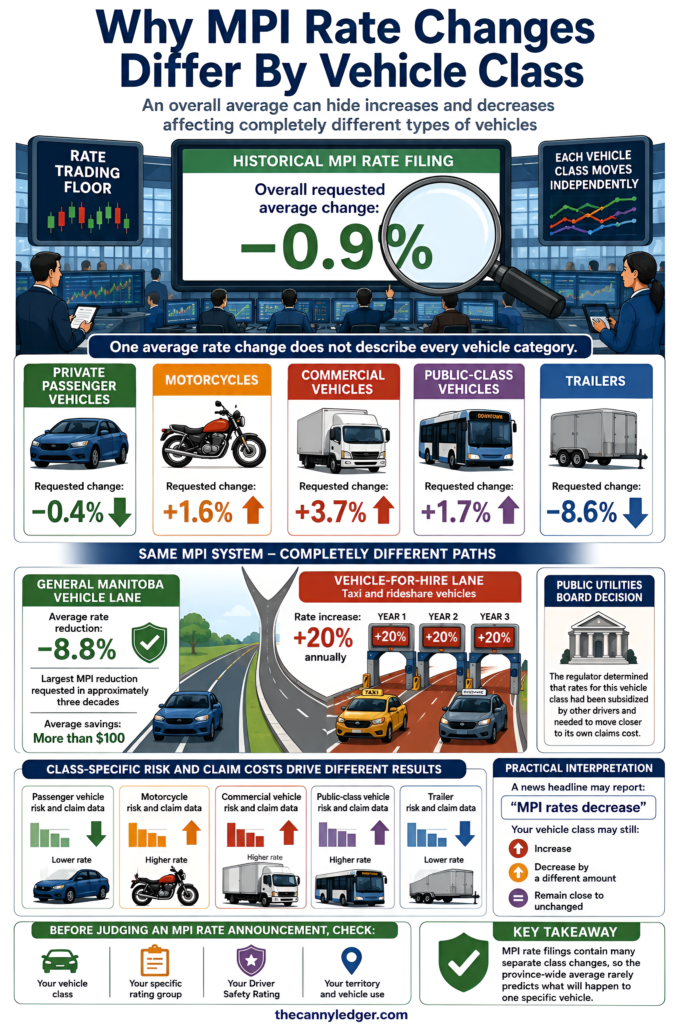
Historical rate filings make the variance concrete in a way a single average number never could. In one filing, MPI requested an overall average rate decrease of 0.9 percent, but that average hid real differences underneath it: private passenger vehicles saw a 0.4 percent decrease, motorcycles a 1.6 percent increase, commercial vehicles a 3.7 percent increase, public class vehicles a 1.7 percent increase, and trailers an 8.6 percent decrease, all within the same single rate request. In a separate, larger filing, Manitoba drivers overall received an 8.8 percent rate cut, the largest reduction MPI had sought in three decades, averaging over $100 in savings, while vehicle-for-hire drivers, taxis and rideshare vehicles, faced a 20 percent increase that year and again in each of the following two years, a decision the Public Utilities Board justified by ruling that rates for that specific vehicle class had been unfairly subsidized by other drivers for years. These aren’t edge cases, they’re a genuine, recurring pattern: an “average” rate change almost never describes what happens to any specific vehicle class.
Why You Shouldn’t Trust Third-Party “MPI Calculator” Websites
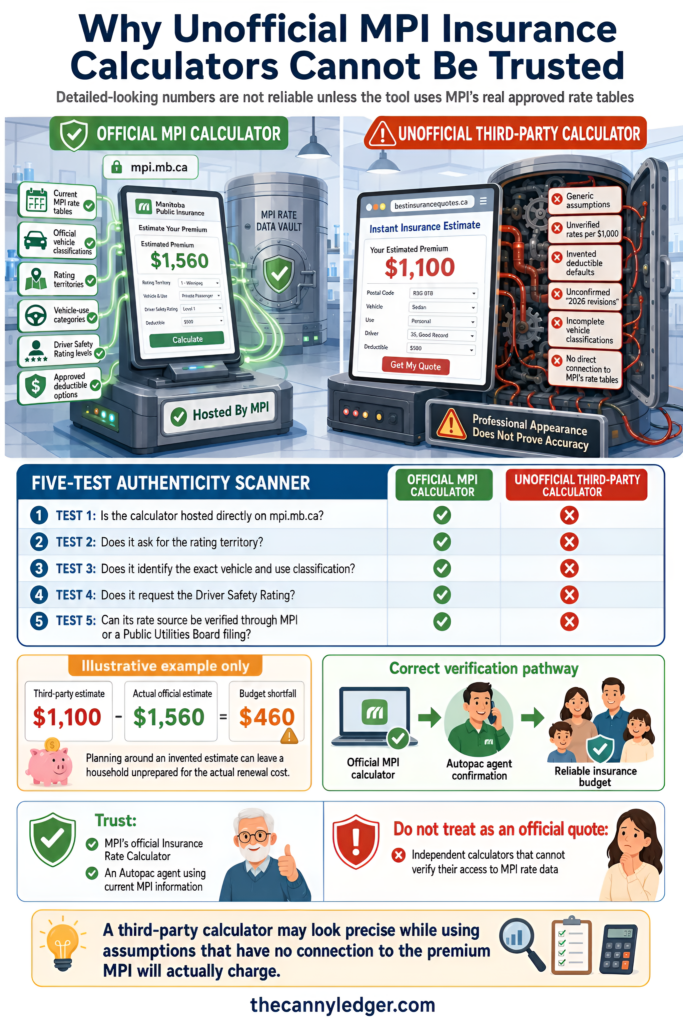
Search results for Manitoba car insurance calculators turn up a genuine problem worth flagging directly: several unofficial websites present detailed-looking premium estimators with specific dollar-per-thousand rates, invented deductible defaults, and even claimed “2026 rate revisions” that don’t match anything MPI has actually published or filed with the Public Utilities Board. These tools look convincing, complete with charts and itemized breakdowns, but they aren’t pulling from MPI’s actual rate tables, and treating their output as a real quote risks planning a budget around a number that has no connection to what MPI will actually charge. If a calculator isn’t hosted directly on mpi.mb.ca, treat any specific dollar figure it produces as fiction dressed up as data, and confirm anything that matters directly through the official tool or an Autopac agent instead.
When Your Actual Bill Might Differ From the Calculator Estimate
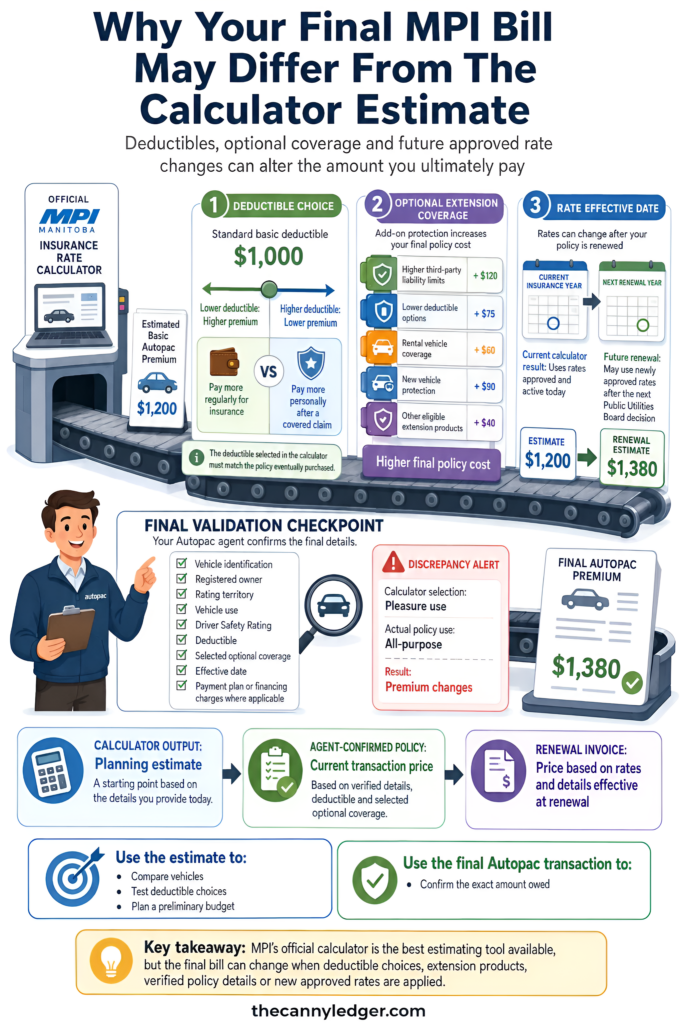
Even MPI’s own official calculator produces an estimate, not a locked-in final number, and a few things can shift what actually appears on a real bill. Choosing a lower deductible than the standard $1,000 raises the premium, while accepting a higher one lowers it, a tradeoff the calculator lets you test directly. Adding extension coverage, increased liability limits, rental vehicle insurance, or new vehicle protection, adds cost on top of the Basic estimate, since these are optional products layered onto the mandatory baseline. And because rates get reviewed and adjusted through the Public Utilities Board process roughly annually, a calculator estimate run today reflects current approved rates, not necessarily what next year’s renewal will show once the next rate filing takes effect.
Common Questions About Manitoba Car Insurance Rates
Does MPI’s official calculator require me to create an account or provide personal information? The Insurance Rate Calculator is built to run an estimate from vehicle and rating details you provide directly, without requiring a full account setup, though confirming an actual binding quote for your specific policy still goes through an Autopac agent or MPI directly.
Why did my neighbour’s rate change look completely different from mine this year, even with similar vehicles? Different vehicle classifications, territories, or Driver Safety Rating levels between two otherwise similar vehicles can produce genuinely different rate outcomes in the same filing year, exactly the kind of variance the 2022 example above illustrates at a province-wide scale.
Can I use the calculator to compare buying a used vehicle against a new one before purchasing? Yes, running each vehicle option through the calculator separately before committing to a purchase is a legitimate and useful way to compare how a specific make, model, or vehicle class might affect your ongoing insurance cost, not just the upfront purchase price.
Run your own numbers through MPI’s actual official calculator rather than trusting a third-party site’s instant estimate, and treat any generic “average Manitoba premium” figure with real skepticism given how much rates genuinely vary by vehicle class alone. For the full picture of what factors into your premium and what your Basic Autopac coverage actually includes, Manitoba’s auto insurance system explained covers the complete mechanics behind whatever number the calculator gives you.