

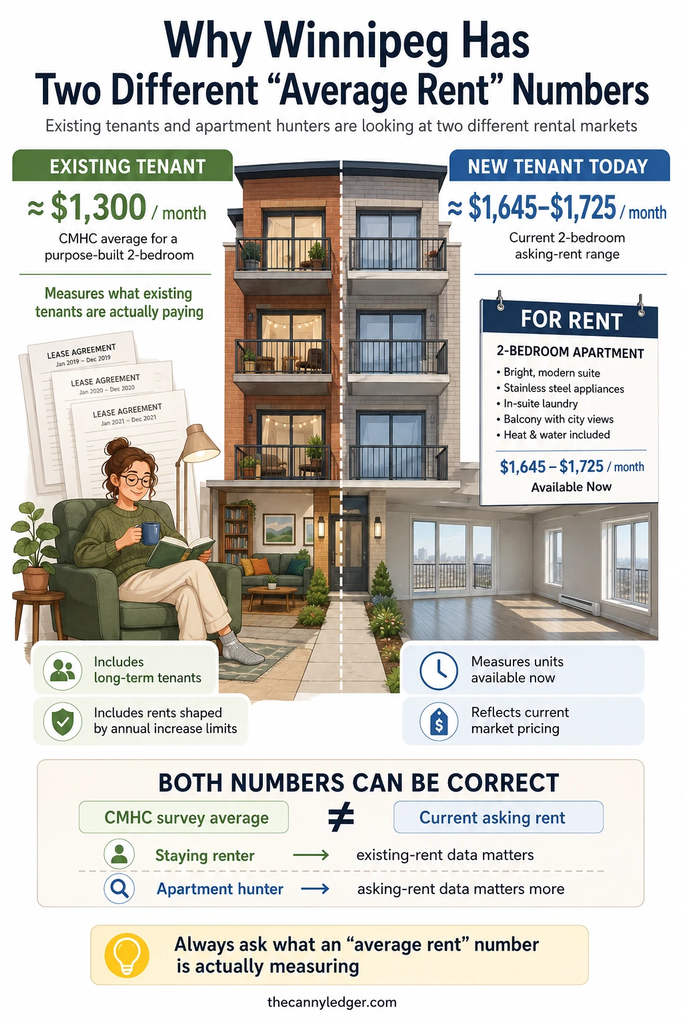
Search “average rent Winnipeg” and you’ll find two genuinely different numbers, both accurate, both current, and both measuring something real. One says roughly $1,300 for a two-bedroom. Another says $1,645 or more for the exact same size unit. Neither figure is wrong, they’re measuring two different things entirely, and understanding that gap is worth more to an actual renter than either number on its own.
- Two Different Numbers Both Called “Average Rent”
- What CMHC’s Own Survey Actually Measures
- What Winnipeg Rent Actually Looks Like by Bedroom Count Right Now
- Winnipeg Compared to the Rest of Canada
- Why Winnipeg’s Vacancy Rate Matters More Than the Headline Number
- Manitoba’s Rent Control Rules Shape These Numbers Too
- What It Actually Takes to Afford Winnipeg Rent
- Neighbourhood Variation Is Wider Than the City Average Suggests
- Common Questions
- Check Both Numbers Before You Budget
Winnipeg’s average two-bedroom rent sits around $1,300 a month according to the Canada Mortgage and Housing Corporation’s most recent official survey of existing purpose-built rental units, conducted in October 2025 and published that December. Current asking rents on active listings tell a different story, with one-bedroom units running roughly $1,297 to $1,450 and two-bedrooms landing between $1,645 and $1,725 as of mid-2026, reflecting what a new tenant moving today would actually pay rather than what existing long-term tenants are paying on leases signed years ago.
Two Different Numbers Both Called “Average Rent”
CMHC’s Rental Market Survey happens once a year, every October, and measures the average rent tenants are actually paying across the existing purpose-built rental stock, a figure that includes long-term tenants who’ve been in the same unit for years under Manitoba’s rent control rules, alongside anyone who moved recently. Private listing aggregators like Zumper and Door Insight, by contrast, track asking rents on units currently listed for rent, capturing only what’s available right now rather than the full existing tenant base. Since Manitoba limits rent increases for sitting tenants to once every 12 months, and often at modest guideline amounts, existing tenants in a unit for several years typically pay meaningfully less than what that same unit would rent for today on the open market, which is precisely why CMHC’s survey average and current asking rents diverge as much as they do.
What CMHC’s Own Survey Actually Measures
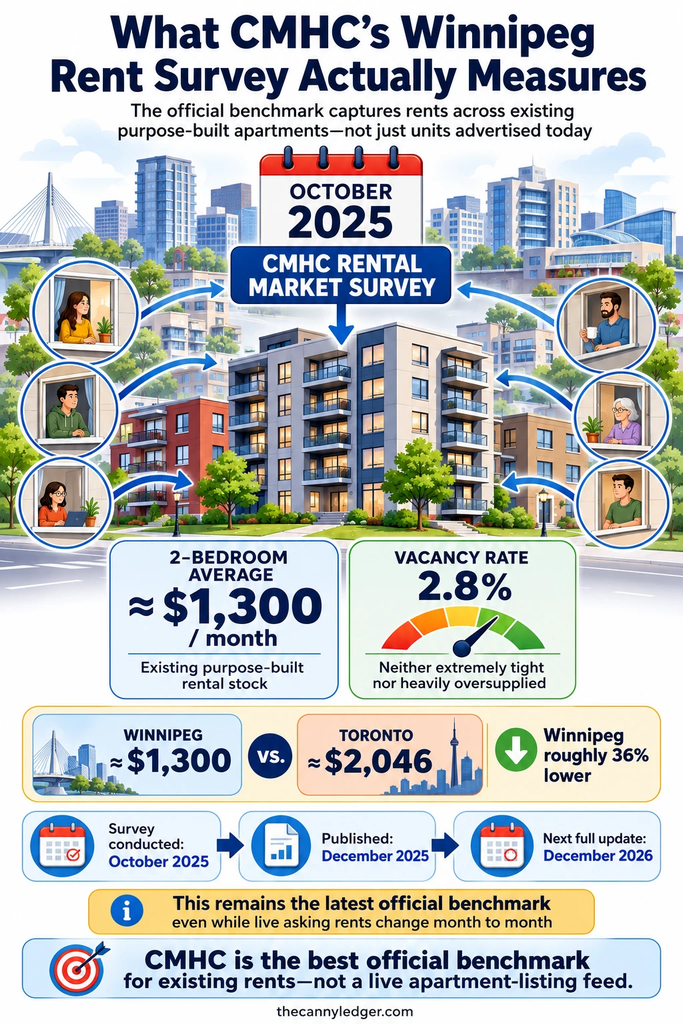
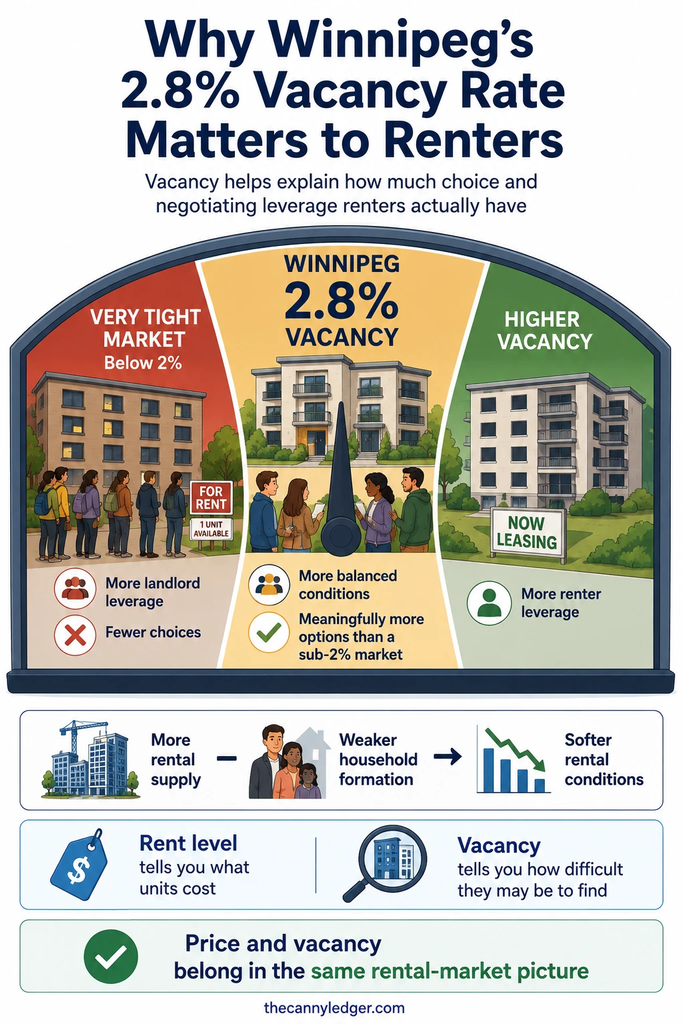
CMHC’s official average, drawn from its October 2025 survey, put Winnipeg’s purpose-built two-bedroom rent at roughly $1,300 a month, a figure that sits about 36 percent below Toronto’s comparable average of roughly $2,046 and meaningfully below Edmonton’s as well. This same survey recorded Winnipeg’s rental vacancy rate at 2.8 percent, a genuinely balanced market condition, neither the extreme tightness Canadian renters faced in 2022 and 2023 nor an oversupplied market favouring tenants heavily. CMHC won’t publish its next full survey update until December 2026, meaning this October 2025 figure remains the most current official benchmark until then, even as asking rents on the ground continue shifting month to month in the meantime.
What Winnipeg Rent Actually Looks Like by Bedroom Count Right Now
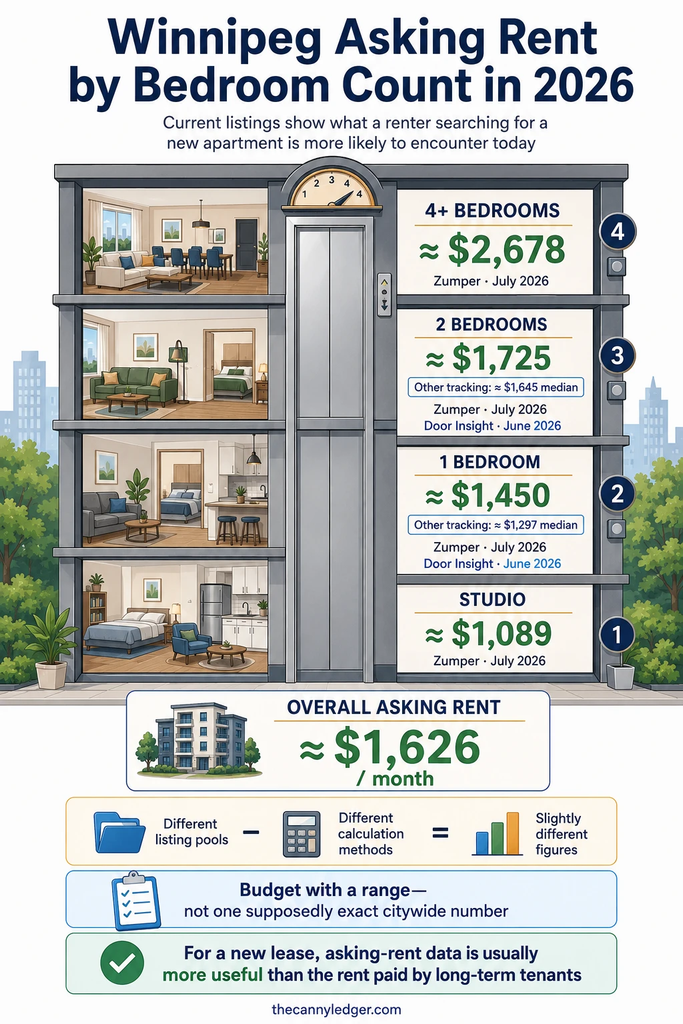
For anyone actually apartment hunting today rather than researching historical averages, current asking rents matter more than CMHC’s annual survey figure. As of July 2026, Zumper reported Winnipeg’s overall average rent at $1,626 a month, broken down by unit size as roughly $1,089 for a studio, $1,450 for a one-bedroom, $1,725 for a two-bedroom, and $2,678 for units with four or more bedrooms. Door Insight’s June 2026 tracking showed a slightly different but broadly consistent picture, with one-bedroom units listing at a median of $1,297 and two-bedrooms at $1,645, both up modestly year over year. The specific dollar figures differ somewhat between these two tracking services simply because they draw from different listing pools and calculation methods, but both point to the same broad range for anyone budgeting for a move in the current market.
Winnipeg Compared to the Rest of Canada
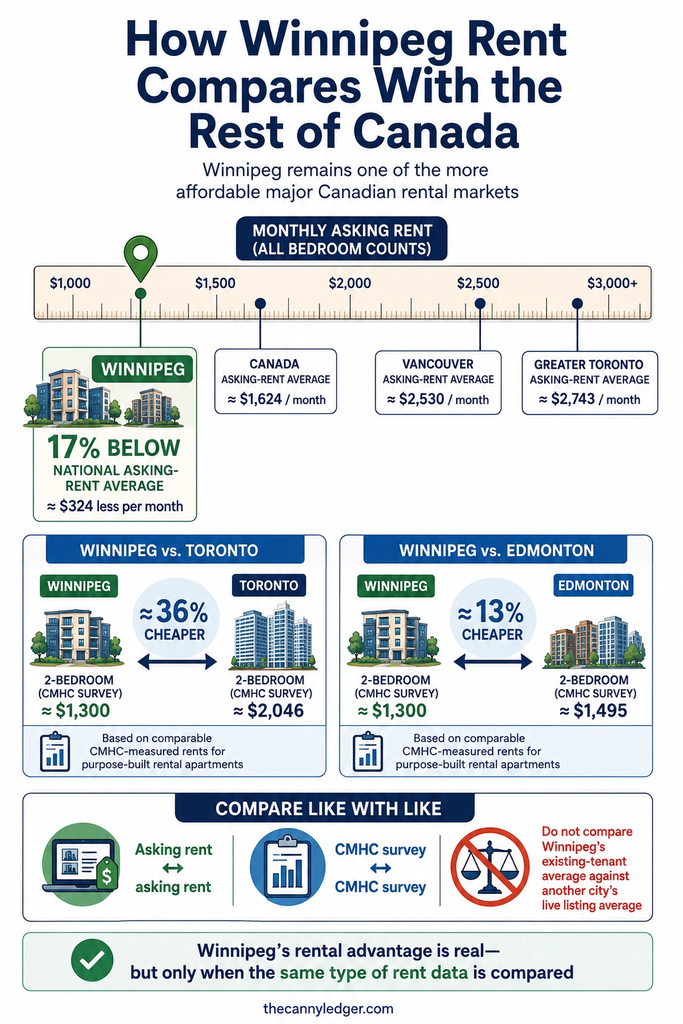
Winnipeg remains one of Canada’s more affordable major rental markets by a wide margin. Zumper’s July 2026 data put Winnipeg rent 17 percent below the national average, translating to roughly $324 less per month than a typical Canadian renter pays. Against specific comparison cities, Winnipeg’s CMHC-measured purpose-built rent runs about 36 percent cheaper than Toronto’s and roughly 13 percent cheaper than Edmonton’s, a genuinely significant gap for anyone weighing a move between provinces or comparing cost of living before relocating.
Why Winnipeg’s Vacancy Rate Matters More Than the Headline Number
A 2.8 percent vacancy rate, while not extremely loose, gives Winnipeg renters meaningfully more negotiating room and available options than markets with vacancy rates under 2 percent, where landlords hold most of the leverage in any rental negotiation. CMHC itself has noted that softening conditions across Canada through 2025, driven by increased rental supply and weaker household formation, contributed to easing rent pressure nationally, and Winnipeg’s specific vacancy figure reflects that broader national trend playing out locally rather than a uniquely Winnipeg-specific shift.
Manitoba’s Rent Control Rules Shape These Numbers Too
Manitoba applies rent control to most residential rental units, both older and newer buildings, limiting standard increases to once every 12 months at a provincially set guideline rate, though landlords can apply for an above-guideline increase if they can demonstrate operating costs genuinely justify it. This structure is exactly why the gap between CMHC’s average-rent figure and current asking rents runs as wide as it does, a tenant who moved into their unit several years ago and has stayed since has had their rent increases capped annually the entire time, while a tenant signing a new lease today pays whatever the current market rate happens to be with no such protection built in yet. Our guide to qualifying for Rent Assist in Manitoba covers the province’s rent-related assistance program for lower-income households navigating this gap specifically.

What It Actually Takes to Afford Winnipeg Rent
Using the standard affordability benchmark of spending no more than 30 percent of gross income on rent, comfortably affording Winnipeg’s current average rent requires an income in the range of $65,000 a year based on current asking-rent figures. Winnipeg’s median household income sits close to $90,000, which means a typical two-income Winnipeg household spends roughly 20 percent of gross income on a two-bedroom unit at CMHC’s average rate, comfortably below the 30 percent affordability threshold, though this comfortable citywide average doesn’t reflect the reality for single-income households, newcomers without established Canadian income yet, or anyone renting in a specifically higher-cost neighbourhood or newer building.

Neighbourhood Variation Is Wider Than the City Average Suggests
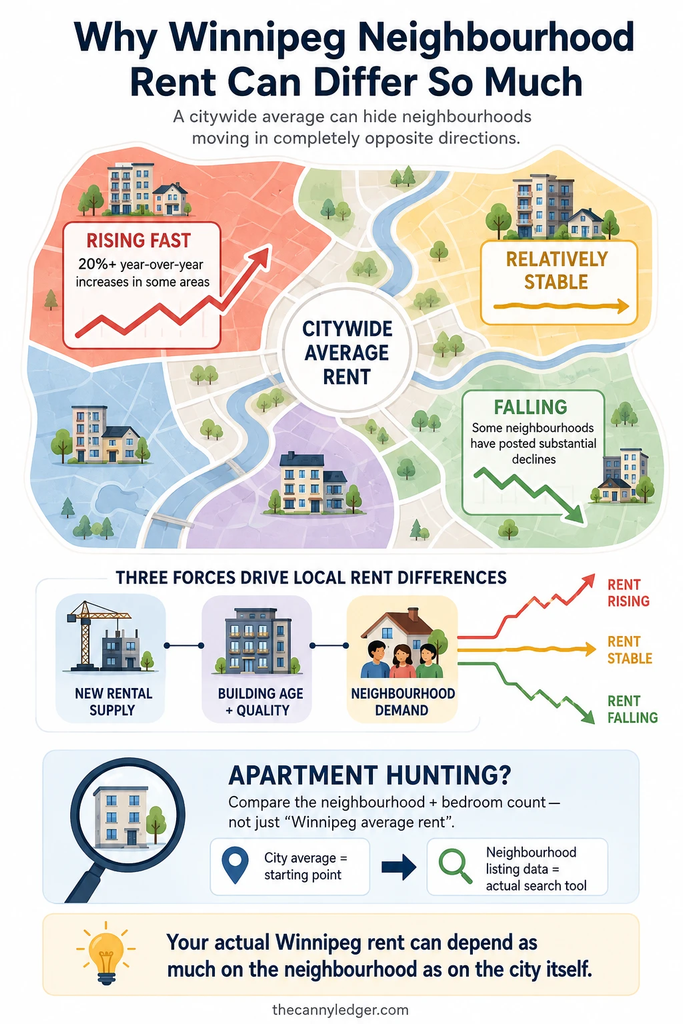
Citywide averages flatten out genuinely significant neighbourhood-level variation. Some Winnipeg neighbourhoods have seen asking rents climb over 20 percent year over year, while others have actually fallen by a comparable margin over the same period, reflecting local supply changes, building age, and specific neighbourhood demand shifts that a single city-wide average simply can’t capture. Our guide to the cheapest neighbourhoods to rent in Winnipeg breaks down exactly where rents run below the citywide average, and our comparison of 1, 2, and 3-bedroom apartments across Winnipeg covers unit-size-specific pricing in more depth than a single city average can offer.
Common Questions
Which figure should I actually use when budgeting for a move, CMHC’s average or current asking rents? Use current asking rents specifically, since CMHC’s survey average includes long-term tenants paying below-market rates under rent control, while you as a new tenant will be quoted current market pricing regardless of what the city-wide historical average suggests.
Does Winnipeg’s rent control protect me the moment I sign a new lease? Yes, once you’re a tenant, Manitoba’s rent control rules apply to your unit going forward, limiting future increases to once every 12 months at the guideline rate, though your very first rent as a new tenant is set at whatever the landlord is currently asking, uncontrolled at that initial point.
Where can I find genuinely current, specific asking rents rather than a city-wide average? Our guides to Winnipeg apartments under $1,000 a month and cheap bachelor and studio apartments in Winnipeg cover specific, budget-focused options beyond the citywide averages covered here.
Check Both Numbers Before You Budget
Before setting a rental budget or comparing Winnipeg’s cost of living against another city, check both figures deliberately rather than relying on whichever number a single search result happens to surface first. CMHC’s October 2025 survey average tells you what the existing rental market looks like broadly, while current listing data from Zumper or Door Insight tells you what you’d actually pay moving today, and the meaningful gap between those two numbers is itself useful information about how Manitoba’s rent control system actually functions in practice.