

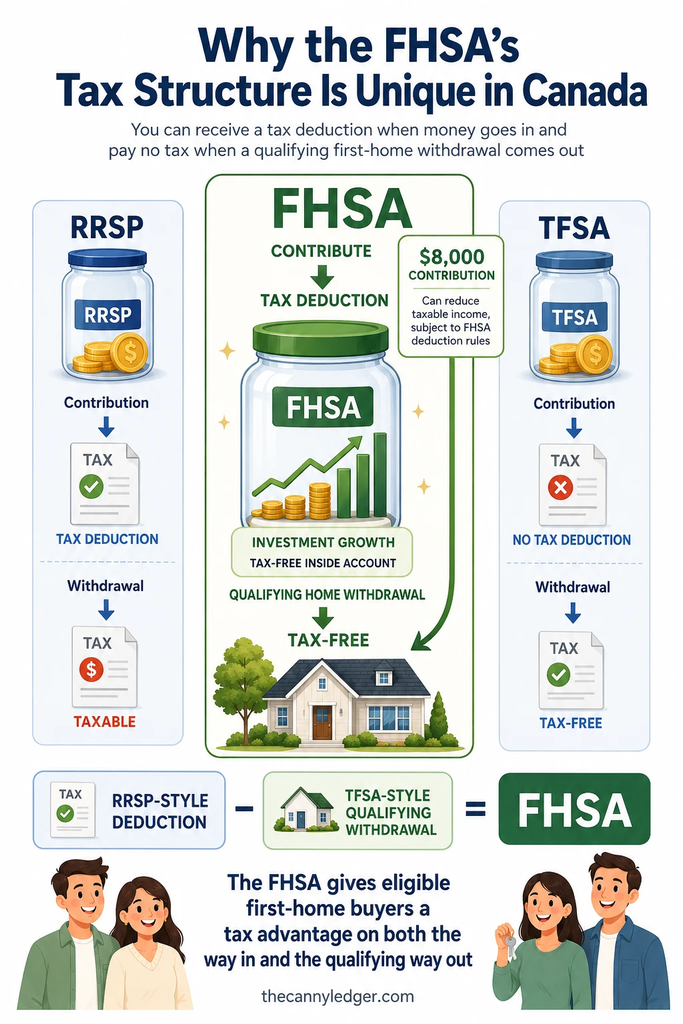
No other registered account in Canada works the way a First Home Savings Account does, and that’s not an exaggeration, it’s a specific structural fact worth understanding before anything else. An RRSP gives you a tax deduction now but taxes you fully on the way out. A TFSA gives you no deduction at all but never taxes withdrawals. An FHSA does both at once, a real tax deduction on the way in, and a completely tax-free withdrawal on the way out, provided that withdrawal goes toward a qualifying first home. According to Shajani CPA’s own description of this structure, that combination is truly unique among registered accounts, and it’s exactly why the FHSA gets described as structurally superior to the RRSP Home Buyers’ Plan for the specific purpose it was built for.
- The Hybrid Tax Structure That Makes This Account Unique
- Who Actually Qualifies, and a Distinction Most People Miss
- How Much You Can Actually Contribute
- The 60-Day Rule Doesn’t Apply Here
- The Participation Period, and the Built-In Escape Hatch
- Combining the FHSA With the Home Buyers’ Plan
- Getting Started on Your Own Timeline
- Common Questions From First-Time FHSA Holders
A First Home Savings Account is a registered Canadian account that lets eligible first-time home buyers contribute up to $8,000 a year, to a $40,000 lifetime maximum, with contributions fully tax-deductible and qualifying withdrawals toward a first home entirely tax-free, including any investment growth earned inside the account. Eligibility requires being a Canadian resident between 18 and 71 who hasn’t owned and lived in a qualifying home, either alone or with a spouse, in the current calendar year or the four preceding ones. Understanding both halves of that tax treatment, the deduction and the tax-free withdrawal, matters more than knowing either one alone, since it’s the combination that makes this account fundamentally different from anything that came before it.
The Hybrid Tax Structure That Makes This Account Unique
This is worth understanding precisely, since it’s the entire reason the FHSA exists as a separate account rather than just being folded into the existing RRSP or TFSA framework. According to Horizon CPAs’ own summary of this dual structure, contributions to an FHSA are tax deductible the same way RRSP contributions are, reducing taxable income in the year the contribution gets made, while both the investment income earned inside the account and any qualifying withdrawal remain entirely tax-free, the same treatment a TFSA provides. Someone contributing the full $8,000 in a given year gets a real deduction against that year’s income, and years later, when that same money comes out to fund a qualifying first home purchase, none of it, not the original contribution and not whatever growth accumulated on top of it, gets taxed at all.
Who Actually Qualifies, and a Distinction Most People Miss
Eligibility runs on two separate tests that sound identical but aren’t quite the same, and understanding the gap between them matters directly. According to ATB’s own FHSA reference guide, the definition of first-time home buyer used to determine whether someone can open an FHSA is actually different from the definition used to determine whether a specific withdrawal later qualifies as tax-free. Opening an account requires being a Canadian resident between 18 and 71 who hasn’t owned and lived in a qualifying home as a principal residence, either personally or with a spouse or common-law partner at the time the account gets opened, during the current calendar year or the four preceding calendar years.
That test applies specifically at the moment of opening the account, and it’s worth confirming your own situation matches it precisely, since owning a rental property you’ve never personally lived in doesn’t disqualify you, but living in a home your spouse owned during that four-year window does, provided that person is still your spouse when you open the account.

How Much You Can Actually Contribute
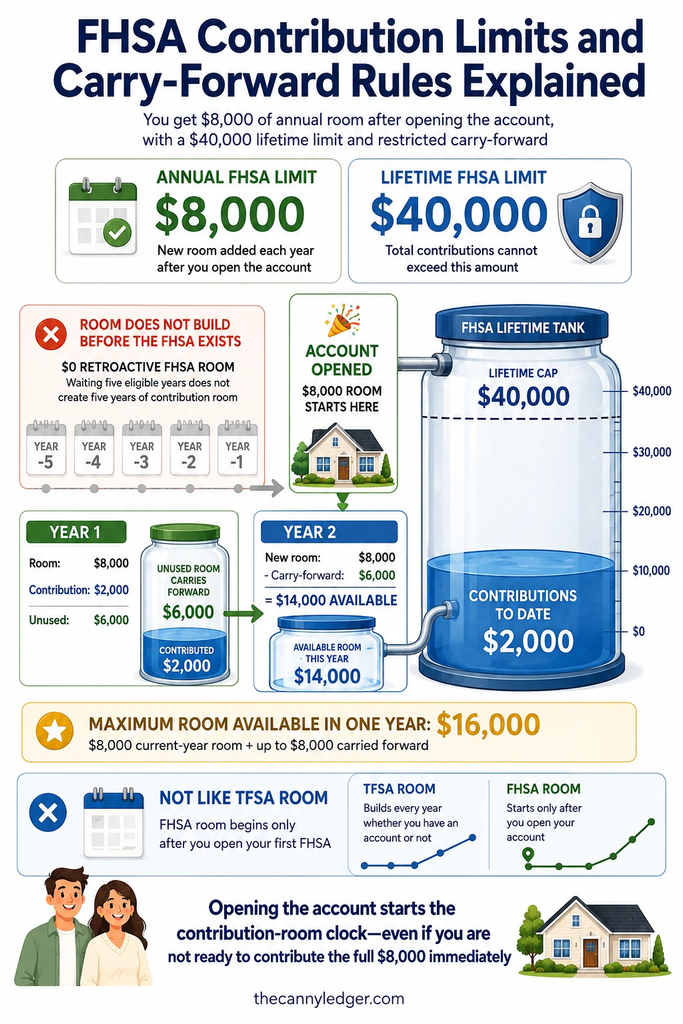
The contribution structure runs on two separate limits working together. According to Canadian Money Help’s own confirmation of these figures, the annual contribution limit is $8,000 for 2026, unchanged from every year since the account launched, with a $40,000 lifetime cap, and neither figure is indexed to inflation, since both are fixed dollar amounts written directly into the Income Tax Act rather than adjusted annually the way TFSA and RRSP limits are.
Unused room carries forward, but only up to one additional year’s worth, capped at $8,000, meaning the maximum anyone can contribute in a single calendar year, combining current room with carried-forward room, is $16,000. One detail worth flagging directly, since it surprises people coming from an RRSP or TFSA background, room only starts accumulating from the year an FHSA account is actually opened, not from the year someone first became eligible to open one. Someone eligible since turning 18 who waits five years before actually opening an account doesn’t get five years of retroactive room the way TFSA contribution room accumulates automatically starting at eighteen, they simply start from zero the year the account gets opened.
The 60-Day Rule Doesn’t Apply Here
This is a specific, meaningful difference from how an RRSP works, and it’s worth stating plainly since assuming the same flexibility applies here is a real, avoidable mistake. An RRSP allows contributions made in the first 60 days of a new calendar year to be deducted against either the prior or current tax year, but no equivalent flexibility exists for an FHSA. A contribution made on January 1 counts toward that specific calendar year only, deductible on that year’s return alone, meaning anyone hoping to make a late contribution in early January and apply it retroactively to the prior year’s taxes will find that option simply doesn’t exist for this particular account.

The Participation Period, and the Built-In Escape Hatch
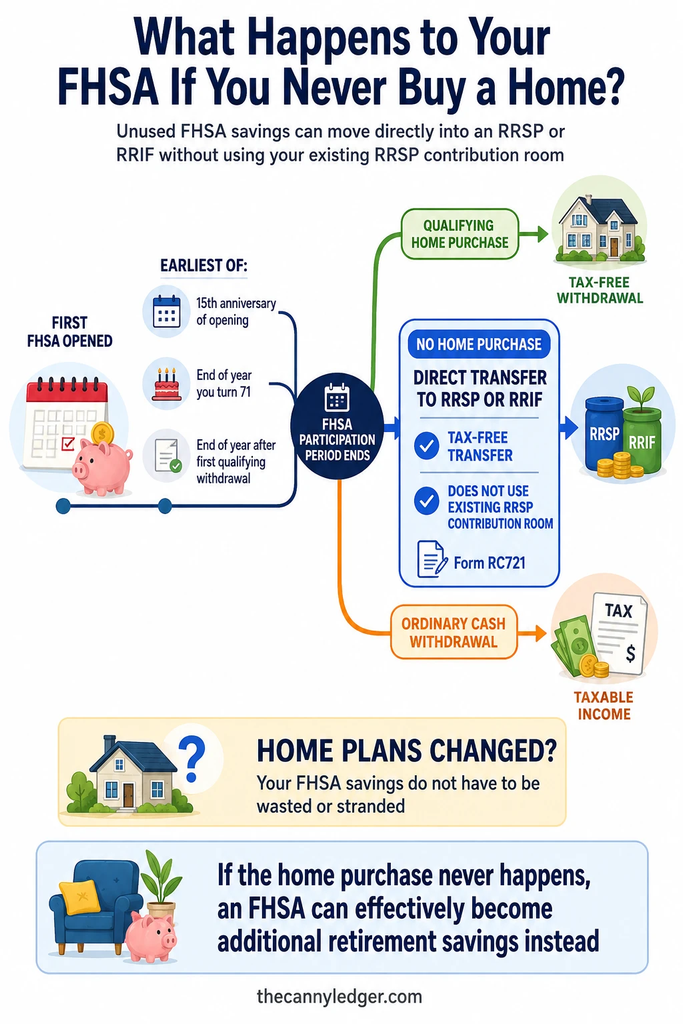
An FHSA doesn’t stay open indefinitely, and understanding exactly when it closes matters for anyone using one. The maximum participation period ends at the earliest of three specific triggers, the 15th anniversary of first opening an FHSA, the end of the year someone turns 71, or the end of the year following their first qualifying withdrawal. Whichever of those three happens first closes the account to further contributions.
What happens to the money if a qualifying home purchase never materializes is worth knowing directly, since it removes a real source of hesitation some people have about opening an account in the first place. The full balance, original contributions plus every dollar of growth, can transfer tax-free directly into an RRSP or RRIF using Form RC721, without using up any of that person’s existing RRSP contribution room at all. That transfer functions as a real safety net, money contributed toward a home that never happens simply becomes ordinary retirement savings instead, rather than being stranded or penalized. A straight cash withdrawal instead of a transfer or qualifying purchase is the one path that does trigger full taxation, treated as ordinary income in the year it’s received.
Combining the FHSA With the Home Buyers’ Plan
These two programs aren’t mutually exclusive, and using both together for the same home purchase is a legitimate, commonly used strategy. According to RBC’s own explanation of combining the two programs, a first-time buyer can withdraw the full $40,000 FHSA lifetime maximum tax-free alongside up to $60,000 through the RRSP Home Buyers’ Plan for the same qualifying home, bringing total combined access to $100,000 plus whatever investment growth accumulated inside the FHSA specifically. The real difference between the two worth remembering, FHSA withdrawals never need to be repaid, while HBP withdrawals function as a structured loan against your own RRSP, requiring repayment over 15 years or facing taxable income on any missed portion.

Getting Started on Your Own Timeline
Open an FHSA as soon as you confirm your own eligibility rather than waiting, since contribution room only starts accumulating from the year the account actually opens, not from whenever you first became eligible. Contribute within the calendar year itself if you want that specific year’s deduction, given the account offers none of the RRSP’s first-60-days flexibility. And if a home purchase feels uncertain or years away, remember the tax-free RRSP transfer option removes most of the real downside to opening an account early and contributing steadily regardless.

Common Questions From First-Time FHSA Holders
Can I have more than one FHSA at the same time? Yes, though your total contributions across every FHSA you hold in a given year still can’t exceed your combined annual and lifetime limits, so opening multiple accounts doesn’t create additional room.
Does my spouse need their own separate FHSA, or can we share one? Each eligible person needs their own individual FHSA, since the account can’t be jointly held or shared the way some other savings products can, though a couple can each open their own account and combine both toward the same home purchase.
What happens to my FHSA if I stop being eligible partway through, for example by buying a home with someone else first? The specific beneficiary and successor holder rules that govern an FHSA in changed circumstances are worth understanding directly, since ongoing eligibility and what happens to an existing account can differ depending on the exact situation.