

Your Manitoba Health card doesn’t stop working the moment you cross the border, but what it actually pays once you’re there is nowhere near what most people assume. Manitoba Health will cover a doctor’s visit outside Canada at the same rate a Manitoba doctor would be paid, and it pays hospital care outside the country at a limited average daily rate set by the province, not the actual cost charged by the hospital you end up in. The province’s own guidance says it plainly: the difference between what gets covered and what a hospital actually bills can be substantial, and that gap is entirely your responsibility unless you’ve bought separate coverage before you left.
- What Manitoba Health Actually Covers Outside Canada, and Why It’s Not Enough
- The Referral Process for Non-Emergency Care Is a Completely Different Track
- Manitoba Blue Cross: The Local, Provincial Option
- Pre-Existing Conditions Are Where Claims Actually Get Denied
- Single-Trip vs Annual Multi-Trip Plans
- Snowbird Coverage for Manitoba Retirees Wintering South
- Credit Card Travel Insurance: The Fine Print Nobody Reads
- What to Actually Do Before You Book
- Common Questions
- Buy the Policy Before You Need the Coverage, Not After
Travel and medical travel insurance in Winnipeg matters because Manitoba Health’s out-of-country coverage was never designed to match real hospital costs, particularly in the United States, where a multi-day hospital stay can run into six figures. Manitoba Blue Cross offers the most locally rooted option, with plans up to $5,000,000 in lifetime coverage per person, while national insurers and Prairie-based providers like GMS round out the market for single-trip, annual, and snowbird-specific coverage.
What Manitoba Health Actually Covers Outside Canada, and Why It’s Not Enough
Manitoba Health, Seniors and Long-Term Care pays doctor bills incurred outside Canada at the same rate a Manitoba physician would receive for an equivalent service, which sounds reasonable until you consider that a Manitoba rate and an American emergency room’s actual billed rate are two entirely different numbers. Hospital bills work similarly but arguably worse: the province pays an average daily rate it sets itself, and the province’s own website states directly that you may be charged more than that amount for services provided outside Canada, with the difference described as potentially substantial and your responsibility to cover.
This isn’t a hypothetical risk. A single night in a U.S. hospital, before any surgery, specialist involvement, or ICU care factors in, routinely costs several thousand dollars, and a genuinely serious emergency, a heart attack, a car accident, a stroke, can run past $100,000 once air ambulance transport back to Canada gets added to the bill. Manitoba’s daily rate reimbursement covers a fraction of that, which is exactly the gap private travel medical insurance exists to close.

The Referral Process for Non-Emergency Care Is a Completely Different Track
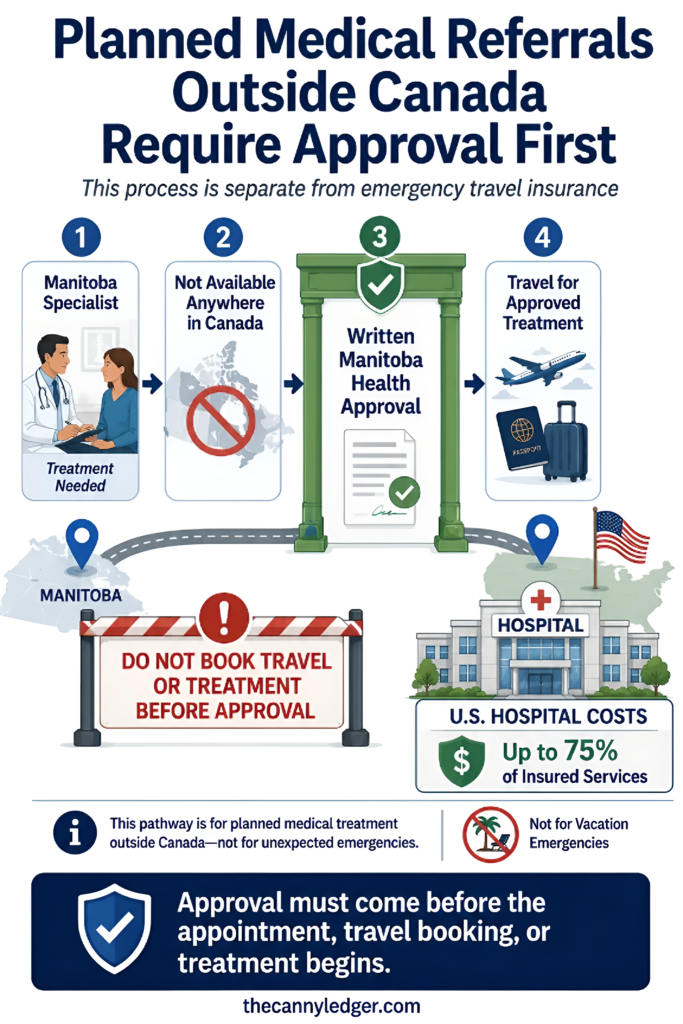
Separate from emergency travel coverage, Manitoba Health has a formal referral process for non-emergency treatment a Manitoba specialist determines isn’t available anywhere in Canada. If a Manitoba specialist refers you outside the country for approved treatment under this process, and specifically that treatment could not be found anywhere in Canada first, the coverage is meaningfully better: doctor bills at the Manitoba rate and hospital bills up to 75 percent of insured hospital services in the United States specifically. This is not the same thing as travel emergency coverage, though, and it doesn’t apply if you get sick or injured on a vacation. It’s specifically for planned, pre-approved medical referrals that go through your Manitoba specialist and get formal written approval from Manitoba Health before any travel happens, and arranging travel or appointments before that approval comes through means you could be personally responsible for the entire cost.
Manitoba Blue Cross: The Local, Provincial Option
Manitoba Blue Cross runs the most Manitoba-rooted travel insurance option available, and its Deluxe Travel Health Plan covers emergency medical treatment anywhere outside Manitoba up to $5,000,000 per person, per claim, with a lifetime maximum of $5,000,000 per person. Coverage under this plan applies specifically to sudden, unexpected, or unforeseen emergency treatment, spanning hospital in-patient and out-patient care, medical and surgical treatment, and ambulance transport, alongside a smaller benefit of up to $300 for emergency relief of dental pain. Beyond the single-trip Deluxe plan, Manitoba Blue Cross also offers annual multi-trip coverage, aimed specifically at frequent travellers or Manitoba residents who own a vacation property in another province and cross the border regularly enough that buying a new policy for every individual trip stops making sense.
Coronavirus-specific add-on coverage is also available on top of the standard plans for travellers who want more inclusive protection for pandemic-related complications, quarantine costs, or an advisory-related early return home, on top of the baseline emergency medical coverage every plan includes.

Pre-Existing Conditions Are Where Claims Actually Get Denied
This is the single detail that causes more genuine financial disaster than any other part of travel insurance, and it deserves blunt treatment rather than a passing mention. Every travel medical insurer in Canada, not just Manitoba Blue Cross specifically, applies what’s called a stability period to pre-existing medical conditions, a window of time, commonly somewhere between 90 and 180 days depending on the insurer and the specific plan, during which a condition must have remained stable, with no new symptoms, medication changes, or treatment adjustments, before you travel. If a condition wasn’t stable during that window and something related happens on your trip, the claim gets denied, in full, regardless of how much you paid in premiums.
This catches people off guard specifically because “stable” has a precise definition insurers apply strictly, and a routine medication dosage adjustment, something that might feel minor to the person experiencing it, can reset that stability clock and jeopardize coverage for a related emergency that happens shortly after. Reading a policy’s exact stability period definition before buying, and being honest about your full medical history when applying rather than assuming a minor detail won’t matter, is the difference between insurance that actually pays out and a policy that looks reassuring right up until you file a claim.

Single-Trip vs Annual Multi-Trip Plans
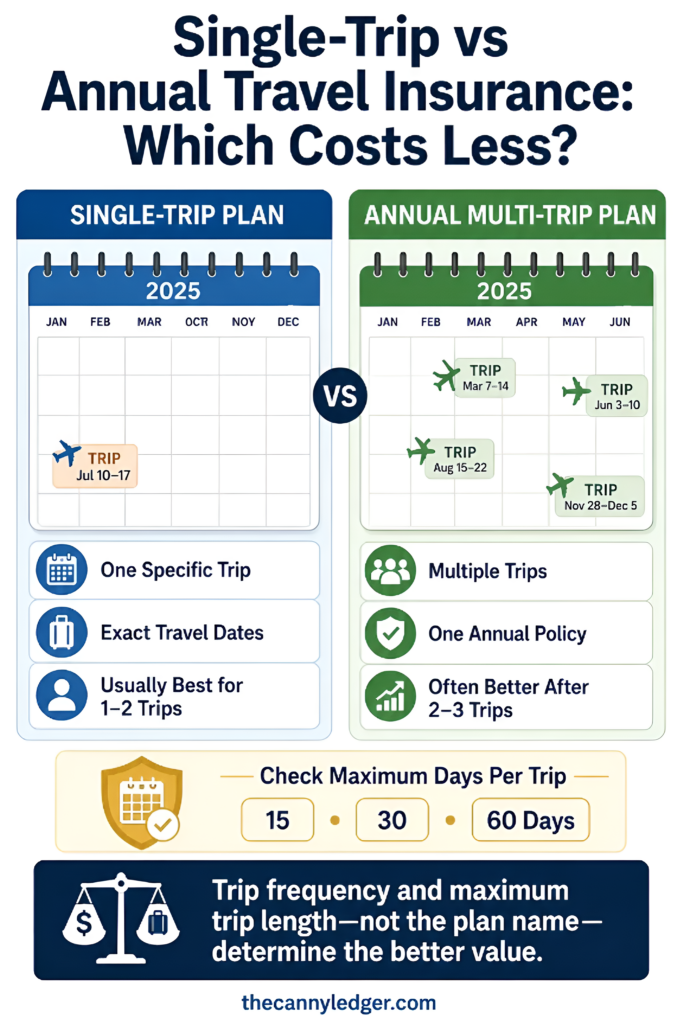
For someone travelling once or twice a year, a single-trip plan purchased for the specific dates of that trip is usually the more cost-effective choice, since you’re only paying for the exact window you’re actually exposed to risk. For frequent travellers, snowbirds, or anyone crossing the border regularly for work or family reasons, an annual multi-trip plan covering an unlimited number of trips up to a set number of days per trip, commonly 15, 30, or 60 days depending on the policy, usually works out considerably cheaper over the course of a year than buying individual single-trip policies each time. The break-even point depends on how often you actually travel, but as a general rule, more than two or three trips a year is usually where annual coverage starts winning out financially.
Snowbird Coverage for Manitoba Retirees Wintering South
Manitoba has a genuinely large population of retirees who spend a significant part of the winter in Arizona, Florida, or Texas, and this specific travel pattern needs its own category of coverage rather than a standard vacation policy. Snowbird plans are built around extended stays, often 30, 60, or even 90-plus consecutive days at a stretch, rather than the shorter trip windows a typical single-trip or even annual multi-trip plan assumes. GMS, a Prairie-rooted insurer based in Regina and popular specifically with travellers aged 60 and older, offers dedicated emergency medical travel plans built around exactly this kind of extended winter stay, alongside air ambulance coverage up to $20,000 under its emergency medical plans.
For anyone planning an extended winter stay, confirming the specific plan explicitly supports the full length of your actual trip matters more here than with a standard vacation, since some policies cap single-trip duration well below what a genuine snowbird stay requires, and exceeding that cap without extending or upgrading coverage first can leave the back half of your trip completely uninsured.

Credit Card Travel Insurance: The Fine Print Nobody Reads
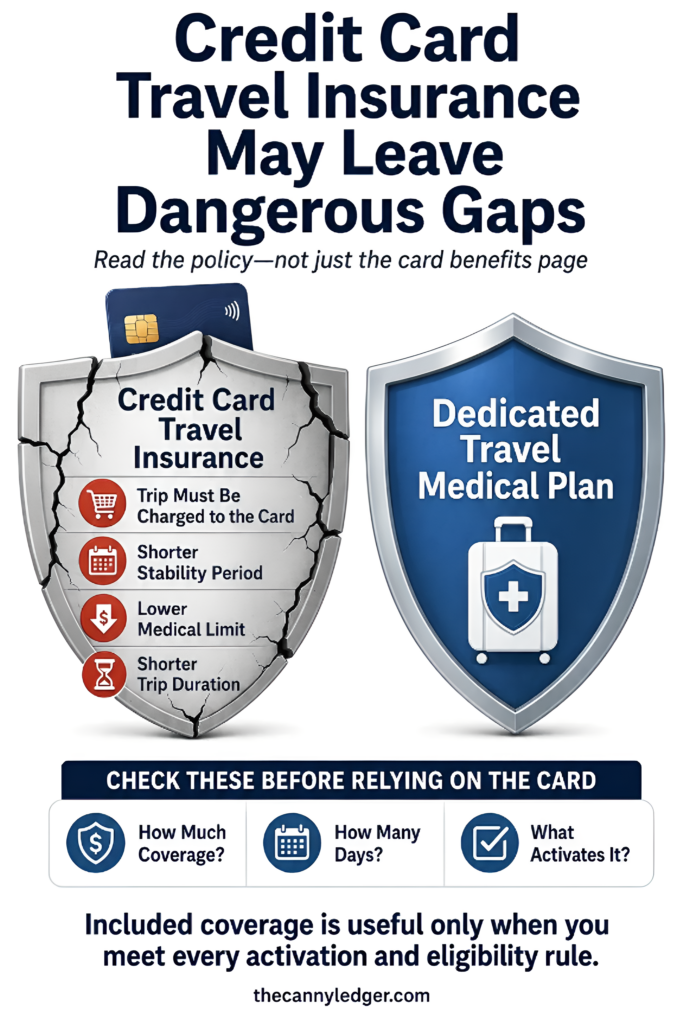
Many premium credit cards, particularly travel rewards cards, advertise built-in travel medical insurance as a card benefit, and it’s tempting to treat that as sufficient coverage on its own. The reality is more conditional than the marketing suggests. Credit card travel coverage typically requires the entire trip cost, or at minimum a meaningful portion of it, to be charged to that specific card to activate the benefit, often comes with a stricter and shorter pre-existing condition stability period than a dedicated travel insurance policy would apply, and frequently caps coverage well below what a genuinely serious medical emergency would require, sometimes in the range of $1 million to $2 million rather than the higher limits a dedicated plan like Manitoba Blue Cross’s Deluxe option offers. Reading your specific card’s actual policy document, not just the marketing page, before relying on it as your only coverage for a trip is worth the twenty minutes it takes, since discovering a gap in that coverage after an emergency has already happened is the worst possible time to learn about it.
What to Actually Do Before You Book
Confirm your Manitoba Health card status is current, then get a travel medical quote specifically built around your actual health situation, your trip length, and your destination, rather than defaulting to whatever a travel agent bundles in automatically or assuming a credit card’s built-in benefit is enough on its own. If you manage any ongoing health condition, get the insurer’s exact stability period definition in writing before you buy, and if anything about your medication or treatment has changed recently, wait for confirmation that you’re clear of that window before travelling if at all possible, rather than assuming a minor change won’t matter to a claims adjuster reviewing your file after the fact.

Common Questions
Does Manitoba Health cover me at all if I travel within Canada but outside Manitoba? Yes, Manitoba has reciprocal billing agreements with every other Canadian province and territory except Quebec, meaning a hospital or doctor can bill Manitoba Health directly for approved care, though some services are still excluded and additional coverage is recommended even for domestic travel.
Is travel medical insurance mandatory to leave the country? No, it isn’t legally required to travel, but going without it means accepting the full financial exposure of the gap between what Manitoba Health pays and what an actual foreign hospital bill would be, a gap that can run into hundreds of thousands of dollars in a serious U.S. emergency.
Can I buy travel insurance after I’ve already left on my trip? Generally no for the trip you’re already on. Most insurers require the policy to be purchased before departure, and specifically before any symptoms of an issue that later becomes a claim first appear, which is exactly why buying coverage as part of your pre-trip planning, not as an afterthought once you’ve landed, matters.
Buy the Policy Before You Need the Coverage, Not After
The entire value of travel medical insurance depends on it being in place before anything goes wrong, since a policy purchased after symptoms appear or after you’re already at your destination generally can’t help with the situation that prompted you to consider it in the first place. Get a quote, read the stability period language for any condition you manage, and confirm the coverage actually matches your trip length and destination before you finalize travel plans, not the week you’re already packing. If you’re weighing this alongside other household coverage, our comparison of term vs whole life insurance in Winnipeg and our guide to disability and critical illness insurance in Winnipeg cover two other categories worth factoring into a full insurance budget.