

Every Manitoba Public Insurance premium already has a 7 percent tax folded into it, and it never shows up as a separate line item the way sales tax does at a cash register. Since 2012, Manitoba has applied its Retail Sales Tax to most insurance premiums, not just retail goods, and insurers are required to build it directly into the quoted price rather than adding it visibly at the point of sale. Most Manitobans paying auto or property insurance every month have no idea that quiet 7 percent is baked in, since nothing about the bill announces it.
- The Basic Rate and How It’s Calculated
- RST on Insurance: The Tax Baked Into Every Premium
- When a Business Actually Needs to Register
- No Input Tax Credits: Why RST Hits Businesses Differently Than GST
- Vehicle Sales: Registered vs Unregistered Dealers
- The Rate That Keeps Expanding, Even When the Percentage Doesn’t
- What This Guide Doesn’t Cover
- Common Questions About Manitoba’s RST
Manitoba’s Retail Sales Tax (RST), still commonly called PST, sits at 7 percent and applies to most goods, many services, and most insurance premiums sold or used in the province, administered entirely separately from the federal 5 percent GST. Businesses making more than $30,000 in annual taxable sales must register to collect it, and unlike GST, businesses generally can’t recover RST paid on their own purchases through anything comparable to an input tax credit.
The Basic Rate and How It’s Calculated
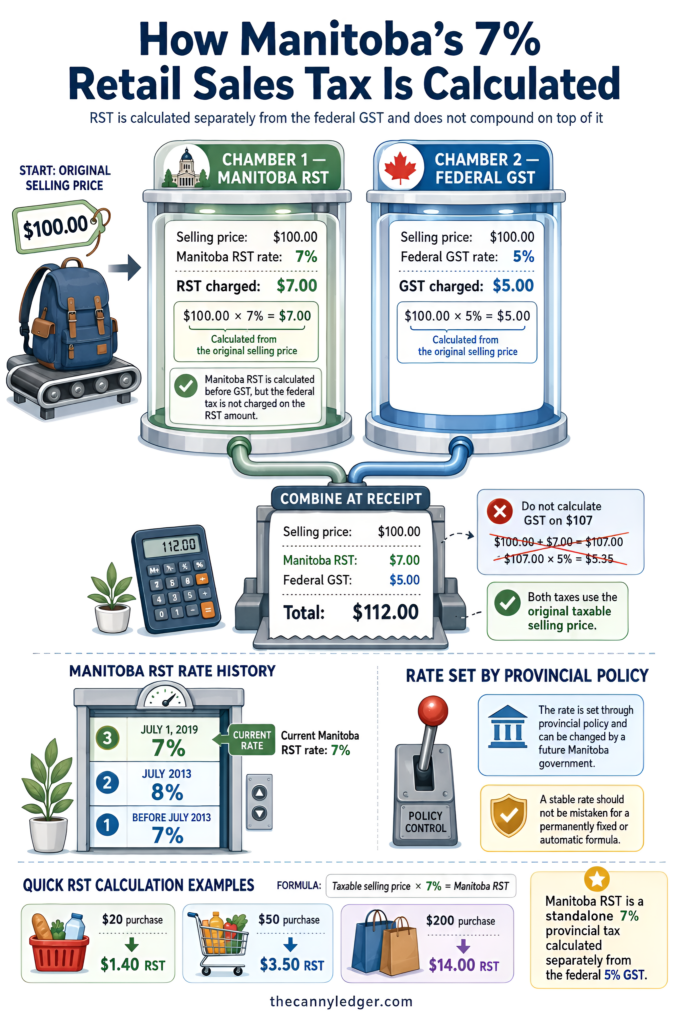
Manitoba’s Retail Sales Tax is calculated on the selling price of most goods and certain services, before GST gets applied, sitting at 7 percent as a standalone rate rather than compounding with the federal tax. The rate hasn’t always sat at 7 percent, either: it rose to 8 percent in 2013, then dropped back to 7 percent on July 1, 2019, following a provincial commitment to cut it. That history matters context-wise, since it shows the rate isn’t fixed by some unchangeable formula, it’s a policy lever a provincial government has moved before and could move again depending on fiscal conditions and political priorities.
RST on Insurance: The Tax Baked Into Every Premium
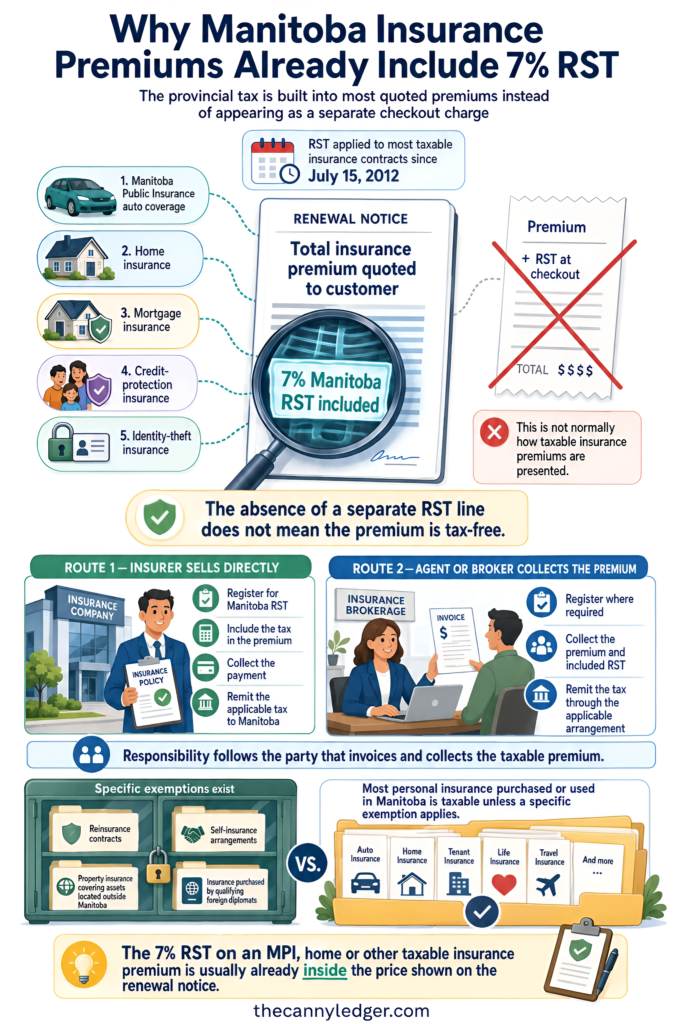
This is the part of Manitoba’s sales tax system most residents never learn about directly. Since July 15, 2012, Manitoba has applied RST to most taxable insurance contracts, covering everything from auto insurance through Manitoba Public Insurance to home, mortgage, credit protection, and even identity theft insurance. The registration chain runs through whoever actually handles the transaction: insurance companies selling directly must register and remit the tax themselves, while agents and brokers who invoice and collect premiums on an insurer’s behalf take on that same registration and remittance responsibility instead. Genuine exemptions exist, reinsurance contracts, self-insurance arrangements, property insurance covering assets located outside Manitoba, and insurance purchased by qualifying foreign diplomats all fall outside the tax, but the baseline assumption for most personal insurance products Manitobans actually buy is that the 7 percent is already built into the number on the renewal notice.
When a Business Actually Needs to Register
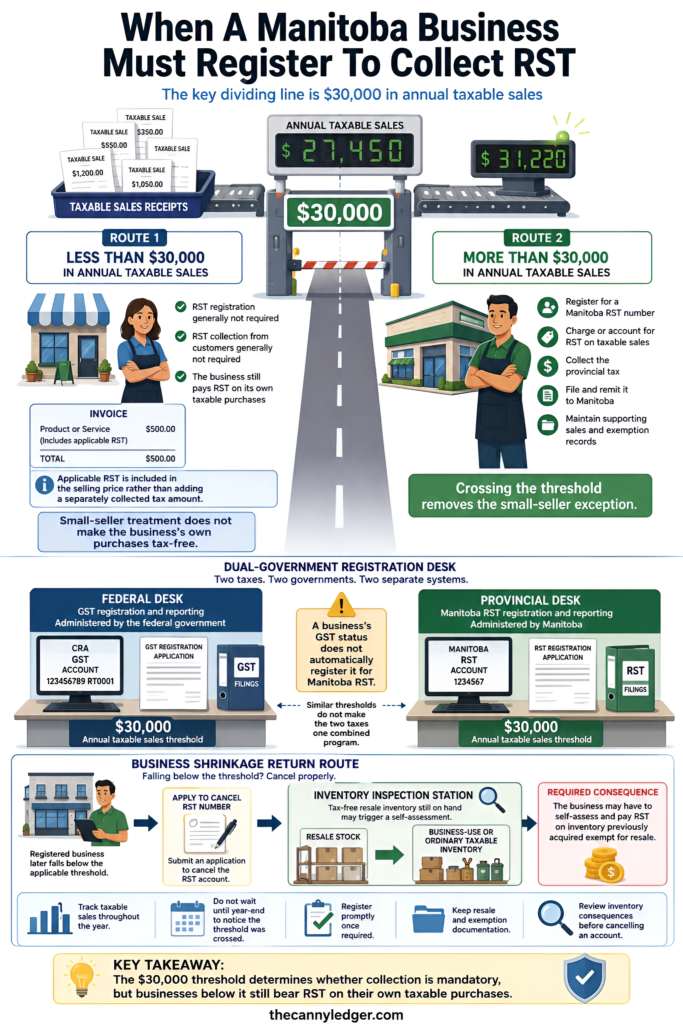
Manitoba sets a real threshold here, and it’s worth knowing precisely since some other sales tax guides get this wrong. Businesses with less than $30,000 in annual taxable sales aren’t required to register for or collect RST, the same small supplier exemption structure GST uses, though administered completely separately since RST and GST report to different governments entirely. A business under that threshold still pays RST on its own purchases as a regular consumer would, it just doesn’t charge RST to its own customers, and it has to note on invoices that RST is included in the price rather than charged separately. Crossing above $30,000 in taxable sales removes that exception entirely, requiring full registration, collection, and remittance going forward, and a business that later drops back under the threshold can cancel its RST number, though it then has to self-assess tax on any inventory it had been holding tax-free for resale.
No Input Tax Credits: Why RST Hits Businesses Differently Than GST
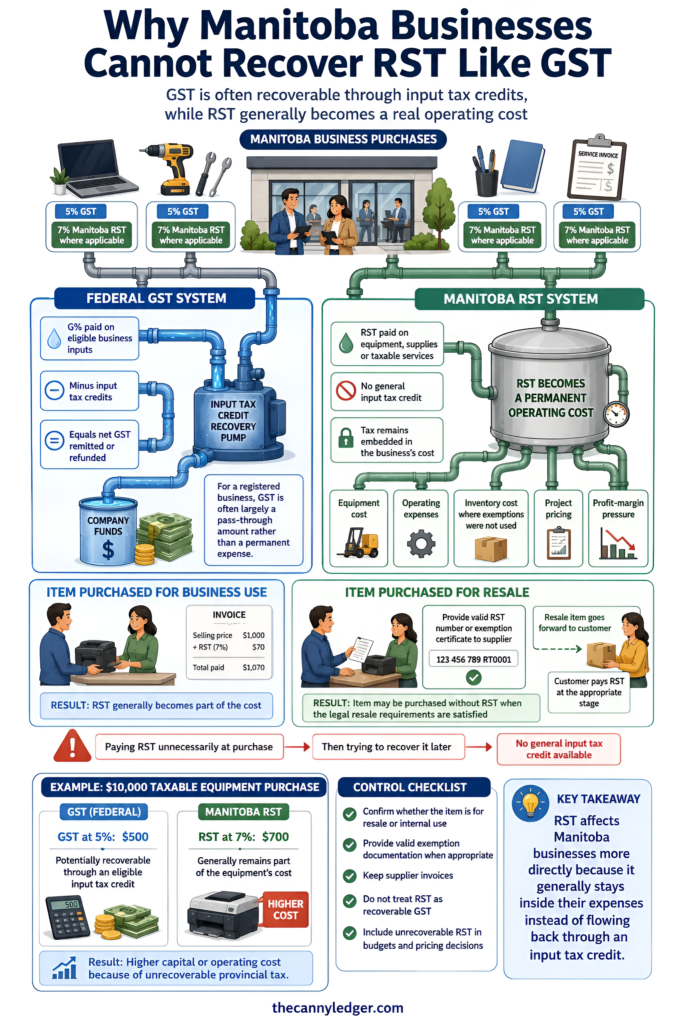
This structural difference matters enormously for anyone running a business in Manitoba. Under the federal GST system, a registered business can generally recover the GST it pays on its own supplies and equipment through input tax credits, making GST largely a pass-through cost for registered businesses rather than a real expense. RST doesn’t work that way. A Manitoba business paying RST on equipment, supplies, or services used to run its operations generally can’t recover that tax the way it could recover GST paid on the same purchase, meaning RST embeds itself as a genuine cost of doing business in Manitoba in a way GST doesn’t. This is part of why RST registration and exemption certificates matter so much to Manitoba businesses specifically, buying an item tax-exempt for resale rather than paying RST upfront and having no way to claim it back later is a real, meaningful cost difference.
Vehicle Sales: Registered vs Unregistered Dealers
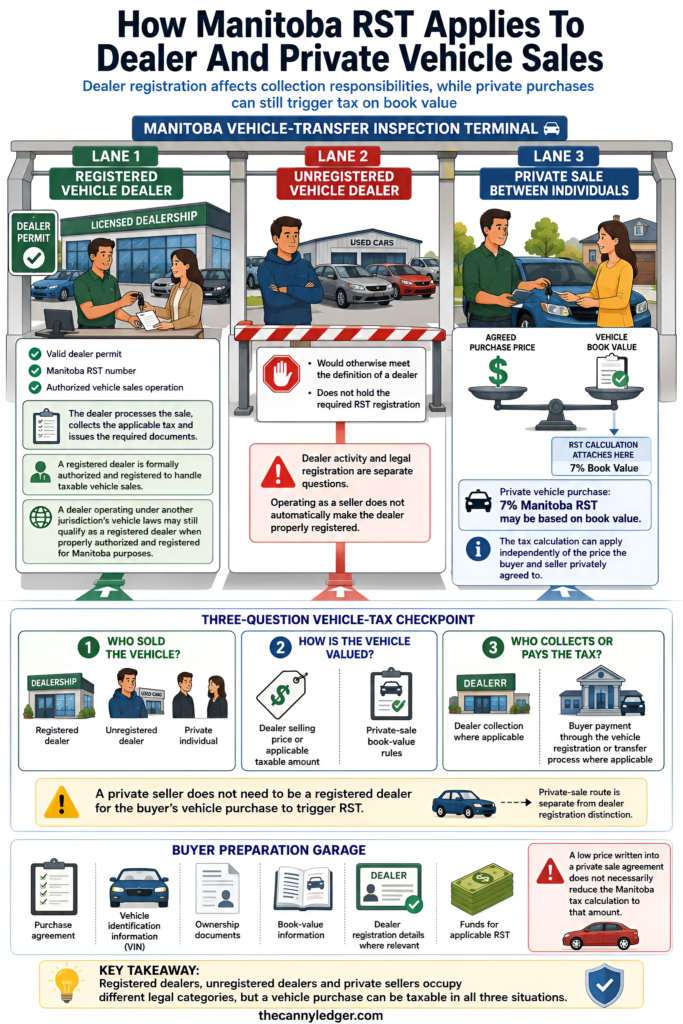
Manitoba’s Retail Sales Tax Act draws a specific legal line between registered and unregistered vehicle dealers, and it affects how a vehicle purchase gets taxed. A registered vehicle dealer holds a valid dealer permit and an RST number, whether operating inside Manitoba or authorized to sell vehicles under another jurisdiction’s laws, while an unregistered vehicle dealer would otherwise qualify as a dealer but lacks that registration. This distinction is separate from, but related to, the fact that buying a vehicle privately between two individuals in Manitoba still triggers 7 percent RST on the vehicle’s book value, calculated independently of whatever price the two parties actually agreed on, regardless of whether either party is a registered dealer at all.
The Rate That Keeps Expanding, Even When the Percentage Doesn’t
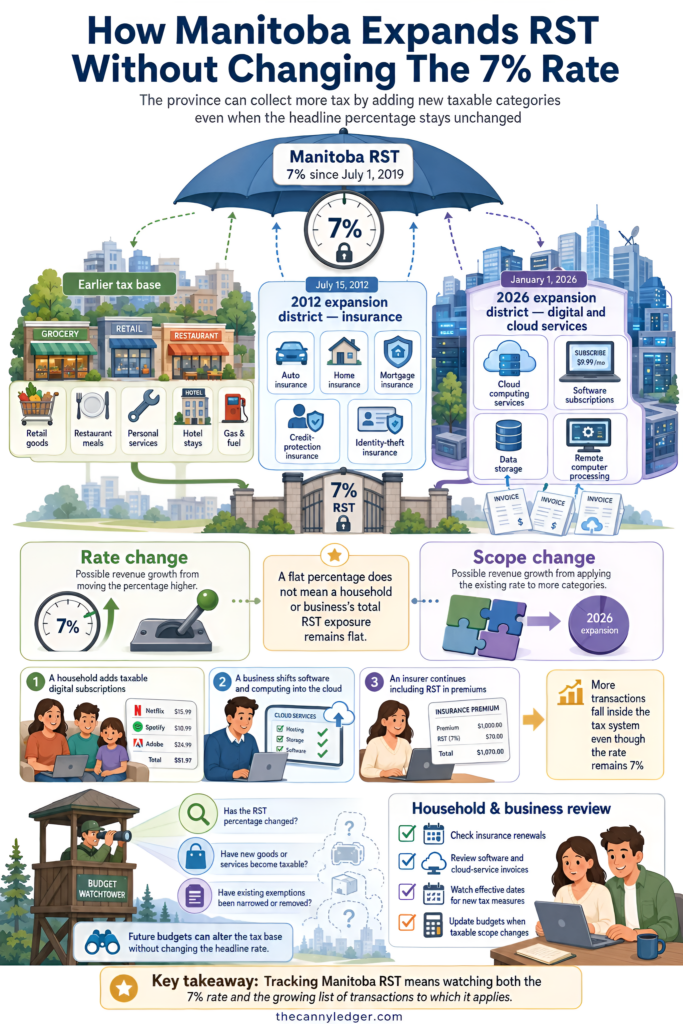
Manitoba’s 7 percent RST rate has stayed put since 2019, but what falls under that rate has kept growing. The most recent expansion brought cloud computing services, software subscriptions, data storage, and remote computer processing under RST starting January 1, 2026, a change covered in more depth in recent Winnipeg and Manitoba tax changes. The pattern worth noticing is that provincial sales tax revenue can grow considerably even with a flat headline rate, simply by widening what counts as taxable in the first place, insurance premiums in 2012, cloud services in 2026, and potentially other categories in future budgets. Watching for scope changes matters just as much as watching the percentage itself when trying to track how much RST actually affects a specific household or business over time.
What This Guide Doesn’t Cover
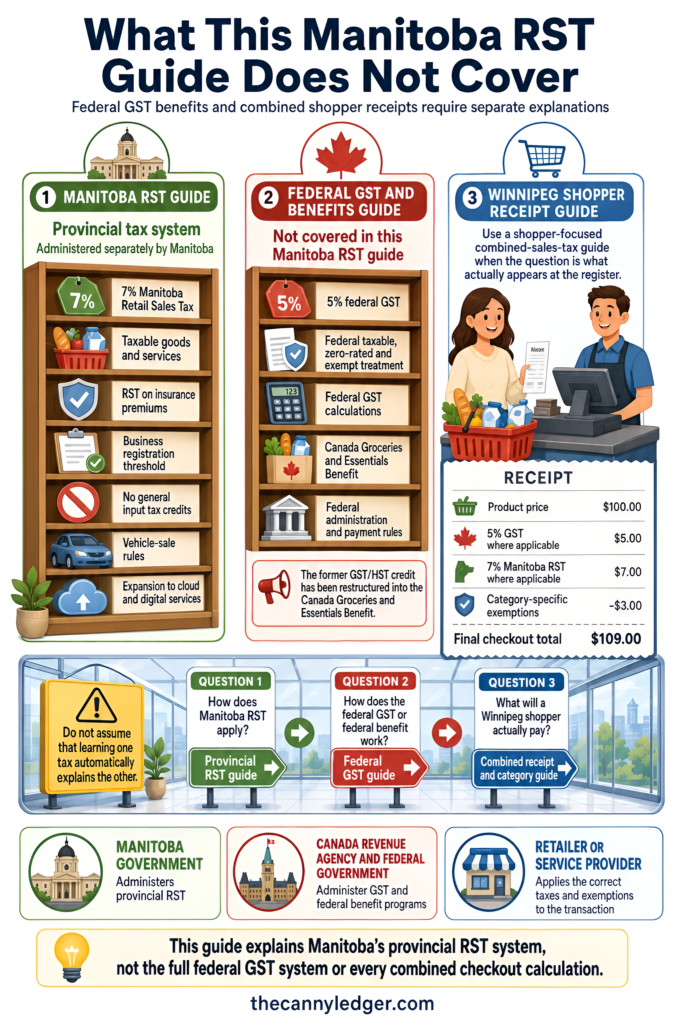
The federal side of Manitoba’s sales tax picture, including the major restructuring of the old GST/HST credit into the new Canada Groceries and Essentials Benefit, runs on entirely separate rules and a different administering government, covered fully in GST in Winnipeg. For the combined, shopper-focused view showing exactly what a real Winnipeg receipt looks like once both taxes are added together, Winnipeg sales tax explained for shoppers walks through specific categories, exemptions, and a worked example at the register.
Common Questions About Manitoba’s RST
Does RST apply to used goods sold privately, the same way it applies to retail purchases? It depends on the category. Manitoba specifically exempts used clothing and used furniture valued at $100 or less from RST, but other used goods, vehicles being the clearest example, still carry RST on a private sale regardless of the item’s age or condition.
If my business is under the $30,000 threshold, can I still choose to register voluntarily? Manitoba’s rules are built around the threshold as an exemption from a requirement, not a hard ban on registering below it, so it’s worth confirming directly with Manitoba Finance whether voluntary registration is available for your specific situation, since the standard guidance focuses on when registration becomes mandatory rather than optional early registration.
Why doesn’t my insurance bill show RST as its own line the way a store receipt does? Because the law requires insurers and their agents to build the tax into the quoted premium rather than disclose it as a separate charge, unlike retail sales, where itemizing RST separately from the pre-tax price is the standard, expected format.
The 7 percent figure itself hasn’t moved since 2019, but treating that as the whole story misses how much has changed underneath it, insurance premiums since 2012, cloud subscriptions since 2026, and whatever comes next. Checking what’s actually taxable today, not just the rate everyone already knows, is the only way to keep an accurate picture of what RST actually costs a Manitoba household or business each year.