


Here’s something that surprises a lot of people searching for part-time work in Winnipeg for the first time: for a huge share of retail and food service hiring specifically, walking into the store or restaurant with a printed resume and asking to speak to a manager still beats submitting an application through a corporate careers portal and waiting. Online applications for high-turnover, entry-level positions often get funneled into a large pool that a manager may not review carefully for days, while a five-minute in-person conversation during a slow afternoon shift puts a face to a name immediately and frequently gets a callback within days rather than weeks. This guide is built around that practical reality rather than a purely digital job-search strategy, covering both where the actual openings tend to cluster and the online tools worth using alongside the legwork.
- Retail: start with the malls, and go in person
- Food service and hospitality
- Grocery and big-box retail
- Call centres and customer service roles
- Gig and delivery platform work
- Campus and student-specific opportunities
- The online tools worth using alongside the legwork
- Know your protections before you accept a shift
- Weighing what a part-time income actually covers
- Getting to the job itself
- The bottom line
Retail: start with the malls, and go in person
Winnipeg’s major shopping centres, CF Polo Park, St. Vital Centre, Kildonan Place, and the Outlet Collection at Winnipeg, collectively represent one of the largest concentrations of part-time retail hiring in the city at any given time, spanning everything from big-box anchor stores to small independent boutiques. Individual stores post openings on their own career pages and on general job boards, but a genuinely effective strategy specific to malls is a single afternoon walking the concourse, checking storefronts for “now hiring” signage, and asking directly at the counter whether they’re taking applications, since many smaller retailers don’t bother posting online at all and rely entirely on walk-in interest or word of mouth.
Seasonal hiring at these same malls ramps up predictably twice a year: a significant wave in the weeks leading into the winter holiday shopping season, typically starting in October and running through December, and a smaller wave heading into back-to-school season in late August and September. If your schedule allows flexibility on when you start, timing an application to land just ahead of either surge meaningfully improves your odds, since stores are actively expanding their part-time roster rather than filling occasional one-off vacancies.

Food service and hospitality
Restaurants, cafes, and quick-service chains across the city hire part-time staff at a volume and turnover rate that consistently outpaces almost every other sector, which cuts both ways: openings are frequent, but the work itself often comes with unpredictable scheduling and physically demanding shifts. Chains with a strong Winnipeg presence, coffee shops, quick-service restaurants, and casual dining locations across the city, post consistently on their own career pages and general job boards, and here too, a direct in-person inquiry during a slower mid-afternoon window, rather than during a lunch or dinner rush when staff genuinely can’t stop to talk, tends to get more traction than an online application alone.

Grocery and big-box retail
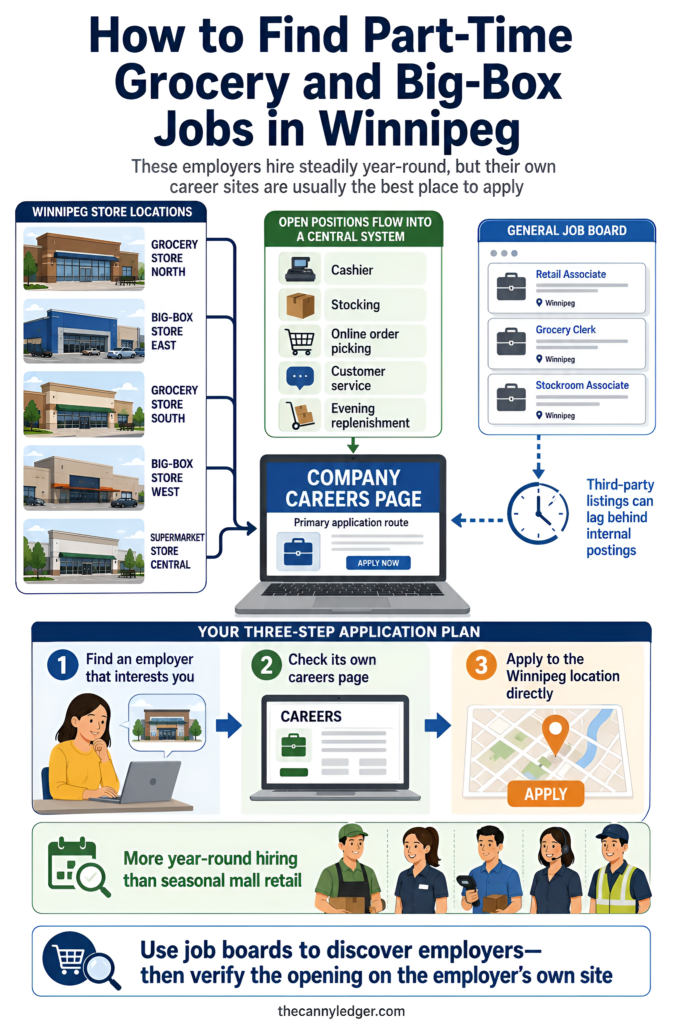
Grocery chains and big-box retailers with multiple Winnipeg locations represent some of the most consistent part-time employers in the city, largely because their staffing needs are steady year-round rather than concentrated around seasonal peaks the way mall retail tends to be. These employers typically run centralized online application systems through their own career sites rather than accepting walk-in resumes the way smaller independent retailers do, so it’s worth applying directly through the specific company’s careers page rather than relying entirely on a general job board’s listing, which sometimes lags behind what’s actually posted internally.
Call centres and customer service roles
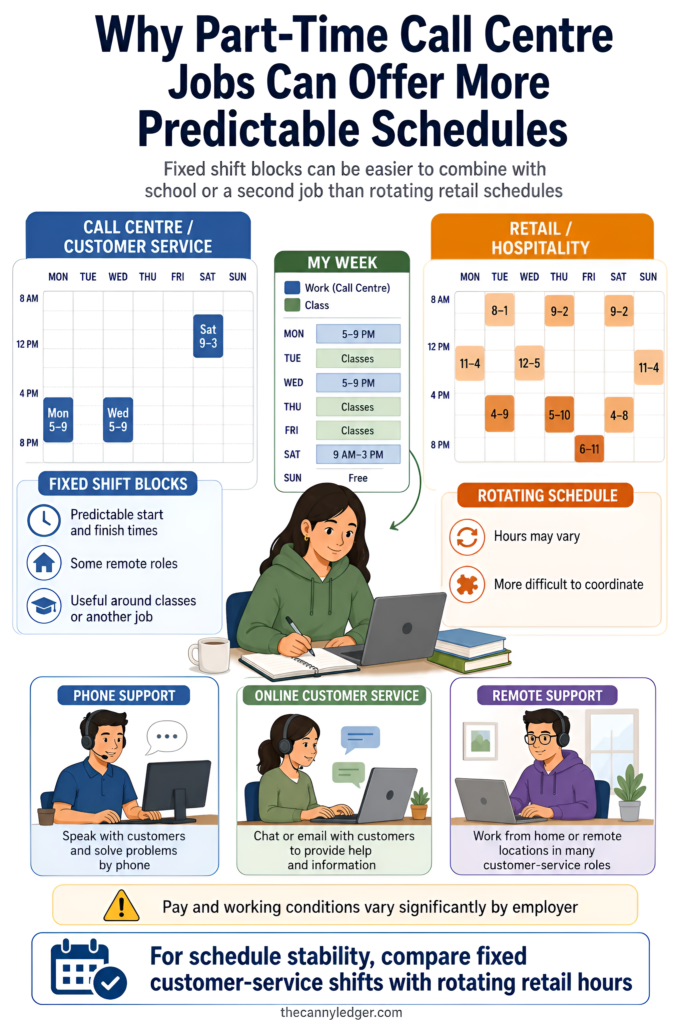
Winnipeg has a genuine concentration of call centre and remote customer service employment, some union-adjacent and well-compensated relative to other part-time work, others considerably more variable. These roles tend to offer more predictable scheduling than retail or food service, often built around fixed shift blocks rather than the rotating and on-call scheduling common in customer-facing hospitality work, which can make them a better fit for anyone balancing part-time work against a class schedule or a second job with fixed hours.
Gig and delivery platform work
Food delivery and rideshare platforms offer some of the most flexible part-time earning available in the city, with no fixed schedule and the ability to log on and off at will, though it’s worth understanding clearly that this work is structured as independent contracting rather than employment, meaning none of the Employment Standards Code protections covered below, minimum wage, reporting pay, or vacation entitlements among them, apply to it the way they would to a standard part-time job. It can be a genuinely useful way to fill gaps around a more structured part-time role or a full course load, but it shouldn’t be treated as equivalent to traditional part-time employment when comparing total compensation and protections.

Campus and student-specific opportunities
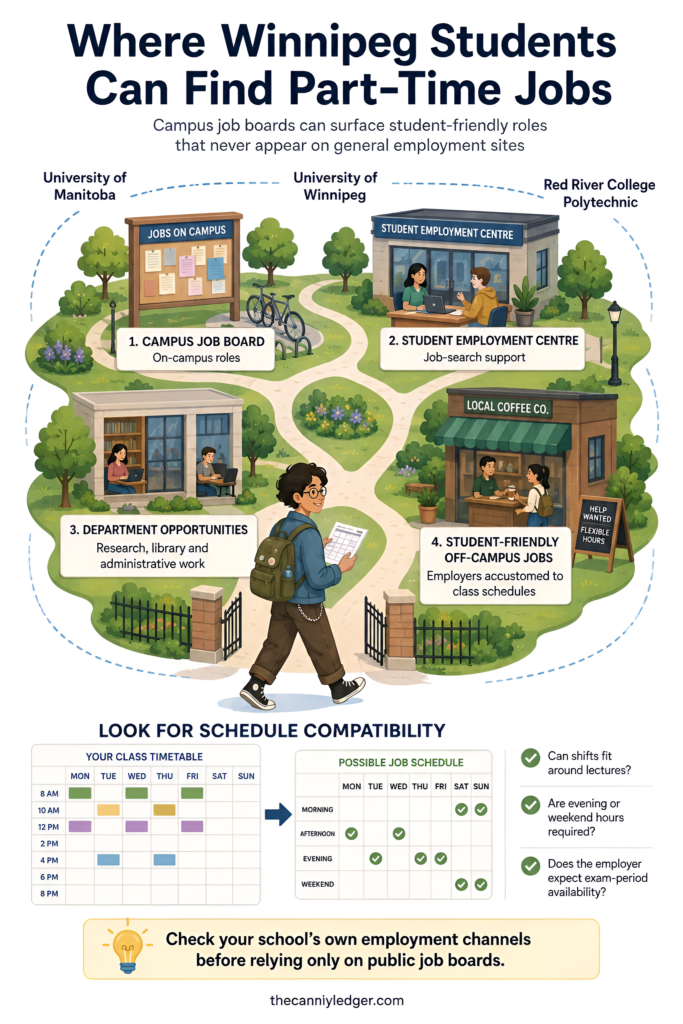
If you’re a student at the University of Manitoba, the University of Winnipeg, Red River College Polytechnic, or another local institution, campus job boards and student employment centres frequently post opportunities, both on-campus roles and off-campus positions specifically flagged as student-friendly around class schedules, that don’t always surface on general job boards. Our student jobs in Winnipeg guide covers this specific segment of the market in more depth, including which sectors are most accustomed to working around a full course load.
The online tools worth using alongside the legwork
Job Bank, the federal government’s job posting platform, aggregates a genuinely wide range of Winnipeg openings across every sector covered above and is worth checking regularly, particularly since it also hosts the regional wage data referenced elsewhere on this site, letting you cross-check a specific posting’s offered rate against what similar roles typically pay in the Winnipeg region. General job boards cast a wider net but come with more noise, duplicate postings, and occasionally outdated listings, so treat them as a starting point for discovering employers actively hiring rather than the final word on what’s available. Once you’ve identified a specific company or chain you’re interested in, checking their own careers page directly often surfaces openings before they propagate to third-party job boards at all.

Know your protections before you accept a shift
A handful of specific rules under Manitoba’s Employment Standards Code matter more to part-time workers than to full-time staff, precisely because part-time scheduling tends to be less predictable. If you’re scheduled for a shift longer than three hours and get sent home early, your employer is required to pay you for at least three hours regardless of how little you actually worked, a rule worth knowing if a slow retail or restaurant shift ever gets cut short unexpectedly. Retail employees specifically also have the right to refuse working on a Sunday, provided they give their employer at least fourteen days’ notice, a protection worth knowing about if religious observance or another personal reason makes Sunday shifts a genuine problem for you. Our minimum wage in Winnipeg guide covers the broader wage and overtime rules that apply to part-time employees exactly the same as full-time staff, including the fact that Manitoba has no separate, lower minimum wage for part-time or student workers specifically.

Weighing what a part-time income actually covers
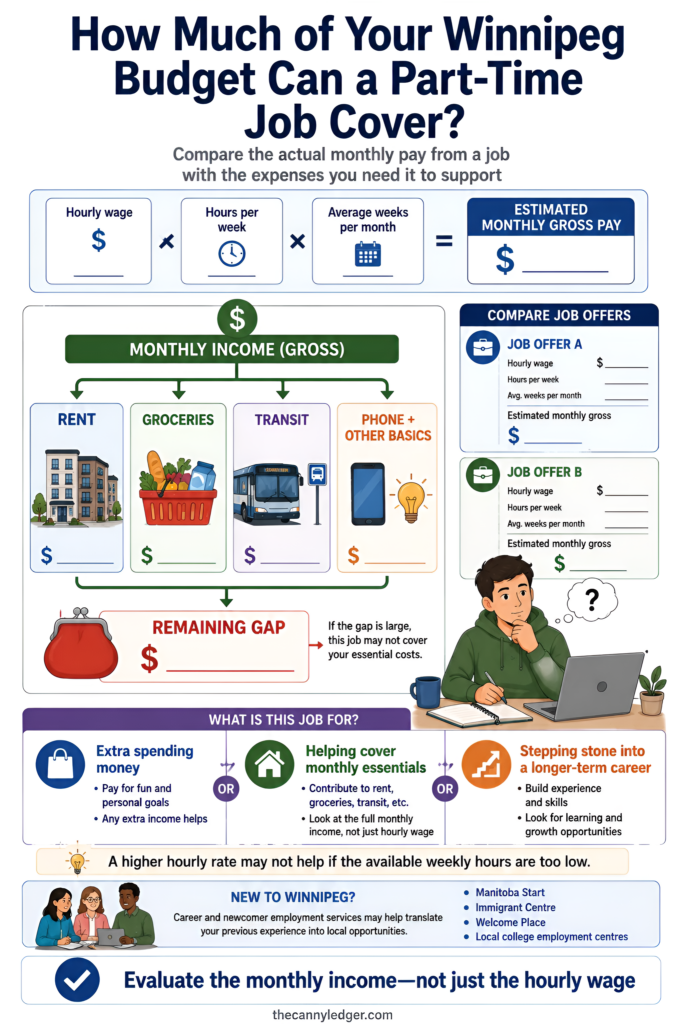
Before committing your schedule to a specific role, it’s worth running the honest math on what a part-time income at a given wage actually contributes toward your monthly needs, particularly if you’re combining it with school, another job, or a fixed income from another source. Our living expenses in Winnipeg guide builds out realistic monthly budgets you can compare a specific part-time wage against, and our average salaries in Winnipeg by profession guide is worth a look if you’re using a part-time role as a stepping stone into a specific field longer-term rather than treating it as a standalone income source.
If you’ve recently arrived in Winnipeg and are navigating the local job market for the first time, our career counselling for newcomers in Winnipeg and jobs for new immigrants in Winnipeg guides cover resources specifically built to help translate outside experience into a foothold in the local market, which can matter considerably for part-time roles too, not just full-time career positions.
Getting to the job itself
If you don’t drive, it’s worth confirming a specific job’s location against Winnipeg’s transit routes before committing to a schedule, since a role that looks convenient on paper can turn into a genuinely difficult commute depending on bus frequency during evening or weekend shifts specifically, exactly when a lot of part-time retail and hospitality scheduling clusters. Our Winnipeg transit fares guide covers current pricing if a monthly pass makes more sense than paying per ride once you’ve settled into a regular part-time schedule.

The bottom line
Winnipeg’s part-time job market rewards a mixed strategy more than a purely digital one. Check Job Bank and company career pages regularly, but don’t underestimate the value of a printed resume and a direct conversation at a mall storefront or restaurant during a quiet stretch of the day, particularly heading into the seasonal hiring surges each fall. Know your rights around reporting pay and scheduling before you accept a shift, and run the honest math on what the wage actually contributes to your budget before you commit your calendar to it.
