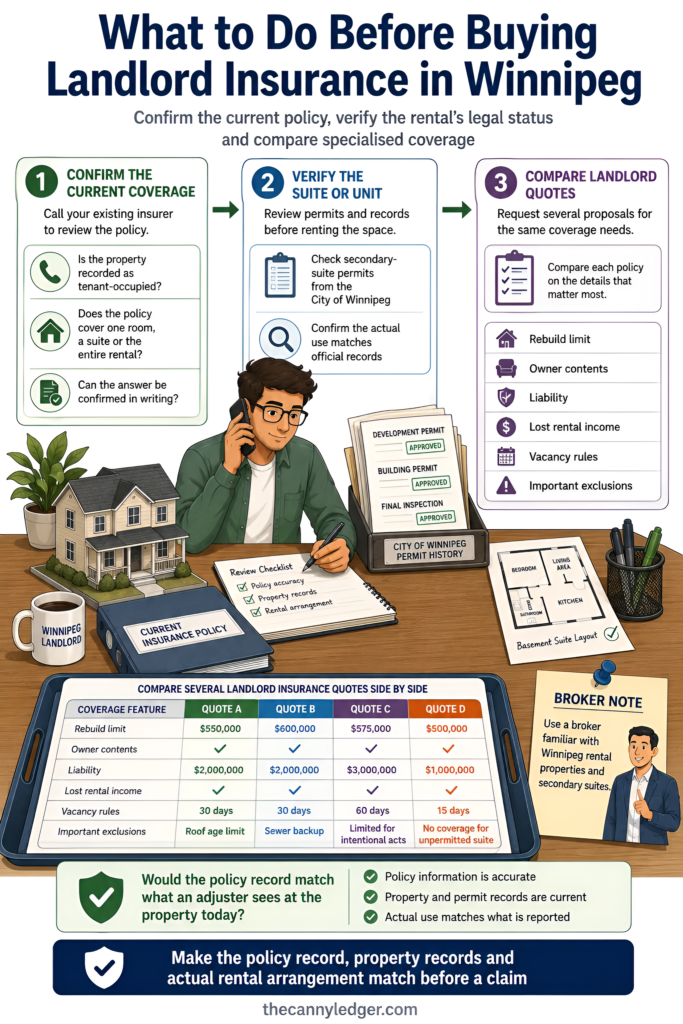

A homeowner’s insurance policy in Manitoba doesn’t announce when it quietly stops protecting you. It just does, the exact moment a tenant moves in, whether that’s a full house rented out or a basement suite handed off to a single renter. Landlord insurance in Winnipeg exists because that gap is real and it’s the single most common reason property owners discover, usually during a claim, that they’ve been uninsured for months or years without realizing it.
- Why Your Regular Home Insurance Stops Working the Day You Get a Tenant
- What Landlord Insurance Actually Covers
- What It Actually Costs
- The Secondary Suite Trap
- What Landlord Insurance Doesn’t Cover
- If You’re Renting Out a Condo Instead of a House
- Landlord Insurance vs. Tenant Insurance: Who Covers What
- Common Mistakes That Cost Landlords Real Money
- What to Actually Do Next
Here’s the direct version: a standard home insurance policy is written for owner-occupied homes, and renting out any part of that property without telling your insurer can void your coverage entirely, not just the portion related to the tenant. Landlord insurance is a separate product built specifically for rental properties, covering the building, your own contents used in the rental, liability, and lost rental income if a covered event forces the property empty.
Understanding exactly where that coverage starts and stops is worth more to a Winnipeg landlord than almost any other insurance decision they’ll make, since the alternative is finding out the gap exists the day you actually need the payout.
Why Your Regular Home Insurance Stops Working the Day You Get a Tenant
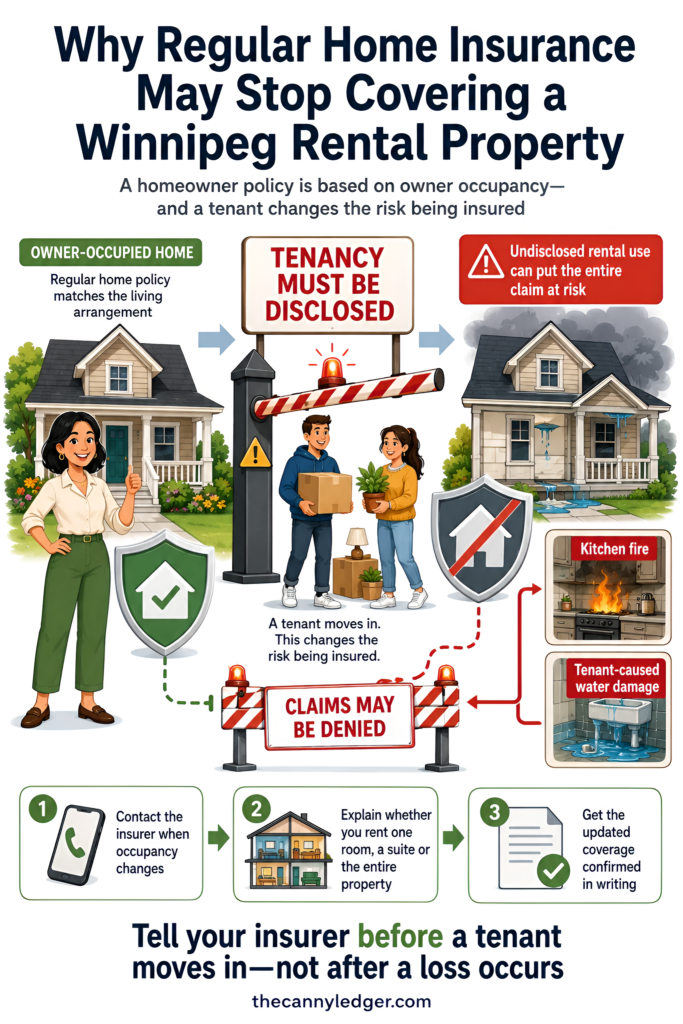
Standard home insurance is underwritten around a specific assumption: that the person named on the policy actually lives in the home. The moment that stops being true, whether you’ve moved out and rented the whole house or you’re still living there and renting a basement suite to someone else, the risk profile the insurer originally priced no longer matches reality.
This isn’t a minor technicality. Across Canadian insurance guidance, the pattern is consistent and blunt: if an insurer discovers a property was tenant-occupied and that wasn’t disclosed, they can deny a claim outright, and in some cases cancel the policy retroactively, leaving the owner uninsured for a loss that already happened. This applies even to claims that have nothing to do with the tenancy itself. A grease fire in the kitchen gets denied the same way a tenant-caused flood would, because the underlying problem is that the insurer was never given accurate information about who actually lives there.
The fix is straightforward and cheap relative to the risk: call your insurer the moment your living situation changes, whether that’s renting out one room or an entire property, and get it in writing that your coverage has been updated to reflect it.
What Landlord Insurance Actually Covers
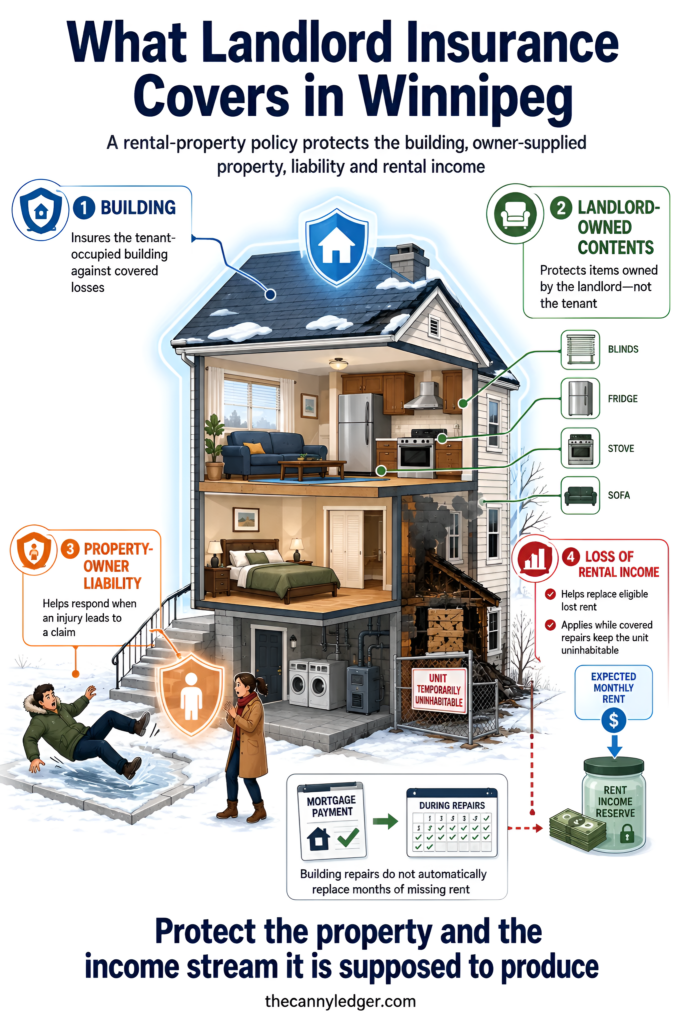
A proper landlord policy, sometimes marketed as rental dwelling or rental property insurance, typically bundles four distinct types of protection built specifically around the realities of renting to someone else.
Building coverage insures the physical structure itself, the same core function a homeowner’s policy serves, but priced and underwritten for a property with a tenant living in it rather than the owner. Landlord-owned contents covers whatever you, as the owner, have supplied for the rental, appliances, window coverings, and any furniture included as part of the unit, since none of that belongs to the tenant and their own tenant insurance wouldn’t touch it. Liability coverage protects you if a tenant or a visitor is injured on the property, say a fall on an icy front step in the winter, and pursues a claim against you as the owner. Loss of rental income replaces the rent you’d have collected if a covered event, like a fire, makes the unit uninhabitable and forces your tenant out while repairs happen.
That last piece is easy to overlook until it’s the one you need. A landlord without loss of rental income coverage can be paying a mortgage on a property generating zero rent for months during a rebuild, on top of whatever the building coverage is already handling.
What It Actually Costs
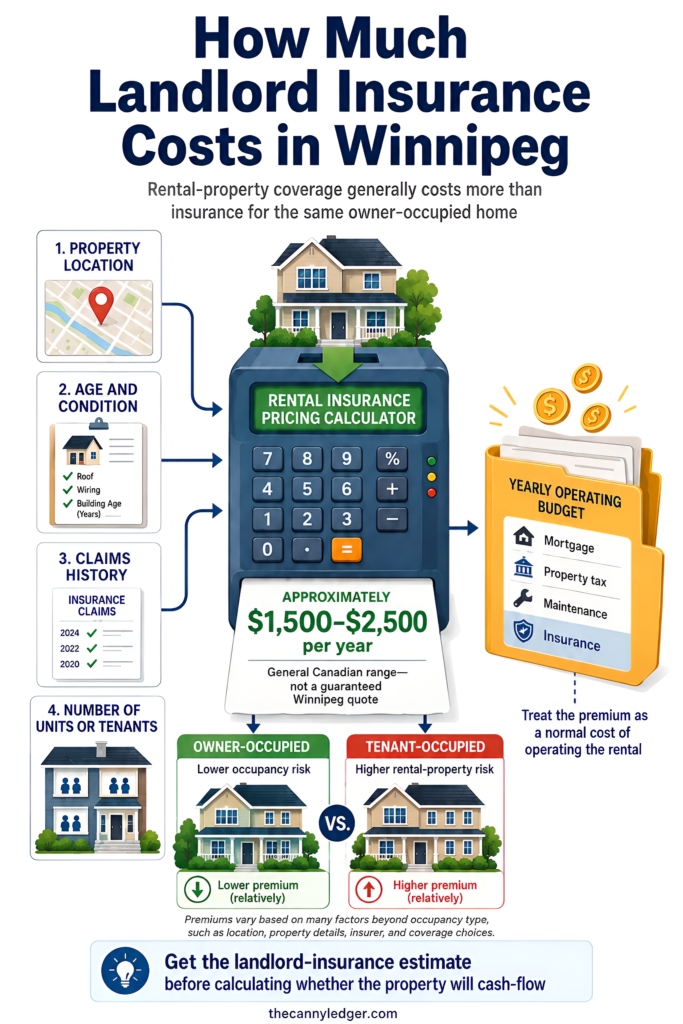
Landlord insurance runs meaningfully more than a comparable owner-occupied home policy, and that gap reflects genuinely higher risk rather than insurers padding margins. Across Canada, landlord insurance typically costs between $1,500 and $2,500 a year, with the actual number shaped by the property’s location, age, claims history, and how many units or tenants are involved.
That’s a real jump from what the same physical building might cost to insure as an owner-occupied home, and it’s worth budgeting for as a genuine cost of being a landlord rather than an unpleasant surprise discovered after the fact. Weighing this against what a comparable owner-occupied home costs to insure in Winnipeg is a useful way to see exactly how much the rental designation itself is adding to the number.
The Secondary Suite Trap
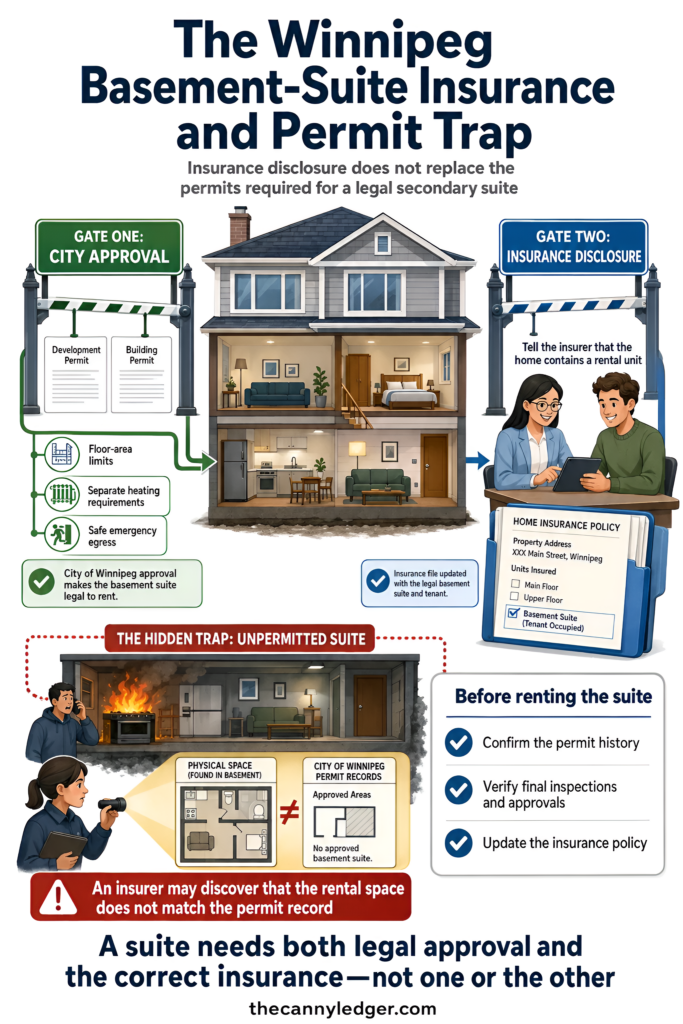
This is the gap that catches Winnipeg homeowners specifically, and it has nothing to do with insurance paperwork at first glance. The City of Winnipeg requires both a development permit and a building permit before a homeowner can legally create a secondary suite, the official term for a self-contained rental unit built into a basement or elsewhere on a single-family property. The suite has to meet specific requirements too, including floor area limits, a dedicated heating system separate from the main home, and proper egress, all reviewed and signed off by the city before the suite is legal.
An unpermitted secondary suite creates a second layer of risk on top of the disclosure issue covered above. If your suite was never permitted and something goes wrong, a fire, a structural issue, an injury, an insurer investigating the claim may discover the suite doesn’t match city records at all. That’s a materially different problem than simply forgetting to update your policy, since it raises the question of whether the space was ever legally habitable to begin with. Anyone renting out a Winnipeg basement suite, whether newly built or inherited from a previous owner, should confirm the permit history exists before assuming their landlord insurance will respond cleanly to a claim.
What Landlord Insurance Doesn’t Cover
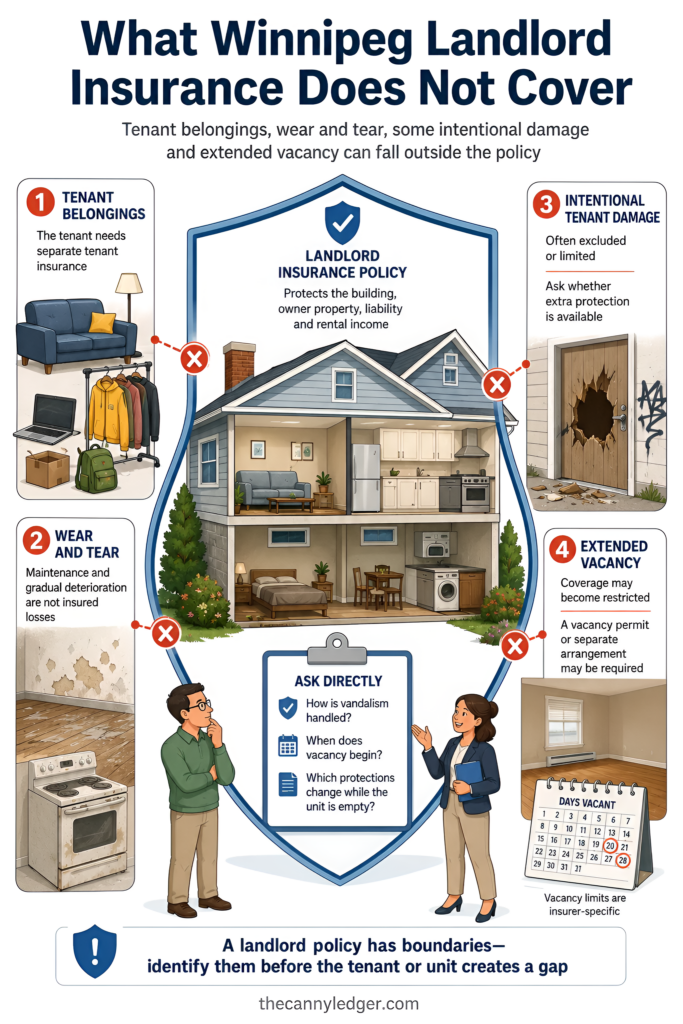
A landlord policy has real boundaries, and knowing them prevents the same kind of unpleasant surprise as an undisclosed rental.
Your tenant’s own personal belongings are never covered under your policy, full stop. That’s exactly what tenant insurance in Winnipeg exists for, and it’s a separate product your tenant needs to carry themselves, since your landlord coverage was never designed to protect their furniture or electronics. Intentional damage or vandalism caused by a tenant is frequently excluded or limited under standard landlord policies, which is a real and known gap worth asking your broker about directly if you want it closed. Ordinary wear and tear on the property, the same exclusion that applies to any home policy, isn’t a covered loss no matter who’s living there. And vacancy matters more than owners expect: a property sitting empty between tenants for an extended stretch, often somewhere around 30 days depending on the insurer, can trigger restricted coverage unless you’ve arranged a vacancy permit or specific coverage for that gap.
If You’re Renting Out a Condo Instead of a House
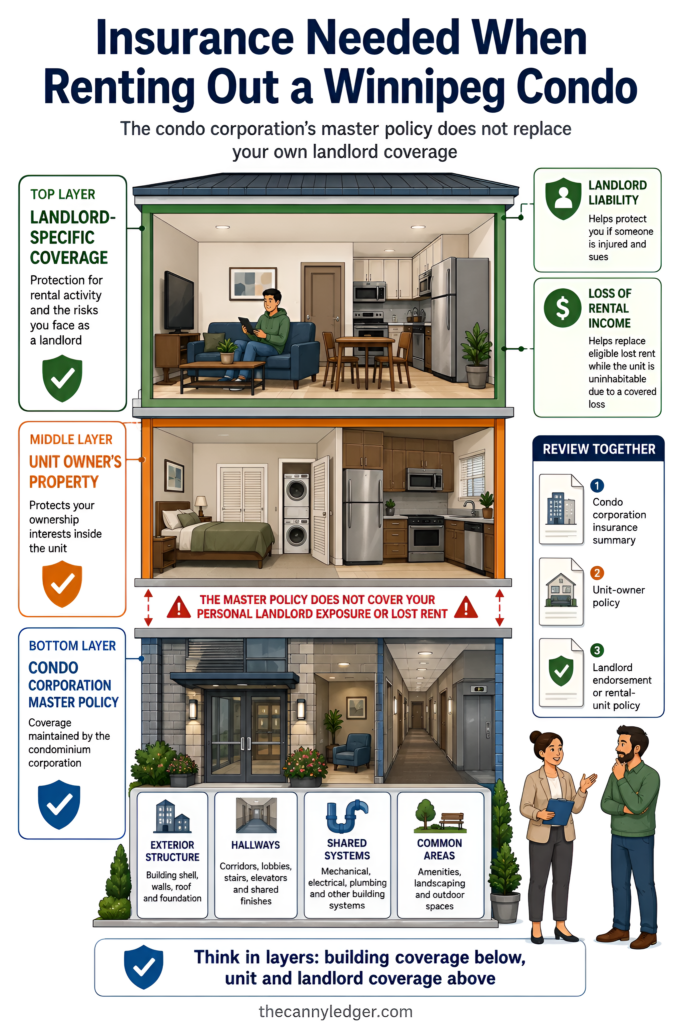
Landlords renting out a condominium unit are working with an extra layer most house-only landlords never have to think about. Manitoba’s Condominium Act requires the condo corporation to maintain a master policy covering the building’s structure and common elements, the same framework covered in detail when it comes to condo insurance in Winnipeg. Renting out that unit doesn’t remove your obligation to carry your own coverage on top of the corporation’s policy. It actually adds to it, since you now need landlord-specific protection, meaning liability and loss of rental income coverage built for a tenant-occupied unit, layered onto whatever contents and improvements coverage you’d already need as the owner.
Skipping this step because “the corporation’s insurance covers the building” repeats the exact same mistake as assuming a tenant’s own insurance protects your rental house. The corporation’s master policy was never designed to cover your liability as a landlord or your lost rent if the unit becomes uninhabitable.
Landlord Insurance vs. Tenant Insurance: Who Covers What
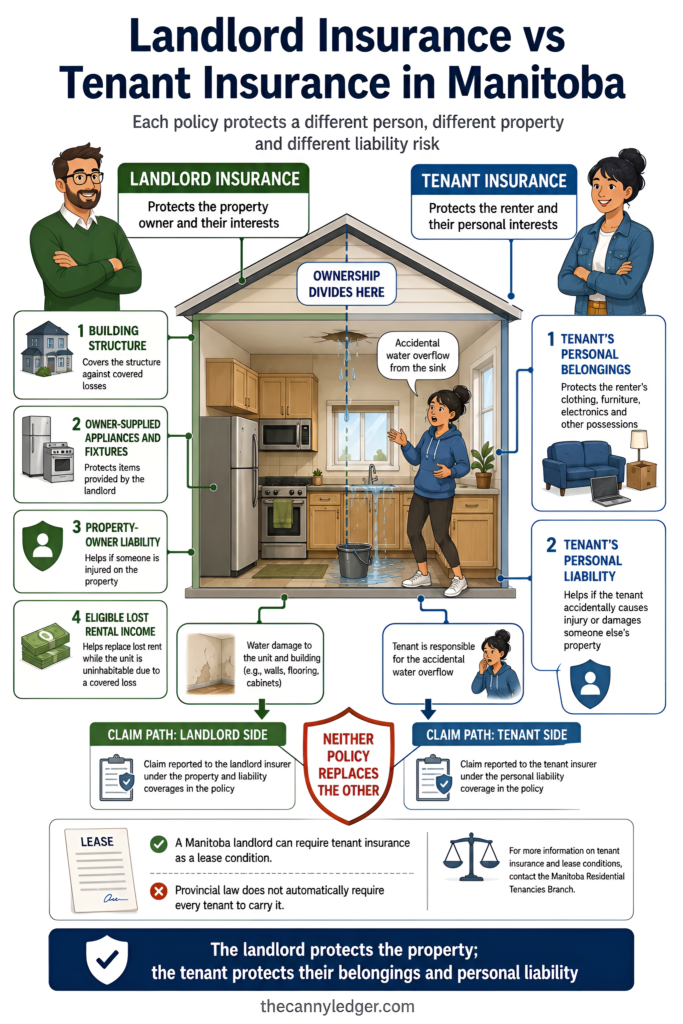
The clearest way to understand this split is to separate it by who owns what. As a landlord, you’re responsible for insuring the structure, your own fixtures and appliances, your liability as the property owner, and your lost income if the unit becomes unrentable. Your tenant is responsible for insuring their own belongings and their own personal liability inside the unit. Manitoba’s Residential Tenancies Branch states this distinction plainly in its own guidance for renters: a landlord’s insurance policy won’t cover a tenant’s belongings, which is exactly why the two products exist separately rather than one covering both parties.
Landlords requiring tenant insurance as a lease condition, which is legal in Manitoba even though the province itself doesn’t mandate it, are essentially closing their own liability exposure. If a tenant accidentally starts a kitchen fire that damages the building, having that tenant carry liability coverage means their insurer handles the claim rather than the landlord chasing an individual renter with limited assets to actually pay for it.
Common Mistakes That Cost Landlords Real Money
A handful of patterns show up repeatedly in how Winnipeg property owners end up underinsured without realizing it until it’s too late.
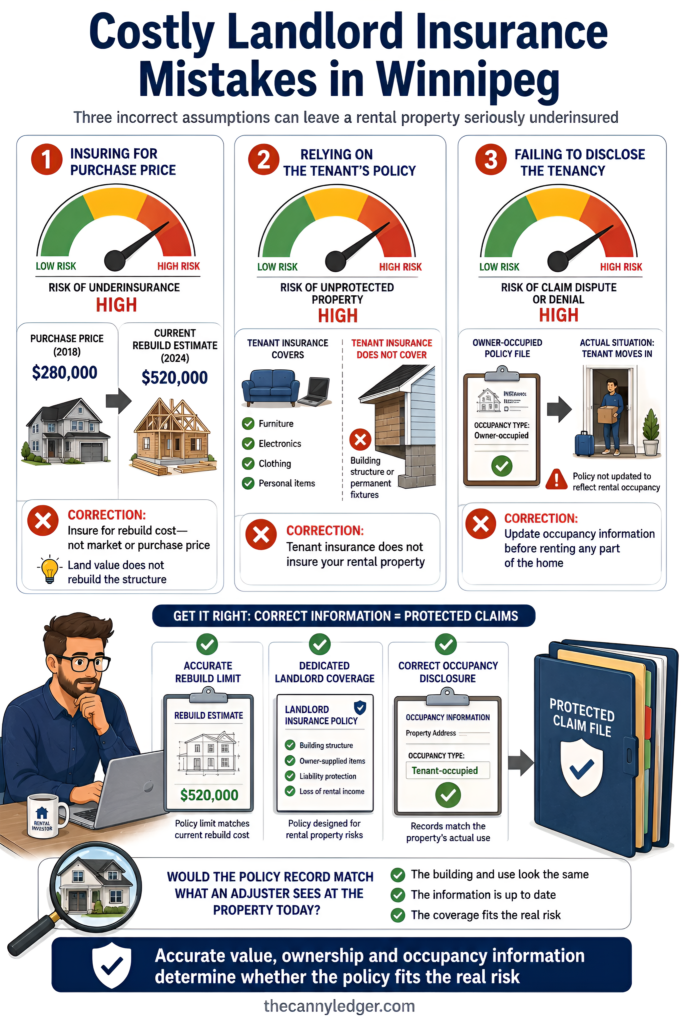
Insuring the property for its purchase price rather than its actual rebuild cost is a quiet, expensive mistake, since those two numbers can diverge significantly, particularly for an older Winnipeg home bought years ago at a price well below what it would cost to reconstruct today. Assuming a tenant’s own insurance somehow protects the building itself is another recurring error, when in reality tenant policies never extend that far regardless of how comprehensive they look on paper. And treating the disclosure requirement as optional paperwork, rather than the single detail that determines whether a claim gets paid at all, remains the most common and most costly mistake landlords make in this province.
What to Actually Do Next
If you’re currently renting out any part of a property under a standard home insurance policy rather than a dedicated landlord policy, call your insurer today and confirm in writing exactly what your coverage actually includes, since finding this out during a claim is far more expensive than finding it out now. If your rental includes a secondary suite, pull your permit history through the City of Winnipeg before assuming your insurance will treat the space as legal. And when you’re ready to shop for proper coverage, a conversation with one of Winnipeg’s local insurance brokers who handles rental properties regularly will surface gaps a generic online quote tool won’t catch, and knowing what to ask when choosing a broker is worth reading first if this is new territory for you.