

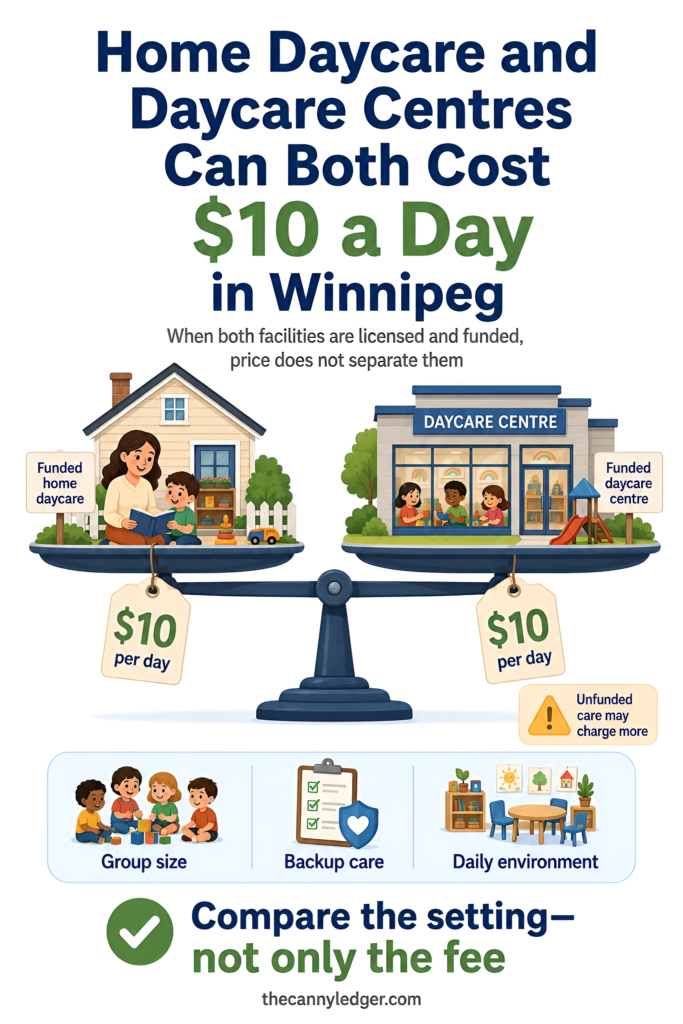
In a lot of provinces, licensed home daycare runs meaningfully cheaper than a centre, and parents choosing between the two often treat cost as the deciding factor from the start. Manitoba doesn’t work that way. The province’s regulated fee cap applies identically to funded family child care homes and funded centres alike, both capped at the same $10 a day for regular hours, which means the usual home-versus-centre cost gap simply doesn’t exist here the way it does elsewhere. If you’re comparing a licensed home provider against a licensed centre in Winnipeg and both happen to be funded facilities, the fee itself won’t tell you which one is actually the better fit.
- The Fee Cap Applies Equally to Both, So Cost Alone Won’t Decide This
- What Manitoba Actually Regulates: Family vs Group Home vs Centre
- Group Size and Ratios Are Where the Real Difference Shows Up
- The Backup Care Problem Home Daycare Carries That Centres Don’t
- Continuity of Caregiver Cuts the Other Way
- Illness Exposure and Closures
- Unlicensed Home Care Is a Different Category Entirely
- Which Actually Fits Your Family
- Common Questions
- Compare the Actual Structure, Not Just the Sticker Price
Home daycare and centre-based daycare in Winnipeg cost the same when both are funded, licensed facilities, since Manitoba’s regulated maximum fee applies equally regardless of setting. Our companion guide to daycare costs in Winnipeg covers that funded-versus-unfunded fee structure in full. The real differences that should actually drive your decision are structural: group size, staff-to-child ratios, backup care when a home provider is sick, and the kind of day-to-day environment each setting offers, all of which vary meaningfully between the two even when the price tag doesn’t.
The Fee Cap Applies Equally to Both, So Cost Alone Won’t Decide This
Manitoba’s $10-a-day fee cap applies to licensed, funded facilities broadly, and that includes both family child care homes and larger centres, without distinguishing between the two for pricing purposes. This is a genuine departure from what “home daycare” typically means cost-wise in other parts of Canada, where a home-based provider often prices below a centre specifically because their overhead is lower. In Manitoba, a funded home provider and a funded centre both land at the same regulated maximum, which means choosing home care specifically to save money only works if you’re comparing against an unfunded centre charging market rates, not against another funded option.
For context on just how much this fee structure has changed the actual cost picture, a 2017 provincial fee survey found the median full-day, full-time monthly infant fee in Winnipeg, combining both centre and regulated home care, sat around $651, with toddler and preschool fees closer to $451 a month. At $10 a day for roughly 20 working days a month, funded facilities today land closer to $200 a month, a dramatic drop from that pre-program baseline, and one more reason cost alone doesn’t meaningfully separate home from centre care anymore now that both categories moved together.
What Manitoba Actually Regulates: Family vs Group Home vs Centre
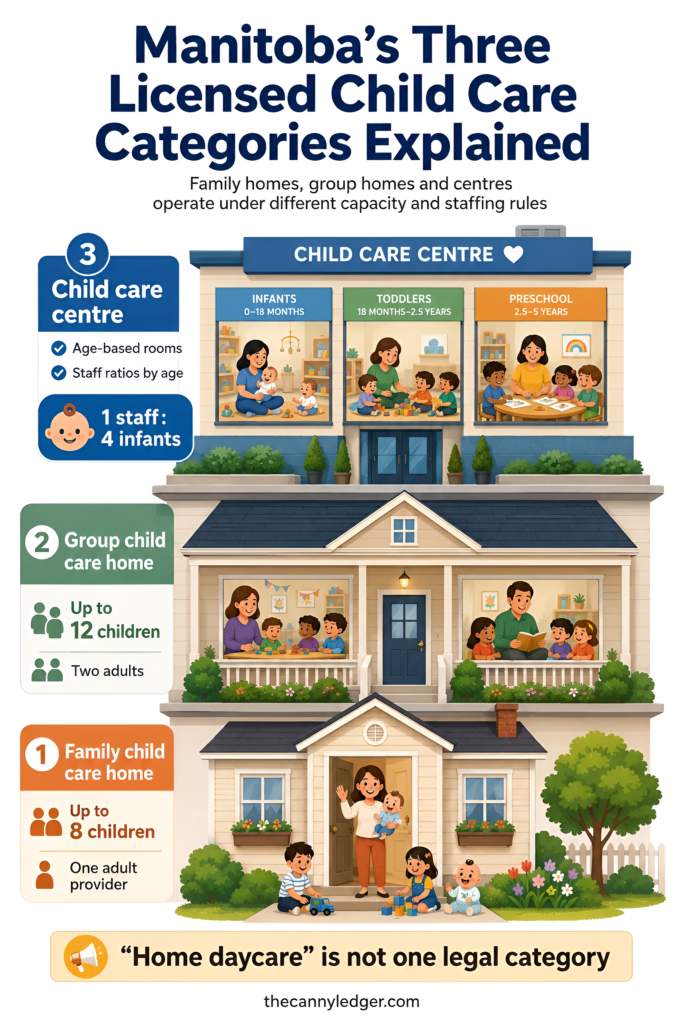
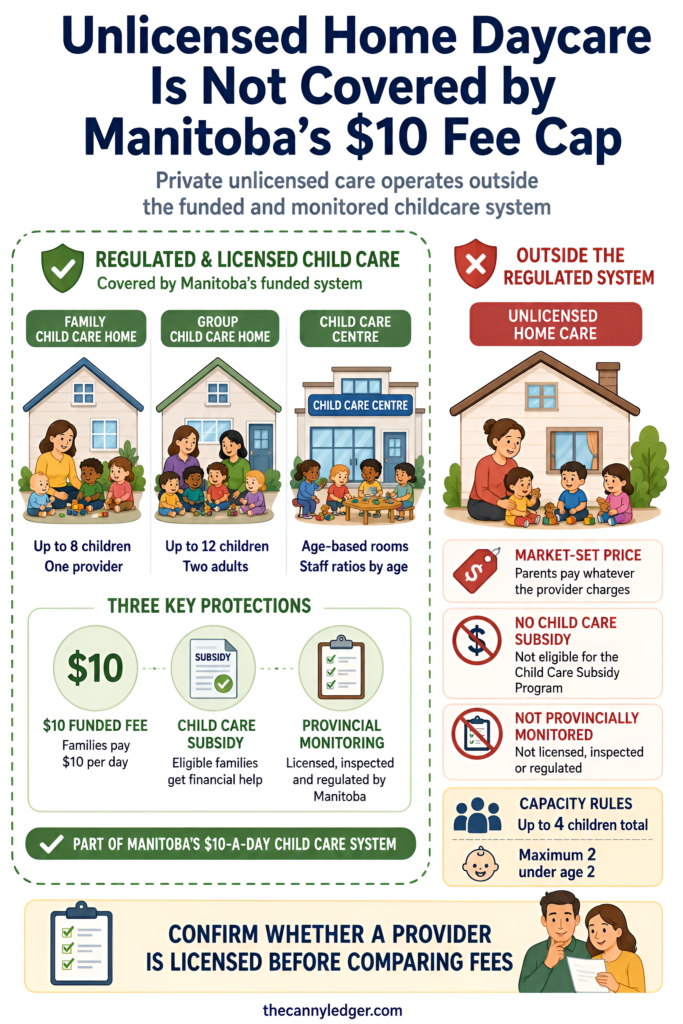
Manitoba’s Community Child Care Standards Act and its Child Care Regulation define three distinct licensed categories rather than a simple home-versus-centre binary. A family child care home cares for up to eight children under 12, including the provider’s own children, with no more than five of preschool age and no more than three infants, run by a single resident adult provider. A group child care home steps up in scale, allowing up to 12 children total, including the provider’s own, cared for by two adults, at least one of whom must live in the home, with a cap of three children under age two. Centres operate under an entirely different structure, with staff-to-child ratios and maximum group sizes set by age category, and a specific requirement that infant ratios maintain one staff member for every four infants at all times, a rule the regulations don’t allow facilities to loosen even temporarily.
Group Size and Ratios Are Where the Real Difference Shows Up
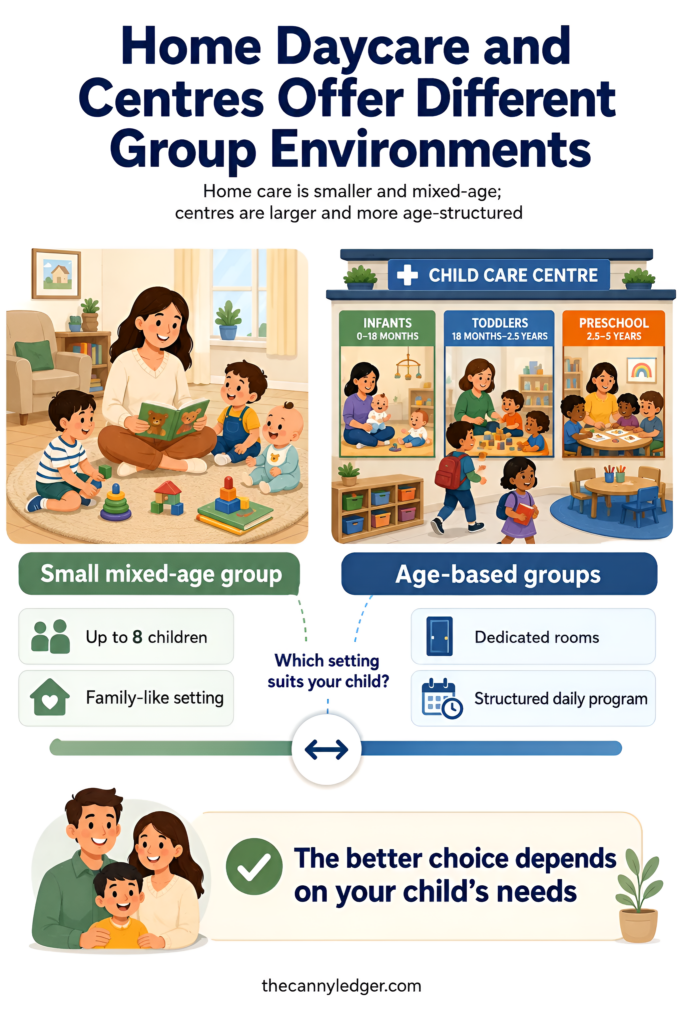
Since cost doesn’t separate the two options in Manitoba, group size and the actual adult-to-child ratio your child experiences day to day become the more meaningful comparison. A family child care home, with one provider and up to eight children spread across a genuinely wide age range, means your child spends the day in a small, mixed-age group resembling an extended family setting more than a structured classroom. A centre, by contrast, generally groups children more narrowly by age, with dedicated infant rooms, toddler rooms, and preschool rooms, each following its own specific ratio, which tends to produce a more structured, program-driven day with peers closer to your child’s own developmental stage. Neither structure is objectively better, a mixed-age home setting suits some children and families beautifully, while others benefit more from the narrower age grouping and more resource-rich physical space a larger centre can typically offer.
The Backup Care Problem Home Daycare Carries That Centres Don’t
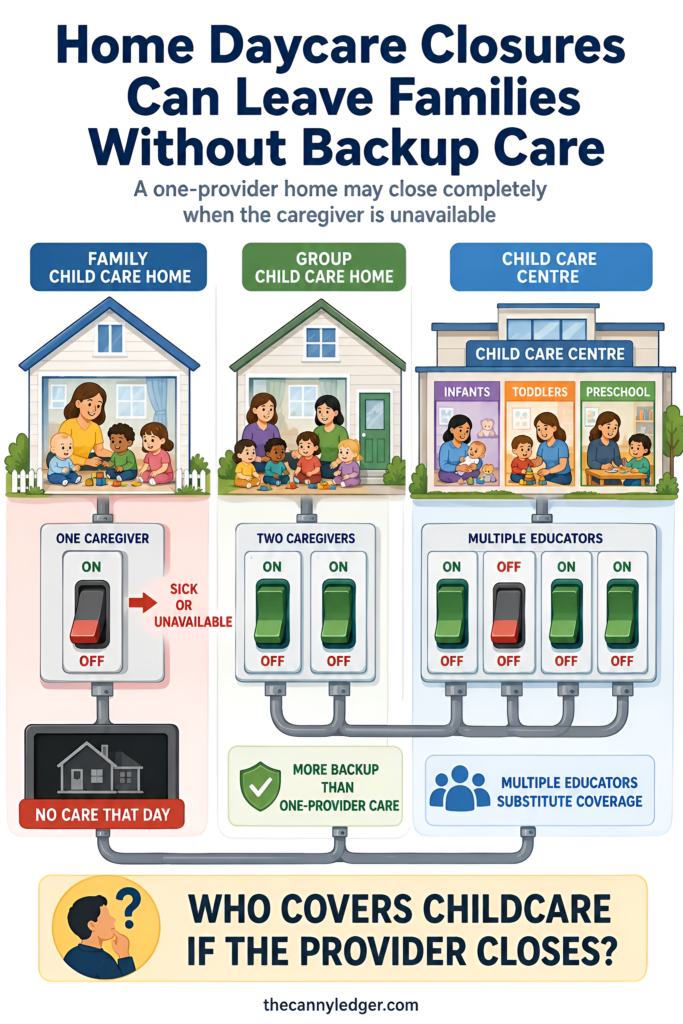
This is the single biggest practical risk home daycare carries that most families don’t fully consider until they’re already relying on it. If your child’s centre-based educator is sick, the centre still opens, since it employs multiple staff covering multiple rooms, and a substitute or another staff member fills the gap. If your child’s home daycare provider is sick, in a family child care home specifically, there’s frequently no backup at all, since the entire operation depends on that one resident adult. A single provider’s illness, family emergency, or even a personal day can mean zero care available with little notice, which matters enormously for a working parent without a flexible backup plan of their own. Group child care homes offer somewhat more resilience here, since two adults share the responsibility, but even that structure can’t match a centre’s staffing depth when something genuinely unexpected happens.
Continuity of Caregiver Cuts the Other Way
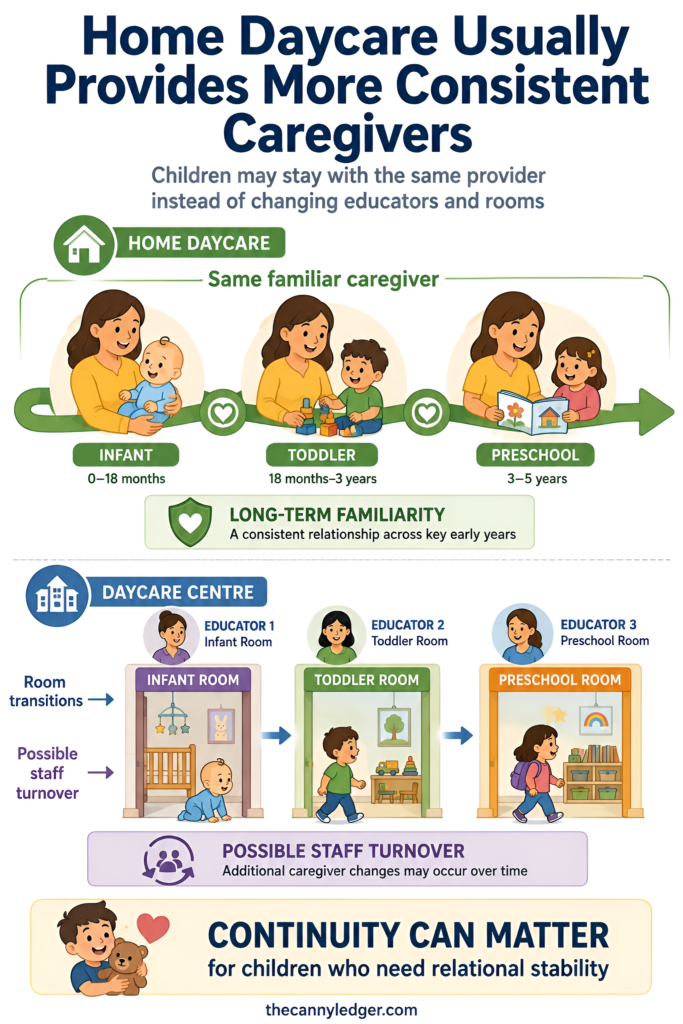
Where home daycare tends to win decisively is continuity. A child in a family child care home typically has the same one or two adults caring for them every single day for as long as they’re enrolled, building a deep, consistent relationship that doesn’t reset when staff turn over. Centres, even excellent ones, experience staff turnover and room transitions as children age from one group to the next, meaning a child might have several different primary educators over a few years of attendance. For some families, particularly those with a child who needs a lot of relational stability to feel secure, that unbroken continuity is worth more than a centre’s staffing depth, even accounting for the backup care tradeoff described above.
Illness Exposure and Closures
Smaller group sizes in a home setting generally mean less overall exposure to the rotating cold and flu circulation a larger centre naturally produces, simply because fewer children and fewer households are involved in any given day. That said, a home daycare closing entirely because the provider is sick, described above, functions as its own kind of disruption, different in kind from illness exposure but just as real a factor in whether the arrangement actually holds up over a full year of unpredictable Manitoba winters.

Unlicensed Home Care Is a Different Category Entirely
It’s worth being precise here, since “home daycare” sometimes gets used loosely to describe something outside the licensed system altogether. Manitoba permits unlicensed private home child care for up to four children total, including the provider’s own children under 12, with no more than two under age two, and the province explicitly does not monitor these arrangements the way it does licensed facilities. Unlicensed care isn’t eligible for the $10-a-day fee cap or the Child Care Subsidy Program, and it operates entirely outside the regulatory oversight, inspections, and staff training requirements that apply to licensed family, group, and centre-based care. Our guide to babysitters in Winnipeg covers this kind of informal, unlicensed arrangement in more depth, since it’s a genuinely different category from anything covered in this comparison.
Which Actually Fits Your Family
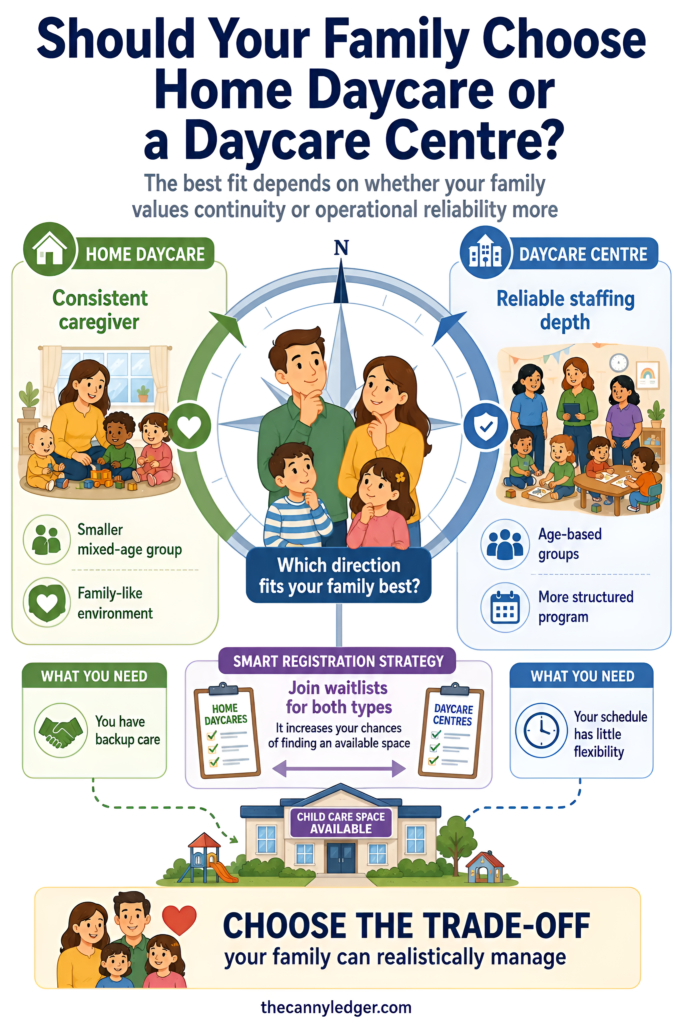
Given that cost parity removes the usual deciding factor, the real decision comes down to which structural tradeoffs your family can actually absorb. If you have flexible backup care of your own, a partner with a flexible schedule, nearby family, a home daycare’s continuity and smaller, more personal setting might be worth the real risk of a no-notice closure. If your work schedule has zero flexibility and a surprise closed day would create a genuine crisis, a centre’s staffing depth is the safer structural bet, even if it means more staff turnover over time and less of that one-on-one, family-like continuity. Our guide to daycare waitlists in Winnipeg is worth reading alongside this comparison too, since registering with both types simultaneously, rather than committing to one category exclusively, genuinely improves your odds of landing a spot before your needed start date arrives.
Common Questions
Does a group child care home count as “home daycare” or something closer to a centre? It’s legally its own category, licensed as a home but permitted a larger group size and two providers rather than one, landing structurally somewhere between a single-provider family home and a full centre.
Can I get subsidy support at a licensed home daycare the same way I could at a centre? Yes, the Child Care Subsidy Program applies to any licensed facility, home or centre, funded or unfunded, so eligibility doesn’t depend on which structural category you’ve chosen.
Is infant care handled differently between homes and centres specifically? Yes. Family child care homes cap infant enrollment at three children total within their overall group of eight, while centres maintain a strict one-to-four staff ratio for infants specifically. Our guide to infant daycare in Winnipeg covers that age category in more depth.
Compare the Actual Structure, Not Just the Sticker Price
Since Manitoba’s fee cap already levels the cost comparison between funded home and centre options, spend your actual research time on the structural tradeoffs that genuinely differ, group size, backup coverage, and continuity, rather than assuming one category is automatically the cheaper or better choice. Manitoba’s own guide to child care covers additional licensing details worth reading before choosing between settings, and our broader overview of daycare in Winnipeg rounds up the full range of care types worth considering alongside this specific comparison. Visit at least one of each type before deciding if you can, since the practical feel of a small home setting versus a larger centre environment is something no fee comparison or regulation summary can fully capture on its own.