

Basic Autopac, Manitoba’s compulsory auto insurance, combines three separate types of protection, physical damage coverage for your own vehicle, third-party liability up to $500,000, and Personal Injury Protection Plan (PIPP) benefits for anyone injured, into one mandatory policy. Your actual premium is set by four factors: where you live, how you use your vehicle, your vehicle’s make and model, and your driving record, with that last factor, the Driver Safety Rating scale, capable of swinging your bill more than any other single variable.
- What Basic Autopac Actually Covers
- When MPI Can Refuse to Pay Your Claim
- How Deductibles Actually Work
- The Eight Ways PIPP Can Pay You After an Injury
- Where You Live Changes Your Premium
- How You Use Your Vehicle Changes Your Premium
- Your Vehicle’s Make and Model Changes Your Premium
- Your Driving Record Changes Your Premium the Most
- The Optional Coverage Worth Knowing About
- Common Questions About Autopac Coverage
What Basic Autopac Actually Covers
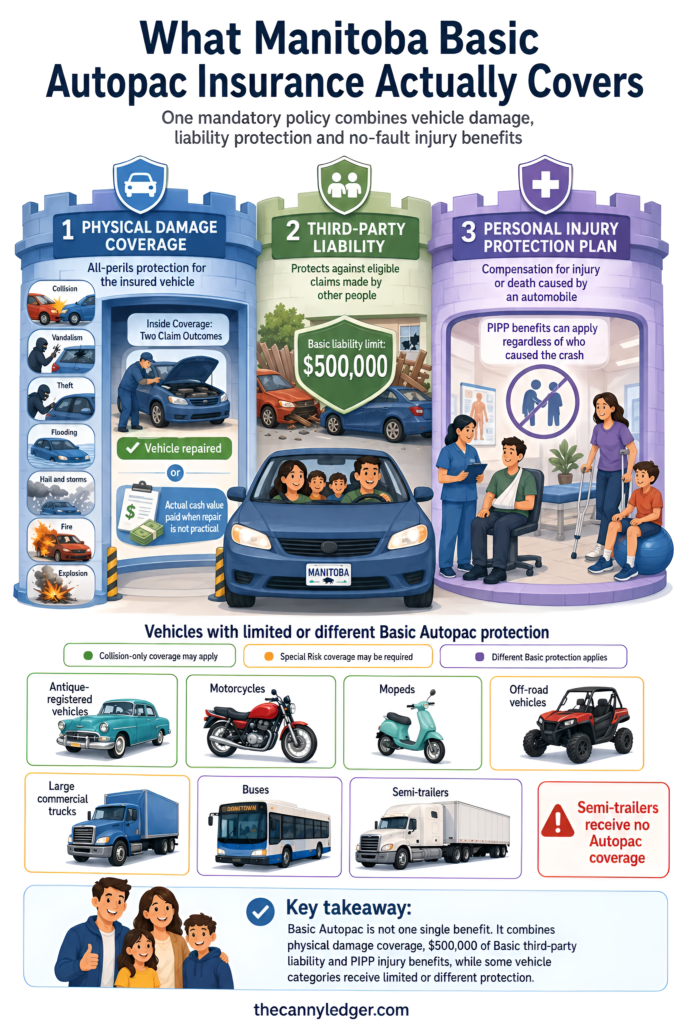
Every Basic Autopac policy bundles three distinct types of coverage into one mandatory package. Physical damage coverage, also called all-perils coverage, pays to repair your own vehicle after accidental damage, or pays its actual cash value if repair isn’t practical, covering collision, vandalism, theft, flooding, hail, storms, fire, and explosions. Third-party liability protects you against claims from other people if your vehicle injures them or damages their property, up to $500,000 for damage in Manitoba, or for injury and property damage anywhere else in Canada or the United States. Personal Injury Protection Plan, PIPP, compensates you and your passengers for injury or death caused by an automobile, regardless of who was at fault, a genuinely different approach than the fault-based lawsuit system used in most of the rest of Canada.
Not every vehicle gets full all-perils coverage under this bundle, either. Antique-registered vehicles, semi-trailers, off-road vehicles, motorcycles, mopeds, and several categories of large commercial trucks and buses are excluded from standard all-perils protection, some limited to collision-only coverage, others requiring a separate special risk application entirely. Semi-trailers specifically carry no coverage at all through Autopac, a detail worth knowing if you’re hauling anything larger than a standard trailer.
When MPI Can Refuse to Pay Your Claim
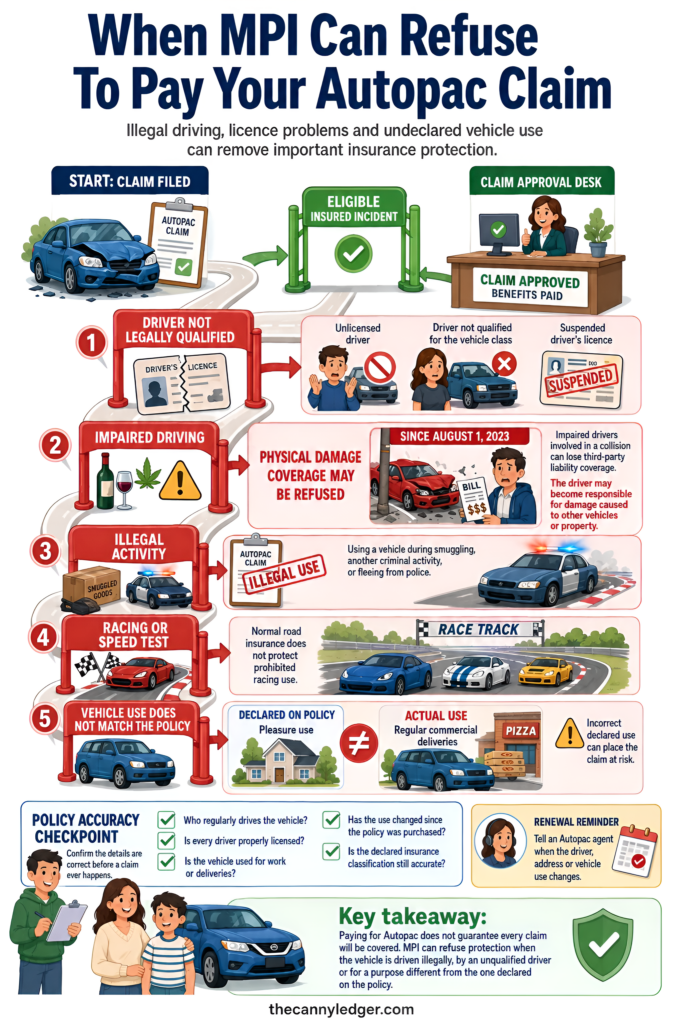
Coverage isn’t unconditional, and knowing the specific situations where MPI can legally deny a claim matters as much as knowing what’s covered in the first place. Physical damage coverage can be refused if the vehicle was being driven by someone unlicensed or unqualified, by a driver with a suspended licence, by someone impaired by drugs or alcohol, during an illegal activity like smuggling, in a speed test or race, or while fleeing police. Coverage can also be denied if the vehicle was being used differently than declared on your application, for instance, insuring a vehicle for pleasure use while actually using it for regular pizza deliveries. Since August 1, 2023, impaired drivers involved in a collision are specifically denied third-party liability coverage entirely, meaning they become personally responsible for covering damage caused to other vehicles or property, a real, direct financial consequence layered on top of any criminal penalties.
How Deductibles Actually Work
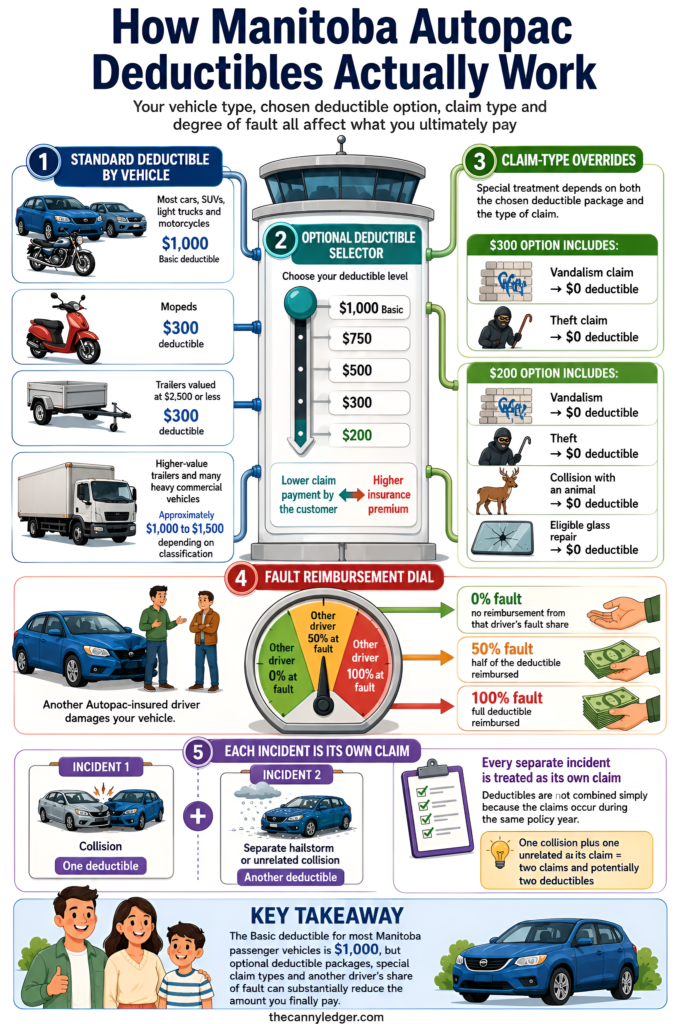
The standard Basic deductible for most cars, SUVs, light trucks, and motorcycles is $1,000, though it varies by vehicle type: trailers valued at $2,500 or less carry a $300 deductible, higher-value trailers and most heavy commercial vehicles carry $1,000 to $1,500, and mopeds sit at $300. Each separate incident counts as its own claim with its own deductible, so two unrelated collisions, or a hail claim alongside a separate collision claim, each carry a deductible independently rather than being combined into one. Autopac offers options to lower that $1,000 base deductible to $750, $500, $300, or $200, and the specific claim type changes what you actually pay at each tier: choosing the $300 option, for instance, reduces your deductible to $0 entirely for vandalism and theft claims, while the $200 option also zeroes out your deductible for a collision with an animal or a glass repair. If another Autopac-insured driver is found at fault for damaging your vehicle, MPI reimburses your deductible in proportion to their share of fault, so a driver found 100 percent at fault means you get your full deductible back.
The Eight Ways PIPP Can Pay You After an Injury

Most Manitoba drivers know PIPP exists without realizing how many distinct categories of compensation actually sit inside it. Income Replacement Indemnity replaces lost income for anyone unable to work because of their injuries, starting after a seven-day waiting period, at 90 percent of net income up to a set maximum. Medical expenses cover treatment costs not already paid by Manitoba Health, including dental, physiotherapy, chiropractic care, and prescription medication. Rehabilitation expenses fund physical and occupational therapy, plus vocational assistance for anyone who can’t return to their previous job. Personal care expenses cover the cost of hiring help with housekeeping, shopping, and daily living tasks when an injury prevents someone from managing independently, a benefit that can continue for life in serious cases. Special expenses compensate for lost unpaid caregiving, someone who cared for a child or a disabled family member without pay before their injury. Student indemnity compensates students for school terms or years they can’t complete because of their injuries. A permanent impairment payment provides a lump sum for injuries causing lasting physical or mental impairment. Finally, lump sum payments, funeral expenses, and grief counselling support spouses, common-law partners, and dependants after a fatal collision. A single injured person can qualify for benefits across several of these categories at once depending on their specific circumstances.
Where You Live Changes Your Premium

MPI divides the province into four rating territories, and which one you live in genuinely affects your premium, since claim frequency and repair costs both vary by region. Territory 1 covers Winnipeg and its immediate surrounding communities, including St. Norbert, Headingley, and East and West St. Paul. Territory 2 covers everywhere south of the 53rd parallel outside Winnipeg, including Brandon, Portage la Prairie, and Dauphin. Territory 3 covers everything north of the 55th parallel, including Thompson and Churchill, and Territory 4 fills the band between the 53rd and 55th parallels, including Flin Flon and The Pas. Anyone living in Territory 2 but commuting into Winnipeg for work or school more than four days a month has to insure specifically as a commuter, rated differently than someone who stays entirely within their home territory, and reporting an address change within 15 days of moving is a legal requirement, not just good practice, since an unreported territory change can put a future claim at risk.
How You Use Your Vehicle Changes Your Premium
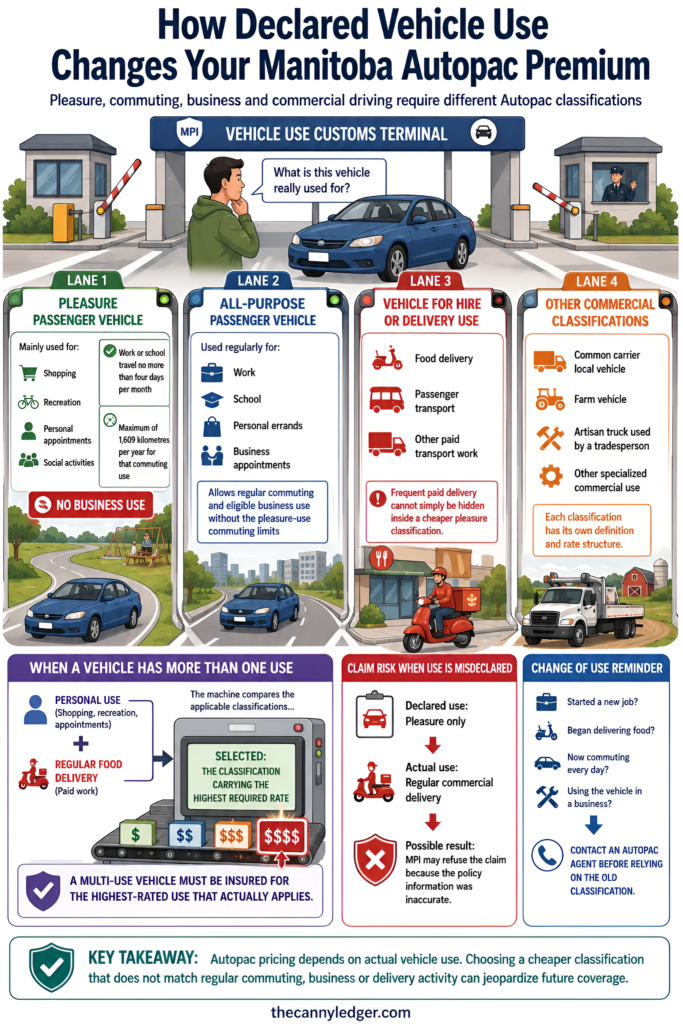
Autopac rates a vehicle based on a specific declared use category, and getting this wrong isn’t just a pricing issue, it can mean a claim gets denied entirely. A pleasure passenger vehicle can only be driven to or from work or school up to four days a month and 1,609 kilometres a year, with no business use permitted at all. An all-purpose vehicle allows both commuting and business use without those same limits. Commercial classifications get considerably more specific still, common carrier local vehicles, vehicles for hire, farm vehicles, and artisan trucks used by tradespeople all carry their own distinct definitions and rate structures. A vehicle used for more than one of these purposes has to be registered under whichever classification carries the highest rate, so a passenger vehicle used partly for food delivery under a lower-rated use, but that actually qualifies as a vehicle for hire, needs to be insured at that higher rate rather than the cheaper one.
Your Vehicle’s Make and Model Changes Your Premium
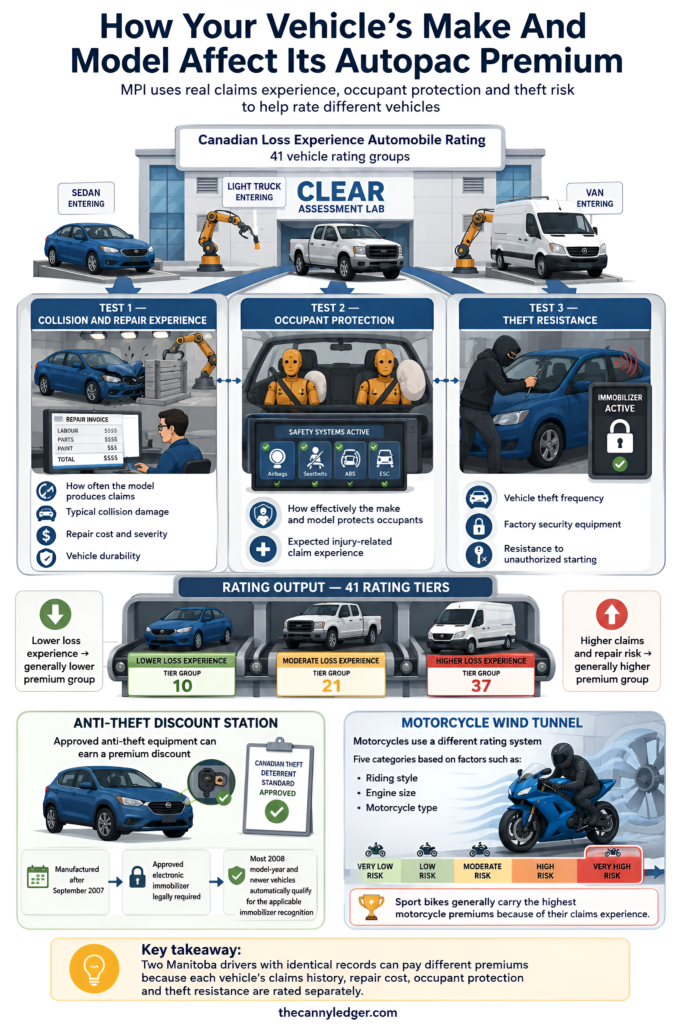
Cars, light trucks, and vans get sorted using the Canadian Loss Experience Automobile Rating (CLEAR) system, a Canada-wide framework developed by the Insurance Bureau of Canada that groups vehicles into 41 rating tiers based on real claims data, how well a specific make and model protects occupants, resists theft, and holds up in a collision. Higher rating groups mean higher premiums, and factory-installed anti-theft devices meeting the Canadian Theft Deterrent Standard automatically earn a premium discount under this system. Any vehicle manufactured after September 2007 is legally required to have an approved electronic immobilizer, so any 2008 model year or newer vehicle receives that discount automatically. Motorcycles run on a separate system entirely, sorted into five categories by riding style and engine size, with sport bikes carrying the highest premiums given their higher claims risk.
Your Driving Record Changes Your Premium the Most
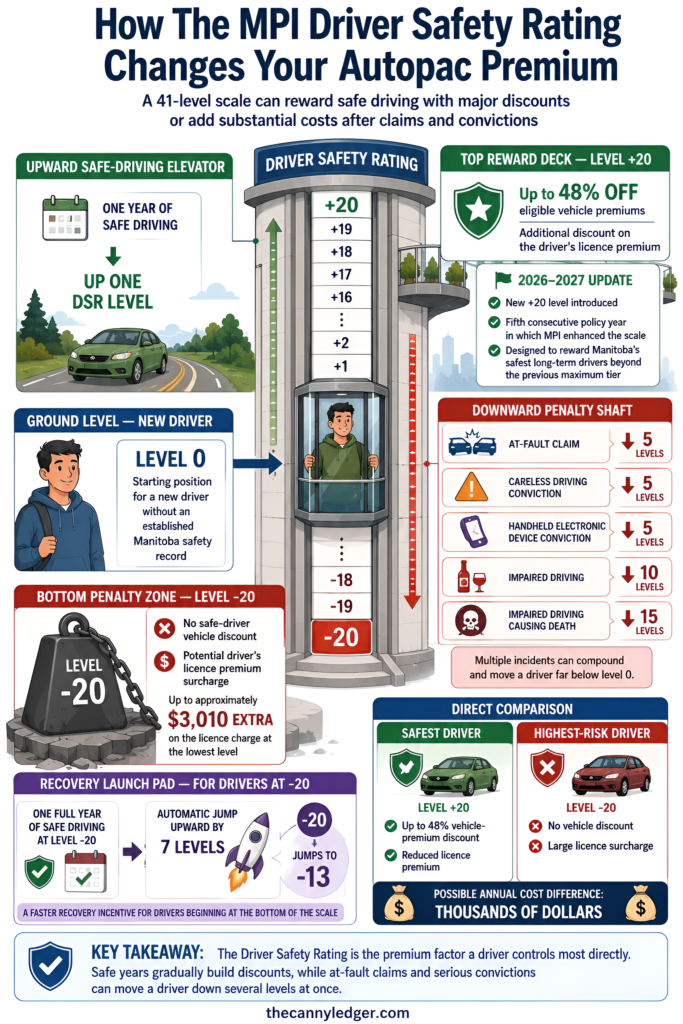
This is the single factor a driver actually controls, and it’s structured as a 41-level scale running from -20 up to +20, called the Driver Safety Rating (DSR). A brand-new Manitoba driver starts at the base level, 0, and moves up one level for each year of safe driving, unlocking savings up to 48 percent off vehicle premiums at the top of the scale, plus an additional discount on driver’s licence premiums. Moving in the other direction costs considerably more: each at-fault claim drops you five levels, a careless driving conviction or using a handheld device while driving costs five levels, impaired driving costs ten levels, and impaired driving causing death costs fifteen levels. A driver already at the bottom of the scale who commits to a full year of safe driving jumps back up seven levels at once, a meaningful incentive built directly into the system for anyone trying to recover from a rough driving history. The 2026-27 policy year marks the fifth consecutive year MPI has enhanced this scale, adding the new +20 tier specifically to reward its safest, longest-tenured drivers with savings beyond what the previous top tier offered.
The Optional Coverage Worth Knowing About
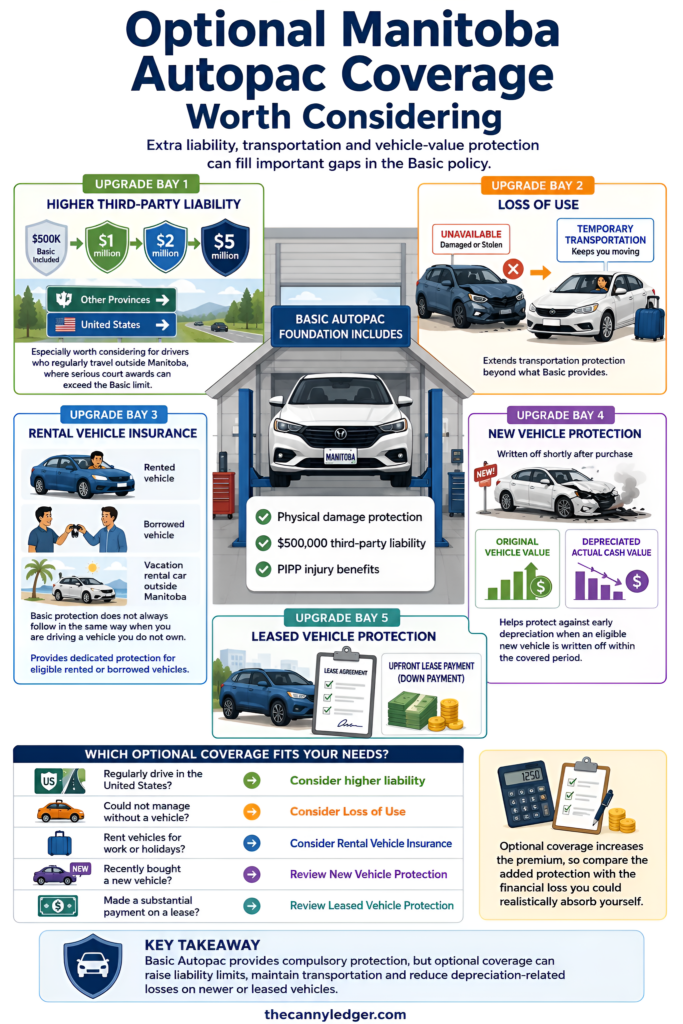
Beyond the mandatory Basic package, MPI offers a range of Autopac options for anyone wanting more protection than the minimum. Third-party liability can be increased from the Basic $500,000 up to $1 million, $2 million, or $5 million, worth genuine consideration for anyone who regularly drives outside Manitoba, since court awards in the United States and some Canadian provinces can run well beyond Basic’s standard limit. Loss of Use coverage extends the replacement transportation benefit beyond what Basic provides if your vehicle is stolen or damaged. Rental Vehicle Insurance covers a vehicle you’re renting or borrowing, essential for business or vacation travel outside Manitoba since Basic Autopac’s protection doesn’t fully extend the same way once you’re driving something you don’t own. New Vehicle Protection and Leased Vehicle Protection cover depreciation on a newer vehicle or a lease’s down payment if it’s written off within the first two years. For the practical side of actually comparing these options against real pricing, Winnipeg car insurance rates and a calculator walks through the numbers directly.
Common Questions About Autopac Coverage
Does a clean driving record guarantee the lowest possible premium? It’s the biggest single factor, but not the only one. Your Driver Safety Rating level interacts with your territory, vehicle use classification, and your specific vehicle’s CLEAR rating group, so two equally safe drivers can still pay different premiums if they live in different territories or drive very differently rated vehicles.
If I’m not at fault in a collision, does my Driver Safety Rating still drop? No, being found not at fault doesn’t move you down the scale. Your DSR is only affected by at-fault claims specifically, along with traffic convictions and impairment-related suspensions, not by collisions where fault was assigned to the other driver.
Can I lower my deductible for just one type of claim, like theft, without changing it for collisions? Not exactly, since the deductible reduction tiers apply as a package rather than being fully customizable claim by claim, though the specific dollar amount you pay does vary by claim type even within a single chosen tier, as covered in the deductible breakdown above.
For the full picture of what MPI is and how it fits into Manitoba’s broader system of driver licensing and vehicle registration, the complete guide to Manitoba Public Insurance covers that structural context. Once you understand how your own premium actually gets built, from territory to vehicle to driving record, the rest of the system, filing a claim, booking a road test, comparing rates, becomes a lot easier to navigate with real confidence rather than guesswork.

