
- What Running a Block Heater Actually Costs You
- Getting a Block Heater Installed If Your Car Doesn’t Have One
- Why Winnipeg Parking Lots Have Plug-In Posts Everywhere
- Winter Tires Are Their Own Line Item
- Heated and Indoor Parking as a Winter Cost
- Your Battery Works Harder in the Cold
- Small Costs That Add Up
- Putting Your Winter Car Budget Together
Winter car costs in Winnipeg include tires, seasonal changeovers and storage, block heater electricity, and any extra parking or maintenance your vehicle needs. The electricity can be modest: a hypothetical 600-watt heater used for three hours costs about 18 cents before tax at the residential rate effective January 1, 2026. Tires and parking need separate quotes, so that figure is not a complete winter driving budget.
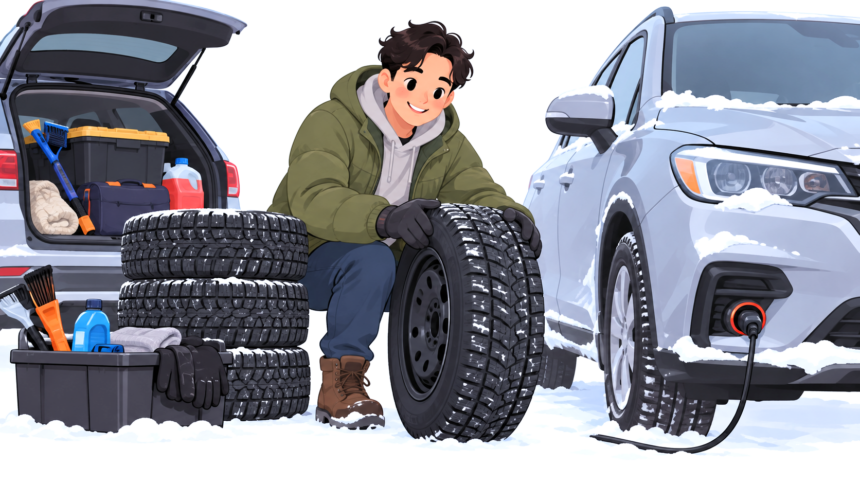
A block heater warms the engine before starting. Follow your vehicle manufacturer’s temperature and timing instructions. MPI has advised using one when temperatures drop below -15°C. Check the cord and plug before use, because cracks and corrosion can cause electrical fires.
What Running a Block Heater Actually Costs You
The standard residential electricity rate effective January 1, 2026 is 9.970 cents per kilowatt-hour. Calculate added energy cost as watts ÷ 1,000 × operating hours × $0.09970. The existing monthly basic charge is not an additional block heater expense.
For a hypothetical 600-watt heater running continuously for three hours, consumption is 1.8 kWh and cost is $0.17946, or about $17.95 over 100 uses. A 1,000-watt heater under the same assumptions costs $0.29910 per use, or $29.91 over 100 uses. These Canadian-dollar examples exclude tax and assume no cycling. The 100 uses illustrate a budget, not a forecast of how many nights Winnipeg will require plugging in.
A timer limits unnecessary operating hours. Use your heater’s rated wattage and recommended operating period to estimate your own cost. An apartment’s flat parking or plug-in charge may differ from this household-meter calculation.
Getting a Block Heater Installed If Your Car Doesn’t Have One
A vehicle bought in a milder climate may not have a block heater. Ask a qualified installer whether a compatible heater is available for your exact engine. Request an itemized Canadian-dollar quote covering the part, labour, any coolant work and tax.
Installation complexity varies, so a quote for another vehicle should not determine your budget. Confirm the manufacturer’s instructions before selecting a heater.
Why Winnipeg Parking Lots Have Plug-In Posts Everywhere
Parking-lot electrical posts let drivers power block heaters while their vehicles are parked. Before renting a space, confirm that its outlet works, that you are permitted to use it, and whether electricity is included in the parking charge.
Ask about timers or temperature-controlled power, too. An outlet’s presence does not establish that it supplies continuous electricity. If your assigned space has no power, discuss suitable cold-weather starting arrangements with your vehicle’s service provider.
Winter Tires Are Their Own Line Item
Budget separately for the tires themselves, installation, seasonal changeovers and storage. A set can serve more than one winter; its purchase price should not be described as a bill every driver pays each year.
The MPI Winter Tire Program offers eligible customers financing of up to $2,000 per vehicle at prime plus two percentage points. That is a loan with interest, not a rebate. Ask the retailer for the repayment total and any amount you must pay upfront.
Under the rules effective October 1, 2026, approved tires must carry the Three Peak Mountain Snowflake symbol and be designed and marketed solely for winter driving. All-weather, all-season, four-season and year-round tires are excluded even if they carry the symbol. Storage and switchover costs qualify only when included in the initial purchase; later standalone bills do not qualify.
Heated and Indoor Parking as a Winter Cost
Heated parking adds a recurring expense but may reduce the time you spend clearing snow and ice. Winnipeg Square offers heated underground parking. Confirm the current rate, access hours and availability directly before including a space in your budget.
Compare the extra cost against the parking you would otherwise buy. If a hypothetical heated space costs $50 more each month, using it for five months adds $250. That example is a comparison method, not a quoted Winnipeg parking rate.
Your Battery Works Harder in the Cold
A battery that struggles in mild weather may fail to start the engine in colder conditions. A pre-winter inspection should include the battery and charging system. Have a weak battery assessed before assuming that plugging in the block heater will solve the problem.
A standard engine block heater does not replace a battery charger. Keep any replacement or charging equipment separate from the block heater electricity estimate.
Small Costs That Add Up
Allow for winter-rated windshield washer fluid, an ice scraper, a suitable outdoor extension cord and a timer if needed. Buy fluid rated for the conditions you expect. Remote starters are optional purchases with their own installation costs; longer engine idling also uses fuel.
For tire storage, ask whether the quote is per season or per year, and whether tax and changeovers are included. Confirm whether storing tires at home is permitted and practical before paying for commercial storage.
Putting Your Winter Car Budget Together
What should a winter car budget include?
Separate one-time purchases from recurring bills. List tires and equipment first, then changeovers, storage, plug-in electricity and any parking premium. Add a repair allowance based on your vehicle’s condition.
Does winter equipment replace auto insurance?
No. Manitoba’s Autopac coverage remains a separate part of vehicle ownership. Your vehicle-specific insurance premium should sit alongside the winter-only expenses in an annual budget.