

Two couples can each buy a policy labelled joint life insurance and end up with products that behave nothing alike. One pays out the moment either partner dies and then disappears completely. The other pays nothing until both partners are gone, sometimes decades apart. The word joint tells you two people are covered under one contract, and nothing more than that, which is exactly why so many Canadians end up with the wrong structure for what they actually needed it to do.
- How First-to-Die Actually Pays Out
- What Happens to the Survivor After the First Death
- How Last-to-Die Actually Pays Out
- Why Canadian Couples Actually Need This for Taxes
- Why the Pricing Runs in Opposite Directions
- The Divorce and Separation Problem Nobody Brings Up at the Sales Table
- Taxes on the Death Benefit Itself
- Choosing Between the Two Without Guessing
- What Happens If Your Insurer Fails
- Mistakes Worth Avoiding Before You Sign
- Common Questions About Joint Life Insurance in Canada
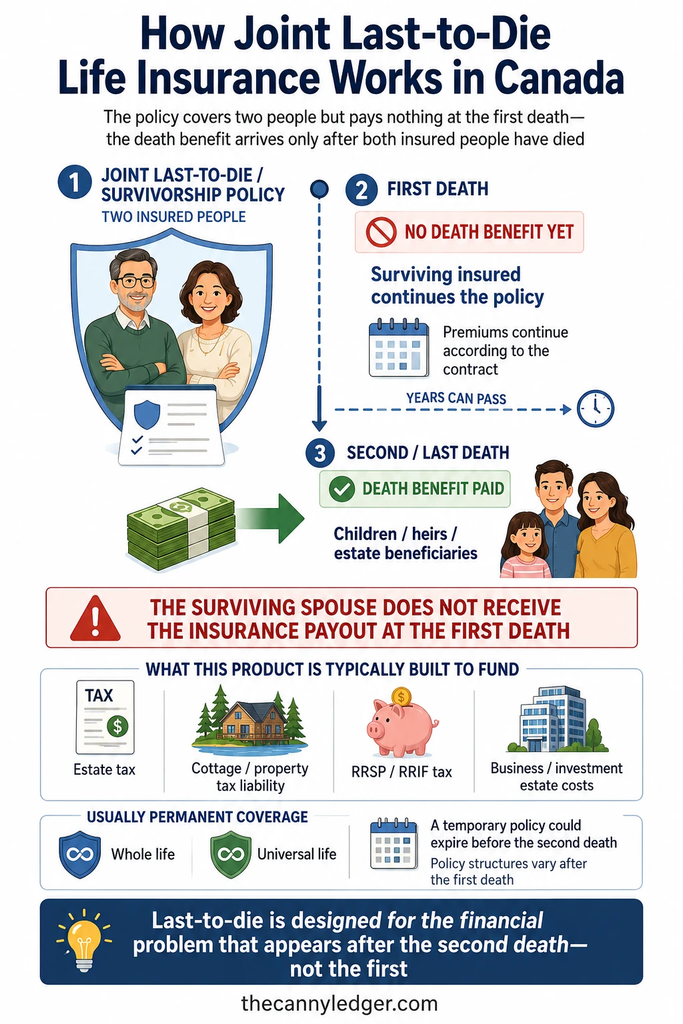
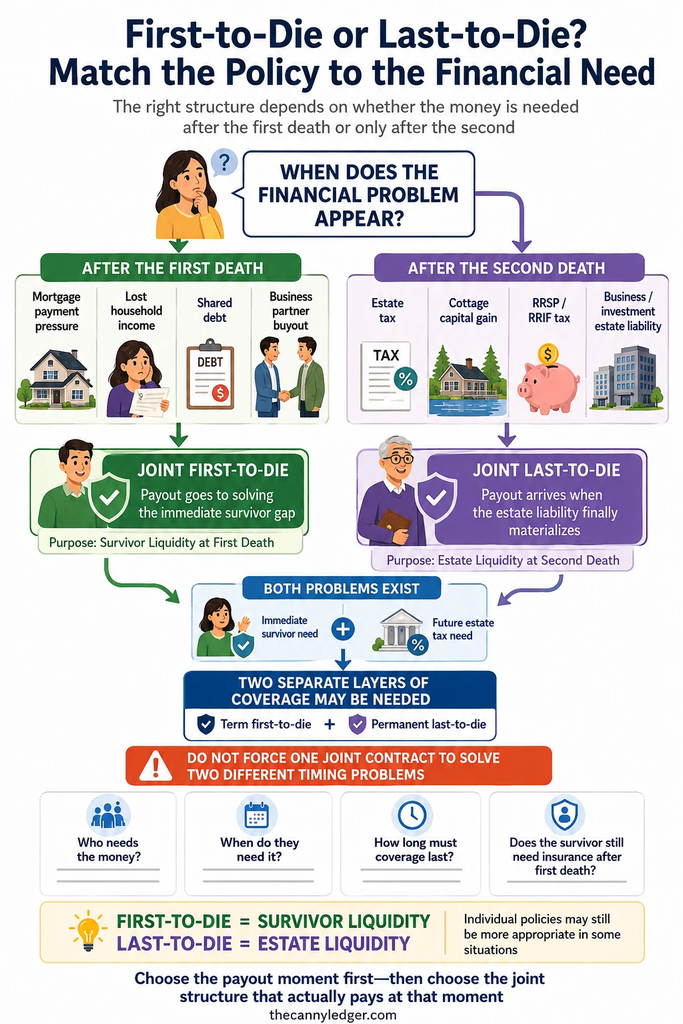
Joint life insurance in Canada covers two people under a single contract instead of two separate policies, one of several structures worth understanding alongside the broader types of life insurance available in Canada, and it comes in two structures that pay out at opposite moments for opposite reasons. First-to-die coverage pays a death benefit the moment either insured person dies, then ends. Last-to-die coverage, also called survivorship insurance, pays nothing until both insured people have died, often used to fund taxes owed by an estate rather than to support a surviving partner day to day.
How First-to-Die Actually Pays Out
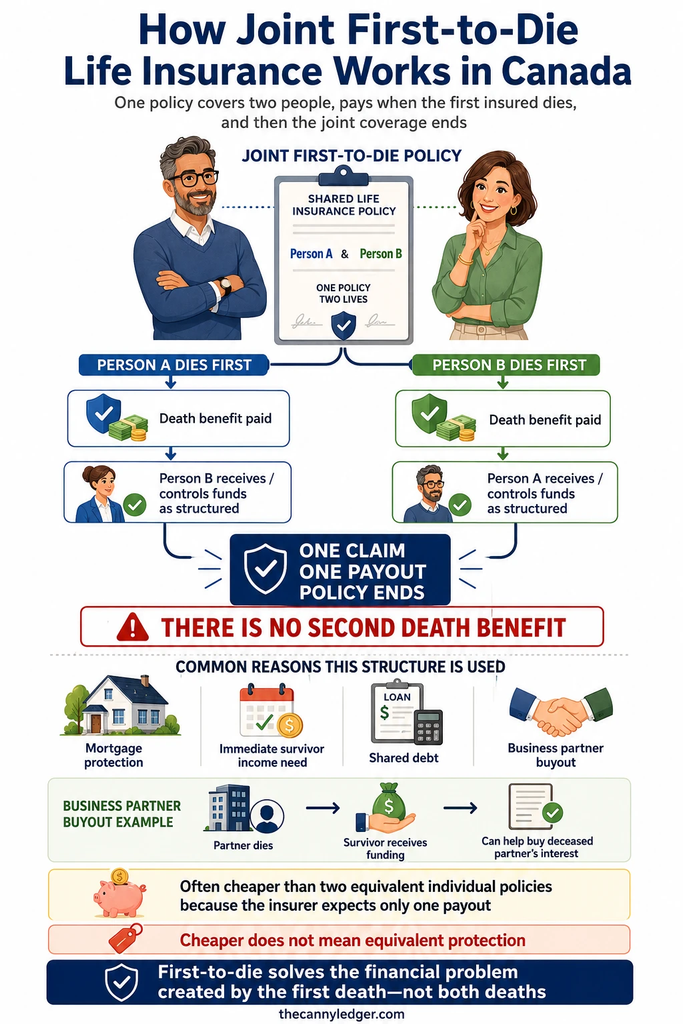
The mechanics of first-to-die insurance are straightforward once you separate them from last-to-die, and the confusion mostly comes from people assuming both structures work the same way with just a different name attached. Sun Life’s own description of joint life insurance confirms the first-to-die structure pays out the death benefit when the first person covered by the policy dies, with the surviving partner receiving that lump sum and the policy then ending entirely. There’s no second payout waiting in the wings, and no coverage remaining for the survivor once that claim is settled.
This structure fits situations where the surviving partner needs an immediate cash injection to keep functioning financially, which is why it shows up so often attached to a mortgage, a young family’s income replacement need, or a small business partnership. If two business partners each guarantee a loan or hold shares the other would need to buy out, a joint first-to-die policy funds exactly that scenario, paying whichever partner survives enough money to settle the departed partner’s stake without draining the business’s own cash reserves. Two individual policies could accomplish the same goal, but a joint policy covering both partners under one contract is often cheaper than buying two full policies separately, since the insurer only ever expects to pay out once.
What Happens to the Survivor After the First Death
This is the part of first-to-die coverage that gets glossed over in most sales conversations, and it matters more than almost anything else about the product. Once the death benefit pays out, the surviving partner has no life insurance coverage left under that policy, full stop, and if they still need protection, whether for dependents, a remaining mortgage balance, or simply peace of mind, they have to apply for an entirely new policy at whatever age and health status they happen to be at that point.
Some insurers soften this gap with a conversion or survivor privilege built into the original contract, and it’s worth confirming whether yours has one before assuming you’re covered either way. Foresters’ own term insurance documentation spells out a concrete version of this feature, confirming that a surviving insured person may exercise a conversion privilege within 60 days of the first death to move into a new policy without providing evidence of insurability, provided the joint policy is converted before the policy anniversary nearest the older insured person’s 71st birthday. Sun Life structures a similar protection differently on some of its permanent joint products, where policy documentation describes an automatic survivor death benefit that can pay an additional amount if the surviving insured person dies before a set policy anniversary, without requiring the survivor to reapply at all. Neither feature is universal across every joint first-to-die product sold in Canada, which makes checking your specific policy wording, rather than assuming a generic industry standard applies, a worthwhile five minutes.

How Last-to-Die Actually Pays Out
Last-to-die insurance flips the entire premise. Canada Life describes its version of this product paying out only after both policyholders have passed away, with the surviving partner required to keep paying premiums after the first death to maintain coverage that will eventually pay their own beneficiaries, not themselves. Nobody who was actually insured under the policy ever receives the payout personally, since by definition the last living insured person has also died by the time it triggers.
That structure sounds counterintuitive until you see what it’s actually built to solve. Because last-to-die coverage is designed to fund whatever tax bill or estate expense shows up after the second spouse’s death, it’s almost always sold as permanent coverage, whole life or universal life, rather than term, since a term policy that expired before the second death would have solved nothing. Couples buy this specifically to make sure their children or other heirs aren’t forced to sell a cottage, liquidate an investment portfolio at a bad time, or drain an inheritance to cover a tax bill the estate itself doesn’t have the cash to pay.
Why Canadian Couples Actually Need This for Taxes
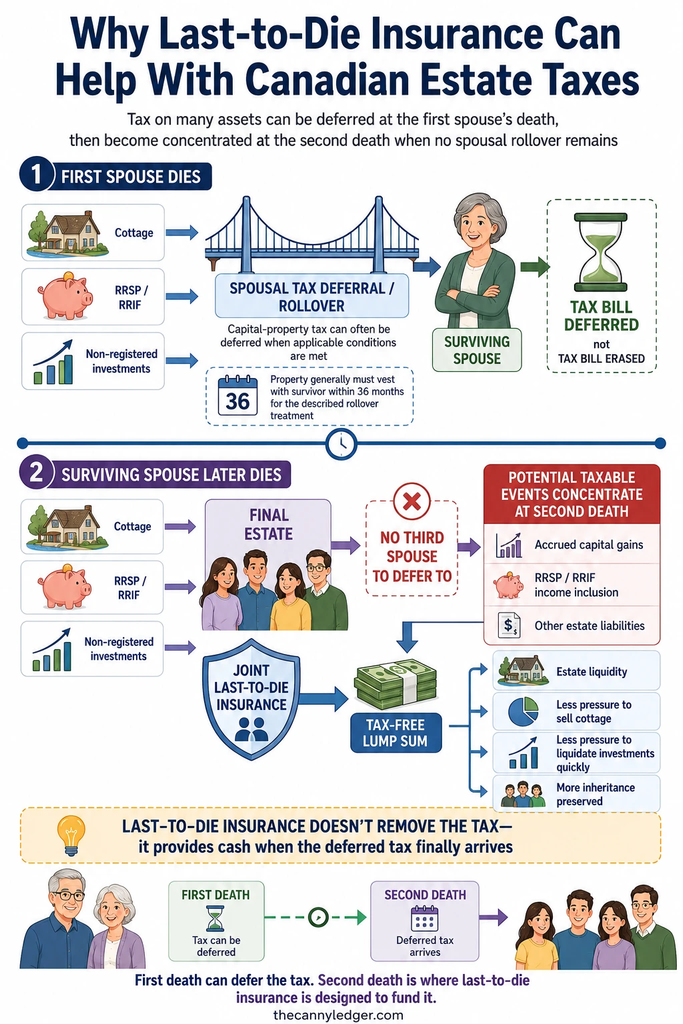
The reason last-to-die insurance exists as a distinct Canadian product, rather than just being a curiosity, comes down to how this country taxes a married or common-law couple’s assets at death. When one spouse dies, the Canada Revenue Agency generally allows capital property to transfer to the surviving spouse on a tax-deferred basis, meaning the capital gain or loss on that property is postponed rather than triggered immediately. The property must vest with the survivor within 36 months of the first death for that deferral to apply, and once it does, no tax bill shows up on the first spouse’s final return for that asset.
That deferral is useful in the moment, but it means the tax bill hasn’t disappeared, it’s been pushed entirely onto the second death instead. A cottage that’s appreciated by hundreds of thousands of dollars, an RRSP or RRIF that’s never been taxed, and a portfolio of non-registered investments all get taxed at once when the surviving spouse eventually dies, since there’s no third spouse left to roll the property over to. This is precisely the moment last-to-die insurance is built to fund, delivering a tax-free lump sum at exactly the point the estate needs cash the most and has no further deferral option left to lean on.
Why the Pricing Runs in Opposite Directions
First-to-die and last-to-die policies price against completely different actuarial assumptions, and understanding why explains a lot about which one ends up cheaper for a given couple. A first-to-die policy has to price in the possibility that either partner could die first, which means the insurer is effectively betting on whichever death comes sooner between two lives, a statistically earlier event than either individual death alone. Combined premiums for joint first-to-die coverage typically land below the cost of buying two full individual policies for the same face amount, since only one payout will ever happen, though the savings compared to insuring just the healthier or younger partner alone are more modest than people expect, since the policy still has to account for the less favourable of the two health profiles.
Last-to-die pricing runs the opposite way. Because the insurer only pays out once both people have died, and two people together statistically outlive either one of them individually, the insurer’s expected payout date sits further in the future than it would for either partner’s own individual policy. That deferred timeline is exactly why last-to-die coverage often costs meaningfully less than two separate permanent policies covering the same combined amount, even though the total protection on paper looks similar. Couples specifically shopping for estate tax funding, rather than survivor income protection, tend to find last-to-die delivers more coverage per premium dollar than any other structure available to them.

The Divorce and Separation Problem Nobody Brings Up at the Sales Table
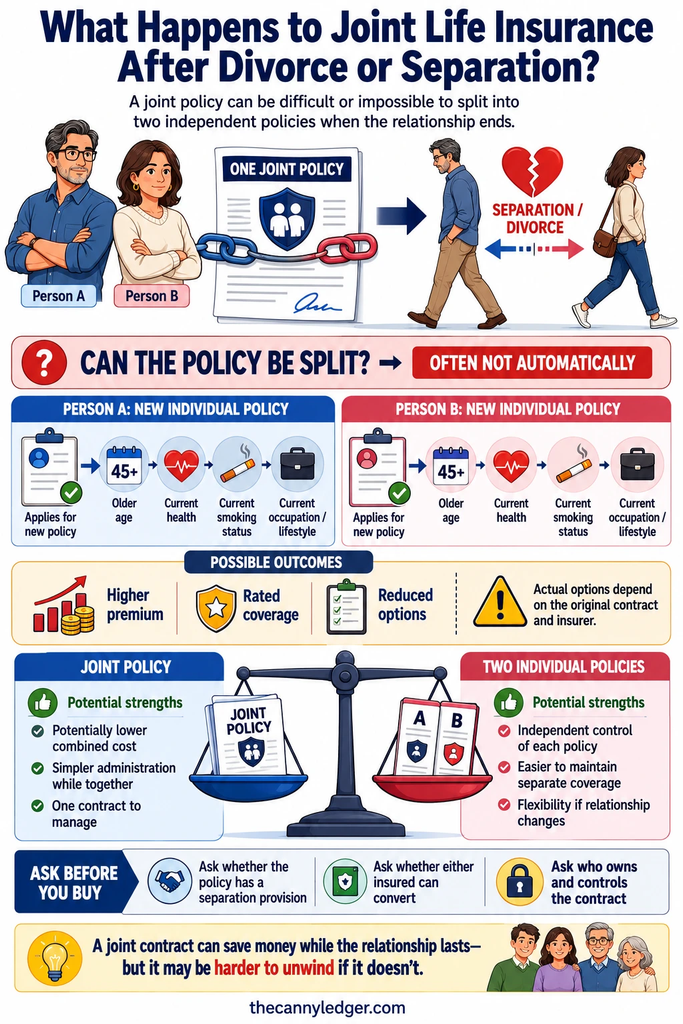
Joint policies of either kind share a structural weakness that almost never comes up until it’s relevant, and by then it’s often too late to do much about it cheaply. If a couple separates or divorces after buying a joint first-to-die or last-to-die policy, splitting that single contract back into two individual policies isn’t a simple administrative request, and in many cases isn’t something the insurer offers at all. Each partner typically has to apply fresh for their own new coverage, medically underwritten at whatever age and health status they’ve reached by the time of the split, which can mean paying considerably more than they would have if they’d started with two individual policies from day one.
This isn’t a reason to avoid joint coverage outright, since plenty of couples stay together for the full term or the full remainder of both lives and never encounter the problem. It’s a reason to treat the decision the same way you’d treat any other financial product tied to a relationship’s permanence, weighing the upfront savings against the cost of unwinding it if circumstances change, rather than assuming the lower combined premium is a pure win with no downside attached.
Taxes on the Death Benefit Itself
Regardless of which structure you choose, the death benefit follows the same rule that governs every life insurance payout in Canada. It reaches the named beneficiary tax-free, whether that’s a surviving partner collecting on a first-to-die policy or a group of adult children collecting on a last-to-die policy meant to cover their parents’ final tax bill. The distinct tax planning value in last-to-die coverage comes entirely from timing the payout to match a known future tax liability, not from any special tax treatment the death benefit itself receives beyond what applies to every other Canadian life insurance policy.
This distinction matters most for anyone comparing joint coverage against buying a policy on just one spouse, since the tax-free treatment applies identically either way. What changes is timing and purpose, not the tax bill on the payout itself, which means the decision between joint and individual coverage should rest on the actual financial gap you’re closing rather than any perceived tax advantage unique to insuring two lives under one contract.

Choosing Between the Two Without Guessing
The decision comes down to what problem you’re solving, not which product sounds more comprehensive because it covers two lives at once. If the concern is a surviving partner’s ability to cover a mortgage, replace lost income, or keep a household running the month after a death, first-to-die coverage answers that need directly, since it puts money in the survivor’s hands exactly when the gap in household finances opens up. Business partners insuring each other against the cost of buying out a deceased partner’s share are almost always better served by first-to-die as well, since the entire purpose is funding that single, immediate transaction.
If the concern is instead a future tax bill your estate will owe, whether tied to a cottage, a business, an RRSP, or a large non-registered portfolio, last-to-die coverage is built specifically for that job in a way first-to-die simply isn’t designed to handle, since first-to-die coverage ends at exactly the wrong moment for estate tax planning, well before the tax liability it would need to fund ever materializes. Couples juggling both needs at once, an immediate survivor gap and a longer-term estate tax concern, often end up owning both a term first-to-die policy for the near-term risk and a separate permanent last-to-die policy for the eventual estate bill, rather than trying to force one joint contract to solve two very different problems.
What Happens If Your Insurer Fails
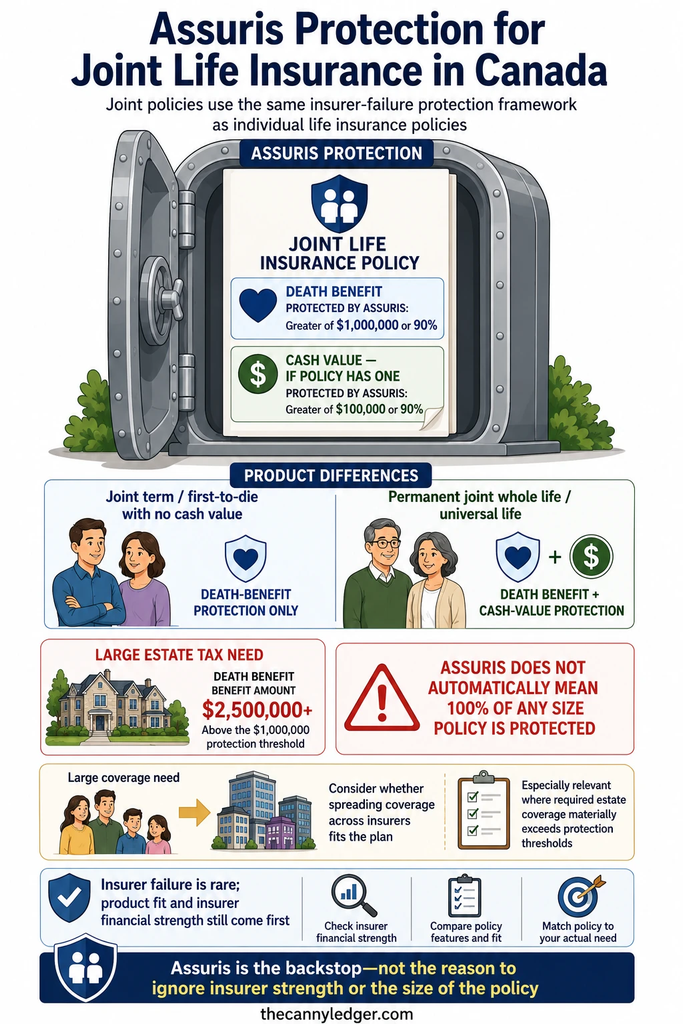
The same Assuris protection framework that applies across the Canadian life insurance industry covers joint policies without any special carve-out for the fact that two lives sit under one contract. If a member insurer became insolvent, policyholders would retain the greater of one million dollars or 90 percent of the death benefit, and the greater of one hundred thousand dollars or 90 percent of any cash value, the same thresholds that apply to an individual whole life or universal life policy. For most joint policies bought for mortgage protection or moderate estate planning purposes, those limits comfortably cover the full coverage amount.
Where it’s worth paying closer attention is a large last-to-die policy sized specifically to cover a substantial estate tax bill, since a couple with a valuable cottage, a large RRIF, or significant non-registered holdings could reasonably need coverage well above either threshold. In that situation, the same logic that applies to any large permanent policy applies here too, spreading coverage across more than one insurer becomes a reasonable way to keep the full amount protected rather than assuming Assuris automatically covers whatever total the estate plan calls for.
Mistakes Worth Avoiding Before You Sign
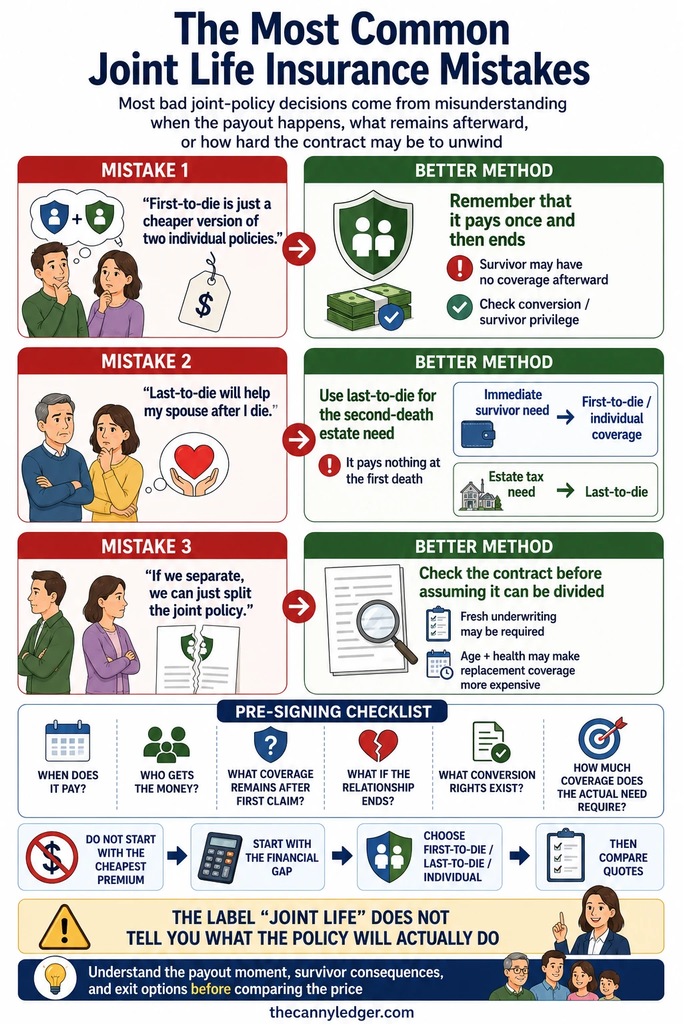
The single most common mistake is buying a joint first-to-die policy under the impression it’s simply a cheaper version of two individual term policies, without registering that the survivor’s coverage disappears entirely at the first claim. A couple who bought first-to-die coverage in their thirties, assuming it would carry them through retirement, can find themselves in their sixties with one partner suddenly uninsured and facing full medical underwriting at an age and health status that makes new coverage expensive or unavailable, precisely the outcome a conversion privilege or automatic survivor benefit is meant to prevent.
A second mistake runs in the opposite direction, buying last-to-die coverage as a stand-in for near-term protection needs it was never built to serve. Because nothing pays out until both insured people have died, a surviving spouse counting on a last-to-die policy to cover living expenses or a remaining mortgage after the first death will find the policy offers nothing at that moment, since its entire design assumes the survivor doesn’t need the money until they’re gone too. A third mistake is skipping the conversation about what happens if the relationship ends, since assuming a joint policy will simply follow whichever way a marriage or partnership goes is exactly the assumption that leaves people scrambling for new, more expensive coverage after a separation nobody planned for at the time of purchase.
If you’re weighing joint coverage right now, the practical next step is matching the structure to the specific financial gap you’re trying to close, a mortgage or income gap points toward first-to-die, an estate tax bill points toward last-to-die, and working out how much coverage the underlying need actually requires before comparing quotes, rather than starting from a premium number and working backward into whichever structure happens to be cheapest.
Common Questions About Joint Life Insurance in Canada
Can a joint policy be split into two individual policies later? Rarely as a simple administrative change. Most insurers require each person to apply fresh for individual coverage, which means new medical underwriting at whatever age and health status applies at the time, so splitting a joint policy after years of coverage can end up costing considerably more than either partner expected.
Is joint life insurance always cheaper than buying two separate policies? Usually, but not by as much as people assume, and the savings differ sharply between the two structures. First-to-die pricing reflects the earlier of two possible deaths, while last-to-die pricing benefits from the later of two deaths, which is why last-to-die often shows the larger relative savings compared to buying separate coverage.
Do business partners typically use first-to-die or last-to-die coverage? First-to-die, almost exclusively, since a buy-sell agreement between business partners needs funding the moment either partner dies, not decades later when both have passed, which is exactly the gap last-to-die coverage would leave unfilled.