

The actual barrier to getting help as a newcomer in Winnipeg usually isn’t a shortage of organizations, it’s the opposite. Somewhere north of seventy settlement service providers operate across Manitoba, and almost nobody arrives with a map of which one handles which problem. Ask five different newcomers where they got their first real help and you’ll often get five different answers, not because four of them found the wrong place, but because this sector genuinely has that many legitimate entry points, each with its own address, its own intake process, and its own narrow specialty. This directory exists to cut through that specific kind of overwhelm, organized by what you actually need rather than by an alphabetical list of names that mean nothing until you already know the sector.
- How This Directory Is Organized
- Settlement and Orientation
- Employment and Career Development
- Language Training
- Skills, Business, and Tech Training
- Immigration and Legal Help
- Housing Essentials
- Food Security
- Support for Women and Families
- Health Access
- Rural and Regional Manitoba
- MANSO: The Directory Behind This Directory
- Common Questions
- Start With One Call, Not a Research Project
New immigrant services in Winnipeg span settlement orientation, employment support, language training, legal and immigration help, housing assistance, food security, and services targeted at women, families, and specific communities, delivered through a network of free and low-cost organizations. Manitoba Start and the Immigrant Centre serve as the two broadest entry points, with more specialized organizations handling everything else.
How This Directory Is Organized
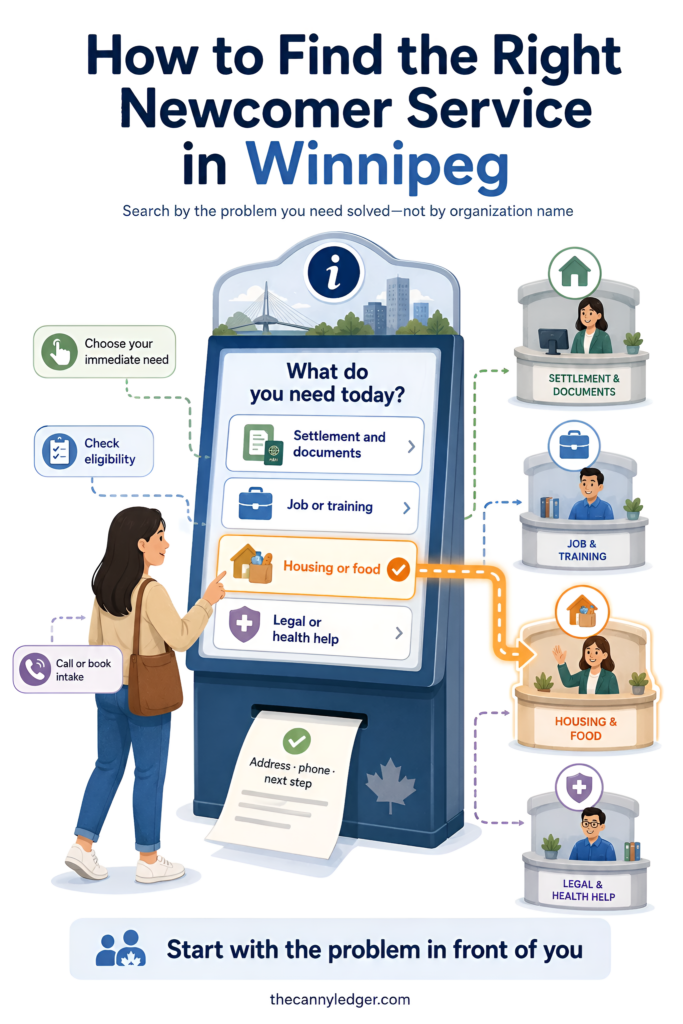
Rather than one long alphabetical list, this covers Winnipeg’s newcomer services by the actual problem they solve, since that’s the order most people search in anyway, a person doesn’t wake up wanting “an immigrant-serving organization,” they wake up needing a health card, a job, or a bed to sleep on. Several categories below link out to a full, dedicated breakdown we’ve already published, since a single paragraph here couldn’t do topics like credential recognition or free English classes real justice, those deserve the depth they got elsewhere on this site. Where no dedicated post exists yet, the section below stands as the complete answer on its own, addresses, phone numbers, and eligibility notes included rather than a vague pointer to “look it up.” The goal throughout is that you should be able to read one section, close the article, and actually make a phone call, not bookmark this page for later research that never happens.
Settlement and Orientation
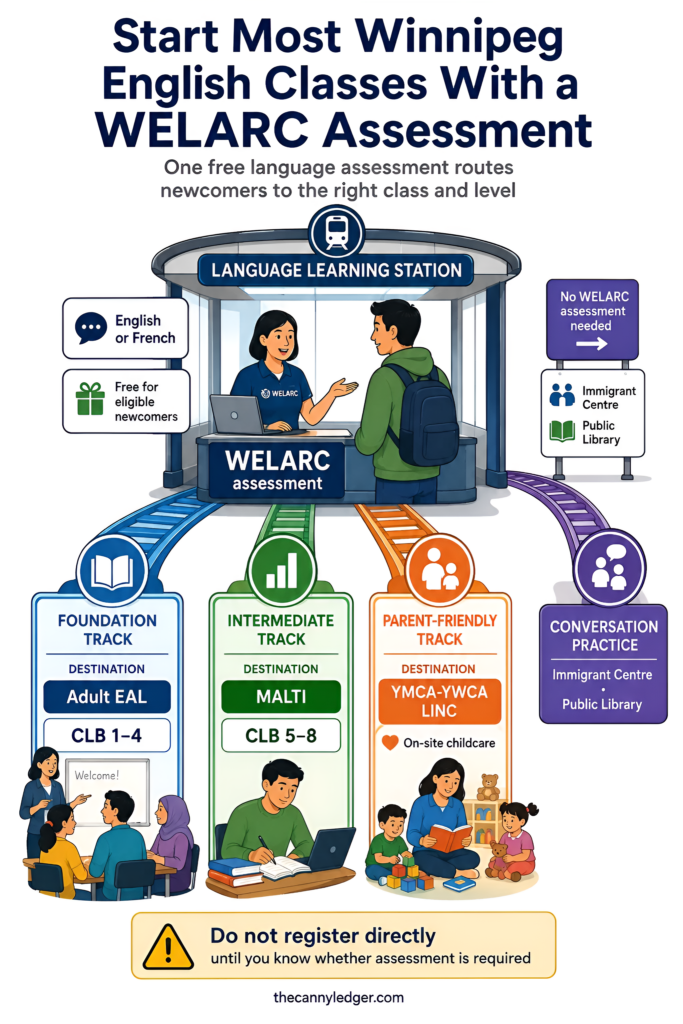
This is where almost every newcomer’s Winnipeg experience should start, regardless of what specific need brought you to this page, because the organizations here are built to sort you into everything else rather than to solve one narrow problem. Manitoba Start functions as the central intake point for the city, running a Needs and Assets Assessment and Referral Services appointment that typically takes an hour to ninety minutes and covers your background, your goals, and what barriers you’re actually facing, then routes you into whichever more specialized services fit. It’s free, open to permanent residents, provincial nominees, refugees, and most temporary residents on valid work or study permits, and it also happens to be the referral gateway into programs like SEED Winnipeg’s credential recognition loans that you can’t access by walking in cold.
The Immigrant Centre runs a similarly broad settlement program out of its main office at 100 Adelaide Street, alongside employment help specifically built for beginners in English, nutrition classes that most newcomers never expect a settlement agency to offer, and document services like translation verification and notarization. Its Settlement Facilitators cover the genuinely practical first-steps material, housing, banking, transportation, and Manitoba law, and they can walk you through application forms for a Social Insurance Number, the Manitoba Health Card, and provincial benefits like Rent Assist, without charging a cent for any of it.
Welcome Place, run by the Manitoba Interfaith Immigration Council, occupies a narrower but deeper lane, focusing specifically on refugees and refugee claimants rather than newcomers broadly. Its advisors work in more than twenty languages and handle settlement needs alongside paralegal support for people actively navigating a refugee claim, a combination general settlement agencies don’t typically offer under one roof. Our newcomer’s guide to Winnipeg walks through what to actually do in your first weeks using these three organizations in sequence, and our full profile of the Immigrant Centre breaks down that specific organization’s entire service list, hours, and eligibility in far more depth than fits in this overview.
Employment and Career Development
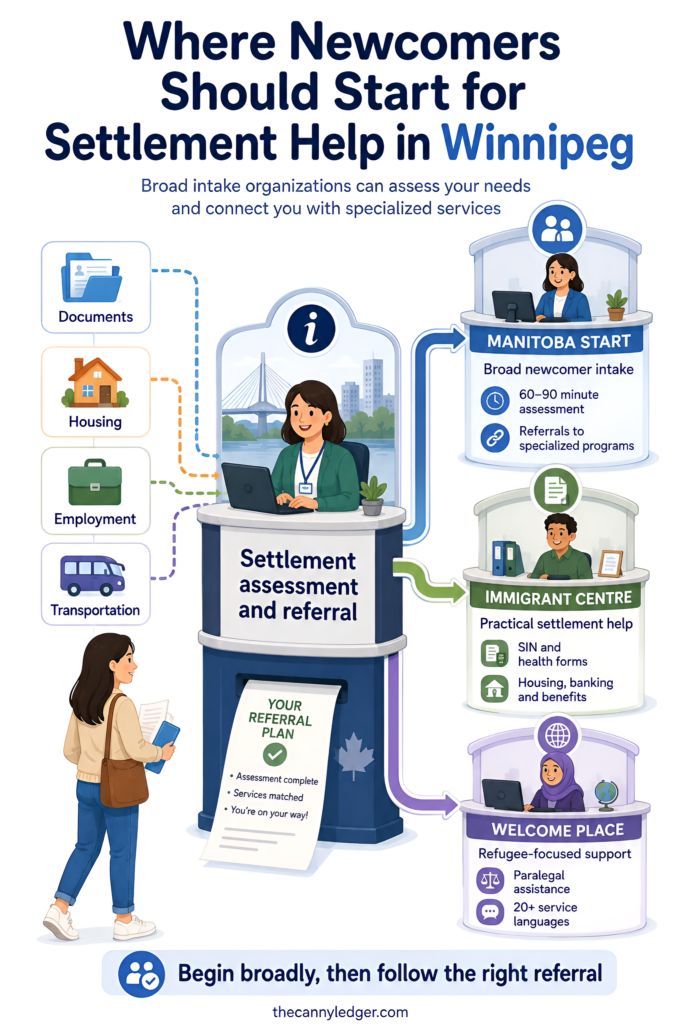
Finding work runs through a genuinely different set of organizations depending on whether you’re aiming for entry-level employment quickly or trying to get back into a profession you practiced before immigrating, and mixing those two paths up is one of the most common ways a job search stalls out in the first few months. Manitoba Start’s Career Services work with newcomers across the board, from international students to skilled tradespeople, matching you with a certified Career Coach who builds a plan around your actual background rather than a generic template. The Immigrant Centre’s employment program takes a narrower, faster-moving approach aimed specifically at newcomers with beginner to intermediate English, publishing real wait times of a week or less for most permanent residents and pointing most clients toward entry-level work within about ninety days.
For professionals whose credentials came from outside Canada, Success Skills Centre and SEED Winnipeg’s Recognition Counts program serve a meaningfully different function. Success Skills Centre acts as a broker between you and the specific testing, credential assessment, and networking steps your regulated or unregulated field requires, while Recognition Counts pairs career coaching with an actual loan, up to $30,000 through Assiniboine Credit Union, earmarked for licensing exams, bridging courses, and living expenses while you requalify. Neither of these is something you can access by walking in on your own, both route through a referral partner, most often Manitoba Start for people who’ve been in Canada under three years. Our guides to jobs for new immigrants in Winnipeg and career counselling for newcomers in Winnipeg cover this entire landscape in full, including exactly which organization fits which career stage and how the referral chain between them actually works in practice.
Language Training
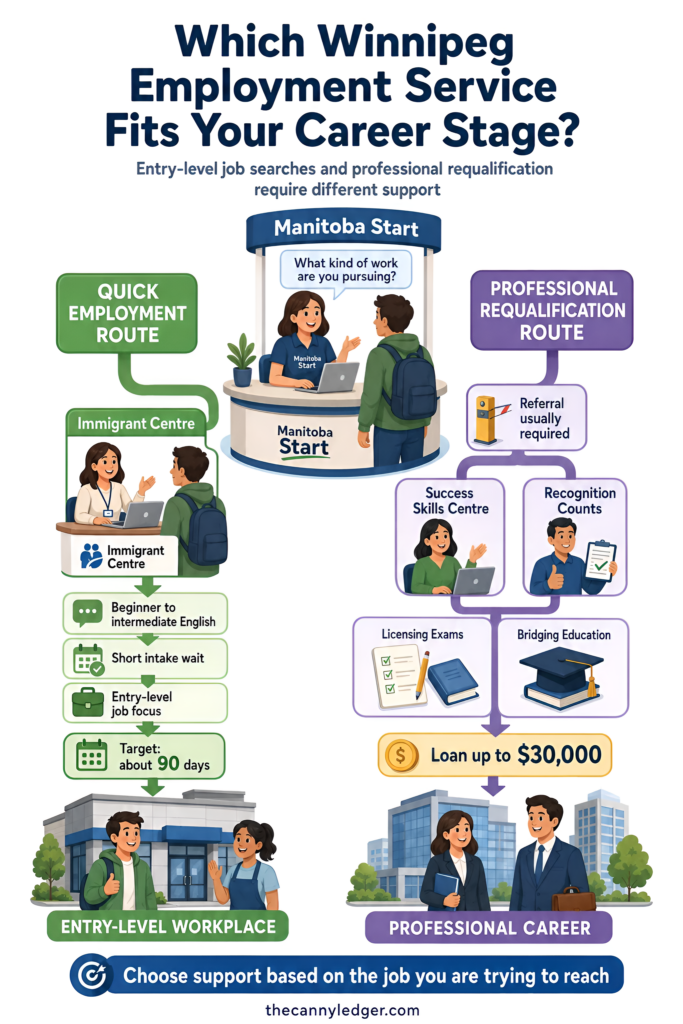
English classes in Winnipeg mostly route through one centralized assessment, WELARC, the Winnipeg English Language Assessment and Referral Centre, before you’re placed into the right provider at your actual level, and this single detail trips up more newcomers than almost anything else on this list. People routinely try to register for a class directly, only to get bounced back to book a WELARC appointment first. WELARC operates out of 400-275 Portage Avenue, tests both English and French, and the assessment itself is free for permanent residents, sponsored refugees, and, for certain provincially funded programs, some people who wouldn’t otherwise qualify for federally funded classes.
From there, providers split by CLB level and by what else you need alongside the class itself. The Winnipeg School Division’s Adult EAL program covers Stage 1, CLB levels 1 through 4, out of the Robertson Building on Main Street, while its MALTI program at the main Vaughan Street campus covers CLB 5 through 8 for learners working toward employment or further education. The YMCA-YWCA’s LINC classes come with a genuinely rare advantage, Care for Newcomer Children, on-site childcare for kids six months to five years old, timed to match the class schedule, solving a barrier that stops a lot of parents, usually mothers, from attending consistently. For anyone whose English is already conversational and mainly wants regular practice, the Immigrant Centre’s Access English Centre and the Winnipeg Public Library’s free conversation groups skip the WELARC assessment entirely and accept participants regardless of immigration status. Our guide to free English classes for immigrants in Winnipeg covers the full landscape in depth, including which option actually fits a specific schedule, childcare situation, or CLB level rather than just listing names.
Skills, Business, and Tech Training
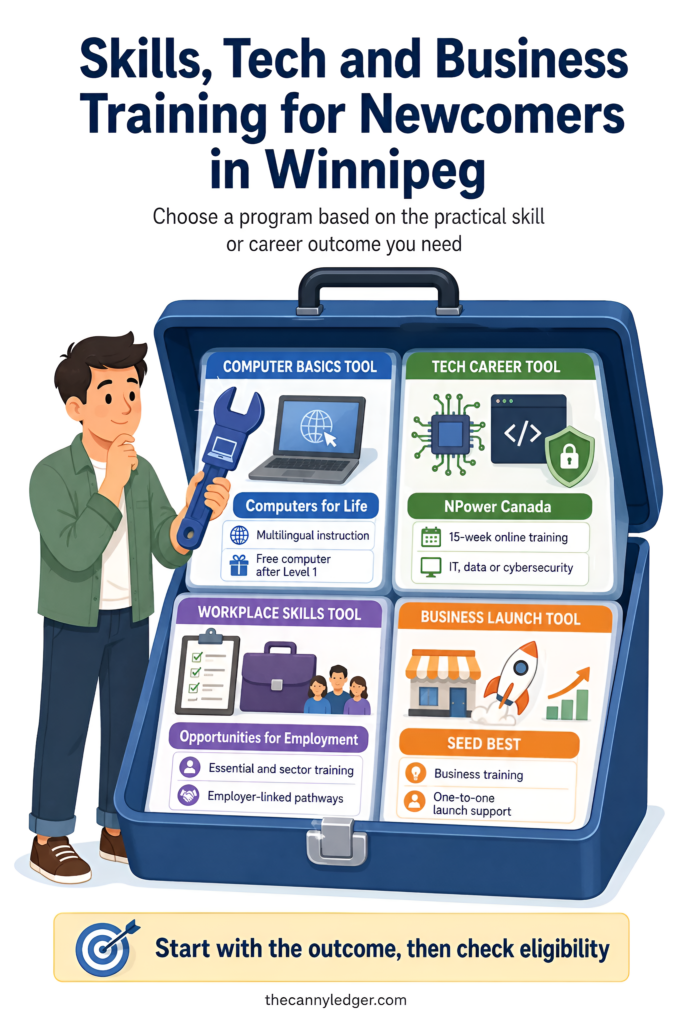
Beyond language and general career coaching, a distinct layer of hands-on training exists for people who want a specific new skill rather than a job search workshop, and this is the category most newcomers discover the latest, usually by word of mouth rather than by finding it in a search. Altered Minds’ Computers for Life program gives newcomers basic computer literacy taught in their own language, English, French, Arabic, and Ukrainian among them, over two four-week levels, and completing the first level earns you a free refurbished desktop computer to take home, a genuinely unusual incentive for a settlement-adjacent program to offer.
NPower Canada runs something with a different scale entirely, a free fifteen-week online tech certification track covering paths like Junior IT Analyst, AI and Data Analytics, and Network Security, aimed at people with legal status to work full-time in Canada who are facing unemployment or underemployment rather than people already working steadily in tech. Opportunities for Employment, known as OFE, covers a wider band still, computer literacy classes, essential skills training, and sector-specific programming including a direct partnership with Canada Goose that has placed more than 1,300 people into sewing machine operator and material handler roles with full-time pay, benefits, and a pension attached. And for newcomers who want to build something of their own rather than find an employer, SEED Winnipeg’s BEST program trains people specifically to launch a small business, structured across training, one-on-one consulting, and launch support, open to Manitoba residents on a low income with an actual business idea to work from. Our guide to free courses and training programs for new immigrants in Winnipeg covers all four of these organizations in real depth, including the eligibility differences that matter before you apply to any of them, since NPower Canada in particular has status and enrollment requirements that catch people off guard.
Immigration and Legal Help
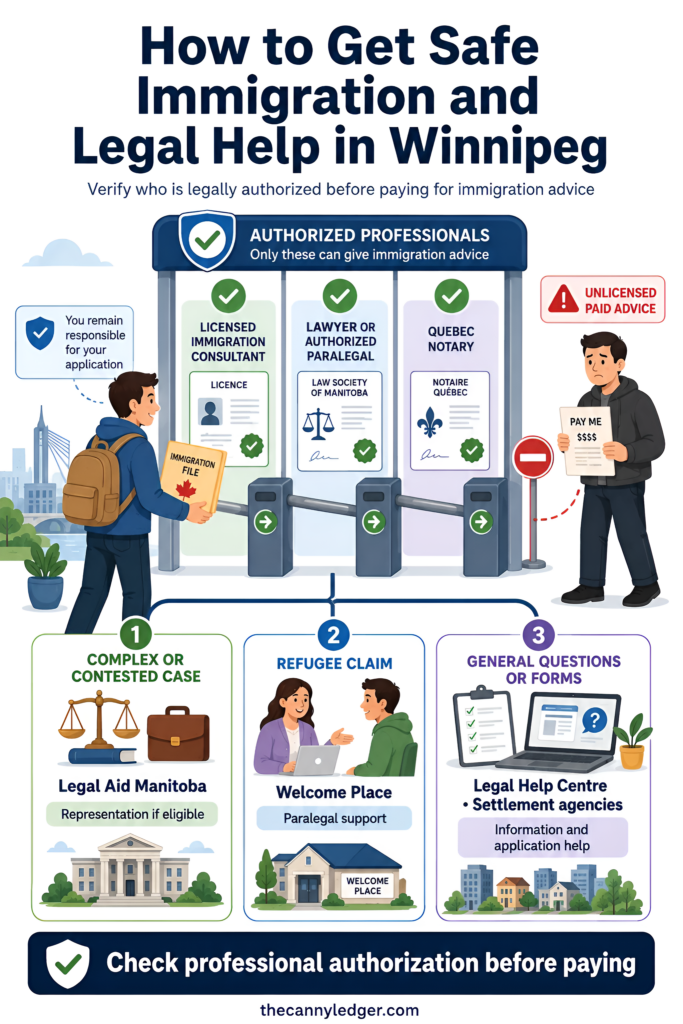
This is one of the few categories on this list where getting the wrong information carries real consequences, since an unlicensed “consultant” charging for immigration advice is breaking Canadian law regardless of how confident they sound or how many success stories they claim. Under federal law, only immigration consultants registered with the College of Immigration and Citizenship Consultants, lawyers and paralegals in good standing with a provincial or territorial law society, and Quebec notaries can legally charge a fee for immigration advice or representation. Anyone else taking your money for this kind of help is operating outside the law, and you bear the legal responsibility for whatever ends up in your application, not them.
The legitimate free and low-cost options in Winnipeg cover a genuine range. Legal Aid Manitoba covers immigration and refugee matters for eligible low-income applicants, including preparing the Basis of Claim document every refugee claimant must file and legal representation at Immigration and Refugee Board hearings. The Community Legal Education Association runs a free Law Phone-In service for general legal questions and referrals, the Legal Help Centre operates free drop-in clinics co-located with Welcome Place, and Welcome Place itself provides paralegal support specifically for refugee claimants navigating an active claim. Settlement agencies including Manitoba Start and the Immigrant Centre can walk you through basic immigration forms, family sponsorship, citizenship applications, PR card renewals, without crossing into actual legal advice on a contested case. Our guide to free and low-cost immigration help in Winnipeg covers that whole landscape in depth, and if your situation genuinely needs a lawyer, our breakdowns of immigration lawyers in Winnipeg offering free consultations and what an immigration lawyer actually costs in Winnipeg cover the paid side of that decision, including real published fee schedules from local firms rather than vague estimates.
Housing Essentials
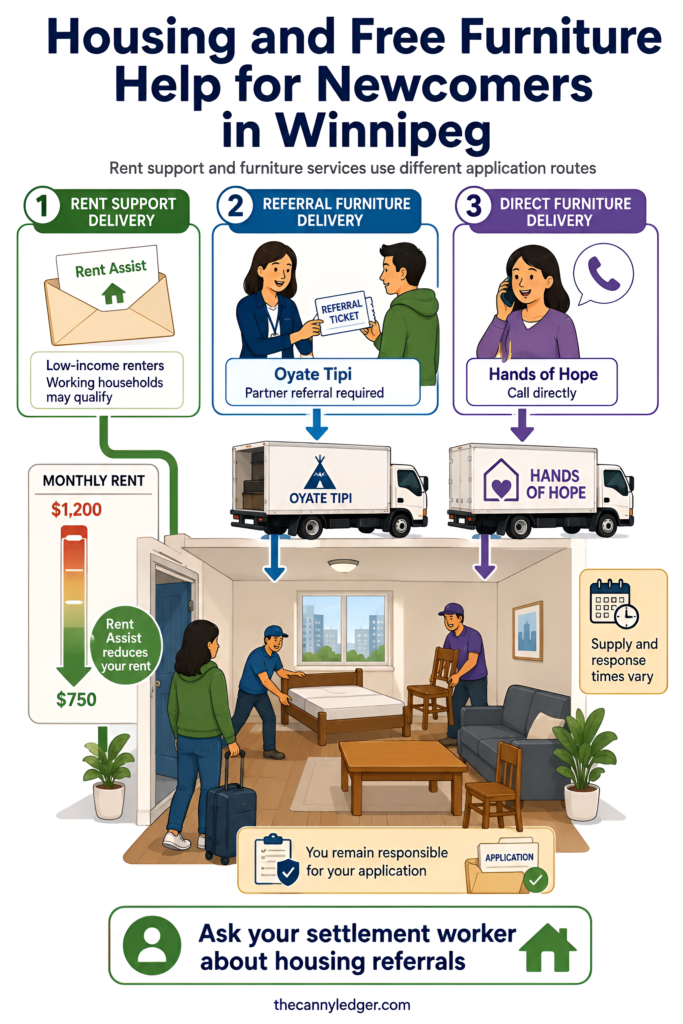
Getting into an apartment is only the first half of the problem, since an empty apartment still needs furniture, and rent itself can be a genuine strain in the first year before employment stabilizes, especially for a family sponsoring more than one dependent. Manitoba’s Rent Assist program helps cover rent for eligible low-income renters, and a detail that surprises a lot of newcomers is that it isn’t restricted to people on social assistance, working households under a certain income threshold can qualify too, with the benefit calculated against your household size and local rent costs rather than handed out as a flat amount.
On the furniture side, Oyate Tipi Cumini Yape, Winnipeg’s main furniture bank, explicitly lists newcomers among the populations it serves, but access runs through a referral from a partner social service agency rather than a direct appointment, which means the practical first move is asking your settlement worker whether their organization is a listed partner. Hands of Hope takes a different approach entirely, delivering free furniture directly to people who call in, no referral or caseworker required, though as an organization that runs largely on volunteer capacity, response times can vary with how much donated stock they have on hand at a given moment. Our guides to how to qualify for Rent Assist in Manitoba and free furniture for new immigrants in Winnipeg cover both of these in full, including exact income thresholds for Rent Assist and the specific contact details for both furniture organizations, and our general furniture bank profile goes deeper on Oyate Tipi specifically for any Winnipegger navigating furniture poverty, not just newcomers.
Food Security
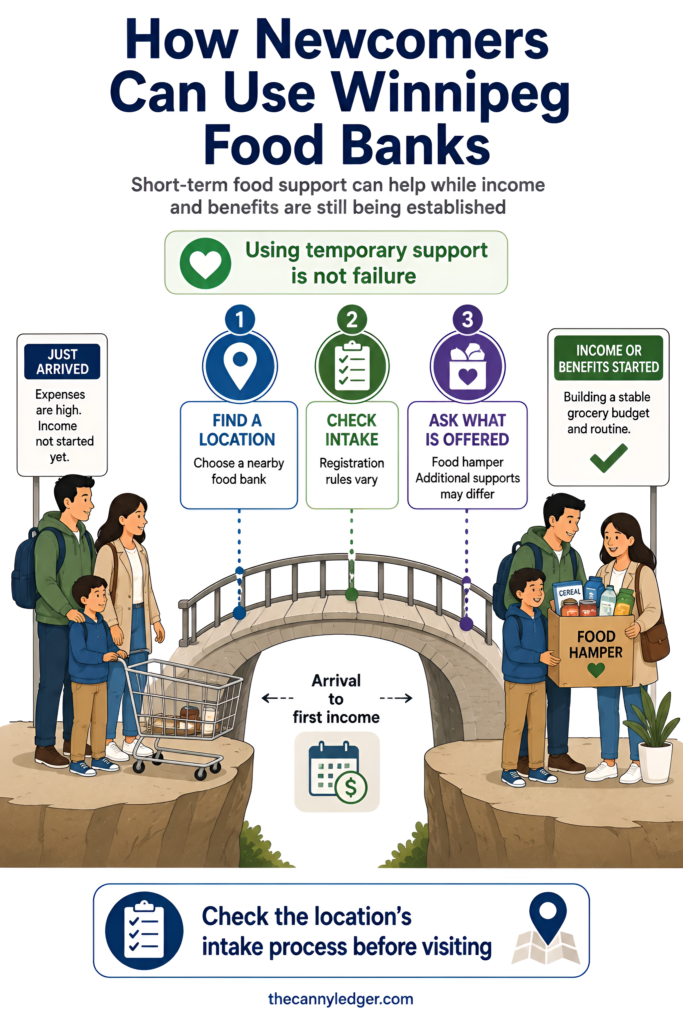
Tight budgets during a settlement period are common and nothing to feel embarrassed about, particularly in the stretch between arriving and a first paycheque actually landing, or while waiting on a first Rent Assist payment to come through. Winnipeg’s food bank network exists precisely for situations like this, and using it during a genuinely difficult few months isn’t a sign of failure, it’s the system working as intended. Locations vary in what they offer beyond basic hampers, some run alongside settlement partnerships, and intake processes differ enough between organizations that it’s worth checking specifics before assuming any one location works the same way as another. Our directory of food banks in Winnipeg covers locations and how intake typically works across the city, including which ones are more newcomer-aware in their approach.
Support for Women and Families
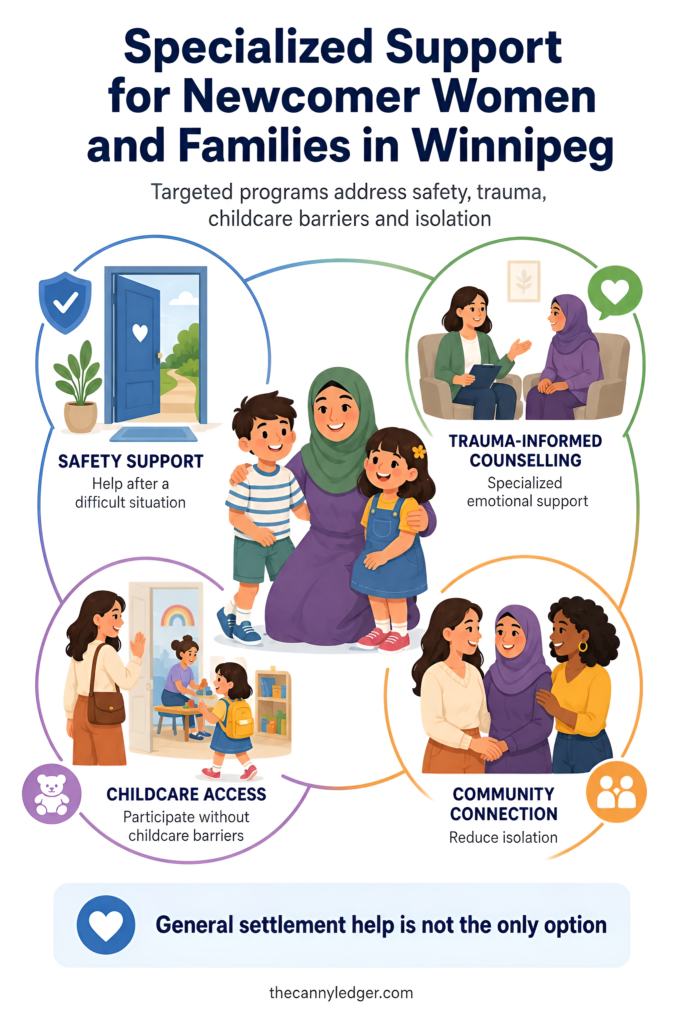
Some services are built specifically around circumstances general settlement programs don’t always account for, safety concerns after leaving a difficult situation, childcare barriers that make attending a language class or job search workshop genuinely impossible, or the particular isolation newcomer women sometimes face without an established local network or extended family nearby. These aren’t edge cases within the broader newcomer population, they’re common enough that dedicated programming exists specifically to address them rather than expecting a general settlement worker to have the specialized training a situation like this actually calls for. Our guide to counselling services for immigrant women in Winnipeg covers where that more targeted support lives in the city, including which organizations specialize in trauma-informed care versus general settlement support with a women-specific lens.
Health Access
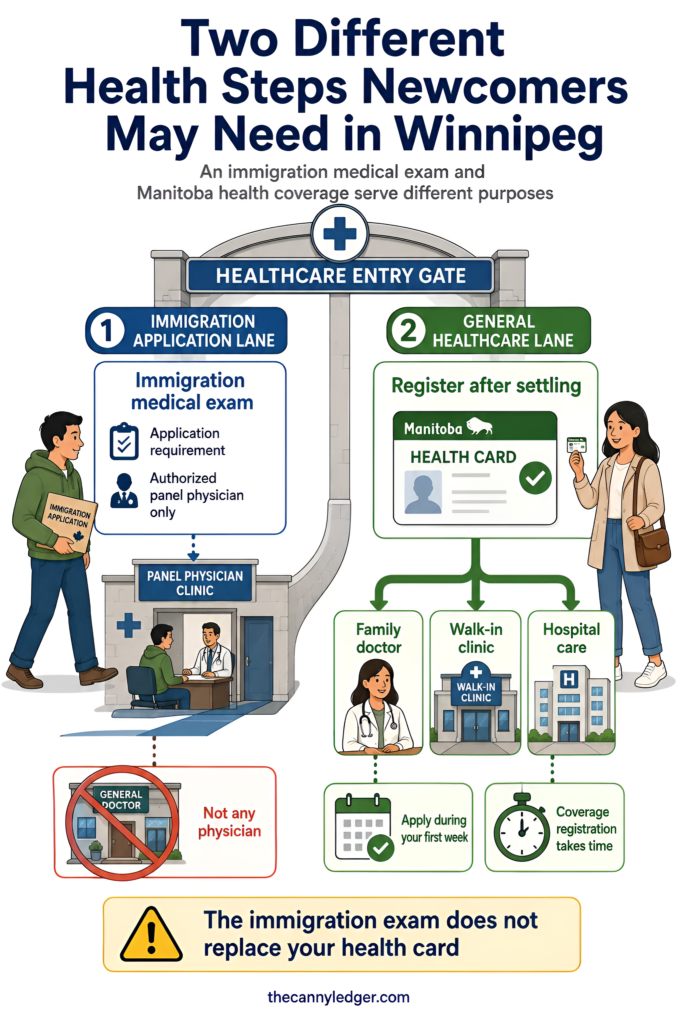
If your situation involves an immigration medical exam specifically, that’s a distinct process from general healthcare access, tied to specific immigration application requirements set by Immigration, Refugees and Citizenship Canada rather than ongoing care you’d access through a family doctor or walk-in clinic. It typically has to be completed by a panel physician authorized for that purpose, not just any doctor, which is a detail that catches people off guard if they assume any clinic visit satisfies the requirement. Our guide to the immigration medical exam process in Winnipeg covers what that step actually involves, including where to find an authorized panel physician in the city.
For general health coverage once you’re settled, registering for a Manitoba Health card is one of the first things worth doing after landing, since it’s what actually gets you access to a family doctor, walk-in clinics, and hospital care without paying out of pocket, and processing takes time, so treating it as a same-week priority rather than something to get to eventually genuinely matters. Our newcomer’s guide covers this as part of the broader first-weeks checklist, including what documents to bring and where to register.
Rural and Regional Manitoba
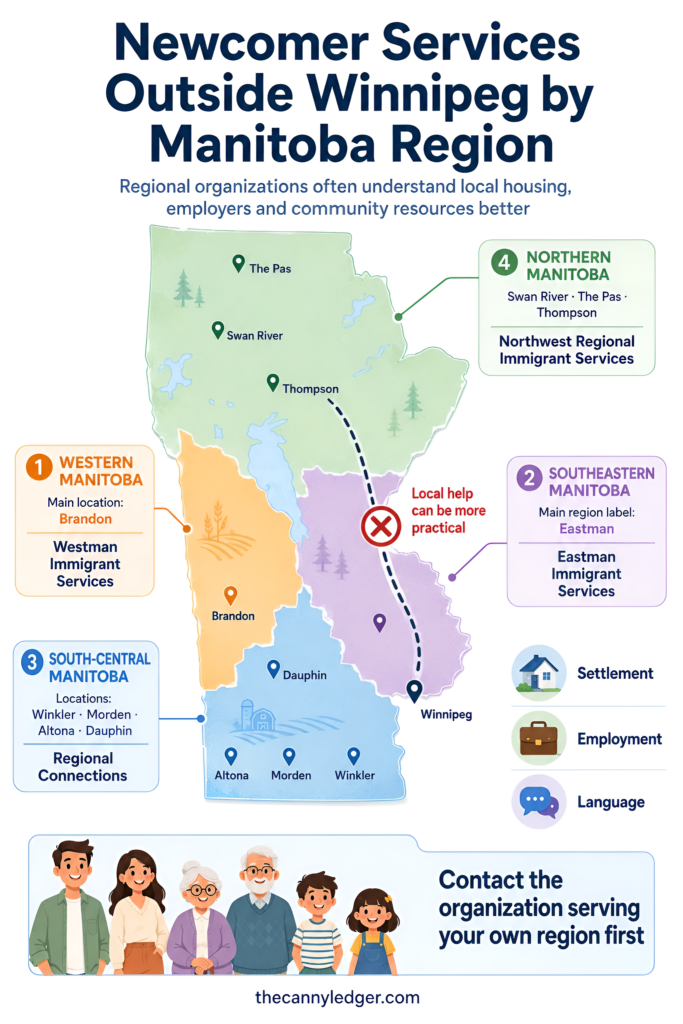
Not every newcomer settles in Winnipeg itself, and the city’s major settlement agencies aren’t the only option, or even always the most practical one, for people in smaller Manitoba communities where a two-hour drive to a downtown Winnipeg office isn’t realistic for a regular appointment. Westman Immigrant Services covers Brandon and the surrounding region, serving the western part of the province with settlement, employment, and language services structured similarly to what Winnipeg’s larger agencies offer but sized and located for that community. Eastman Immigrant Services serves communities in southeastern Manitoba, Regional Connections operates out of Winkler covering Morden, Altona, and Dauphin, and Northwest Regional Immigrant Services Inc. covers Swan River, The Pas, and Thompson, reaching into the northern part of the province where settlement infrastructure is thinnest and most needed. If you’re outside Winnipeg’s core, calling one of these regional organizations directly, rather than defaulting to a downtown Winnipeg agency out of habit or because it showed up first in a search, is usually the more practical first move, since they understand the specific housing market, employers, and community resources in their own region in a way a Winnipeg-based caseworker simply won’t.
MANSO: The Directory Behind This Directory
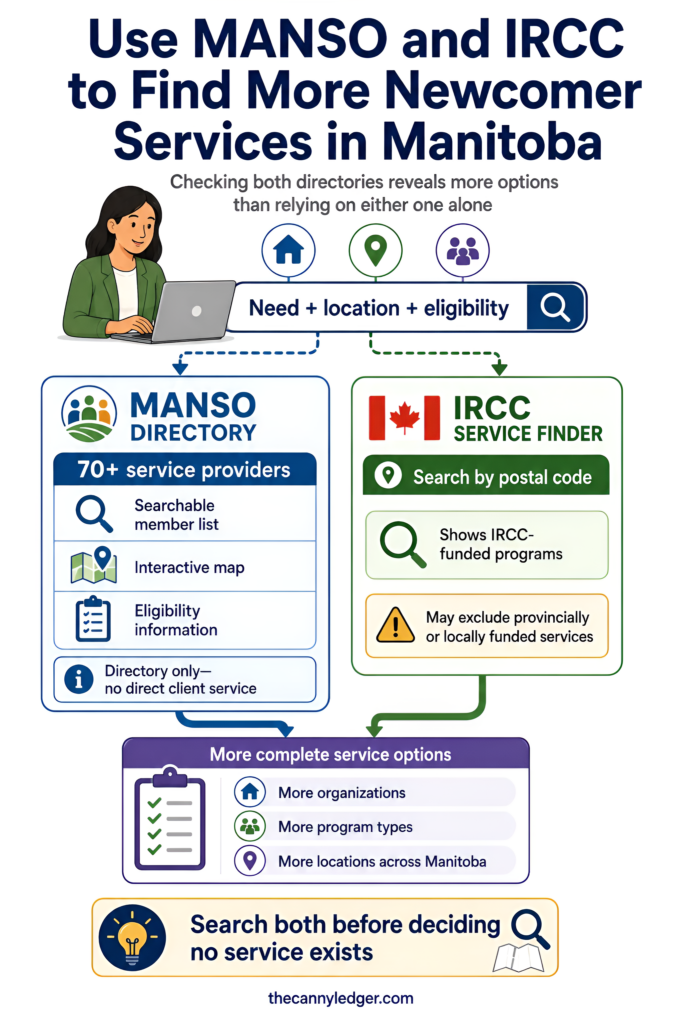
If a specific need genuinely doesn’t fit anywhere covered above, the Manitoba Association of Newcomer Serving Organizations, known as MANSO, is worth knowing about directly rather than treating this article as the final word. It’s the umbrella body for more than seventy settlement service providers across the province, coordinating communication, professional development, and a unified voice for the sector, and while MANSO itself doesn’t work directly with newcomers or clients, its public member directory, available as both a searchable list and an interactive map, lets you find services near you by category and confirm client eligibility for a specific organization before you make contact and potentially waste a trip. Immigration, Refugees and Citizenship Canada also runs its own free tool to find newcomer services by postal code, though it’s worth knowing that tool specifically surfaces IRCC-funded programs, which means it won’t necessarily show every organization MANSO’s broader member directory does, particularly provincially or municipally funded services with different eligibility rules. Checking both rather than relying on just one covers more genuine ground than either alone.
Common Questions
Do I need to be a permanent resident to access most of these services? No, though eligibility varies by specific program and by who funds it. Federally funded services often require permanent resident, protected person, or specific temporary resident status, while provincially or municipally funded programs sometimes have broader eligibility extending to refugee claimants and some work or study permit holders, so it’s worth confirming with each organization directly rather than assuming a blanket rule applies across the whole sector.
Is there one single place that can sort out everything on this list for me? Manitoba Start and the Immigrant Centre both come closest, since their intake process is specifically built to route you into other services based on your actual situation rather than making you research each category separately, but neither one covers everything, particularly the more specialized legal, women-specific, and rural regional services covered above.
What if an organization on this list can’t help with my specific situation? Ask them directly for a referral rather than starting your search over from scratch. Settlement workers across these organizations routinely refer clients to each other, since the sector runs on exactly this kind of informal cross-referral network, and MANSO’s member directory exists specifically to make that kind of connection easier when a first call doesn’t turn out to be the right fit.
Start With One Call, Not a Research Project
Trying to map this entire landscape before making a single call is exactly the trap this directory is meant to prevent, and it’s a genuinely common one, spending weeks reading about organizations instead of contacting any of them because it feels safer to be thorough first. Pick whichever category matches your most pressing need right now, settlement basics, language, employment, housing, and make that one call or registration first rather than waiting until you’ve read every linked article on this page. Every organization covered here is used to referring people onward when a need falls outside their specific scope, which means starting anywhere reasonable beats spending another week researching the perfect first stop that, realistically, doesn’t exist as a single perfect option anyway.

