

Two spouses can inherit an identical TFSA under two different designations, and one keeps every future dollar of growth tax-free forever while the other starts owing tax on growth the moment the account holder dies. The difference comes down to a single word on a form, successor holder versus beneficiary, and most people naming someone on their TFSA have no idea the two options produce genuinely different tax outcomes.
- The Successor Holder Route Keeps Everything Tax-Free
- Naming A Beneficiary Works Completely Differently
- The One Escape Route For A Spousal Beneficiary
- Non-Spouse Beneficiaries Don’t Get That Same Option
- Why This Also Matters For Probate
- What Happens If The Deceased Had An Overcontribution
- Setting This Up Properly While You Can
- What Trips People Up About These Rules
The Successor Holder Route Keeps Everything Tax-Free
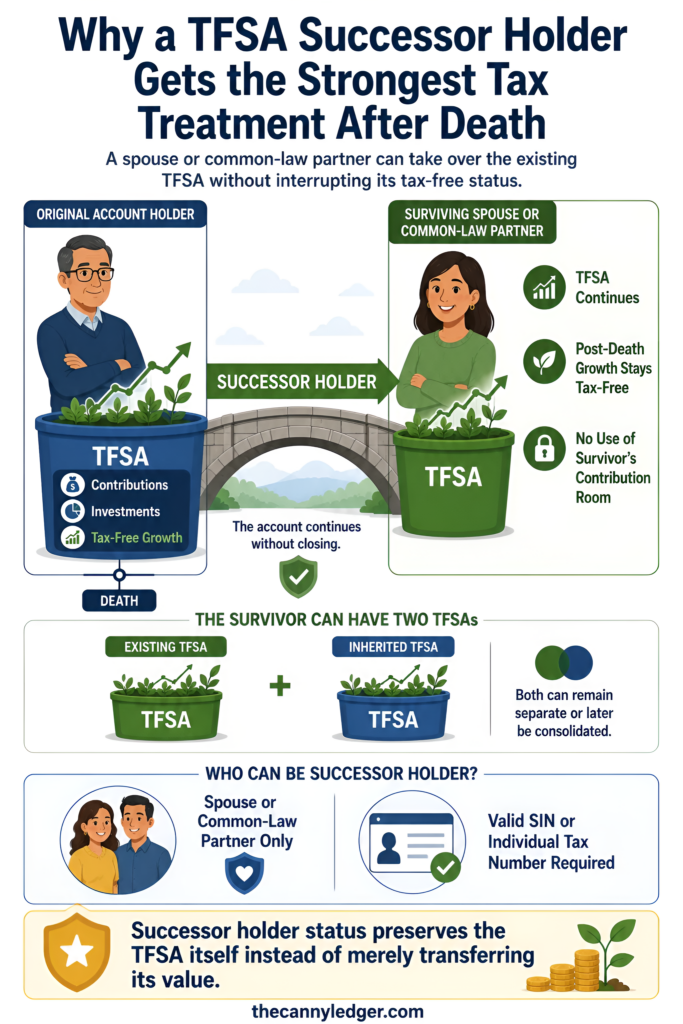
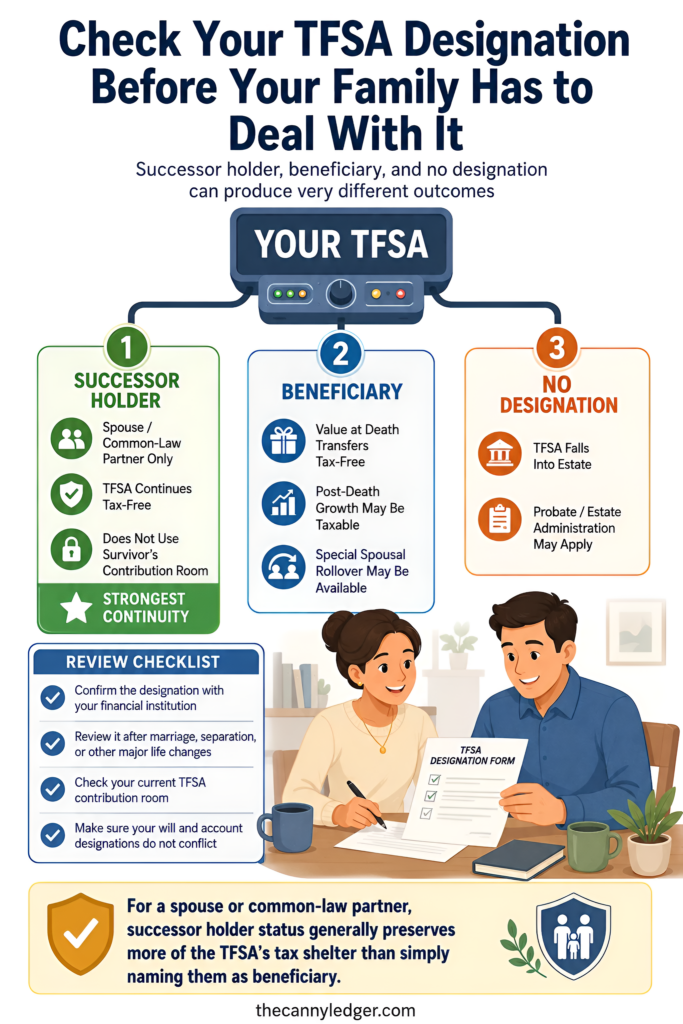
Naming a spouse or common-law partner as successor holder means they simply become the new holder of the exact same TFSA the moment you die, with the account’s tax-exempt status carrying forward uninterrupted. Nothing about the account changes structurally, the growth that happens after death stays just as tax-free as growth that happened before, and taking on the account doesn’t touch the survivor’s own contribution room at all. If the successor already holds a separate TFSA, they simply end up with two accounts, both fully tax-sheltered, which they can keep separate or consolidate as they choose. Only a spouse or common-law partner qualifies for this designation, and they need a valid Social Insurance Number or Individual Tax Number for the transfer to actually go through.
Naming A Beneficiary Works Completely Differently
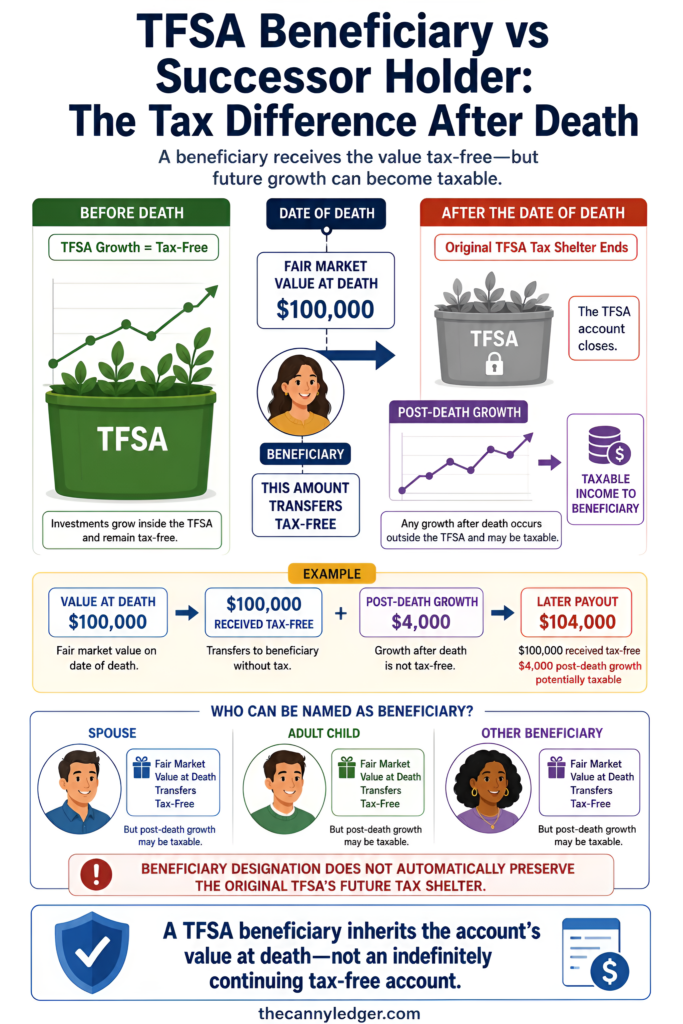
A beneficiary designation, whether it names a spouse, a child, or anyone else, causes the TFSA to stop existing as a TFSA at the moment of death, and the account’s fair market value at that point transfers to the beneficiary entirely tax-free. Everything after that point is where the real difference shows up. Any growth the money earns between the date of death and the date it actually gets paid out to the beneficiary becomes taxable income to that beneficiary, since the account no longer carries any tax-sheltered status once the original holder has died. Our deeper comparison of TFSA beneficiary designations against successor holder status walks through more of the specific scenarios where this distinction matters most.
The One Escape Route For A Spousal Beneficiary
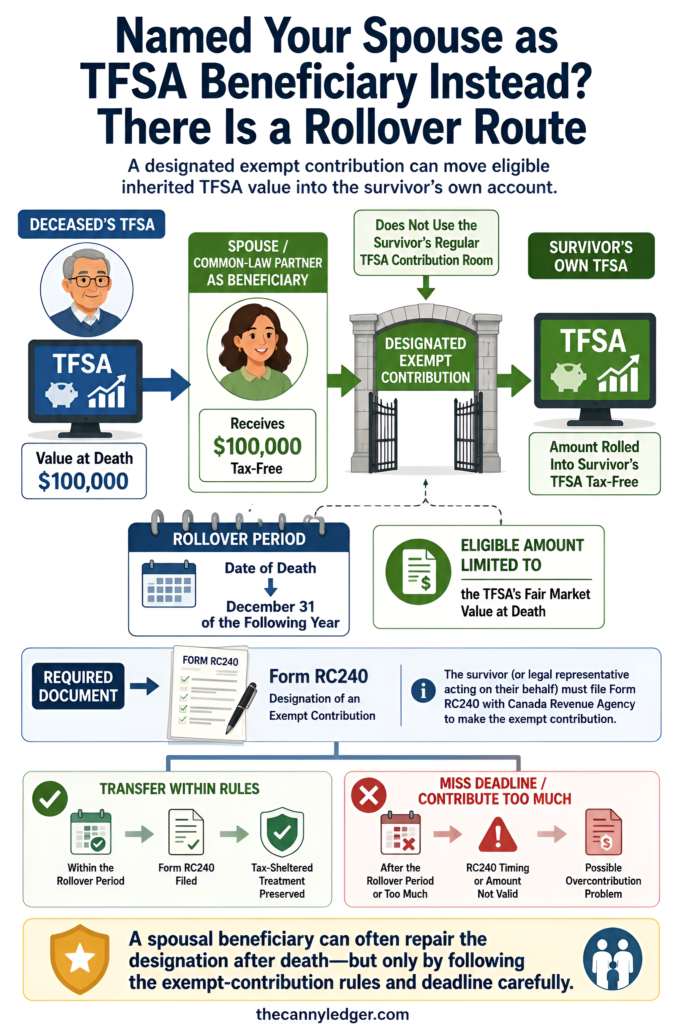
A surviving spouse or common-law partner named as a beneficiary rather than successor holder isn’t entirely out of options, since a specific mechanism exists to recover the tax-free treatment after the fact. Contributing the inherited amount into their own TFSA as a designated exempt contribution shelters it from counting against their personal contribution room, provided the transfer happens within the rollover period running from the date of death to December 31 of the following year, and the amount contributed doesn’t exceed the account’s value at the date of death. This requires filing a Designation of an Exempt Contribution, form RC240, and the timing genuinely matters, since missing the window or exceeding the fair market value threshold can turn what should have been a clean transfer into a real overcontribution penalty.
Non-Spouse Beneficiaries Don’t Get That Same Option
A child, a friend, or any other non-spouse beneficiary receives the account’s value at death tax-free, exactly the same as a spousal beneficiary would, but has no equivalent exempt contribution mechanism available to them. Growth between death and payout is simply taxable to them as ordinary income, with no workaround, since the exempt contribution provision exists specifically to preserve a spouse’s access to tax-sheltered saving, not to extend that benefit more broadly.
Why This Also Matters For Probate
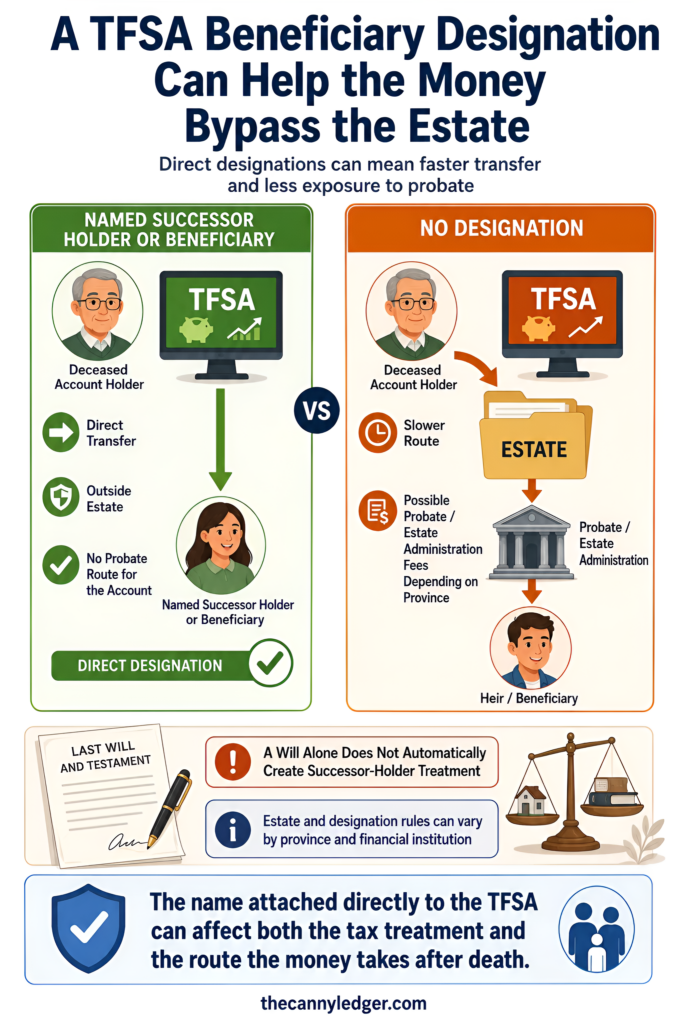
Naming either a successor holder or a beneficiary directly on the TFSA keeps the account outside your estate entirely, passing directly to the named person rather than through the probate process the rest of your estate typically goes through. Skipping that step means both faster access to the funds and avoiding whatever probate fees apply in your specific province, a genuine practical benefit layered on top of the tax treatment covered above. Leaving the TFSA without any named successor or beneficiary at all sends it into the estate by default, subject to probate like any other asset and losing the direct-transfer advantage entirely.
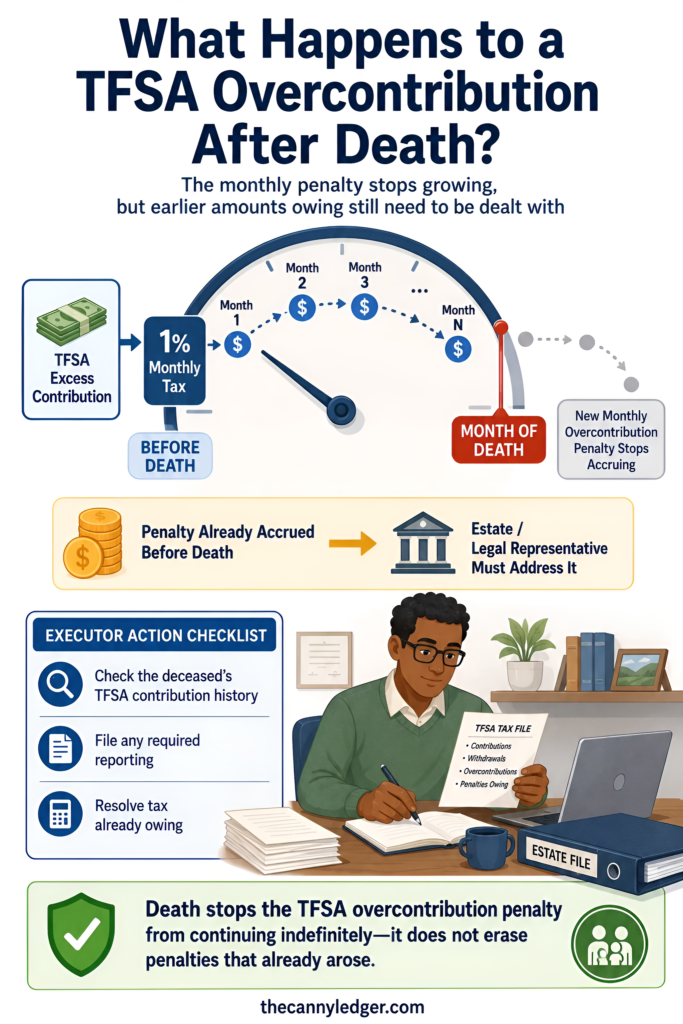
What Happens If The Deceased Had An Overcontribution
If the account holder had an existing overcontribution at the time of death, the standard 1 percent monthly penalty stops accruing as of the month of death rather than continuing indefinitely, though the estate’s legal representative still needs to address whatever penalty had already built up before that point, typically through the appropriate reporting forms filed on the estate’s behalf. This is a detail worth flagging to an executor specifically, since it’s easy to miss amid everything else an estate needs to handle.
Setting This Up Properly While You Can
Confirm your own TFSA actually has a named successor holder or beneficiary on file rather than assuming a will alone covers it, since a successor holder can also be named directly in a will if the will explicitly grants that person the same rights the original holder had, but a will that’s silent on the account defaults it into the estate and probate regardless of who eventually inherits your other assets. If you’re married or in a common-law relationship, naming your partner as successor holder specifically, rather than beneficiary, is almost always the stronger choice given how much more of the account’s value stays sheltered under that designation, a decision worth revisiting whenever you’re already reviewing how your TFSA works more broadly. And if your own TFSA contribution room situation is at all unclear, checking it directly now means whoever handles your account after you’re gone isn’t left guessing at numbers you could have confirmed yourself.
What Trips People Up About These Rules
Can someone other than a spouse be named as a successor holder? No, the successor holder designation is legally restricted to a spouse or common-law partner specifically, and naming anyone else in that role on the account paperwork simply won’t have the intended effect.
If a beneficiary receives the TFSA’s value quickly after death, does the taxable growth issue even come up in practice? It depends entirely on how fast the payout happens, since a beneficiary paid out within days of death likely sees little or no growth to worry about, while an estate that takes months to settle can generate a meaningful taxable amount for a non-spouse beneficiary in the meantime.
Does naming a successor holder prevent that person from also being named a beneficiary as a backup? No, naming a spouse as successor holder with a separate backup beneficiary named for a scenario where both people die simultaneously is a common and sensible structure, ensuring the account still passes outside the estate even in that edge case.