

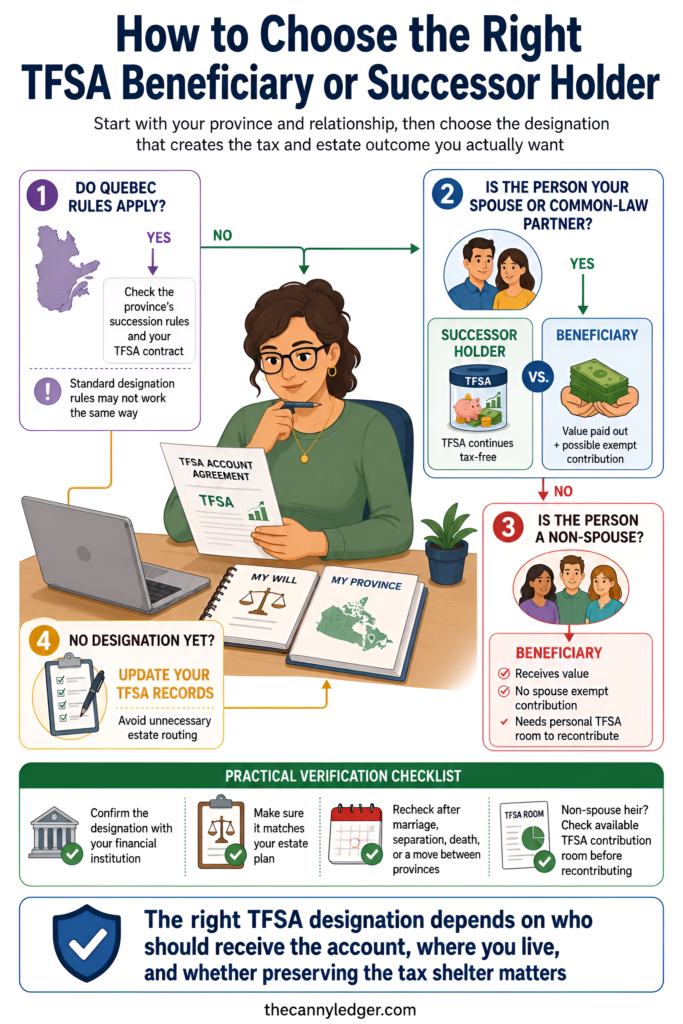
A Quebec resident naming a successor holder on their TFSA contract has actually accomplished nothing. Quebec doesn’t recognize that designation at all, for a standard deposit or investment TFSA, no matter what the paperwork says. That’s not a small technicality buried in provincial fine print, it’s a complete gap between what most TFSA guidance assumes applies everywhere and what actually happens for a meaningful share of the country.
A successor holder, who can only be a spouse or common-law partner, takes over the TFSA itself upon death, and the account keeps its tax-free status without interruption. A beneficiary, who can be anyone, receives the value of the account instead, and the TFSA stops being a TFSA at that point, meaning any growth after death becomes taxable. The broader mechanics of what happens to a TFSA when its holder dies are worth understanding alongside this specific distinction, since it’s the entire difference between the two designations, and it has real tax consequences either way.
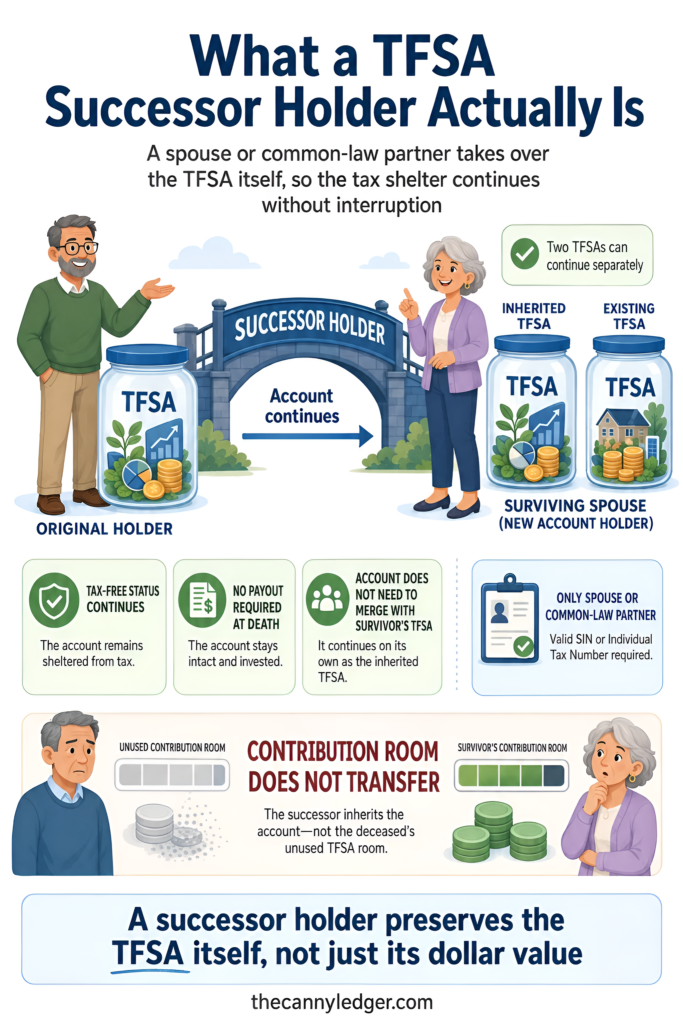
What a Successor Holder Actually Is
According to the Canada Revenue Agency’s own page on successor holders, a successor holder is the survivor of the deceased who becomes the new holder of the TFSA immediately upon death, named either directly in the TFSA contract or in the deceased’s will. Because the account itself continues to exist rather than being paid out and closed, the CRA doesn’t treat the deceased as having received anything from the TFSA at death, and the account’s tax-free status carries forward without any gap or interruption.
This designation is available exclusively to a spouse or common-law partner, no other relationship qualifies, and the surviving spouse needs a valid Social Insurance Number or Individual Tax Number to actually be named. If that successor holder already has their own separate TFSA, they simply end up holding two TFSAs going forward, both continuing to exist independently rather than merging into one combined account. One detail worth knowing directly, the deceased’s own accumulated contribution room disappears entirely rather than transferring to the successor holder, it doesn’t add to the survivor’s existing room in any way.
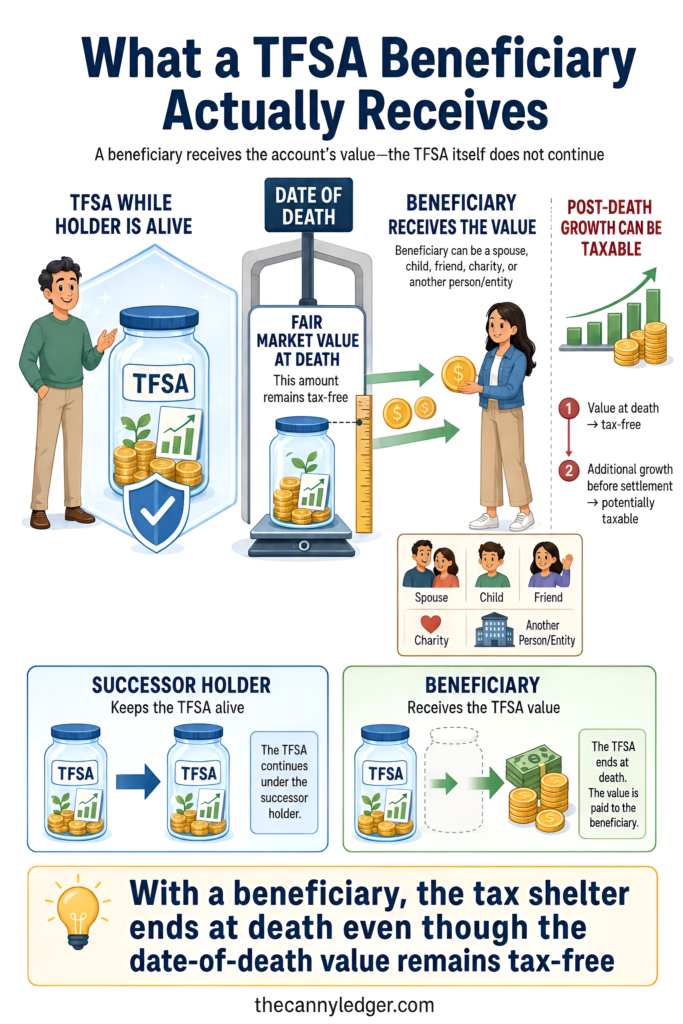
What a Beneficiary Actually Is
A beneficiary can be anyone, a spouse, a child, a friend, a charity, without the relationship restriction that applies to a successor holder. According to the CRA’s own page on designated TFSA beneficiaries, naming someone as a beneficiary means the TFSA itself effectively collapses at death, the tax shelter ends, and the value at the date of death gets paid out. That specific value, the fair market value as of the date of death, remains tax-free. Anything the account earns after that date, while the payout is being processed, becomes taxable income to whoever eventually receives it.
That’s the practical cost of the beneficiary designation compared to a successor holder, a gap between the moment of death and the moment the account actually gets settled, during which growth stops being sheltered from tax. For an account that gets wound down quickly, that gap barely matters. For one that sits unresolved for months, it can generate a real, if usually modest, tax bill nobody was expecting.
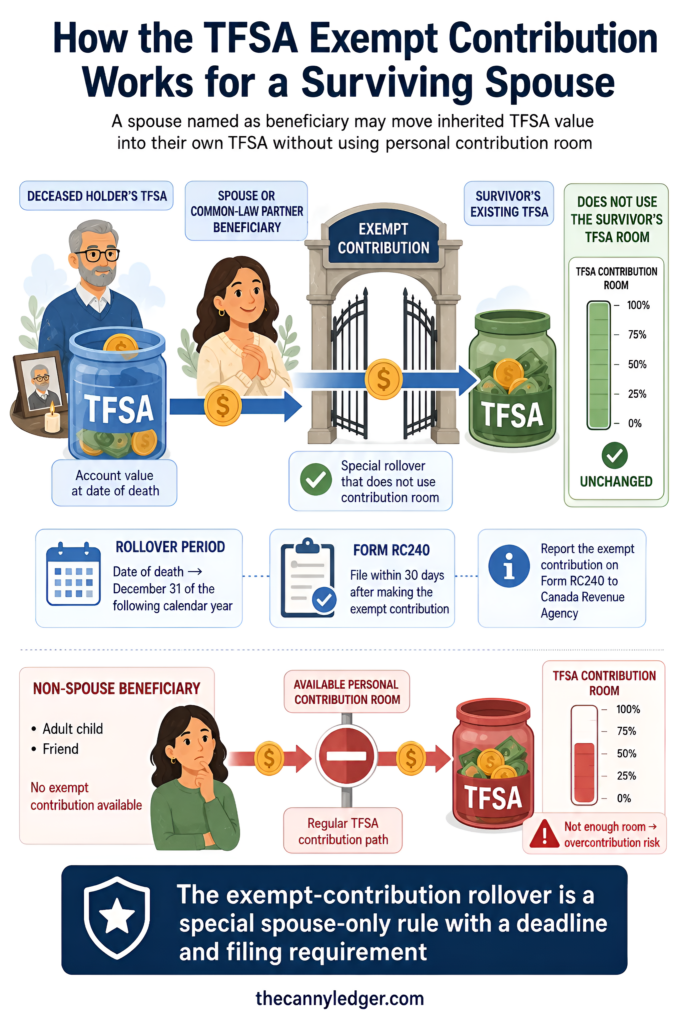
The Exempt Contribution That Only Applies to a Spouse
This is a truly important detail that only helps one specific category of beneficiary, and it’s worth understanding directly rather than assuming it applies broadly. A surviving spouse or common-law partner named as a beneficiary, rather than a successor holder, can still contribute the amount they receive into their own TFSA without it counting against their personal contribution room, a mechanism the CRA calls an exempt contribution. According to the CRA’s own guidance on exempt contributions, that contribution has to happen during the rollover period, which runs from the date of death through the end of the following calendar year, and Form RC240 has to be filed with the CRA within 30 days of actually making that contribution.
This option doesn’t extend to any other kind of beneficiary. A non-spouse beneficiary, an adult child or a friend, has no equivalent exemption available at all, and can only contribute the inherited amount into their own TFSA if they happen to already have available contribution room to absorb it, exactly the same as contributing any other money they came into, with the same overcontribution consequences applying if that room runs out.
Quebec Runs This Completely Differently
This is the detail most general TFSA guidance skips entirely, and it matters enormously for anyone whose estate planning touches the province. According to CIBC’s own guidance on what happens when a TFSA holder dies, Quebec does not accept either a successor holder or a designated beneficiary designation for a standard deposit or investment TFSA, the two mechanisms this entire article has been explaining simply don’t function there the way they do in every other province. The one exception is a TFSA structured as an insurance contract, such as a segregated fund, where beneficiary designations do still work under Quebec’s separate insurance framework.
For a Quebec resident’s standard TFSA, the account instead passes through the estate according to the will, or through the province’s intestacy rules if there’s no will at all, following Quebec’s own succession law rather than the beneficiary and successor holder framework used everywhere else in Canada. A surviving spouse in that situation can still make the same exempt contribution described above, using the same RC240 form and the same deadlines, provided they actually receive the TFSA’s value through that succession process. The mechanism to get there is different, but the underlying tax relief for a Quebec spouse ends up functioning similarly to what a spouse receives as a beneficiary anywhere else in the country.

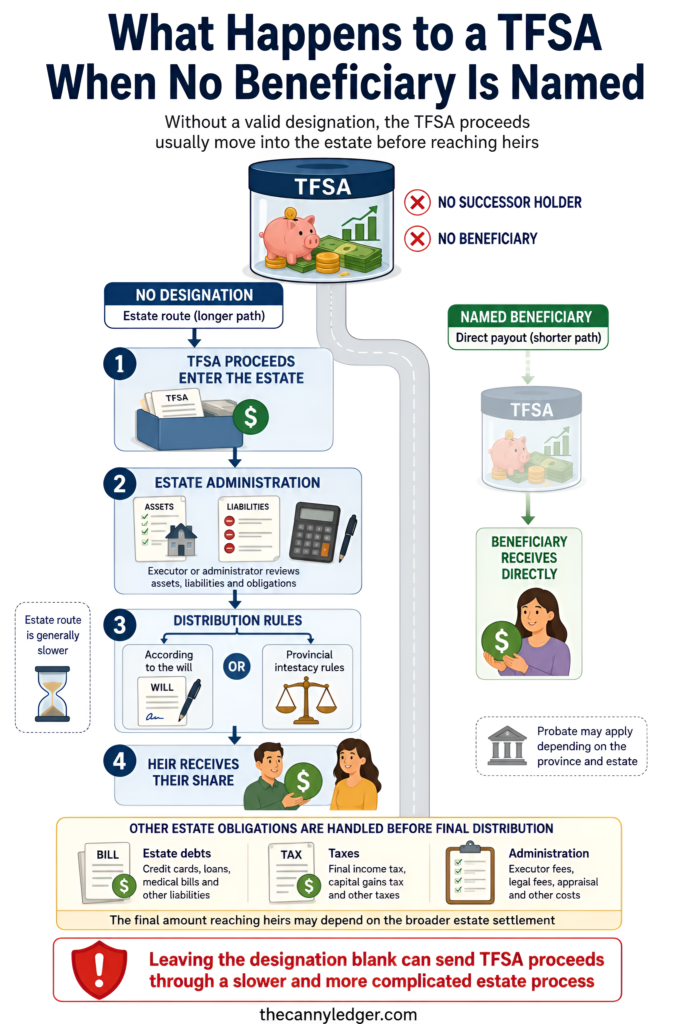
What Happens With No Designation at All
If neither a successor holder nor a beneficiary was ever named, the TFSA’s proceeds go to the deceased’s estate rather than directly to any specific person. That routes the account through the general estate settlement process, potentially including probate depending on the province and the size of the estate, and the funds ultimately get distributed according to the will, or according to provincial intestacy rules if there wasn’t one. That’s a meaningfully slower and more exposed path than either a successor holder or a named beneficiary provides, since how debt and other estate liabilities get handled during that same estate settlement process, including what a surviving spouse is and isn’t responsible for, can affect how much actually reaches anyone before a TFSA payout is finalized.
Setting Up the Right Designation Now
Confirm your own province’s rules apply the way you assume before relying on either designation, particularly if you or anyone in your family lives in Quebec, since the successor holder and beneficiary framework covered throughout this piece simply doesn’t function there for a standard TFSA. If you’re a spouse or common-law partner, weigh successor holder against beneficiary directly, successor holder keeps the account’s tax shelter running without interruption, while beneficiary still offers the exempt contribution option but with a real gap in tax-free growth during the transition. If you haven’t named anyone at all on your own TFSA, that’s worth fixing directly with your institution, since the default path through the estate is slower and less favourable than either alternative. And if you’re a non-spouse beneficiary receiving TFSA proceeds, check your own available contribution room directly before assuming you can simply deposit the full amount into your own TFSA.
Questions Worth Sorting Out Before You Decide
Can I name more than one beneficiary on a single TFSA? Yes, multiple beneficiaries can be named to split the account’s value, though only a spouse or common-law partner among them would qualify for the exempt contribution treatment, any other named beneficiaries would need their own available contribution room.
Does naming a successor holder require a lawyer or notary? No, the designation can typically be made directly through your financial institution’s own TFSA paperwork, or included in your will, without needing a separate legal document specifically for this purpose.
What happens if my named successor holder dies before I do? If a secondary or alternate beneficiary was also named, the account passes to them instead, which is exactly why naming a backup alongside your primary successor holder is worth doing rather than leaving that scenario unaddressed.