

David turned 40 in 2023, the same year he became a Canadian resident. That November, an inheritance landed in his account, and he contributed $88,000 to a brand new TFSA, assuming the full annual dollar limit had been building for him since the program launched in 2009. It hadn’t. David’s actual room only started the year he actually became a resident, and the gap between what he assumed and what he actually had triggered a real overcontribution penalty on money he truly believed he was entitled to.
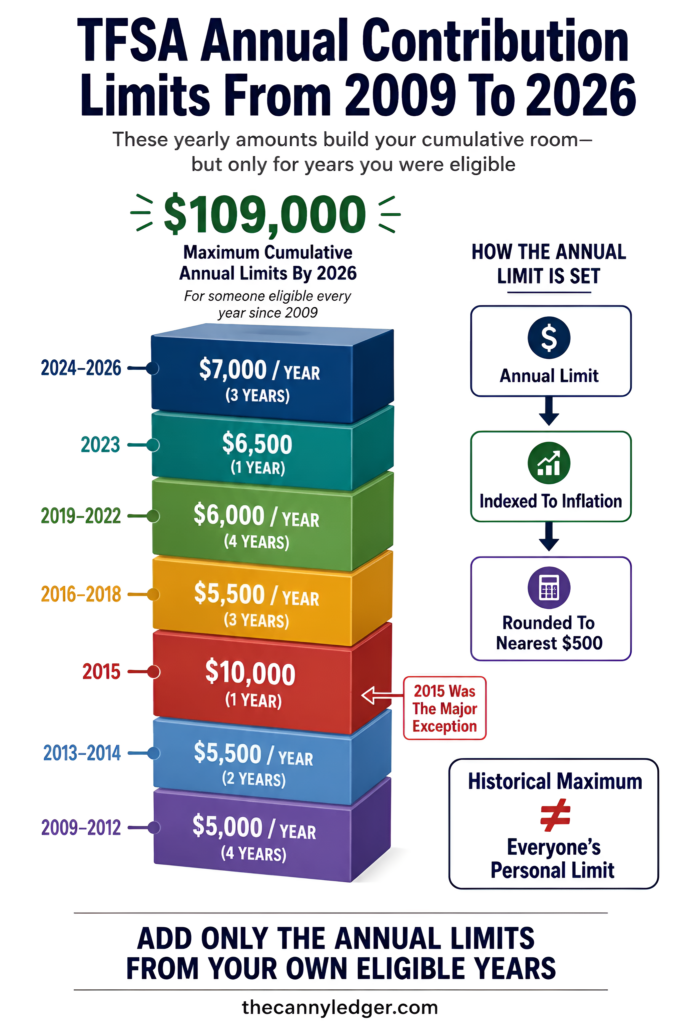
How much you can contribute to a TFSA depends entirely on your own specific history, not a single number that applies to everyone. The broader mechanics of how the account works are worth understanding first if you’re new to the topic, but for 2026, the annual dollar limit is $7,000, and someone who has been an adult Canadian resident since the program’s 2009 start has $109,000 in total available room. Anyone who turned 18 later, or became a Canadian resident after 2009, has a smaller, individually calculated total instead. Getting that individual number right, rather than assuming the maximum headline figure applies to your situation, is exactly where David’s mistake happened.
The Actual Formula Behind Your Number
Your available contribution room is the sum of three things, added together. Start with the annual dollar limit for every year you were eligible, add any unused room you never contributed in past years, then add back any amount you withdrew from the account during the previous calendar year specifically. The CRA’s own calculation guidance confirms this exact three-part formula directly. That total is your actual available room right now, and it changes every January 1 when a new year’s limit gets added on top of whatever you already had.
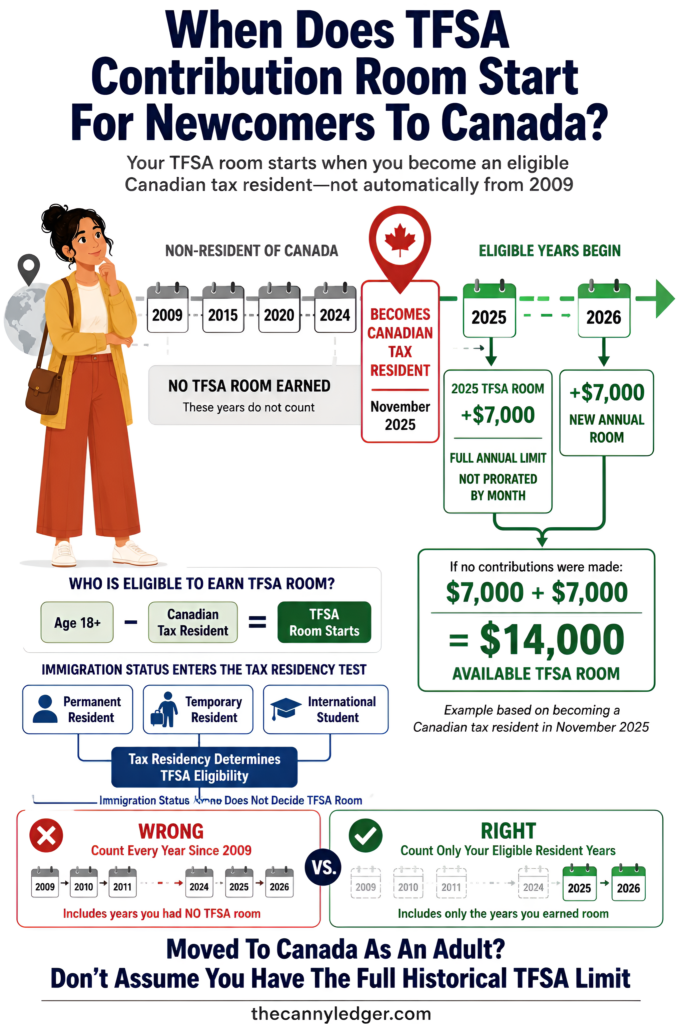
Eligibility for each of those yearly amounts requires two things at once for that specific year, being 18 or older and being a Canadian resident for tax purposes. Miss either condition for a given year, and that year simply doesn’t contribute anything to your running total, which is exactly the gap that catches people who assume every year since 2009 automatically counts toward their number.

The Year by Year Numbers That Feed the Calculation
Since the TFSA launched in 2009, the annual dollar limit has moved several times as the government indexes it to inflation, rounded to the nearest $500. The limit started at $5,000, held there through 2012, then moved to $5,500 for 2013 and 2014, jumped to $10,000 for 2015 alone, dropped back to $5,500 for 2016 through 2018, rose to $6,000 for 2019 through 2022, increased to $6,500 for 2023, and has sat at $7,000 for 2024, 2025, and 2026. Adding every one of those figures together for someone eligible in every single year produces the full $109,000 cumulative total available in 2026. A complete year by year breakdown of exactly how that total builds is available in more depth elsewhere on this site, useful if you want the full historical table rather than just the running sum.
A Worked Example for Someone Building Room Over Several Years
The mechanics are easier to see with real numbers attached. According to the CRA’s own example published in its guidance on contributing to a TFSA, a resident named Joe turned 18 in 2023 and opened a TFSA that same year, contributing the full $6,500 limit immediately, leaving him with zero available room for the rest of that year. In 2024, the new $7,000 annual limit became available, but Joe only contributed $2,000 that year, leaving $5,000 in unused room. Moving into 2025, that $5,000 carried forward and combined with the new $7,000 limit for the year, giving Joe $12,000 in total available room to work with.
That’s the entire mechanic in miniature, each year’s limit stacks on top of whatever was left unused before it, compounding your available room even in years you contribute nothing at all. Someone who’s never opened a TFSA isn’t missing out on that accumulated room, it’s simply been building in the background the entire time, exactly the way it did for Joe’s unused $5,000 even though he hadn’t touched it.

The Newcomer Mistake, and How to Avoid It
This is where David’s situation from the opening applies directly, and it’s worth understanding precisely if you immigrated to Canada as an adult rather than growing up here. Contribution room for a new resident starts in the calendar year residency actually begins, not the year you turned 18 if that happened somewhere else first, and it doesn’t matter what point in the year you arrived, since the CRA grants the full annual limit for any calendar year in which residency was established at any point. Someone who becomes a resident in November still receives that entire year’s full contribution limit, not a prorated partial amount based on how many months remained.
This applies the same way to temporary residents and international students who’ve established Canadian tax residency, not exclusively to permanent residents or citizens, since the eligibility test runs on tax residency and age rather than immigration status specifically. A detailed look at how this plays out for temporary residents specifically confirms the same underlying rule, that years spent as a non-resident generate no TFSA room at all, and that room cannot be claimed retroactively once residency is eventually established. The mistake David made, assuming every year back to 2009 counted for him personally, is exactly why checking your actual number directly matters more than doing rough mental math based on the program’s full history.
How to Actually Verify Your Real Number
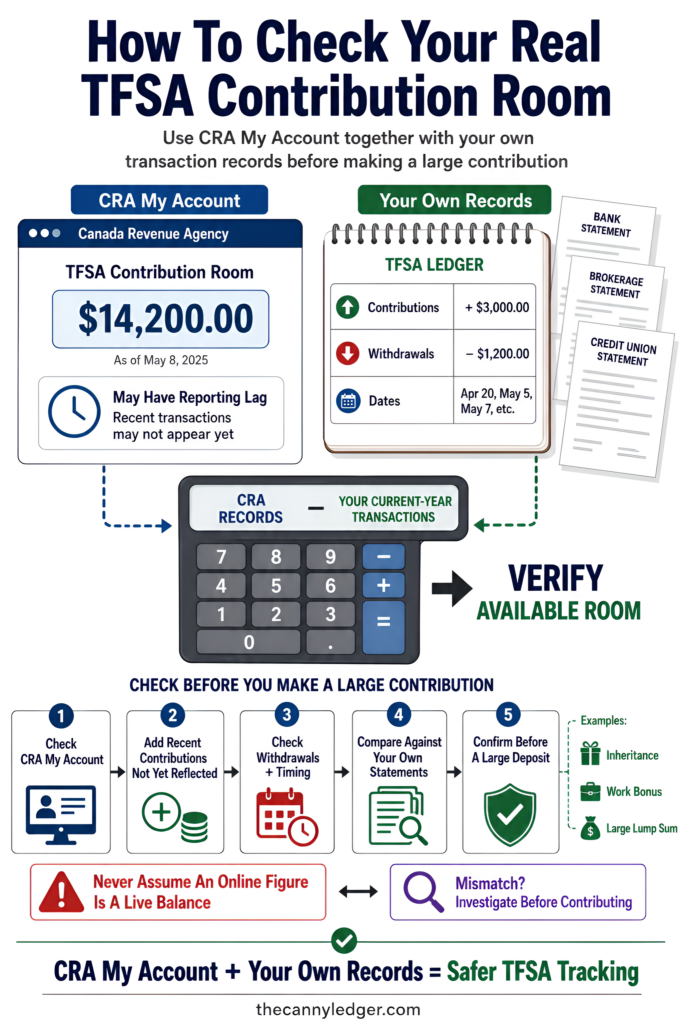
The most reliable way to know your real available room is logging into your CRA My Account directly rather than calculating it by hand from memory. That said, the CRA’s own systems have a real lag, recent contributions and withdrawals can take months to fully process and appear, which means a number checked immediately after a transaction may not yet reflect it accurately. Checking your contribution room through both the CRA portal and your own records is covered in more practical detail elsewhere on this site, including what to do when your own math and the CRA’s displayed figure don’t quite match.
Whatever your own calculated number turns out to be, understand that contributing beyond it triggers a real cost, not just a warning. The specific penalty structure and how to correct an overcontribution once it happens is worth understanding on its own terms before assuming a small excess is a minor issue that resolves itself.
Getting Your Own Number Right
Calculate your own eligible years directly rather than assuming the full $109,000 applies to you, especially if you immigrated as an adult, turned 18 sometime after 2009, or spent any stretch of time as a non-resident of Canada. Log into your CRA My Account to confirm your actual figure before making a large contribution, particularly if you’re depositing a lump sum like an inheritance or a work bonus rather than smaller amounts spread across the year. And if your own calculation and the CRA’s displayed number disagree, treat the CRA’s figure as the one that matters for penalty purposes, then investigate the gap rather than contributing based on your own math alone.

Common Follow-Up Questions
Does my contribution room reset if I close my TFSA and open a new one somewhere else? No. Your available room is a single lifetime total tracked against you personally by the CRA, not tied to any specific account or institution, so closing one TFSA and opening another has no effect on your overall number.
If I never contribute at all, does my unused room eventually expire? No, unused TFSA room carries forward indefinitely with no expiry date, which is exactly why someone opening their first TFSA at 40 or 50 can still have decades of accumulated room waiting for them.
Do TFSA contribution limits apply per person or per household? Per person specifically. A married or common-law couple doesn’t share or combine contribution room, each partner has their own independent total based entirely on their own age and residency history, even if they’re funding both accounts from shared household income.