

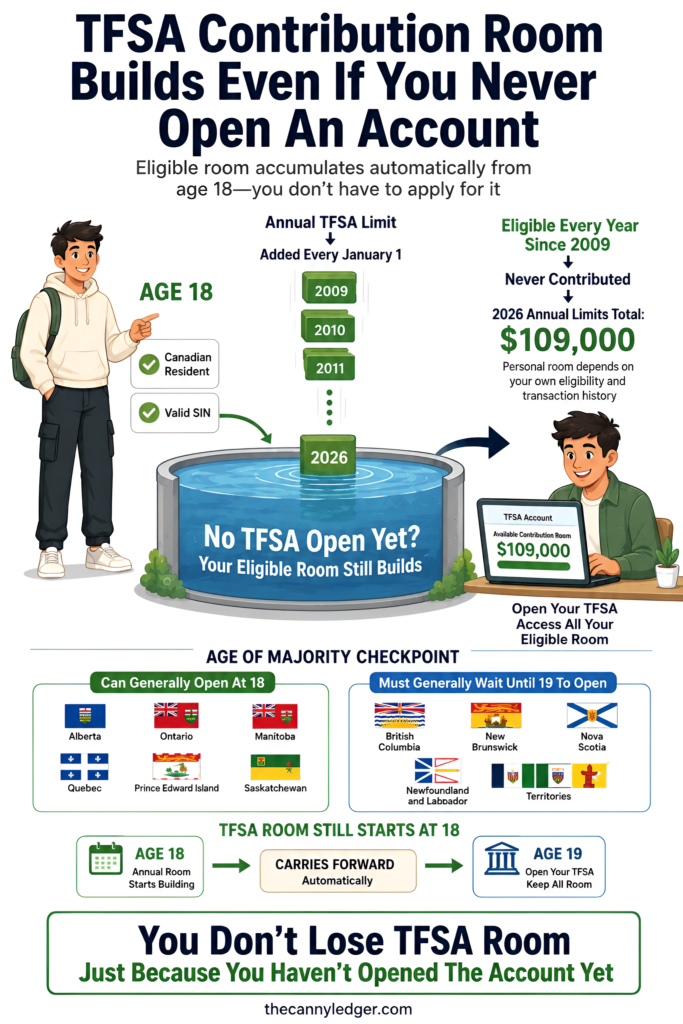
Anyone who turned 18 before 2009 and has never opened a TFSA is sitting on $109,000 of contribution room in 2026, whether they’ve ever heard the term or not. That room doesn’t require an account to exist. It just accumulates quietly in the background every year, tracked by the CRA, waiting for someone to actually claim it. That single fact surprises a lot of people who assume a TFSA is something you either use from day one or miss out on entirely, when the reality is closer to a bank slowly building you a line of credit you never asked for.
A Tax-Free Savings Account lets Canadian residents 18 or older grow investments and withdraw money without paying any tax on the growth, unlike a regular savings account. The 2026 annual contribution limit is $7,000, unchanged for a third consecutive year, and someone eligible since the account’s 2009 launch who has never contributed now has $109,000 in lifetime contribution room. The Canada Revenue Agency’s own contribution room calculator page confirms the 2026 dollar limit directly and explains how that room gets added to your account automatically every January 1. Understanding how that room actually builds, and the specific ways people accidentally lose track of it, matters more than picking the perfect investment to put inside one.
How TFSA Room Actually Builds
Contribution room isn’t something you apply for or unlock, it accumulates automatically the year you turn 18, provided you’re a Canadian resident with a valid Social Insurance Number, regardless of whether you’ve ever opened an account or contributed a single dollar. According to the Canada Revenue Agency’s own guidance on opening a TFSA, that room simply sits there, growing every January when the new annual limit gets added, until you’re ready to actually use it.
There’s a real provincial wrinkle worth knowing here. In Alberta, Ontario, Manitoba, Quebec, Prince Edward Island, and Saskatchewan, the age of majority is 18, matching the TFSA eligibility age exactly. In British Columbia, New Brunswick, Nova Scotia, Newfoundland and Labrador, and the territories, the legal age to enter a contract, including opening a TFSA, is 19. Contribution room still starts building the year you turn 18 no matter which province you live in, but according to the CRA’s own guidance, someone in a 19-year-old-majority province simply can’t open the account until they hit that legal age, at which point the room from the year they turned 18 carries forward and becomes available immediately.
What Actually Makes This Different From Every Other Account
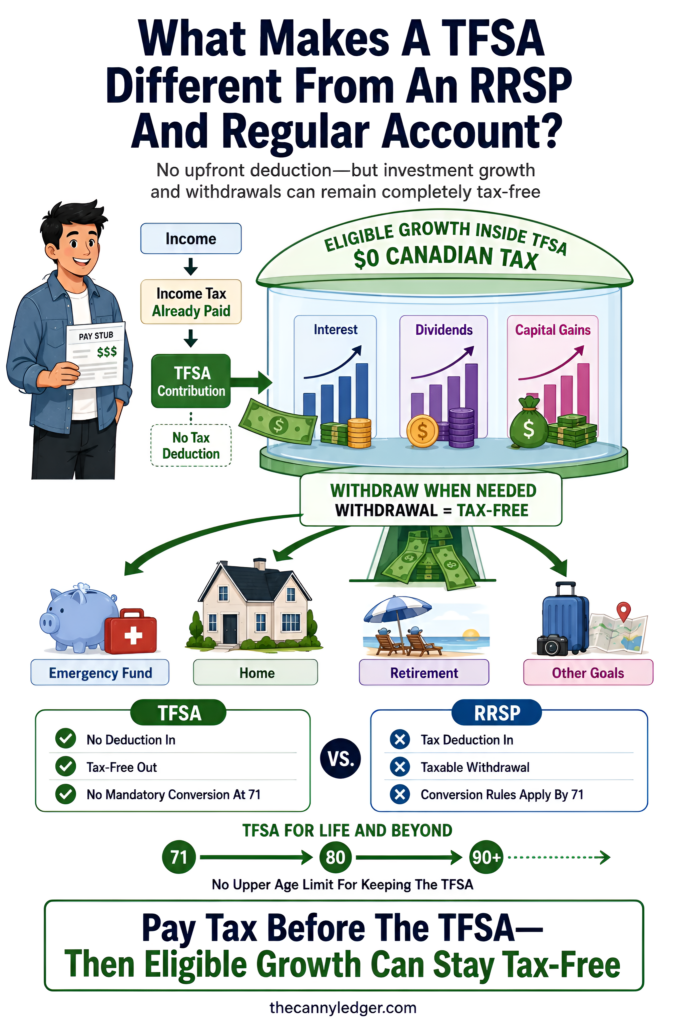
The core mechanic is straightforward once you strip away the jargon. Contributions to a TFSA aren’t tax deductible, unlike an RRSP contribution, but every dollar of growth inside the account, interest, dividends, capital gains, comes out completely tax-free whenever you withdraw it, with no limit on how much you can take out or when. That tradeoff, no upfront tax break in exchange for permanently tax-free growth, is the entire reason this account exists, and it’s also the reason the decision between a TFSA and an RRSP usually comes down to your current tax bracket versus your expected tax bracket in retirement rather than one account being objectively better.
There’s also no upper age limit on holding a TFSA, unlike an RRSP, which has to convert to a RRIF by the end of the year you turn 71. A TFSA can stay open and keep growing tax-free for your entire life, which makes it useful for goals well beyond retirement specifically, a home down payment, an emergency fund, or simply flexible savings you might need access to on short notice without a tax consequence attached to pulling it out.
The Withdrawal Trap That Costs People the Most
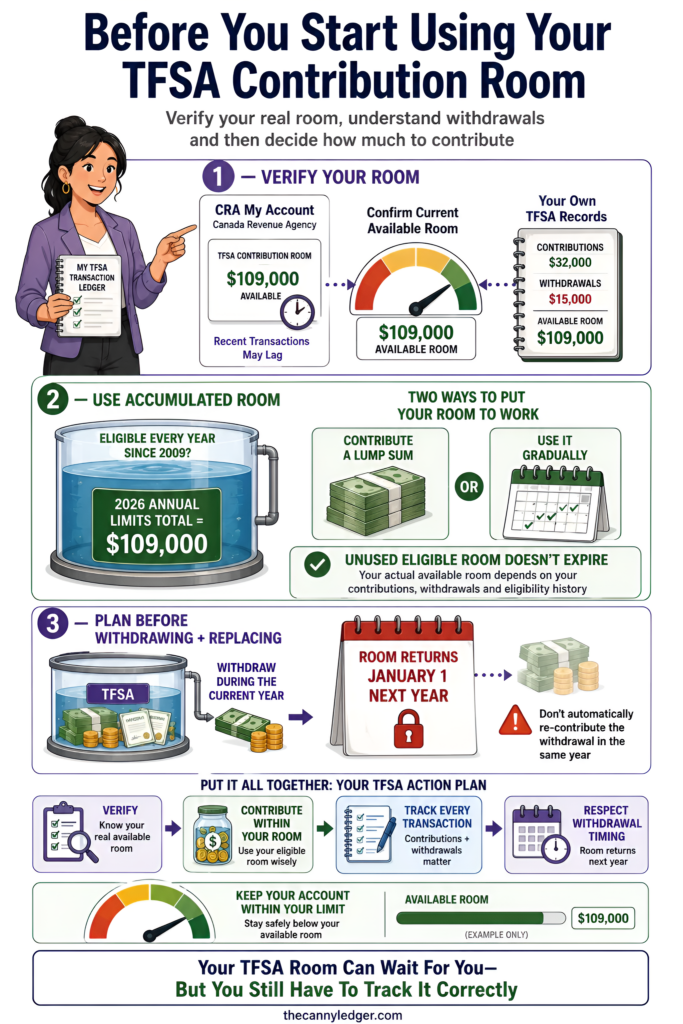
This is the single most common, most expensive mistake people make with a TFSA, and the CRA’s own materials illustrate it directly. Withdrawing money from a TFSA does eventually restore your contribution room, but not immediately, the withdrawn amount only gets added back on January 1 of the following calendar year. Pull out $10,000 in June of this year, and that $10,000 doesn’t become available room again until next January, not the moment it leaves the account.
The CRA’s own worked example makes the consequence concrete. In one scenario from the agency’s own guide for individuals, a contributor named Moira checks her account, sees $20,500 in what she believes is available room, and contributes $11,000 in February, not realizing a chunk of that displayed figure hadn’t actually cleared into usable room yet. The result was a $4,000 excess contribution, immediately subject to the CRA’s penalty tax. That penalty runs at 1% per month on the highest excess amount sitting in the account, charged every month until the excess is either withdrawn or absorbed by new room arriving the following January, which is exactly the kind of slow, compounding cost that catches people who assume a withdrawal and a re-contribution in the same year are a neutral wash. They aren’t. Overcontributing specifically, and how to fix it once it happens, is covered in more detail elsewhere on this site.

What You Can Actually Hold Inside One
A TFSA isn’t just a savings account with a better name, it’s a registered account that can hold a wide range of qualified investments, including stocks, exchange-traded funds, mutual funds, bonds, and GICs, the same building blocks available in a non-registered brokerage account, just wrapped in the tax-free treatment confirmed directly on the CRA’s own program overview page. What you actually choose to hold inside it changes the character of the account entirely, a TFSA built around GICs behaves like a guaranteed, low-volatility savings vehicle, while one built around dividend-paying stocks or US-listed equities introduces market risk and, in the case of US holdings specifically, a cross-border tax wrinkle worth understanding before assuming every asset behaves identically inside the wrapper.
Not every use case fits neatly either. Frequent, high-volume trading inside a TFSA can draw CRA scrutiny under rules distinct from the contribution limits covered here, a separate issue worth understanding on its own terms if your strategy involves anything resembling active trading rather than buy-and-hold investing.

Why the Account Doesn’t Just Belong to You Forever
A TFSA remaining open for life doesn’t mean it’s simple once you’re no longer around to manage it. What happens to the account, and to the person you’ve named on it, depends entirely on whether you named a successor holder or a beneficiary, two terms that sound interchangeable and function very differently. Only a spouse or common-law partner can be named successor holder, letting the account itself pass to them intact with its tax-free status preserved, while a beneficiary of any relationship receives the value of the account instead, without inheriting the TFSA structure itself. What actually happens to the account at death is worth understanding in full before assuming either designation works the way the other one does.

Putting Your Own Room to Use
Check your real, current contribution room directly in your CRA My Account before assuming a number you calculated by hand or remember from a previous year is accurate, since the CRA’s own systems can lag behind recent contributions by several months. If you’ve never opened a TFSA and you’ve been eligible since 2009, understand that the full $109,000 in room isn’t going anywhere, it’s already yours whether you use it this year or spread it out over the next decade. And before making any withdrawal you’re planning to replace later in the same calendar year, confirm the room won’t actually reappear until the following January, since that single misunderstanding is behind more CRA penalty letters than almost any other TFSA mistake.
A Few Things People Ask Once They Understand This
Do I need earned income to contribute to a TFSA, the way I do for an RRSP? No. TFSA contribution room accumulates automatically based on age and residency alone, with no connection to how much you earned that year, unlike RRSP room, which is calculated as a percentage of earned income.
Can I have more than one TFSA at the same time? Yes, there’s no limit on the number of TFSA accounts you can hold across different institutions, but your total contributions across every account combined still can’t exceed your single, overall available contribution room.
Does money inside a TFSA count as income when I withdraw it? No, and this applies regardless of how much has grown inside the account. Withdrawals never count as taxable income and never need to be reported as income on your tax return, which is the entire structural point of the account.