

A parent working full-time at Manitoba’s minimum wage in Winnipeg right now earns $16.00 an hour. The Canadian Centre for Policy Alternatives calculates that actually covering the basics in this city, rent, food, transportation, childcare, without government debt or constant financial strain, takes $19.77 an hour for a two-parent, two-income household. That’s not a rounding difference. It’s $3.77 an hour, more than $7,800 a year for someone working full-time, and it’s the exact gap that “minimum wage” and “living wage” are pointing at when people use the two terms as though they mean the same thing.
A living wage is the hourly rate a worker needs to cover a household’s basic expenses in a specific community, calculated from real local costs like rent, food, and childcare rather than set by government legislation the way minimum wage is. In Winnipeg, the calculated living wage as of the most recent update is $19.77 an hour, well above Manitoba’s legislated minimum wage of $16.00. Unlike minimum wage, no employer is required to pay it, which is exactly why the gap between the two numbers matters.
What Living Wage Actually Means
The distinction between living wage and minimum wage is a legal one before it’s an economic one. Minimum wage is a legislated floor, set by a provincial or federal government, that no employer is legally allowed to pay below, with its own long history behind how that floor came to exist in the first place. A living wage carries no such legal weight at all. It’s a calculated estimate, produced by researchers rather than legislators, describing what an income would actually need to be for a household to cover its real costs in a specific place without falling into constant financial stress.
That calculated number also isn’t the same thing as a poverty line or a low-income measure, which are statistical thresholds used to track deprivation after the fact. A living wage is forward-looking and deliberately modest by design, built to cover necessities and some basic community participation, not comfort, savings, debt repayment, or anything resembling financial security. It’s the floor under which the calculation’s authors consider a household to be struggling in real terms, not a target for a comfortable life.

The Reference Family Behind the Number
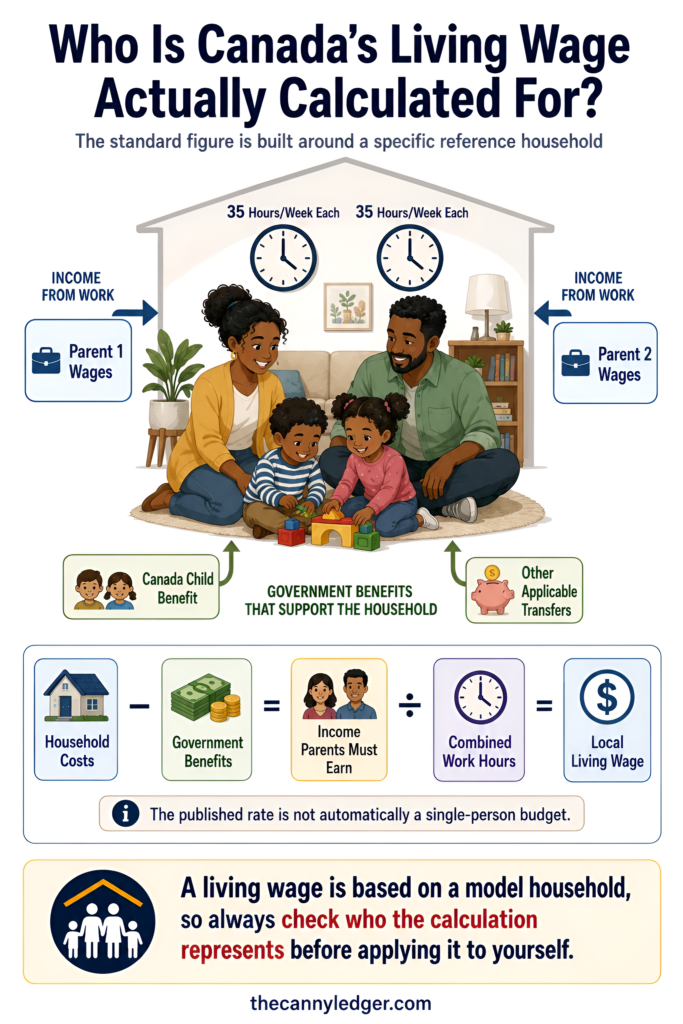
Every living wage figure in Canada is built around a specific household model rather than describing a single individual, and understanding that model changes how the number should actually be read. According to the Canadian Living Wage Framework, the standard reference family used across the country consists of two parents working full-time with two young children, an assumption chosen because it reflects an actually common household structure rather than an edge case built to make the number look better or worse than reality.
Work hours matter to the calculation too. The Ontario Living Wage Network’s own calculation methodology describes a shift several years ago from assuming a 37.5-hour work week to a 35-hour week, a change made deliberately across the movement to standardize comparisons between communities rather than let each region’s own assumptions about full-time work distort the results. Government transfers and benefits, the Canada Child Benefit and similar programs, are added into the family’s income before the final hourly rate is calculated, and that income is measured against the family’s actual costs to arrive at the wage each parent would need to earn.
What’s Actually in the Basket, and What Isn’t
The specific expenses that go into a living wage calculation are deliberately narrow, and the exclusions are just as telling as what’s included. The standard basket covers housing based on median local market rent, food built around Health Canada’s nutrition guidelines, transportation costed as either transit passes or vehicle expenses depending on the community, licensed childcare, clothing, basic household supplies, and a modest allowance for things like a phone plan, internet, and limited recreation or emergency costs.
What’s left out is the more revealing half. There’s no retirement savings built into the number, no line for paying down existing debt, no cushion for a major unexpected expense beyond the small contingency already included, and nothing resembling a vacation or discretionary spending beyond a bare minimum for children’s activities. A living wage, calculated this way, describes a household with almost no financial slack at all, which is worth sitting with directly. Even a family earning the calculated living wage in their community isn’t building savings or getting ahead under this model, they’re covering costs with essentially nothing left over.

Who Actually Calculates This Number
No single government agency produces Canada’s living wage figures, which is a real structural difference from minimum wage and worth understanding before treating any specific number as official in the way a provincial rate is. The calculations come from a network of community-based and provincial organizations coordinated loosely under the Canadian Living Wage Framework, with the Canadian Centre for Policy Alternatives playing a central role in Manitoba and several other provinces, alongside regional bodies like the Ontario Living Wage Network and Living Wage for Families BC running their own local calculations under the same shared methodology.
That decentralized structure is why living wage figures update on different schedules in different places and occasionally use slightly different regional cost data, even while following the same national framework. It’s also why there’s no single national living wage the way there’s a single federal minimum wage, only a patchwork of local numbers built from local costs, which is arguably a more honest reflection of how differently the cost of living actually plays out across a country this large. CBC News reporting on an earlier Manitoba living wage update put a concrete scale on the gap this creates, noting more than 171,000 Manitoba workers were earning below the calculated living wage at the time of that report.
Winnipeg’s Current Number, and Why It Moved
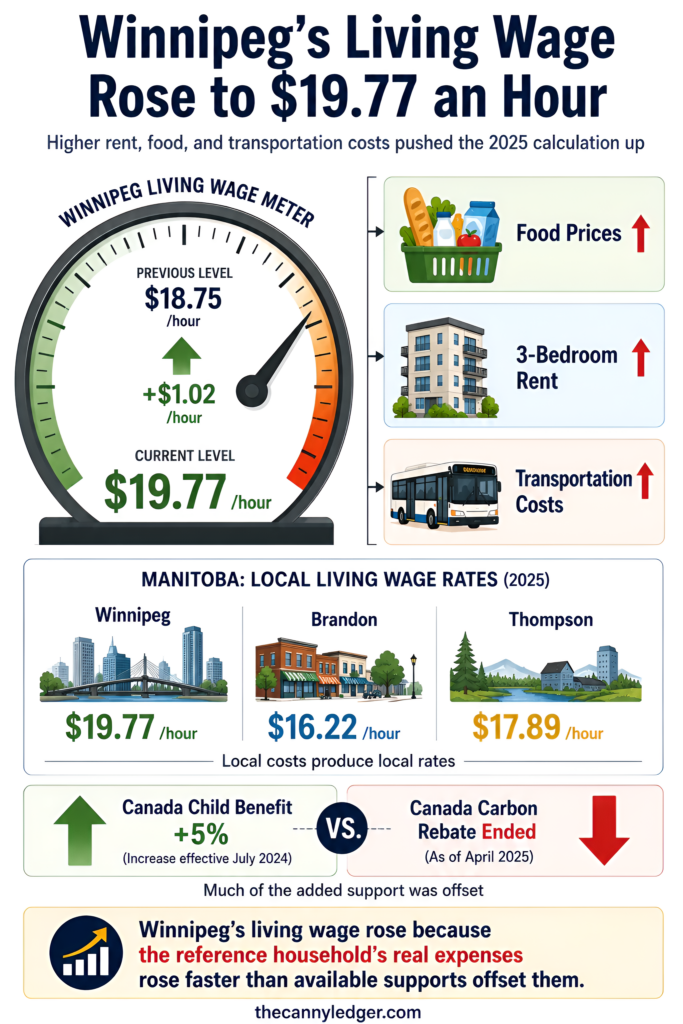
The most recent calculation for Manitoba puts real numbers behind all of this. According to CCPA Manitoba’s December 2025 update, Winnipeg’s living wage rose by $1.02 to $19.77 an hour, while Brandon’s held nearly steady at $16.22 and Thompson’s at $17.89. The report attributes Winnipeg’s larger jump specifically to rising food prices, higher rent for a three-bedroom apartment in the city, and increased transportation costs, compounded by Statistics Canada updating how it measures food and transportation prices using improved consumption data.
That report also notes something easy to miss in the headline number alone. The Canada Child Benefit for the reference Winnipeg family increased by 5% over the same period, which should have partially offset rising costs, except that increase was mostly cancelled out by the elimination of the Canada Carbon Rebate. Two federal programs moved in opposite directions at almost the same time, netting out to very little relief for the family the calculation is built around, which is exactly the kind of detail a bare dollar figure never communicates on its own.

Certified Living Wage Employers
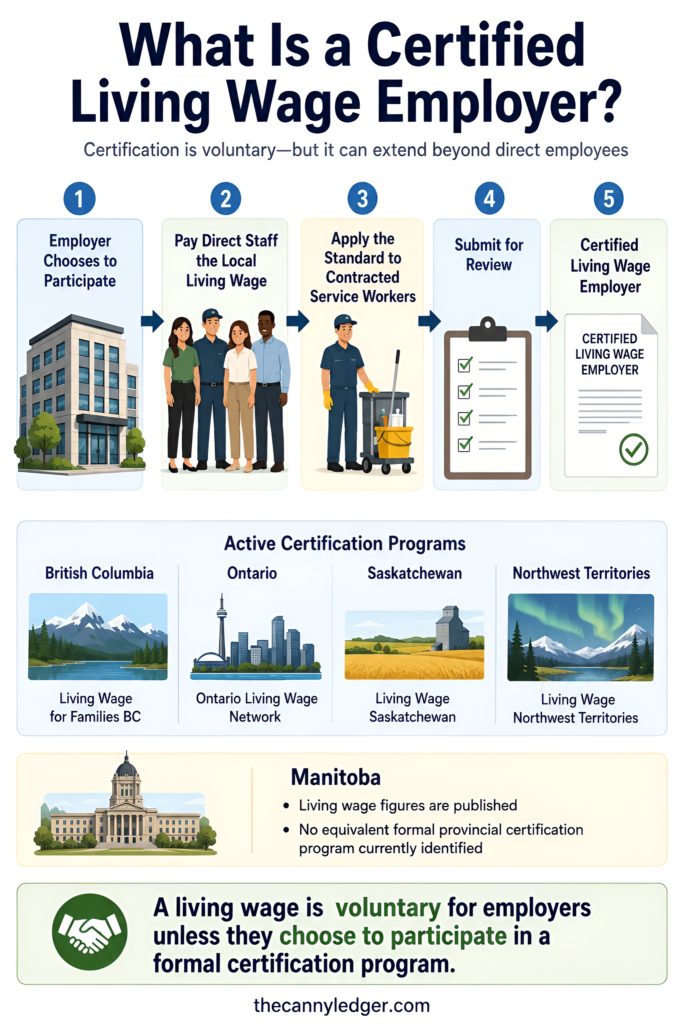
A living wage carries no legal force, but it isn’t purely academic either, since a formal certification structure exists for employers who choose to pay it voluntarily. Living Wage Canada’s national framework describes a certification process that requires an employer to pay all direct staff the locally calculated living wage, extend that same commitment through binding contract language to contracted service workers, and undergo periodic review as the local rate changes. British Columbia, Ontario, Saskatchewan, and the Northwest Territories all run active employer certification programs under this framework, complete with public directories, decals, and formal recognition for participating businesses.
Manitoba calculates and publishes its own living wage figures every year through CCPA Manitoba, but doesn’t currently appear among the provinces running a formal certified employer program the way those other four jurisdictions do. Living Wage for Families BC’s own certification process shows what that infrastructure looks like where it does exist, a formal application, committee review, and an implementation plan for larger employers, none of which currently has a direct Manitoba equivalent. That’s worth knowing if you’re a Manitoba employer looking to formally commit to the living wage standard, since the path likely runs through direct engagement with CCPA Manitoba’s research team rather than an existing certification pipeline built for that specific purpose here.
Questions People Ask About This Number
Does the living wage account for single-person or single-parent households? The standard national reference family is two working parents with two children, but several regional calculators, including some run under the Ontario and BC networks, also publish figures for other household compositions, so it’s worth checking whether your local calculation offers an alternative model rather than assuming the two-parent figure is the only one available.
Is the living wage the same across an entire province? No. The whole point of the methodology is local specificity, which is why Winnipeg, Brandon, and Thompson each have their own distinct figure in Manitoba rather than sharing one provincial number, driven mainly by differences in local housing costs.
Can I calculate what a living wage would look like for my own household specifically? Several provincial networks and national tools let you adjust the standard assumptions to your own household size and location, which gives a far more personally useful number than the published reference family figure alone.

