

Mortgages in this country run on a hard floor. CMHC sets 600 as the line for insured mortgages, and that number exists whether a bank likes it or not. Credit cards work nothing like that. No regulator in Canada sets a minimum credit score for a credit card, at any tier, from a secured starter card to a premium travel card with a four-figure annual fee. Every threshold that follows is a private company’s own risk decision, which is exactly why the numbers shift depending on which issuer, and which card, you’re asking about.
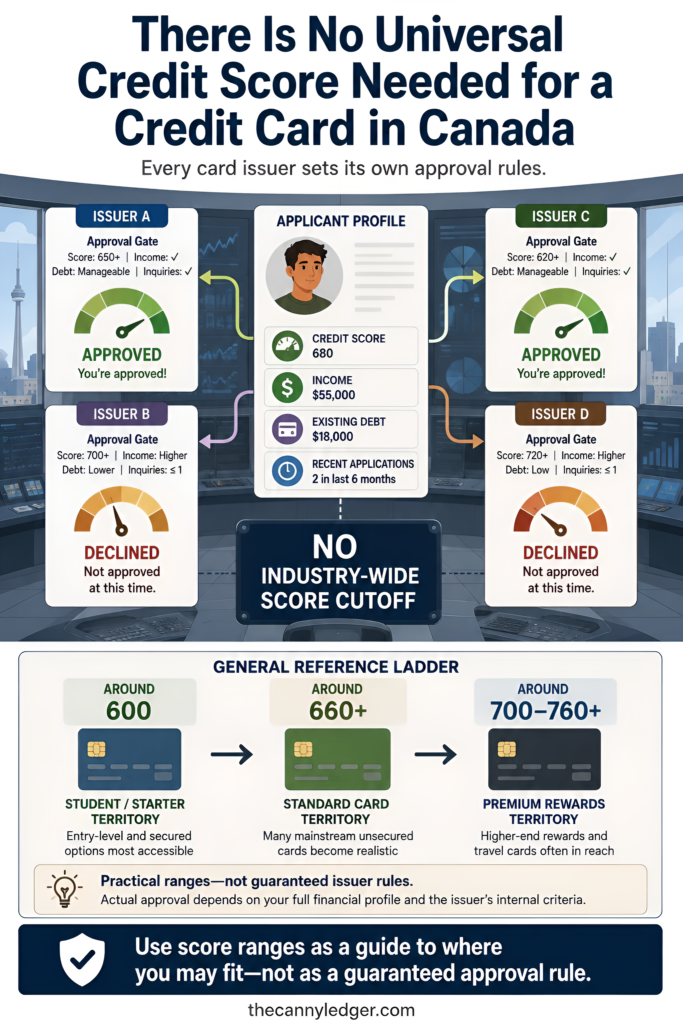
There’s no official minimum credit score for a credit card in Canada. Secured cards approve people with poor or no credit at all since a deposit backs the card. Student and starter cards typically cluster near a 600 score. Standard no-fee cards generally want 660 or higher, and premium rewards or travel cards usually look for 700 to 760 or better. Every issuer sets its own bar, and income, existing debt, and recent applications all factor in alongside the number itself.
Why There’s No Official Number to Point To
This is worth sitting with for a second, because it changes how you should treat every score you see quoted online. According to TD’s own credit education page, credit granting policies vary by product and from one credit grantor to the next, even though most financial institutions collect similar information during the approval process. That’s a bank admitting, in its own words, that there’s no shared industry standard sitting underneath the numbers commonly floating around finance sites.
Treat every specific figure in this article as a well-established pattern across the industry rather than a rule any single company has published. Card issuers protect their exact underwriting criteria the same way credit bureaus protect their scoring formulas, so what follows is the practical, real-world tiering, not a copy of anyone’s internal policy manual.
The Actual Floor, Which Isn’t a Score at All
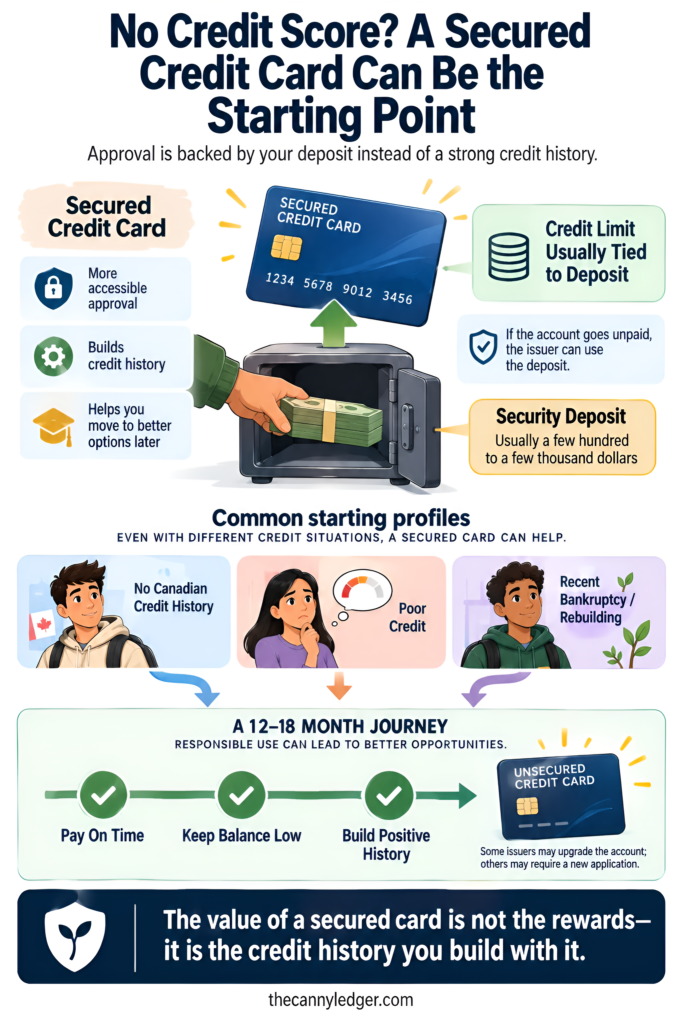
Secured cards don’t have a meaningful credit score requirement because they don’t need one. According to the Government of Canada’s own guidance on choosing a credit card, you provide a security deposit to the issuing institution, typically ranging from a few hundred to a few thousand dollars, and your credit limit is usually set at or above that deposit. If payments go unmade, the issuer can use the deposit to cover what’s owed, which is exactly what makes approval possible even with a poor or nonexistent credit history.
This is the honest starting point for anyone with no Canadian credit file, a recent bankruptcy, or a score sitting low enough that everything else on this list is out of reach, similar to how a bad-credit loan product fills that same gap on the lending side. A secured card’s real value isn’t the card itself, it’s what happens after twelve to eighteen months of on-time payments, when many issuers either upgrade the account to an unsecured card automatically or make an applicant a realistic candidate for one elsewhere.
Student and Starter Cards
A 600 score is the practical range most student and entry-level cards work within, and issuers building these products know their audience has thin files by design. Proof of enrollment usually substitutes for a strong income requirement, since most student cards don’t demand meaningful earnings, and the credit limits tend to stay modest as a result. Building history here matters more than the rewards rate ever will, since the point of a student card is establishing a pattern the file can build on later, not maximizing cash back on textbooks.

Standard No-Fee Cards
Once a score clears 660, the door opens to the bulk of standard unsecured cards, the no-fee, no-frills products that make up most of what a Winnipeg bank or credit union offers to an everyday applicant. Scotiabank’s own consumer page states that a credit score of 660 is generally considered good in Canada and could help with approval, though the bank is careful to note the exact requirement still varies by issuer and by card.
This tier is where most working adults with a clean, unremarkable credit history land, and it’s fine to stay here. A no-fee card that reports faithfully to both bureaus does the same fundamental job for a credit file as an expensive rewards card, just without the annual charge working against you if you’re not going to spend enough to offset it.

Mid-Tier Rewards and Premium Travel Cards
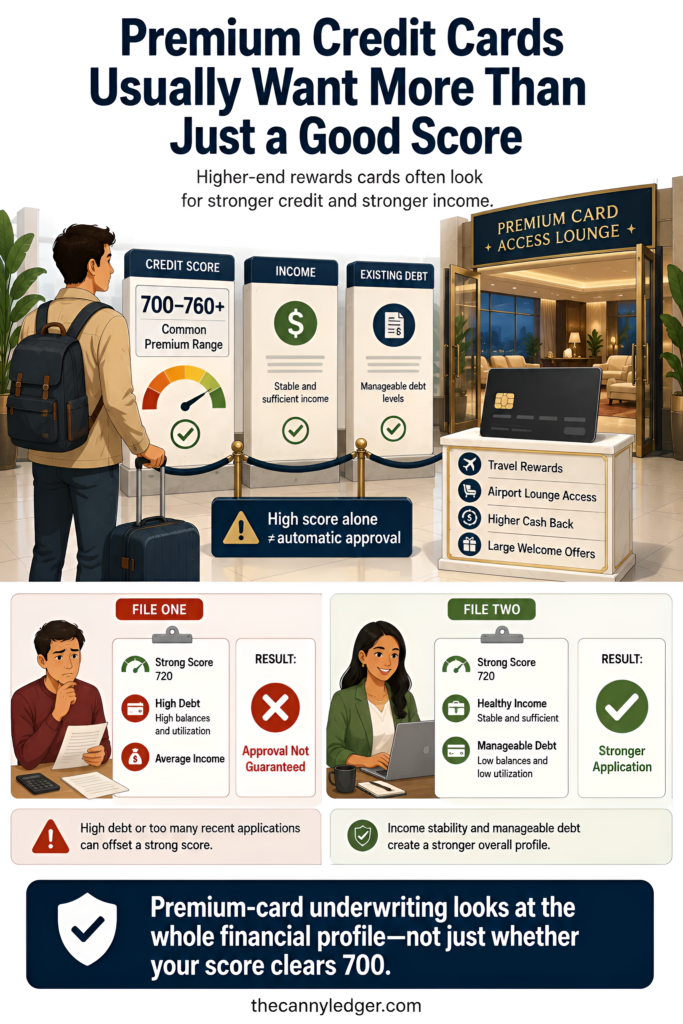
Rewards cards with meaningful cash back or points programs typically want scores landing somewhere in the high 600s to low 700s, and the premium tier, travel cards with airport lounge access, high-value point transfers, and annual fees running into the hundreds of dollars, generally wants 700 to 760 or higher. American Express Canada’s own eligibility criteria confirm applicants need to be Canadian residents of the age of majority with a Canadian credit file, though the company doesn’t publish an exact minimum score the way a stress test or an insurer’s floor gets published for a mortgage.
Income matters more visibly at this tier than it does at the entry level, since a card offering a large sign-up bonus and a premium annual fee is being underwritten with an expectation the cardholder can actually carry meaningful monthly spending, not just clear a credit check. A high score alone won’t necessarily land a premium card if income and existing debt tell a weaker story, which is the same pattern that shows up in mortgage underwriting and isn’t unique to credit cards at all.
Building From Nothing at All
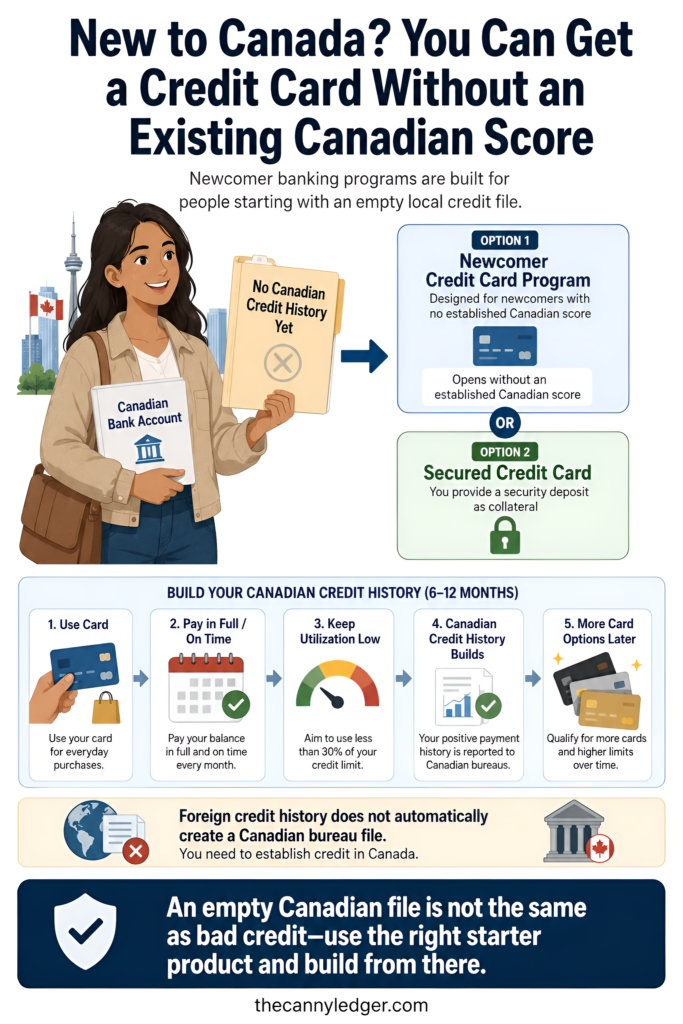
Newcomers to Canada face a version of this problem that has nothing to do with a bad score, since there’s simply no Canadian file yet regardless of credit history built somewhere else. Scotiabank runs a dedicated newcomer track through its StartRight program, offering products like the Scotiabank Scene Visa specifically for new permanent residents, international students, and temporary foreign workers without an existing Canadian credit score. Several other major banks run comparable programs, so it’s worth asking directly rather than assuming a lack of Canadian history functions the same as bad credit.
Anyone in this position, or anyone rebuilding after a rough patch, is better served treating the first card as a tool rather than a reward. A secured card used consistently for six to twelve months, paid in full every cycle, tends to open real doors faster than waiting and hoping a score improves on its own. If a newcomer to Winnipeg specifically is figuring out where to even start with banking, that groundwork usually comes before the card application makes sense at all.
Where This Leaves You
Pull your credit report before applying anywhere, not after a decline shows up on your file as another inquiry. The Financial Consumer Agency’s credit card comparison tool is worth running before settling on a specific card, since it lists options by province, fee structure, and rewards without any single bank’s marketing shaping the results. If your score is sitting in a gap between tiers, a personal loan or a line of credit used responsibly for a few months can move you into the next bracket faster than waiting passively. And if the real obstacle isn’t a low score but debt that’s become unmanageable underneath it, consolidating that debt first will do more for your approval odds than chasing the perfect card application timing ever could. Comparing offers across a credit union rather than only the big banks is also worth the extra half hour, since smaller institutions sometimes show more flexibility on borderline applications than a national bank’s standardized criteria allow.

Follow-Up Questions Worth Answering
Will applying for several cards at once to see which one approves me hurt my chances? Yes, and it can hurt more than the individual rejection itself. Each formal application generates a hard inquiry, and several in a short window signal risk to every issuer that sees the file, even the ones you haven’t applied to yet.
Does a secured card show up differently on my credit report than a regular card? No. A secured card reports to the bureaus the same way an unsecured one does, with the same account type and payment history fields, so the security deposit itself never appears as a mark against you.
If I’m denied for a card, does that lower my score by itself? No. The denial isn’t reported anywhere. The hard inquiry generated by the application is what appears on your file and can have a small, temporary effect, independent of whether the application was approved.