
Look closely at a Winnipeg receipt and there are usually two separate tax lines sitting one above the other, not one. A lot of shoppers glance past both and mentally file the total under “12% tax,” which is close enough for a rough estimate but wrong in a way that actually matters at the register. Manitoba charges two entirely separate taxes on the same purchase, the federal Goods and Services Tax and the province’s own Retail Sales Tax, and they don’t always agree on what counts as taxable. A children’s coat can dodge one and still get hit by the other. A restaurant dinner gets taxed by both, in a province where neighbouring Saskatchewan would only charge one.
- Two Separate Taxes, Not One 12% Tax
- What’s Actually Exempt from Both Taxes
- Where GST and RST Actually Disagree
- The Restaurant Meal Surprise
- Winter Relief: The Home Heating Exemption
- Buying a Car, New or Private
- Streaming, Software, and Cloud Subscriptions
- Doing the Math at the Register
- Common Questions About Manitoba Sales Tax
Manitoba’s combined sales tax works out to 12 percent, 5 percent federal GST plus 7 percent provincial Retail Sales Tax (RST, commonly still called PST), calculated separately on the same pre-tax price rather than stacked on top of each other. Basic groceries and prescription drugs are exempt from both. Beyond that baseline, the two taxes frequently part ways on what’s actually taxable, which is exactly where shoppers get caught off guard.
Two Separate Taxes, Not One 12% Tax
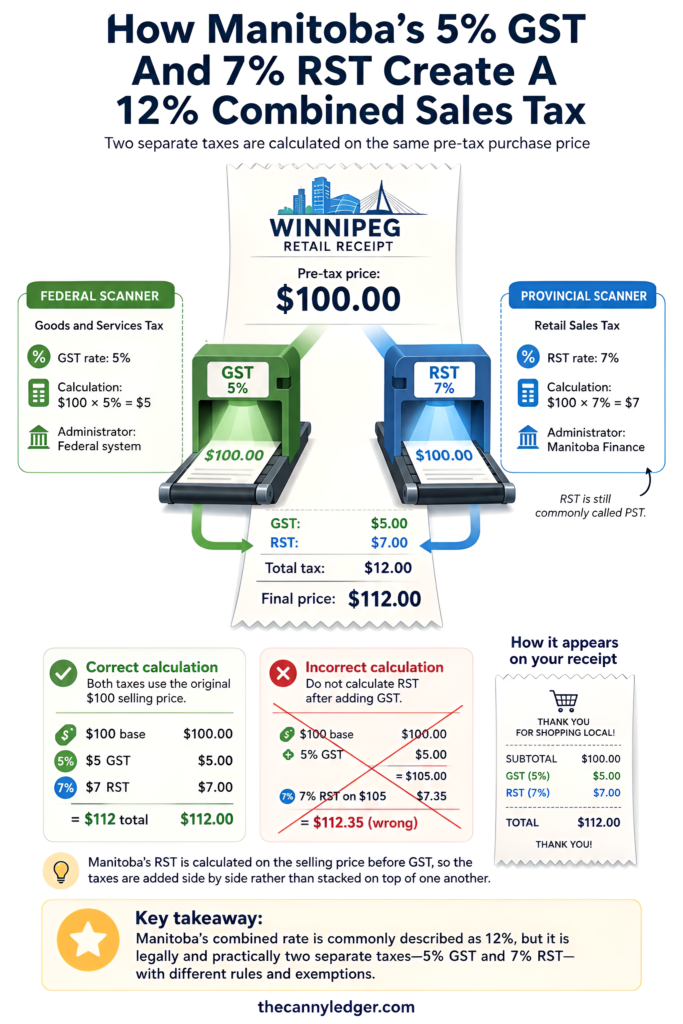
Manitoba’s Retail Sales Tax sits at a general rate of 7 percent, calculated on the selling price before the federal GST gets applied, not on top of a GST-inflated price the way some provinces’ taxes compound. That distinction matters for the math: a $100 item collects $7 in RST and $5 in GST, both calculated independently against the same $100 base, landing at $112 total rather than some higher, compounded figure. Manitoba renamed its old Provincial Sales Tax to Retail Sales Tax years ago, but functionally it’s still the same provincial sales tax most Canadians know as PST, administered separately from the GST by Manitoba Finance rather than the CRA, which is why some purchases show up taxable under one and exempt under the other.
What’s Actually Exempt from Both Taxes
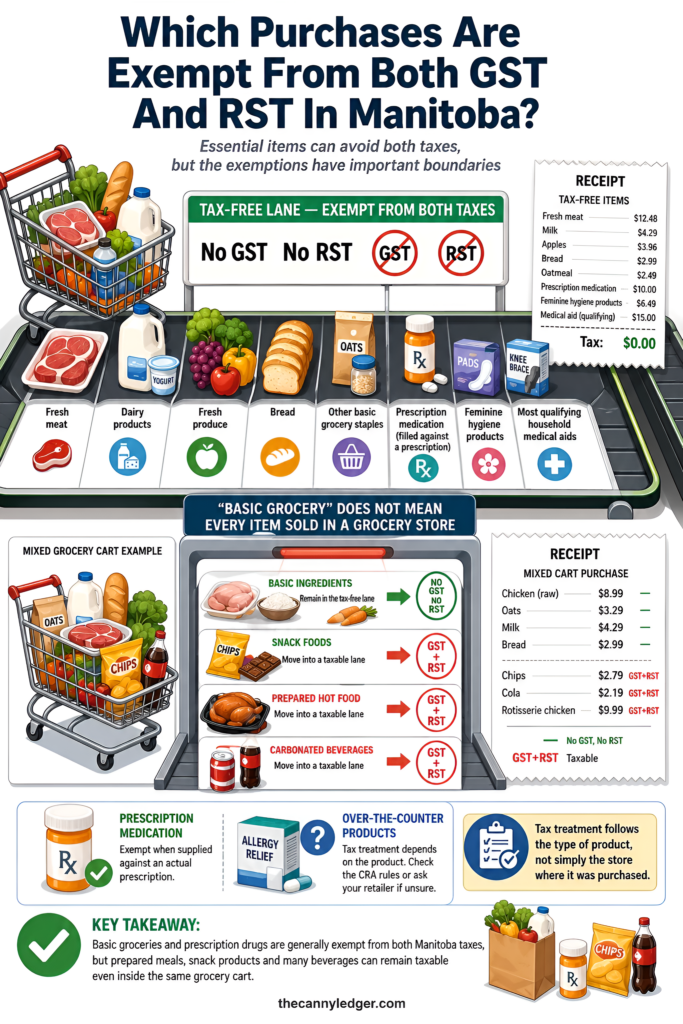
The overlap between the two taxes is narrower than most shoppers assume, but a handful of essentials genuinely dodge both. Basic groceries, meat, dairy, produce, bread, and similar staples, are exempt from GST and RST alike, as are prescription drugs filled against an actual prescription. Feminine hygiene products and most household medical aids clear both taxes too. Where this gets confusing fast is that “basic groceries” has real edges: snack foods, prepared hot meals, and carbonated beverages typically don’t qualify for the grocery exemption even when purchased at the same grocery store, so a cart with both raw ingredients and a hot rotisserie chicken can ring up with some items taxed and others not.
Where GST and RST Actually Disagree
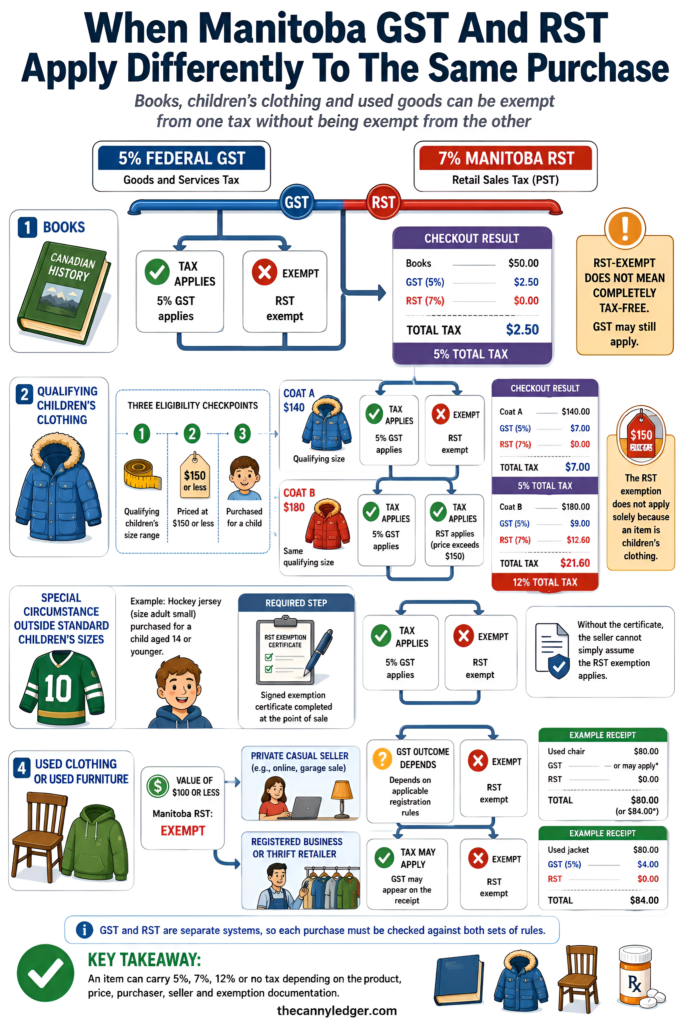
This is the part that catches people off guard, since it’s easy to assume an item exempt from one tax is automatically exempt from both. Books are the clearest example: Manitoba’s RST exempts books outright, but the federal GST still applies to the same purchase, so a book at the till shows 5 percent tax, not 12 percent and not zero. Children’s clothing runs the opposite direction in complexity. Manitoba’s RST exempts children’s clothing, footwear, and accessories specifically priced at $150 or less within defined children’s size ranges, a detail a lot of general summaries leave out entirely, quoting only the size ranges and skipping the price cap. A $180 winter coat in a qualifying children’s size doesn’t get the exemption purely because it crosses that $150 line, even though a $140 coat in the same size range would. Items outside the standard size ranges can still qualify if purchased specifically for a child 14 or under, but only with a signed exemption certificate completed at the point of sale, otherwise the seller is on the hook for the uncollected tax.
Used goods carry their own separate threshold. Used clothing and used furniture valued at $100 or less are RST exempt, which matters directly for anyone shopping secondhand or at a thrift store, though GST can still apply depending on the seller’s registration status.
The Restaurant Meal Surprise
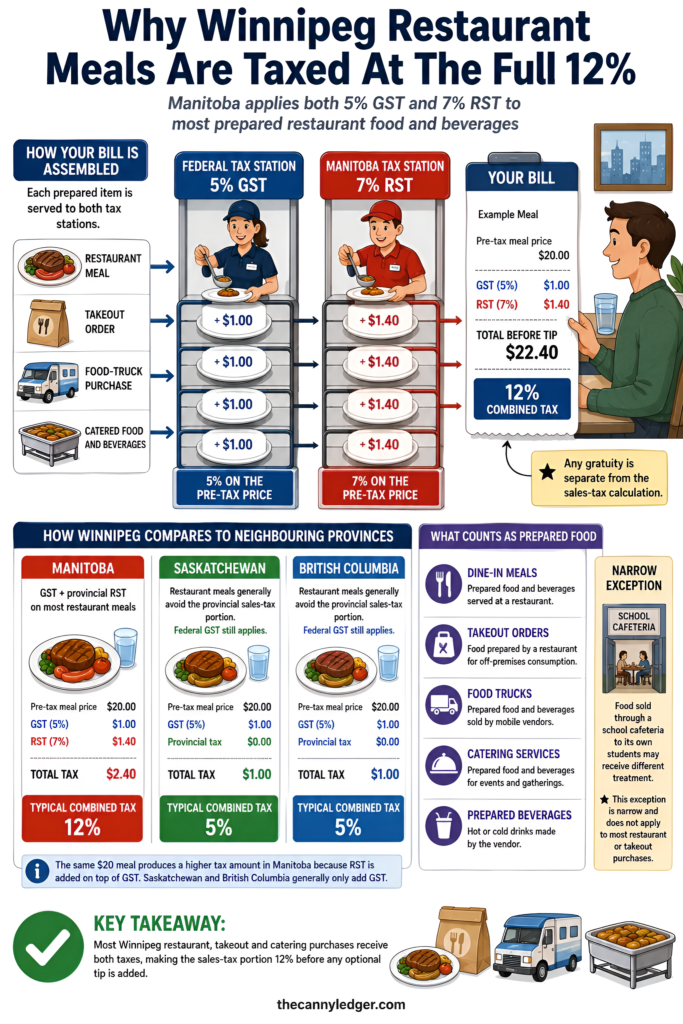
Here’s a genuine Manitoba quirk worth knowing before comparing notes with anyone shopping in a neighbouring province: Manitoba charges RST on restaurant meals, takeout, and catering, the full 7 percent, stacked with the usual 5 percent GST for a full 12 percent on the meal. In British Columbia and Saskatchewan, restaurant meals are typically exempt from the provincial portion of sales tax entirely, so a Manitoban visiting either province and comparing a restaurant bill against a similar one back home will notice the gap immediately. This isn’t a small category either, prepared food and beverages sold by restaurants, food trucks, and caterers all fall under the same taxable rule, with only a narrow set of exceptions like food sold through a school cafeteria to its own students.
Winter Relief: The Home Heating Exemption
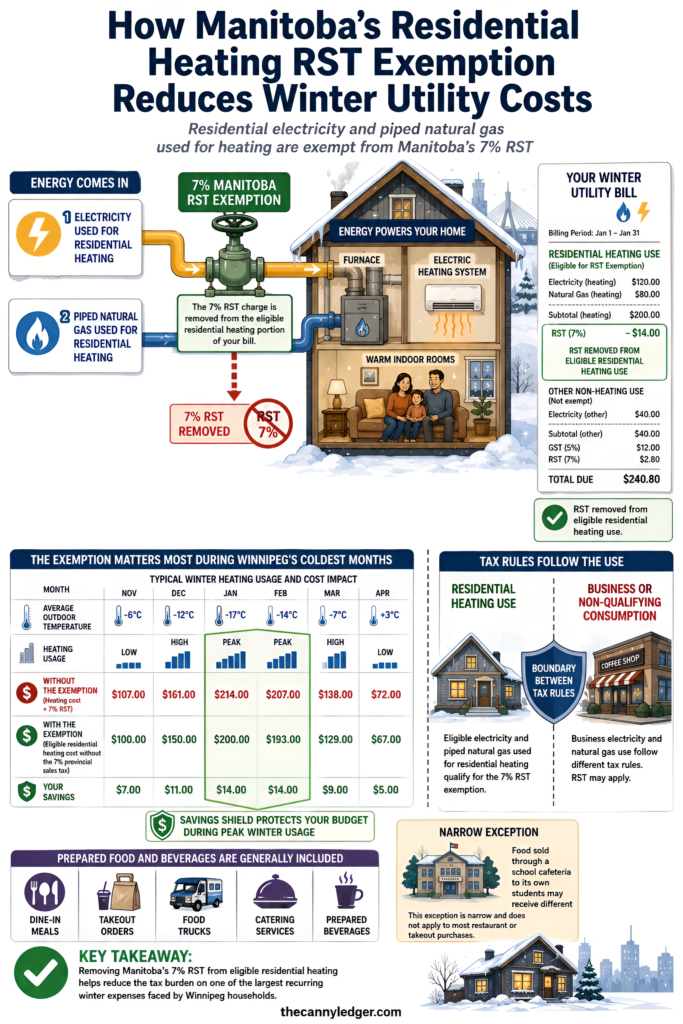
One exemption specifically matters more in Manitoba than in provinces with milder winters: electricity and piped natural gas used for residential heating are exempt from RST. Given how much of a typical Winnipeg household’s utility spending happens during the coldest months, this exemption meaningfully softens what would otherwise be a substantial added cost on an already significant winter expense. It’s worth noting this exemption applies specifically to residential heating use, not to electricity or gas consumed by a business, which is billed and taxed differently.
Buying a Car, New or Private
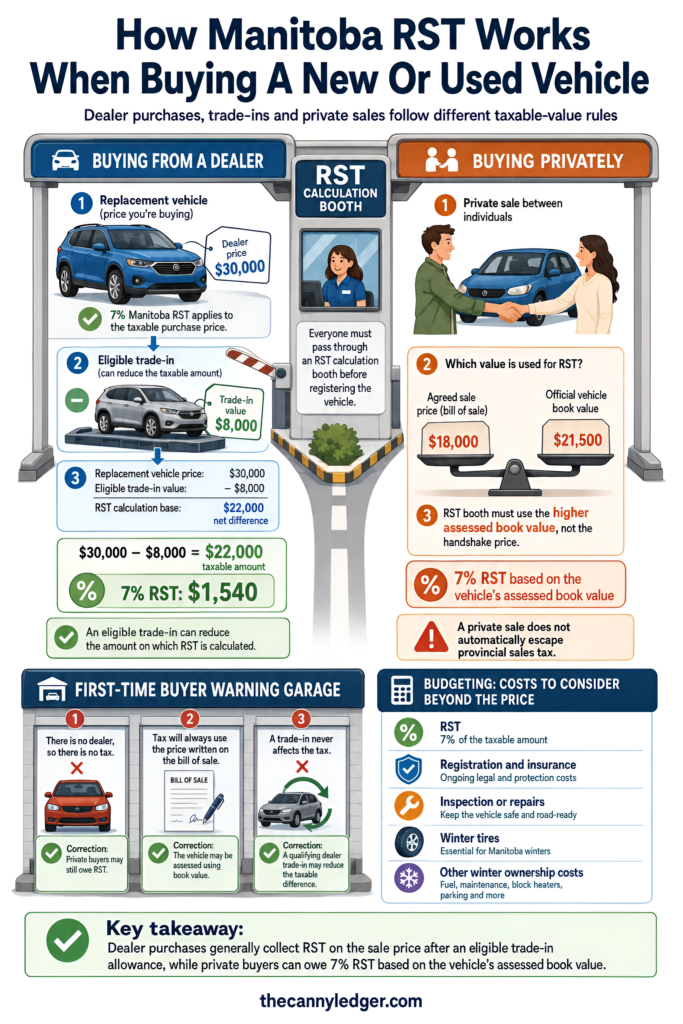
Vehicle purchases come with their own set of RST rules that surprise a lot of first-time or private buyers specifically, on top of the other winter-specific costs of owning a vehicle in Manitoba. Buying new or used from a dealer, RST applies to the purchase price, though Manitoba allows a trade-in allowance, meaning RST is calculated only on the net difference between the new vehicle’s price and the trade-in’s value, not the full sticker price. Buying privately, individual to individual with no dealer involved, doesn’t escape RST either. The buyer is still required to pay 7 percent RST on the vehicle’s book value, assessed independently of whatever price the two parties actually agreed on, which catches a lot of private buyers off guard who assume a handshake deal between two individuals sits outside the tax system entirely.
Streaming, Software, and Cloud Subscriptions
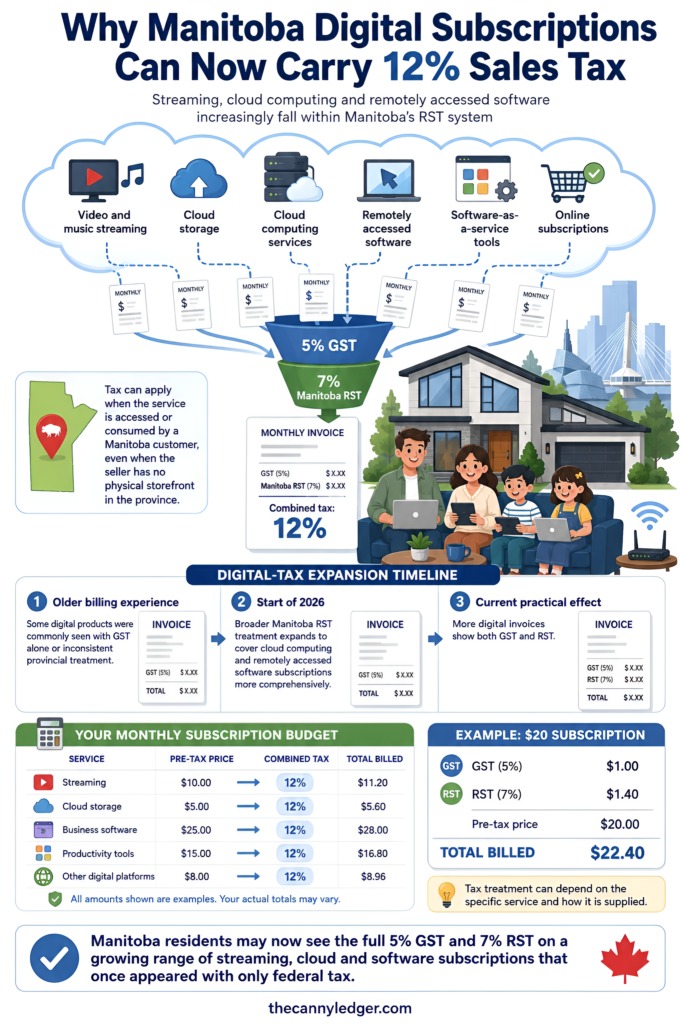
Digital purchases have been a moving target in Manitoba specifically. Software, streaming, and cloud-based subscriptions accessed by Manitoba residents have increasingly fallen under RST’s scope even when the seller has no physical presence in the province, following a legislative expansion effective at the start of 2026 that broadened RST to cover cloud computing services and remotely accessed software subscriptions more comprehensively than before. For a shopper, the practical effect is that a growing share of digital subscriptions, streaming services, cloud storage, software-as-a-service tools, now show the same 12 percent combined tax that physical goods carry, rather than GST alone the way a lot of older digital purchases used to be billed.
Doing the Math at the Register
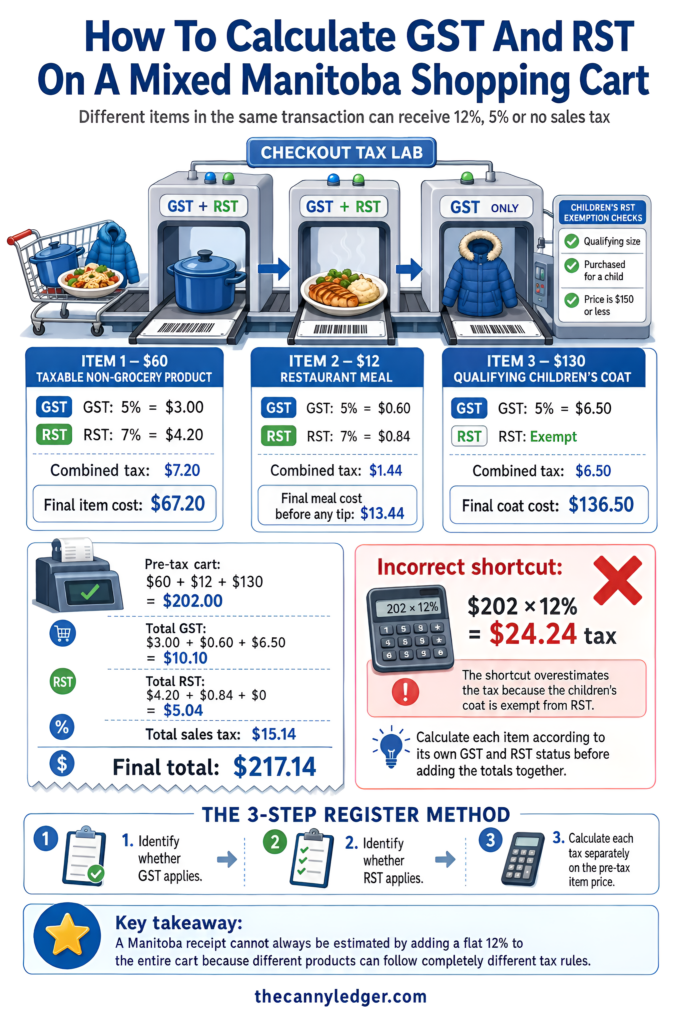
Put the two taxes together on a real cart: a $60 non-grocery item, a $12 restaurant meal, and a $130 qualifying children’s coat. The $60 item picks up $7.20 combined tax (12 percent). The $12 meal picks up $1.44. The children’s coat, priced under the $150 cap and in a qualifying size, skips RST entirely but still owes 5 percent GST, $6.50. Total tax across three items that look similarly “taxable” on the surface: $15.14, unevenly split across three completely different rules, which is exactly why eyeballing a Manitoba receipt as a flat 12 percent markup undercounts or overcounts depending on what’s actually in the cart.
Common Questions About Manitoba Sales Tax
Is RST the same thing as PST? Functionally, yes. Manitoba officially renamed its Provincial Sales Tax to Retail Sales Tax, but it’s still commonly referred to as PST across Canada, and it works the same way, a provincial tax layered on top of the federal GST rather than replacing it.
Do Status Indians or First Nations bands pay RST in Manitoba? Registered Status Indians and Indian Bands are exempt from Manitoba’s 7 percent RST on goods and services purchased on First Nations land, a provincial exemption separate from any federal GST rules, which apply differently and require their own documentation at the point of sale.
Why does a receipt sometimes show GST charged but not RST, or the reverse? Because the two taxes are administered separately with different exemption lists entirely, an item can legitimately owe one without the other. Books are RST-exempt but GST-taxable. A qualifying used item under $100 might dodge RST while still carrying GST depending on the seller. Neither line reflects an error, they’re just two independent tax systems applied to the same purchase.
Next time a Winnipeg receipt shows two separate tax lines rather than one combined number, that’s not a formatting quirk, it’s two different governments applying two different sets of rules to the same cart. Knowing which exemptions apply to which tax, especially around clothing price caps, restaurant meals, and private vehicle sales, is the difference between budgeting accurately and being surprised at the register, the same kind of clarity worth having about Manitoba’s income tax rules when tax season rolls around.