
A dollar earned in Winnipeg gets taxed by three different governments before it’s fully spent. The federal government and Manitoba both take a bite out of it as income. Manitoba and the City of Winnipeg both take a bite out of the home it eventually buys. And the federal government and Manitoba again, separately, tax whatever’s left once that dollar gets spent at a store or a restaurant. None of the three systems talk to each other, each has its own rates, its own schedule for changing them, and its own rules for what counts as taxable, which is exactly why a full picture of what Winnipeg residents actually pay rarely shows up in one place.
- Property Tax Rates at a Glance
- Income Tax Rates at a Glance
- Sales Tax Rates at a Glance
- Putting It All Together: One Household’s Full Tax Picture
- Which Tax Actually Takes the Biggest Bite
- Where Manitoba Ranks Against Other Provinces
- Rates That Move Every Year vs Rates That Don’t
- Common Questions About Winnipeg’s Combined Tax Rates
As of 2026, Winnipeg residents face a municipal property tax mill rate of 13.372 plus a school division mill rate ranging from 11.851 to 16.158 depending on address, provincial income tax brackets of 10.8, 12.75, and 17.4 percent, and a combined 12 percent sales tax (5 percent federal GST plus 7 percent provincial RST). Each of these moves on its own separate timeline, some frozen for years at a stretch, others adjusting every single year.
Property Tax Rates at a Glance
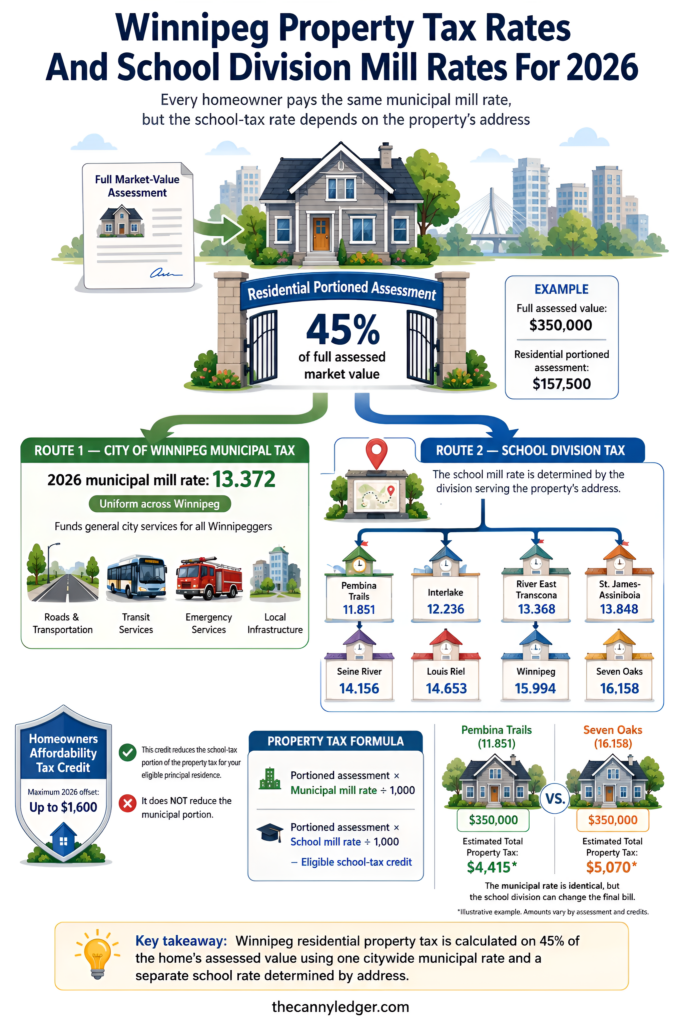
Winnipeg’s municipal mill rate for 2026 sits at 13.372, applied uniformly citywide, while school division mill rates vary by which of Winnipeg’s eight divisions a specific address falls into:
| School Division | 2026 Mill Rate |
|---|---|
| Pembina Trails | 11.851 |
| River East Transcona | 13.368 |
| St. James-Assiniboia | 13.848 |
| Interlake | 12.236 |
| Louis Riel | 14.653 |
| Seine River | 14.156 |
| Winnipeg | 15.994 |
| Seven Oaks | 16.158 |
Both rates apply to a property’s portioned assessment, 45 percent of its full market value assessment for residential property, not the full assessed value itself. The Homeowners Affordability Tax Credit offsets up to $1,600 of the school portion for eligible principal residences. The full mechanics behind these numbers, including how the assessment itself gets calculated and how to search a specific property’s value, are covered separately in understanding your Winnipeg property tax assessment and Winnipeg’s property tax calculator.
Income Tax Rates at a Glance

Manitoba runs a three-bracket provincial income tax system, unchanged between 2025 and 2026 due to an indexation freeze announced in the province’s 2025 Budget:
| Taxable Income | 2025 & 2026 Manitoba Rate |
|---|---|
| First $47,000 | 10.80% |
| $47,000 to $100,000 | 12.75% |
| Over $100,000 | 17.40% |
Manitoba’s Basic Personal Amount, the income exempt from provincial tax entirely, sits at $15,780 for both years, also frozen. Federal rates and brackets sit on top of this provincial structure and move independently, including a rate cut to the bottom federal bracket for 2026. The full breakdown of how the two layers combine, along with the bracket-creep effect the freeze is quietly causing, is covered in Manitoba and Winnipeg’s personal income tax guide.
Sales Tax Rates at a Glance
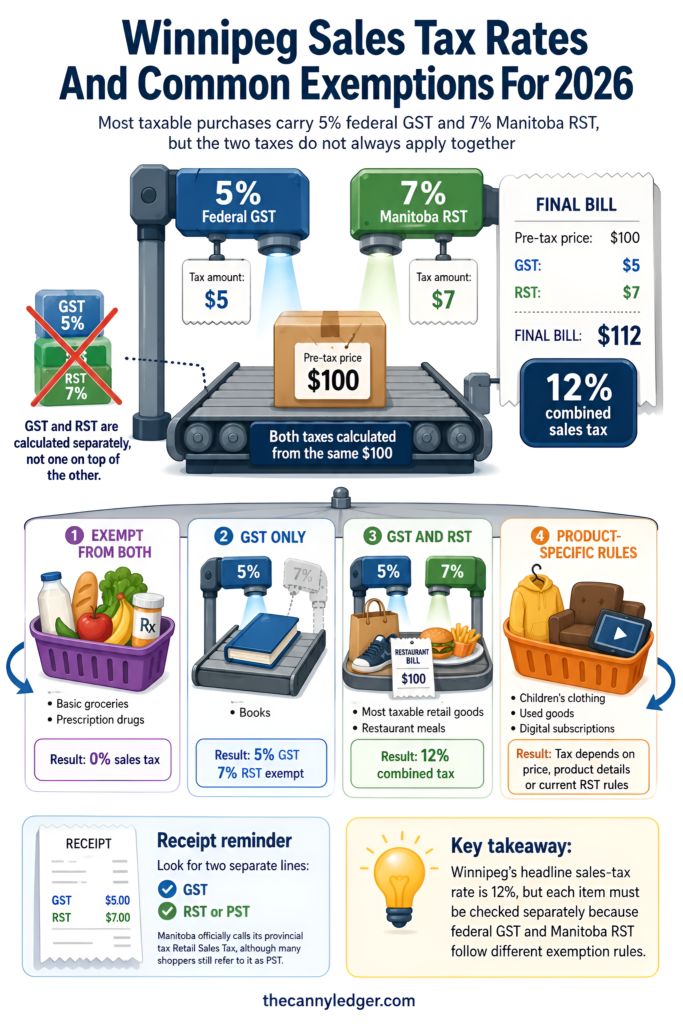
Every taxable retail purchase in Winnipeg carries a combined 12 percent rate, split between the federal 5 percent GST and Manitoba’s 7 percent Retail Sales Tax (RST), calculated independently on the same pre-tax price rather than stacked on top of each other. The two taxes don’t always agree on what’s exempt, basic groceries and prescription drugs clear both, but books dodge RST while still owing GST, and restaurant meals get hit by both at the full combined rate. The complete rundown of what’s taxed, what’s exempt, and where the two systems diverge is covered in Winnipeg sales tax explained for shoppers.
Putting It All Together: One Household’s Full Tax Picture
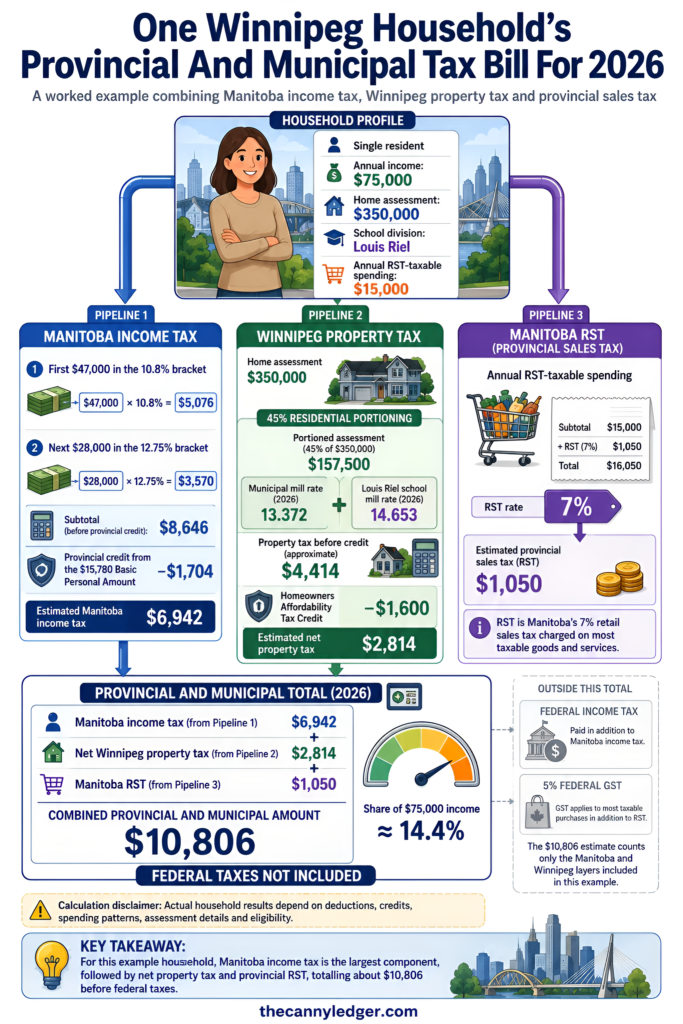
None of the rates above mean much in isolation, so here’s what they add up to for one real, specific household. Take a single Winnipeg resident earning $75,000 a year, owning a home assessed at $350,000 in the Louis Riel school division, and spending roughly $15,000 annually on RST-taxable goods and services.
Manitoba’s provincial income tax alone, before the federal portion, works out to about $6,942: $5,076 on the first $47,000 at 10.8 percent, plus $3,570 on the next $28,000 at 12.75 percent, minus a $1,704 credit from the Basic Personal Amount. Property tax on that $350,000 home, using Louis Riel’s 14.653 school mill rate alongside the citywide 13.372 municipal rate, comes to $4,414 before credits, reduced to roughly $2,814 once the full $1,600 Homeowners Affordability Tax Credit applies. RST specifically, separate from the GST portion, adds another $1,050 on that $15,000 of annual spending. Add the three together, provincial income tax, municipal and school property tax net of credits, and provincial sales tax, and this household sends roughly $10,806 to Manitoba and Winnipeg specifically, before a single dollar of federal income tax or federal GST is counted at all. Against $75,000 in income, that’s about 14.4 percent flowing to the provincial and municipal layer alone.
Which Tax Actually Takes the Biggest Bite
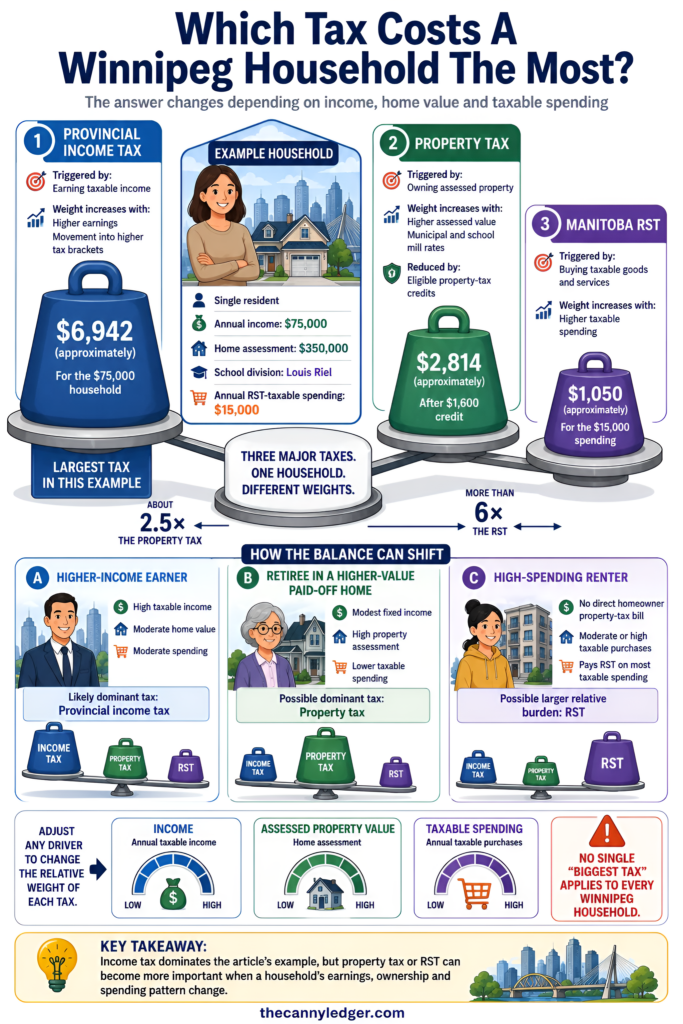
For this specific household, provincial income tax is the largest single piece by a wide margin, nearly two and a half times the property tax bill and more than six times the RST portion. That balance shifts considerably depending on the household, though. A retiree living on a modest fixed income in a paid-off, higher-value home would see property tax dominate instead, since income tax scales with earnings while property tax scales with assessed value, two numbers that don’t move together. A high-spending household with a smaller mortgage or a rental instead of ownership would see RST take on relatively more weight, since it’s the one tax in this picture triggered by spending rather than earning or owning. There’s no single “biggest tax” that holds true for every Winnipeg household, which is exactly why running your own numbers through each rate matters more than trusting an average.
Where Manitoba Ranks Against Other Provinces
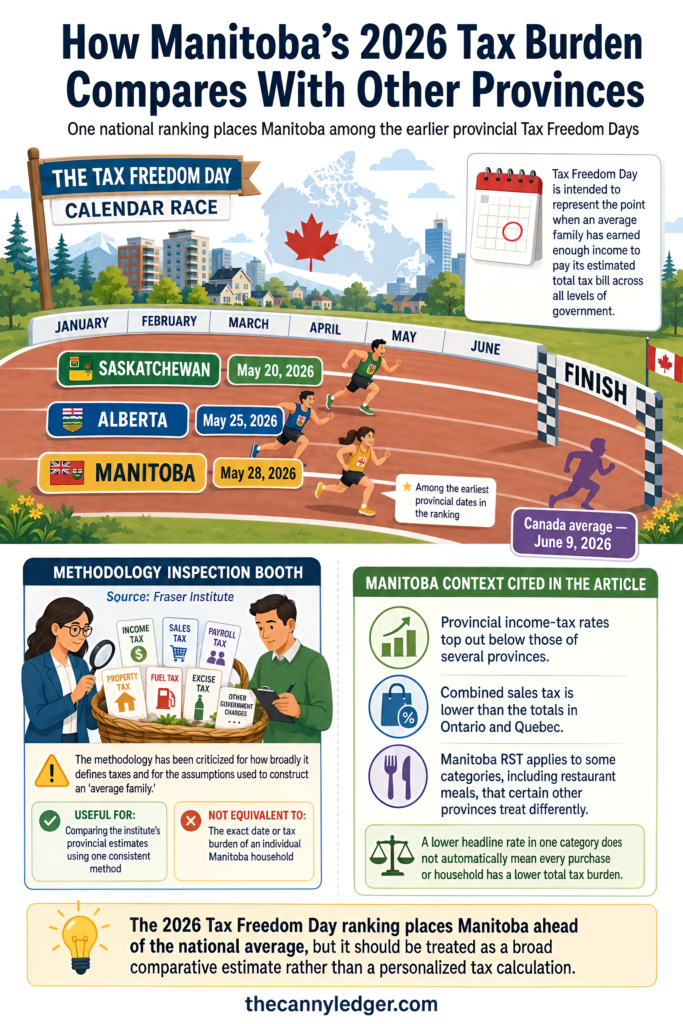
The Fraser Institute, a public policy think tank whose Tax Freedom Day methodology has drawn criticism from other researchers over the years for how broadly it defines “taxes,” calculates a date each year representing how long an average family would need to work to pay its full combined tax bill across all levels of government. For 2026, the institute puts Manitoba’s Tax Freedom Day at May 28, among the earliest of any province, behind only Saskatchewan (May 20) and Alberta (May 25), and well ahead of the national average of June 9. Whatever the methodology’s limitations, the relative ranking lines up with the raw rate comparison: Manitoba’s income tax brackets top out lower than several other provinces’, and its sales tax rate sits below Ontario’s or Quebec’s combined totals, even with RST applying to some categories, like restaurant meals, that other provinces exempt.
Rates That Move Every Year vs Rates That Don’t

Looking at all three tax types side by side reveals a pattern worth knowing about on its own. Manitoba’s income tax brackets and Basic Personal Amount are currently frozen, unchanged since 2024 and confirmed to stay that way through 2026. Property assessments update on a fixed two-year cycle, but mill rates themselves, the actual rate applied to that assessment, get revisited and adjusted annually by both the City and each school division, meaning even a homeowner with an unchanged assessed value can still see their bill move purely from the rate side. Sales tax rates, by contrast, have stayed stable for years at the current 12 percent combined level, though what counts as taxable under RST has continued to expand, digital subscriptions and cloud services being the most recent example. None of these three systems update on the same schedule, which is part of why a single year-over-year comparison of “Winnipeg taxes” rarely tells the whole story without breaking it down by type.
Common Questions About Winnipeg’s Combined Tax Rates
Which of these taxes is actually collected by the City of Winnipeg versus the Province? The municipal portion of property tax is set and kept by the City, while the school portion is set by individual school divisions and collected by the City on their behalf before being passed along. Income tax and sales tax are collected federally and provincially, the City has no role in either.
Do these rates apply the same way outside Winnipeg, elsewhere in Manitoba? Income tax and RST rates are provincial and apply the same way anywhere in Manitoba. Property tax mill rates are set locally, so a comparable home in Brandon or Steinbach would face entirely different municipal and school rates than the ones listed here for Winnipeg specifically.
Is it possible to reduce more than one of these taxes at once through a single credit or program? Not directly, since each tax has its own separate credit system, the Homeowners Affordability Tax Credit only touches property tax, the Basic Personal Amount only touches income tax, and RST exemptions only apply at the point of sale. Reducing your total tax picture means addressing each one separately rather than expecting one credit to touch all three.
Run your own numbers through each rate rather than relying on someone else’s average, since income, property value, and spending habits all pull in different directions across these three systems. The full mechanics behind each number are one click away in the dedicated guides linked throughout, this page exists specifically to show how they add up once they’re sitting side by side.