

Ask what the average Canadian credit score is and you’ll get two genuinely different answers depending on who you ask. FICO reports an average around 760, comfortably in “excellent” territory. Borrowell, drawing from millions of its own Canadian users, reports 679, solidly in “good” but nowhere near excellent. Both numbers are accurate. They’re just measuring different populations through different scoring models, and that single discrepancy is a useful entry point into a truth most explainers skip past, your credit score isn’t one fixed number. It’s a moving estimate built by competing companies from overlapping but incomplete data, and understanding how that machinery works matters more than memorizing any single cutoff.
- The Scale Itself, And Why It Isn’t Universal
- Two Bureaus, Two Separate Files
- The Five Factors That Actually Build The Number
- Checking Your Own Score Never Hurts It
- Building A File From Nothing
- Moving A Score You Already Have
- How Long The Bad Stuff Actually Sticks Around
- Where This Number Actually Gets Used Against You
- Checking And Building From Here
The scale, the bureaus, the five factors that build the number, what actually moves it, and where it gets used against you in the real world, the full picture takes all five pieces together. Several sections here connect to a deeper dive elsewhere on the site, since a topic like credit scores genuinely doesn’t fit inside one article without losing the depth it deserves.
The Scale Itself, And Why It Isn’t Universal
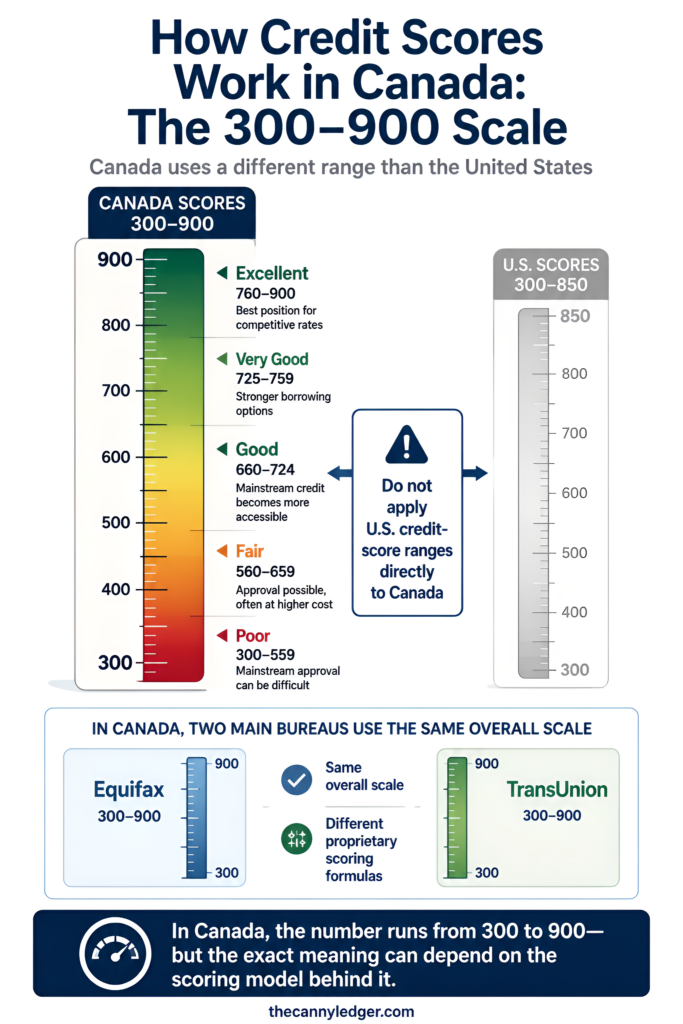
Canadian credit scores run from 300 to 900, a wider band than the 300 to 850 scale most Americans are used to seeing, which matters if you’re reading US-based credit advice and mentally applying it here without adjusting. Both of Canada’s major bureaus use this same 300 to 900 range, even though the specific formulas behind it are proprietary and not identical between the two. Our full breakdown of credit score ranges in Canada covers exactly where the fair, good, and excellent bands sit and what each one typically unlocks.
Two Bureaus, Two Separate Files
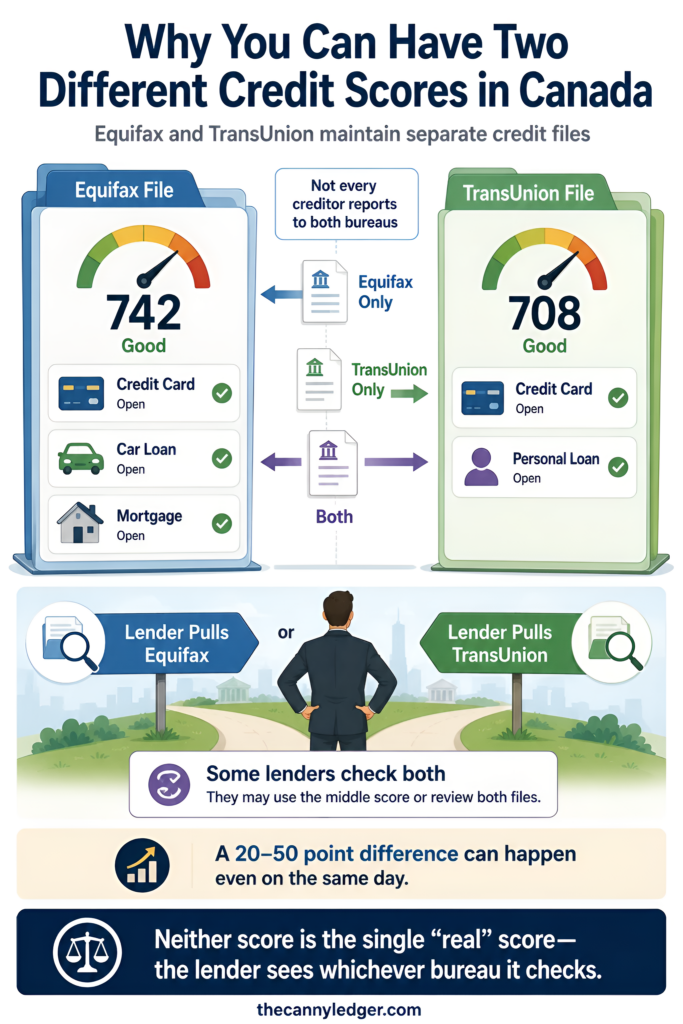
Equifax and TransUnion both operate in Canada, and each maintains an entirely separate file on you built from whichever lenders happen to report to that specific bureau. Not every creditor reports to both, which means your Equifax file and your TransUnion file can genuinely differ, sometimes by 20 to 50 points for the exact same person on the exact same day. Neither number is the “real” one. A lender simply pulls whichever bureau it has a relationship with, and some pull both. Our guide to Canada’s credit bureaus goes deeper into how the two operate and why checking only one can leave you blind to something showing up on the other.
The Five Factors That Actually Build The Number
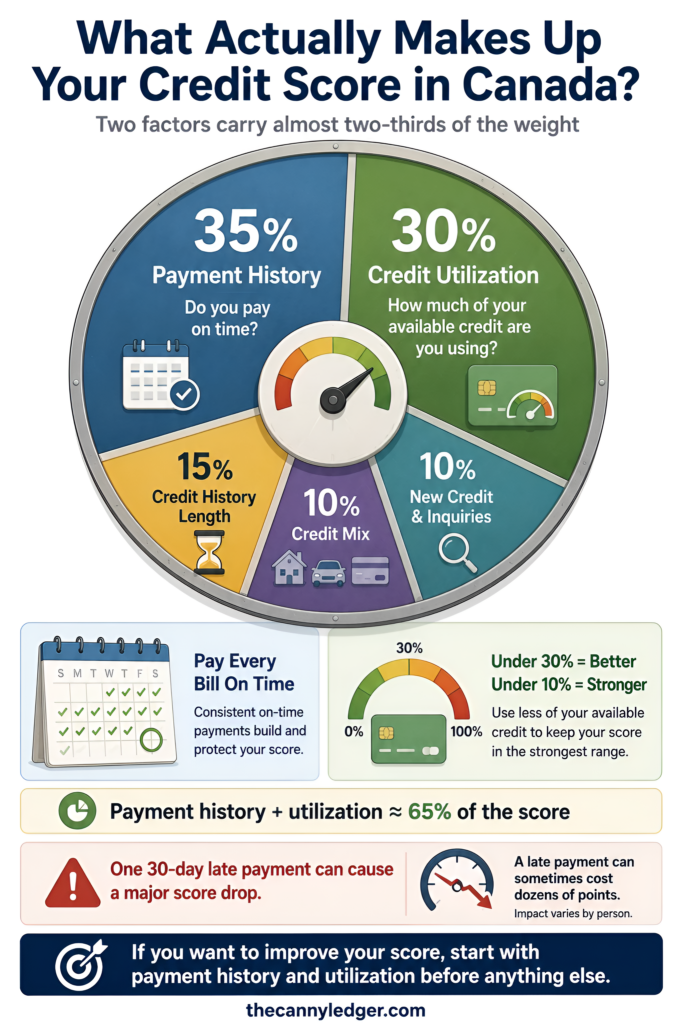
Every score, regardless of which bureau produces it, gets built from the same five weighted categories. Payment history carries the most weight at roughly 35 percent, and it’s exactly what it sounds like, whether you’ve paid on time, how late any missed payment was, and how recently it happened. Credit utilization sits close behind at roughly 30 percent, measuring how much of your available credit you’re actually using at any given moment, with anything under 30 percent considered safe and under 10 percent considered ideal. Together, those two factors alone account for close to two-thirds of your entire score, which is exactly why they deserve the most attention if you’re trying to move the number in either direction.
The remaining three factors matter less individually but still add up. Length of credit history contributes roughly 15 percent, rewarding older accounts and quietly penalizing you if you close your oldest card, since doing so shortens your average account age. Credit mix contributes roughly 10 percent, reflecting whether you handle both revolving credit like cards and installment credit like loans or a mortgage. New credit and recent inquiries round out the final 10 percent, tracking how many new accounts or hard credit checks have hit your file recently. For the full mechanics of how these weights actually get applied, our piece on how credit scores are calculated walks through it factor by factor.
The stakes here are concrete, not abstract. A single 30-day late payment can knock a score in the 700s down by 60 to 110 points, and that impact fades slowly, recovering the ground a single missed payment costs can take months of consistent on-time payments to rebuild.
Checking Your Own Score Never Hurts It
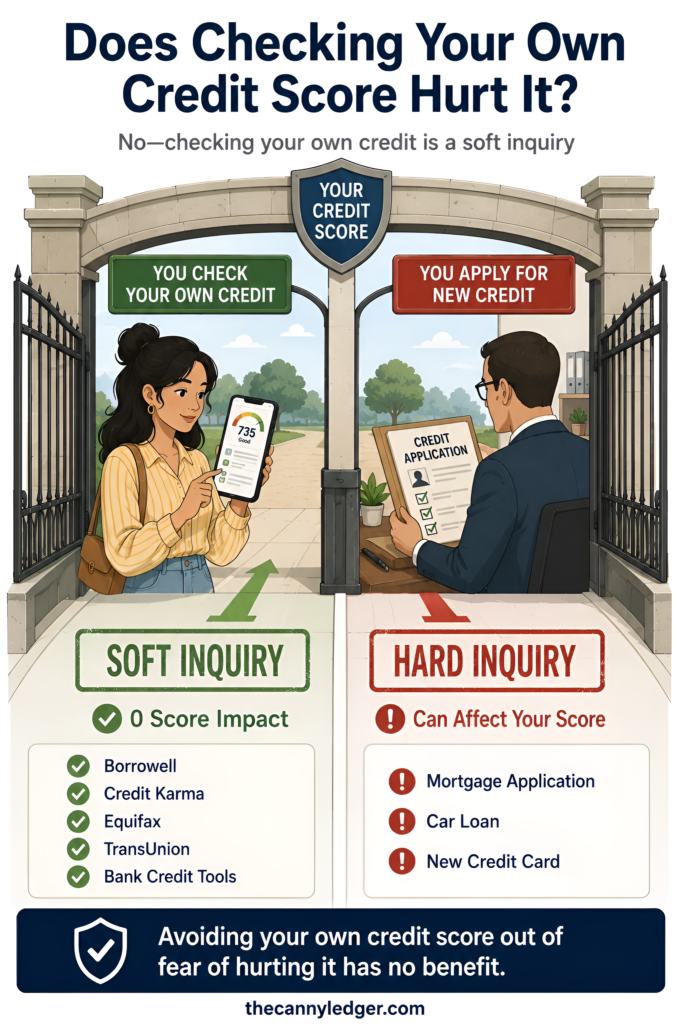
This is one of the most persistent, genuinely damaging misconceptions in Canadian personal finance, and it’s worth stating flatly. Looking at your own credit score or report, whether through Borrowell, Credit Karma, or requesting your file directly from Equifax or TransUnion, is classified as a soft inquiry, and soft inquiries have zero effect on your score. What actually costs you points is a hard inquiry, the kind that happens when a lender pulls your file because you’ve applied for real credit, a mortgage, a car loan, a new credit card. Our dedicated piece on whether checking your credit score hurts it covers the distinction in full, but the short version is that avoiding your own score out of fear of damaging it is a mistake with no upside at all.
Building A File From Nothing
Newcomers to Canada, young adults applying for their first card, and anyone who’s simply never used credit all face the same starting problem, a thin or empty file that neither bureau has enough information to score confidently. A secured credit card, one backed by a cash deposit you provide upfront, is the most common starting point, since it reports to the bureaus the same way an unsecured card does while carrying far less risk for the issuer approving you. Becoming an authorized user on a family member’s well-managed card can help too, provided that card reports authorized-user activity to the bureaus, which not all of them do. Our full guide to building credit from scratch walks through the complete strategy, including how long it realistically takes before a thin file becomes a usable one.

Moving A Score You Already Have
If you already have a file and a number attached to it, the fastest, highest-leverage moves are the same two factors that carry the most weight in the first place, paying every bill on time without exception and keeping your utilization low relative to your available limits. Beyond those two, disputing genuine errors on your report, avoiding a cluster of new credit applications in a short window, and simply letting time pass with steady, boring, on-time behaviour all compound in your favour. Our dedicated piece on improving your credit score covers the full set of levers and roughly how long each one takes to show up in your actual number.

How Long The Bad Stuff Actually Sticks Around
Negative information doesn’t stay on your file forever, though it can feel that way while you’re living with it. Equifax’s own policy keeps late payments on file for roughly six years from the date reported, even if you eventually catch up and pay the past-due balance in full. A first bankruptcy typically stays on your Equifax file for six years after your discharge date, or seven years if you were never formally discharged, and a second bankruptcy extends that visibility to fourteen years on both bureaus. TransUnion’s timelines run similarly but vary by province specifically for bankruptcy, with Ontario, Quebec, Newfoundland and Labrador, and Prince Edward Island holding the record for seven years after discharge rather than six. None of this is permanent, and the practical impact of any single negative mark also fades well before it actually falls off your report entirely.

Where This Number Actually Gets Used Against You
A credit score isn’t an abstract report card, it’s the input other people use to decide what you’re allowed to borrow and at what price. Mortgage lenders use it as one input alongside your income and debt ratios, and the difference between a strong and a mediocre score can genuinely move your rate. Our guide to what credit score you need for a mortgage covers that specific threshold in depth. Credit card issuers use it to decide which products you even see, and our breakdown of the score you need for a credit card and our separate guide to credit cards built for bad credit cover both ends of that spectrum. Auto lenders run their own version of the same calculation, covered in our piece on the credit score needed for a car loan, and if you run a business, business credit scores work as a genuinely separate system from your personal file, worth understanding on its own terms rather than assuming the same rules apply.

Checking And Building From Here
Pull your actual score for free through Borrowell, Credit Karma, or directly from Equifax and TransUnion, since knowing your real starting number beats guessing based on a national average that may not reflect your situation at all. If your Equifax and TransUnion numbers differ by more than a small margin, that gap is worth investigating specifically, since it usually means something is showing up on one file that the other bureau never received. And whichever range you land in, treat payment history and utilization as the two levers worth the most attention first, since together they carry close to two-thirds of the weight behind whatever number comes back.