

- Manitoba Housing: The Core Public Housing System
- The 2026 Income Limits for Manitoba Housing in Winnipeg
- Who’s Excluded From These Programs
- The Affordable Housing Rental Program: A Different, Higher-Income Option
- Winnipeg Housing Rehabilitation Corporation: A Separate Non-Profit Landlord
- Housing Co-ops: Ownership Without a Landlord
- How to Actually Find and Apply to a Co-op
- Which Option Actually Fits Your Situation
- Common Questions About Low-Income Housing in Winnipeg
Treating “subsidized housing in Winnipeg” as one single program is the mistake that costs renters the most time. Someone assumes applying to Manitoba Housing covers the whole search, gets placed on that one waiting list, and never realizes there are at least three other genuinely different systems, each with its own income limits, its own rent structure, and its own separate application, sitting right alongside it. A household that doesn’t qualify for one program can still be a strong fit for another, but only if they know it exists.
Winnipeg’s main low-income housing options are Manitoba Housing’s Social Housing Rental Program (rent geared to 30 percent of income), the Affordable Housing Rental Program (a separate, higher-income-limit option with set rents below market), the Winnipeg Housing Rehabilitation Corporation, and independent, member-run housing co-ops. Each has different eligibility rules and its own application process.
Manitoba Housing: The Core Public Housing System
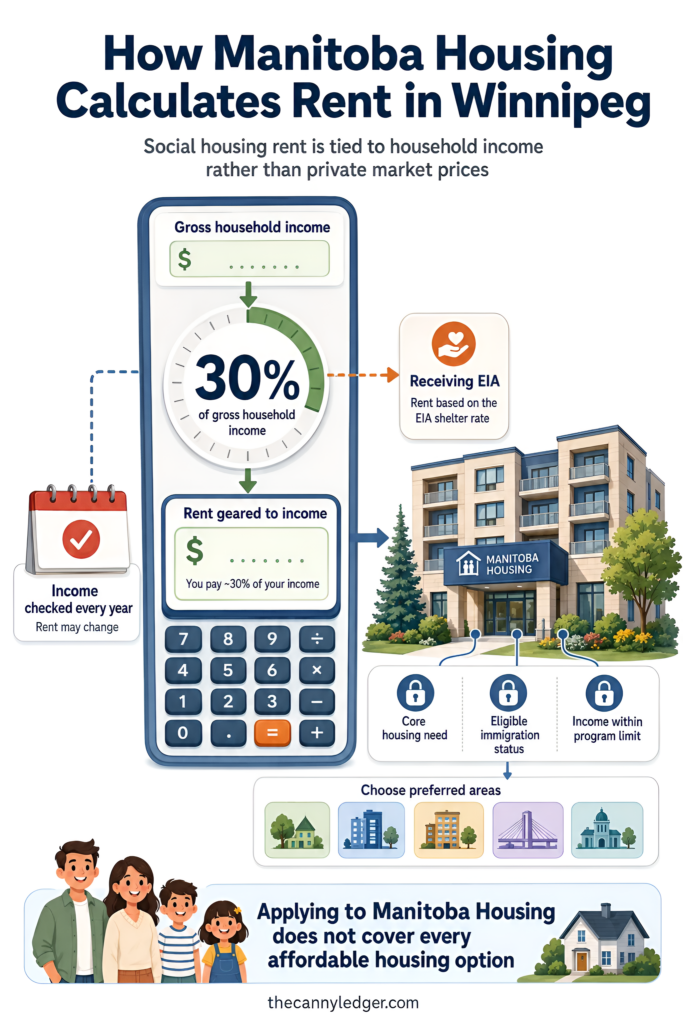
The Social Housing Rental Program (SHRP) is Manitoba Housing’s main offering, and it works on a rent-geared-to-income (RGI) basis: eligible tenants pay 30 percent of their gross household income toward rent rather than a fixed market rate, with tenants on Employment and Income Assistance paying based on their EIA shelter rate instead. To qualify, applicants need to be in core housing need, be a Canadian citizen, permanent resident, or refugee claimant, and have household income at or below the posted limits for their unit size and community. Eligibility gets reverified annually, so a household’s rent can shift from year to year as income changes, not just when a new lease starts.
Manitoba Housing organizes its Winnipeg units across five districts, and applicants choose which areas they’re interested in as part of the application rather than being assigned a location automatically.
The 2026 Income Limits for Manitoba Housing in Winnipeg
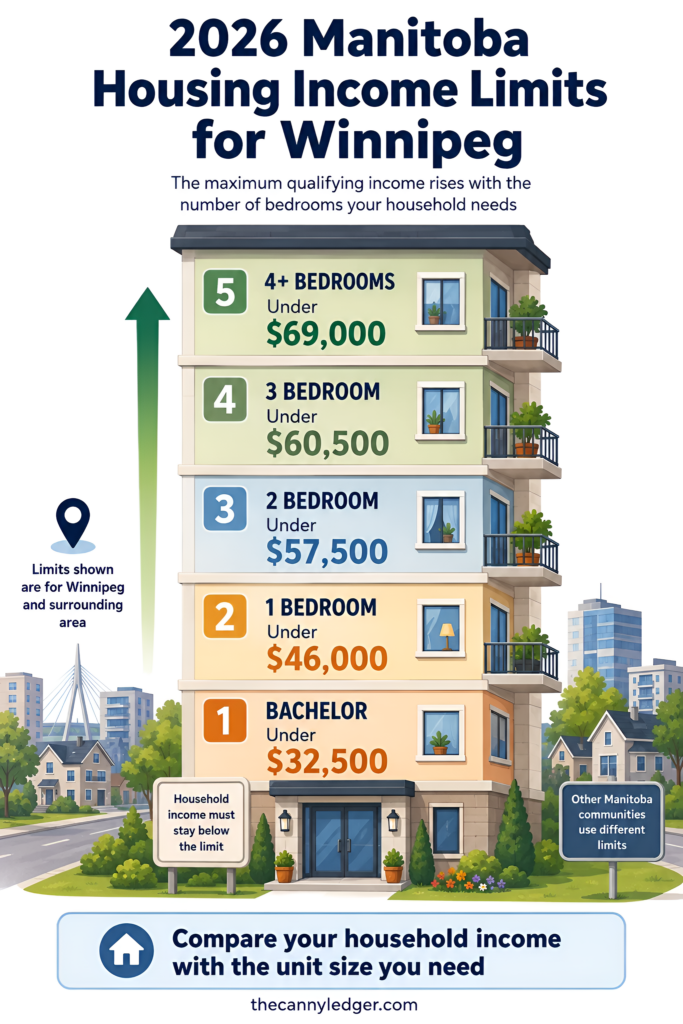
To qualify for SHRP in Winnipeg and the surrounding area, 2026 household income needs to fall under these limits, which rise with the size of unit a household needs:
- Bachelor: under $32,500
- 1 bedroom: under $46,000
- 2 bedroom: under $57,500
- 3 bedroom: under $60,500
- 4+ bedroom: under $69,000
These limits are specific to Winnipeg, other Manitoba communities have their own, generally lower, thresholds, so a household that doesn’t qualify by Winnipeg’s numbers might still qualify in a smaller city or town if relocating is genuinely on the table.
Who’s Excluded From These Programs
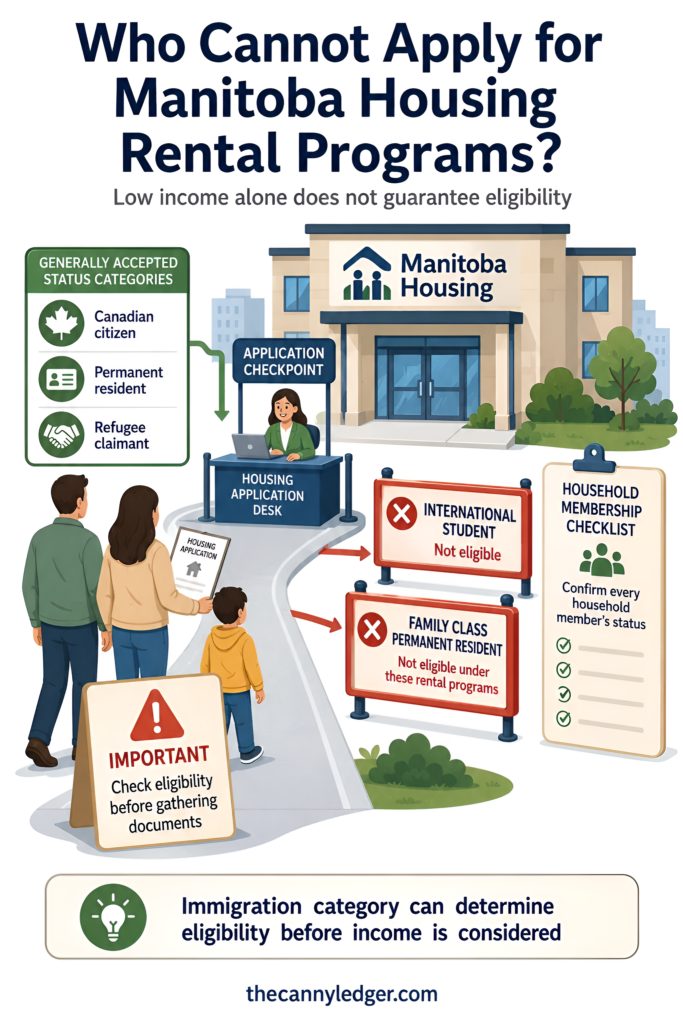
Two exclusions catch people off guard because they don’t show up in most general summaries of the program: international students and Permanent Residents under the Family Class category are not eligible for Manitoba Housing’s rental programs, regardless of how low their income is. This matters for a household that includes a sponsored family member, since it’s worth confirming everyone in the household actually qualifies before investing time in the application rather than finding out partway through the process.
The Affordable Housing Rental Program: A Different, Higher-Income Option
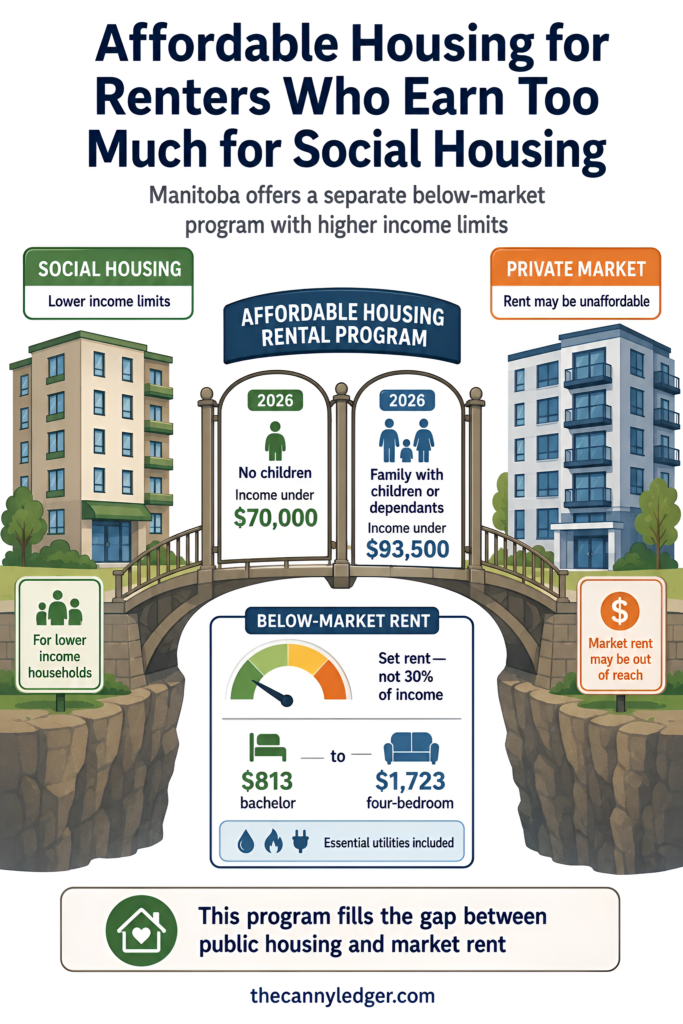
For households whose income is too high for SHRP but who still can’t comfortably afford private market rent, the Affordable Housing Rental Program is a separate track worth checking. The 2026 income limits are considerably higher than SHRP’s: under $70,000 for a household without children, and under $93,500 for a family household with children or dependants. Rather than paying 30 percent of income, tenants in this program pay a set rent below typical market rates for their community. In Winnipeg, the 2026 rent with essential utilities included runs $813 for a bachelor unit up to $1,723 for a four-bedroom, or somewhat less if utilities aren’t included in the unit.
This program is worth knowing about specifically because it fills the gap between “too well-off for public housing” and “still priced out of the private market,” a gap a lot of renters don’t realize has its own dedicated program rather than nothing at all.
Winnipeg Housing Rehabilitation Corporation: A Separate Non-Profit Landlord
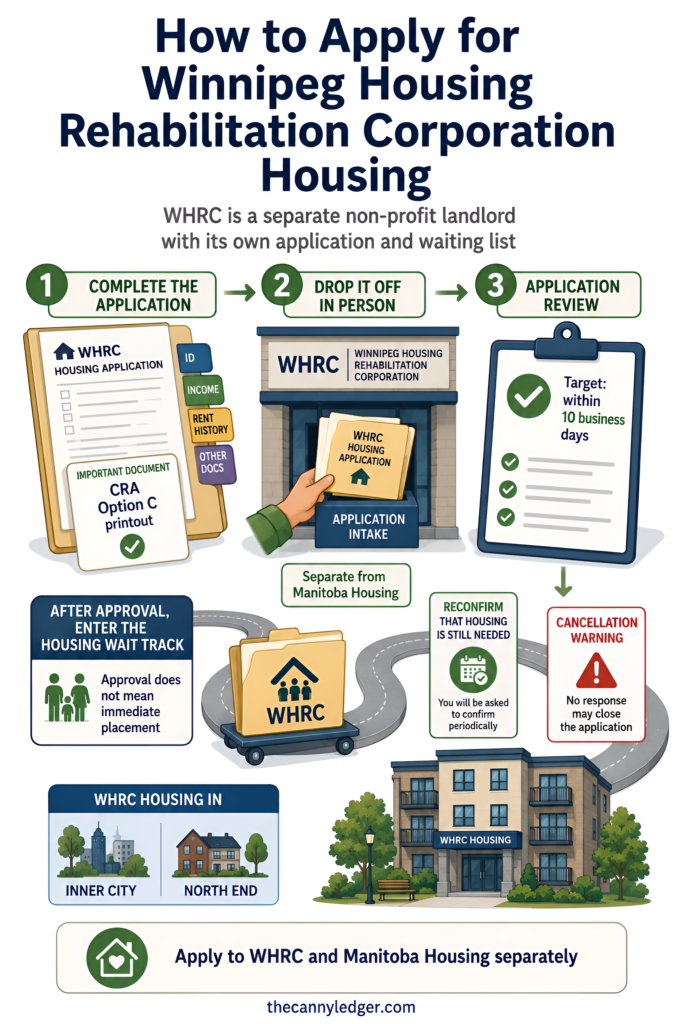
The Winnipeg Housing Rehabilitation Corporation (WHRC) operates independently of Manitoba Housing, focusing on affordable rental units in the inner city and North End alongside some market-rent units elsewhere in the city. Most WHRC units are also offered on a rent-geared-to-income basis at 30 percent of gross household income. The application itself has to be dropped off in person, complete, and includes documentation like a CRA Option C printout, and WHRC aims to review completed applications within 10 business days, though the actual wait for an available unit after approval can run considerably longer depending on unit size and location. WHRC also asks pre-approved applicants to reconfirm their need periodically, so an application left unanswered for too long risks getting cancelled rather than staying active indefinitely.
Housing Co-ops: Ownership Without a Landlord
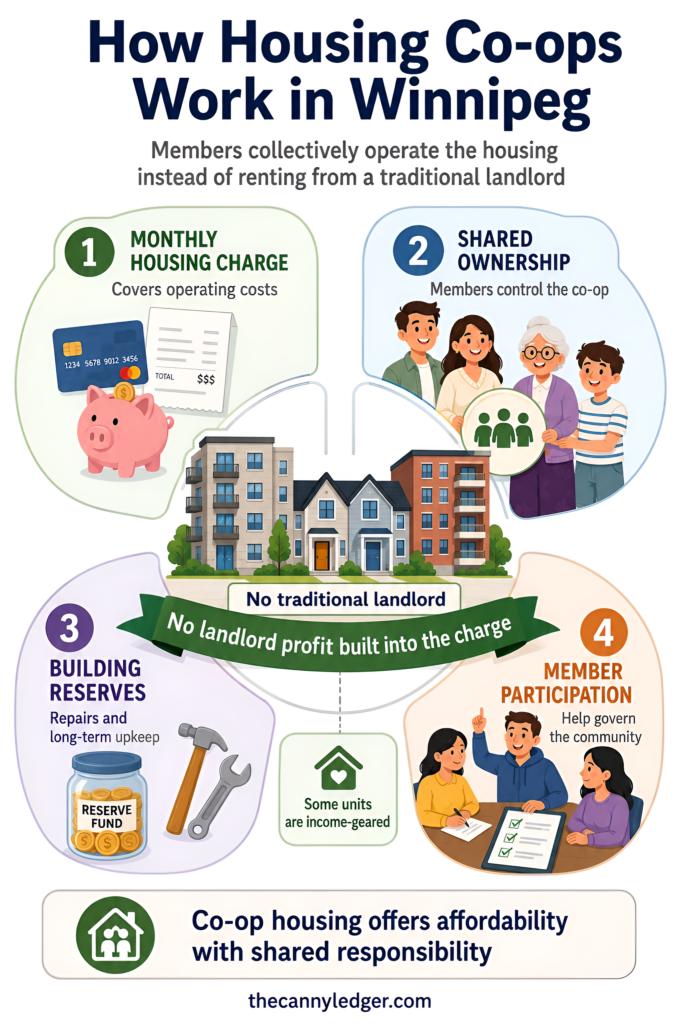
Co-op housing runs on an entirely different model from everything above. In a housing co-op, there’s no landlord, members share ownership of the building or complex collectively, pay a monthly housing charge that covers costs, repairs, and reserves rather than generating profit for anyone, and often take part in running the co-op itself. Because there’s no profit built into the charge, co-op housing tends to run noticeably cheaper than comparable private market rent, and many Manitoba co-ops also offer some units on a subsidized, income-geared basis on top of that baseline affordability. Village Canadien Co-op is Manitoba’s largest housing cooperative, while smaller ones exist too, Bluestem Housing Co-op in Corydon Village runs just six units and started as a private, unsubsidized project among friends who wanted to live communally. Carpathia Housing Co-op manages a 152-unit townhouse complex in River Heights alongside an apartment building in Tuxedo, giving a sense of just how differently sized and structured individual co-ops can be from one another.
How to Actually Find and Apply to a Co-op
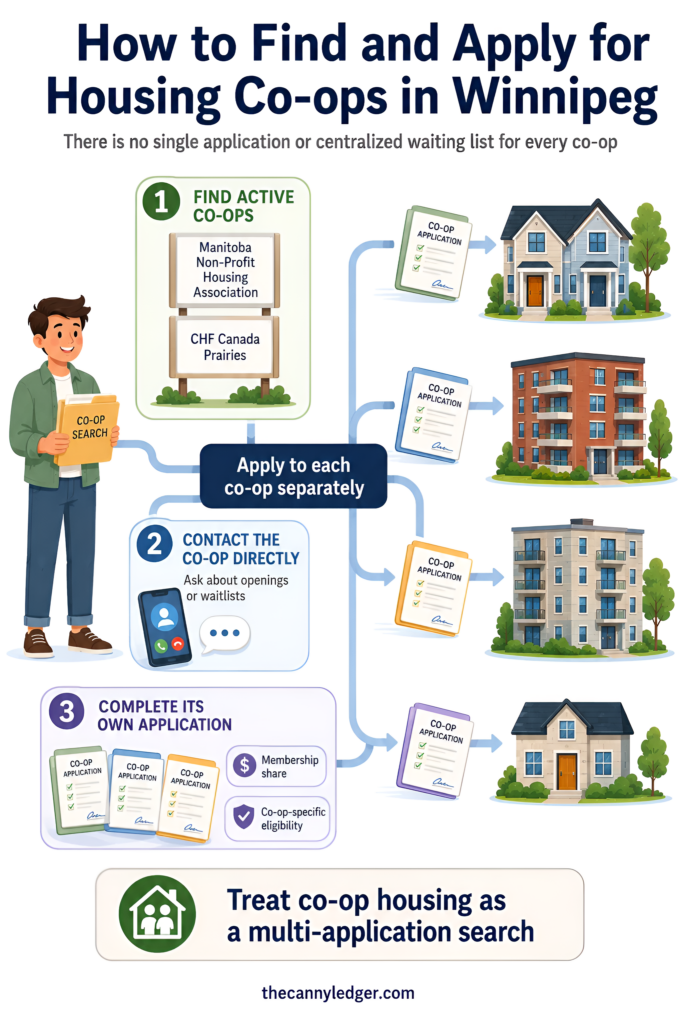
Unlike Manitoba Housing, there’s no single centralized waiting list covering every co-op in the city. Each housing co-op is its own independent organization with its own waiting list, its own application, and often its own membership share requirement, so finding one means researching individual co-ops rather than submitting one application and waiting. The Manitoba Non-Profit Housing Association and CHF Canada’s Prairies regional office are both good starting points for locating co-ops actively operating in Winnipeg and Manitoba more broadly, though contacting a specific co-op directly is usually the fastest way to find out whether it currently has openings or an active waiting list.
Which Option Actually Fits Your Situation
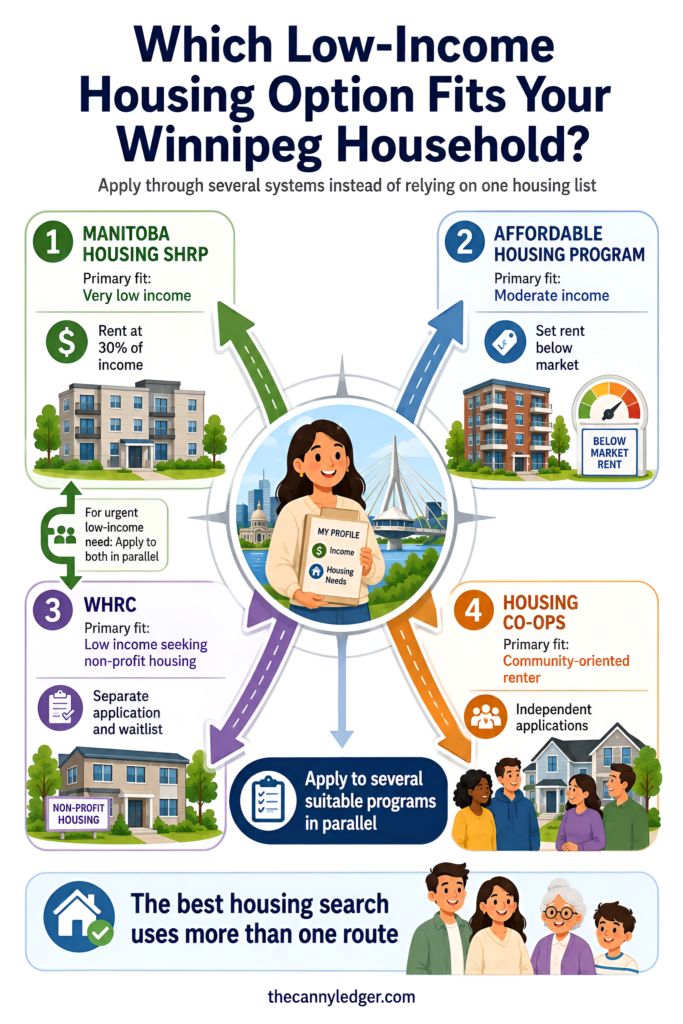
A household with very low income and an urgent need is generally best served applying to Manitoba Housing’s SHRP and WHRC in parallel, since nothing prevents applying to both at once and the eventual placement, whichever comes first, is what matters. A household with moderate income that’s still being priced out of the private market is a stronger fit for the Affordable Housing Rental Program, given SHRP’s lower income ceiling would likely disqualify them anyway. Anyone drawn to a more community-oriented living situation, and willing to research individual co-ops rather than wait on one centralized list, should treat co-op housing as a genuinely separate search process running alongside, not instead of, the other options.
Common Questions About Low-Income Housing in Winnipeg
Can someone apply to Manitoba Housing and a co-op at the same time? Yes. These are entirely separate organizations with no shared waiting list, so there’s no conflict or penalty in applying to both simultaneously, and doing so generally shortens the overall wait since it doubles the number of active applications working in a household’s favour.
Does receiving Rent Assist affect eligibility for these housing programs? It can factor into the picture, since Rent Assist is designed for renters in the private market rather than subsidized housing, and moving into a Manitoba Housing or co-op unit generally means Rent Assist is no longer relevant to that address. The income thresholds for Rent Assist are separate from the income limits covered here, so it’s worth checking both programs independently rather than assuming qualifying for one says anything about the other.
What if income is too high for Manitoba Housing but rent still isn’t affordable? This is exactly the gap the Affordable Housing Rental Program exists to cover, and it’s worth applying to directly rather than assuming the private market is the only remaining option. Comparing it against what’s actually available under $1,000 a month in the open market can help clarify whether the program’s set rents genuinely beat what’s findable without it.
Given how differently these four programs work, applying narrowly to just one closes off options that might come through faster or fit a household’s income better. Start with Manitoba Housing’s SHRP and WHRC applications if income qualifies, check the Affordable Housing Rental Program if it doesn’t, and treat co-op housing as its own parallel search rather than a fallback to try only after everything else falls through.