

Sixty-five dollars up front, before you’ve bought a single roll of paper towels, is the actual entry price to Costco in Canada. That number alone stops a lot of people from ever finding out whether the warehouse makes sense for their household. It shouldn’t. The membership fee is the easiest part of this decision to calculate; the part that actually determines whether a Costco membership is worth it in Winnipeg is what happens after you walk through the door, and that depends entirely on how your household actually shops.
- What a Costco Membership Actually Costs
- The Three Warehouses Serving Winnipeg
- Where the Real Savings Actually Show Up
- Gold Star vs. Executive vs. Skipping Costco
- The Card That Doubles as Your Membership Card
- Who the Math Actually Works For
- Where Costco Loses to a Regular Winnipeg Grocery Run
- The Verdict
- What to Actually Do Next
This comparison is built from Costco’s own published membership terms, the CIBC Costco Mastercard’s official rewards structure, and the three Winnipeg warehouse locations themselves, not from a single personal shopping trip. I don’t have a Costco card in my own wallet right now, so treat the following as a researched breakdown rather than a lived review, and weigh it against your own household’s habits accordingly.
What a Costco Membership Actually Costs
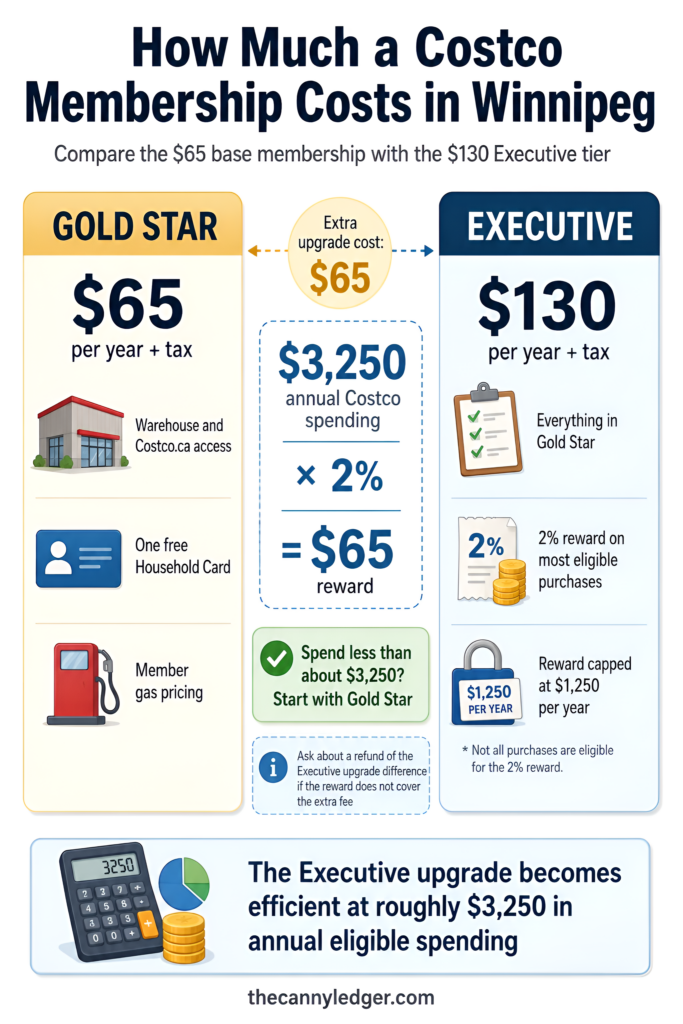
Costco Canada runs two membership tiers for individuals and families. Gold Star Membership costs $65 per year plus applicable tax, and it includes one free Household Card for someone else living at the same address. Executive Membership costs $130 per year plus tax, which is the $65 base fee plus a $65 upgrade, and it adds an annual 2 percent reward on most Costco purchases, capped at $1,250 per year.
The Executive math is straightforward once you lay it out. That extra $65 upgrade fee pays for itself once your household spends roughly $3,250 a year at Costco, since 2 percent of $3,250 works out to $65. Below that spending level, you’re paying for a reward tier you’re not using efficiently, and Gold Star is the better starting point. Costco itself backs this up with its own guarantee: if you upgrade to Executive and your 2 percent reward doesn’t cover the extra fee, the company will refund the difference on request, which makes trying the upgrade close to risk-free.
The Three Warehouses Serving Winnipeg
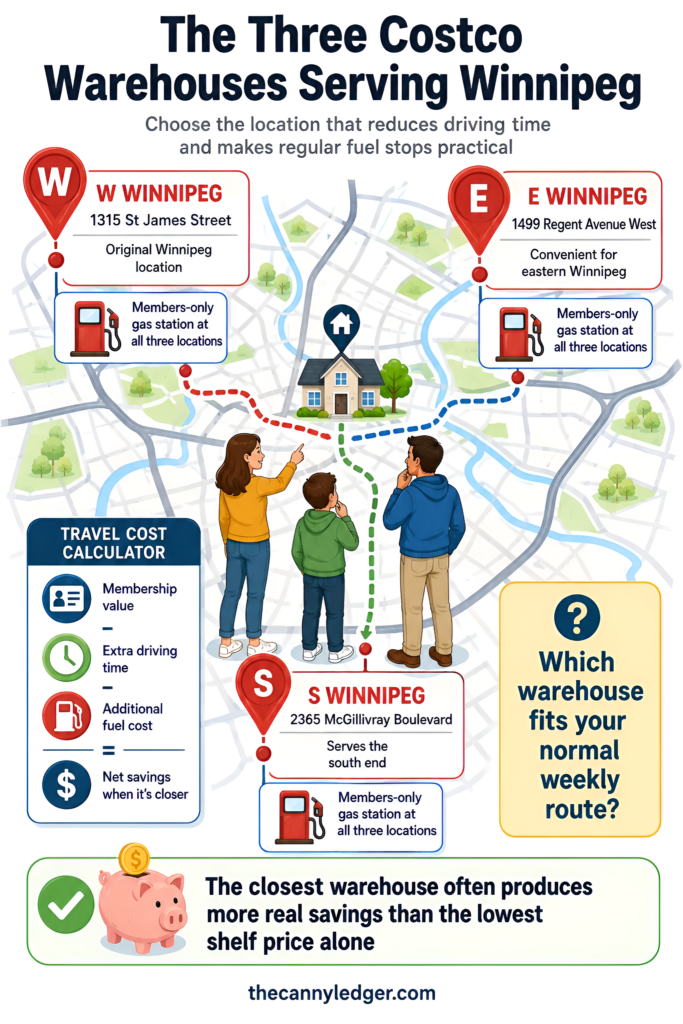
Winnipeg has three Costco locations, which is worth knowing before you assume a membership means a long drive across the city every time. W Winnipeg sits at 1315 St James St and has operated since 1990, making it the city’s original location. E Winnipeg is at 1499 Regent Ave W, and S Winnipeg rounds things out at 2365 McGillivray Blvd, opened in 2007 to serve the growing south end of the city. All three run a members-only gas station on site, which matters more than it sounds like once you factor gas into the overall value calculation below.
Having three locations instead of one changes the practical math on membership more than most price comparisons admit. A household in St. Vital or the south end isn’t making the same round trip as someone in St. James, and that travel time is a real cost against whatever you’re saving per item.
Where the Real Savings Actually Show Up
Costco’s value case rests on a few specific categories, not an across-the-board discount on everything in the warehouse.
Gas is often the single fastest way a membership pays for itself, since Costco’s member-only fuel pricing tends to run consistently below nearby stations. For a household that fills up weekly, that gap alone can approach or cover the Gold Star fee well before you’ve bought any groceries. Given that grocery and fuel prices in Manitoba have climbed sharply in recent years, with Statistics Canada reporting grocery prices up 30.1 percent nationally since February 2021, the appeal of locking in lower per-unit costs on high-frequency purchases like gas has only grown.
Bulk non-perishables are the second clear win: paper products, canned goods, cleaning supplies, and pantry staples with a long shelf life genuinely cost less per unit at Costco than at a standard grocery run, and there’s no waste risk since these items don’t spoil before you use them.
Pharmacy, optical, and the tire centre round out the less obvious savings. These services are open to Gold Star members too, not just Executive, and they’re worth pricing out separately from your regular grocery comparison, since they don’t require you to buy in bulk to benefit.
Fresh produce and bakery items are where the math gets shakier, and I’ll get to that honestly further down.

Gold Star vs. Executive vs. Skipping Costco
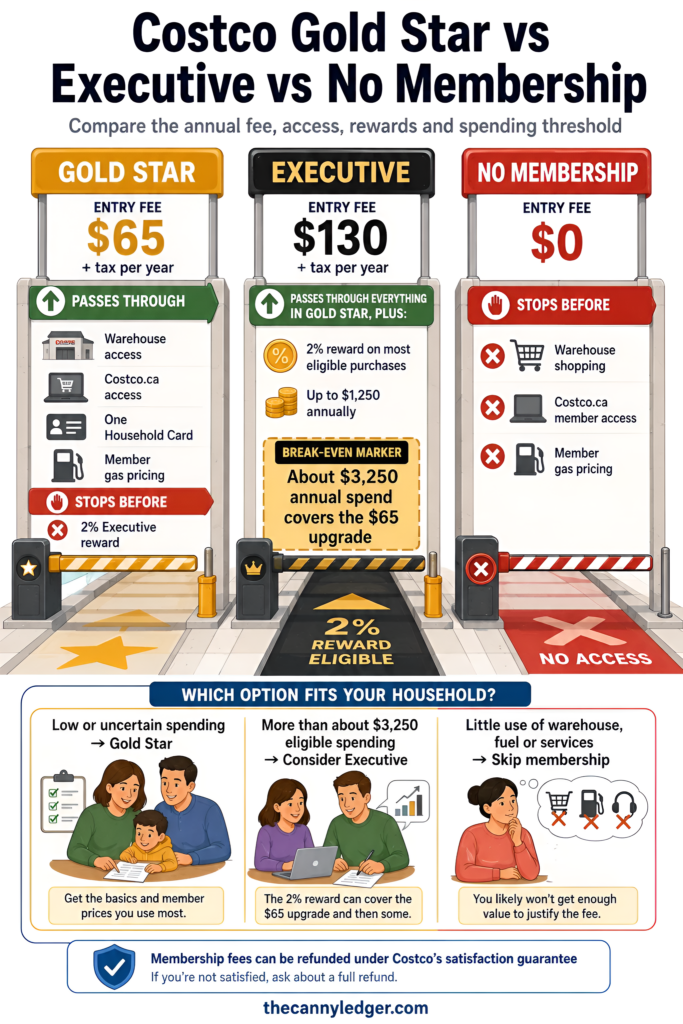
| Gold Star | Executive | No Membership | |
|---|---|---|---|
| Annual cost | $65 + tax | $130 + tax | $0 |
| Warehouse and Costco.ca access | Yes | Yes | No |
| Household Card included | Yes, 1 free | Yes, 1 free | N/A |
| Member gas pricing | Yes | Yes | No |
| 2% annual reward (up to $1,250) | No | Yes | N/A |
| Break-even spend for the upgrade | N/A | ~$3,250/year | N/A |
| Membership refund guarantee | Yes, anytime | Yes, anytime | N/A |
The “no membership” column isn’t really a null option in Winnipeg the way it might be in a smaller market. With three warehouses and a member-only gas station at each, opting out means giving up a fuel discount that’s available to every tier, not just the premium one.
The Card That Doubles as Your Membership Card
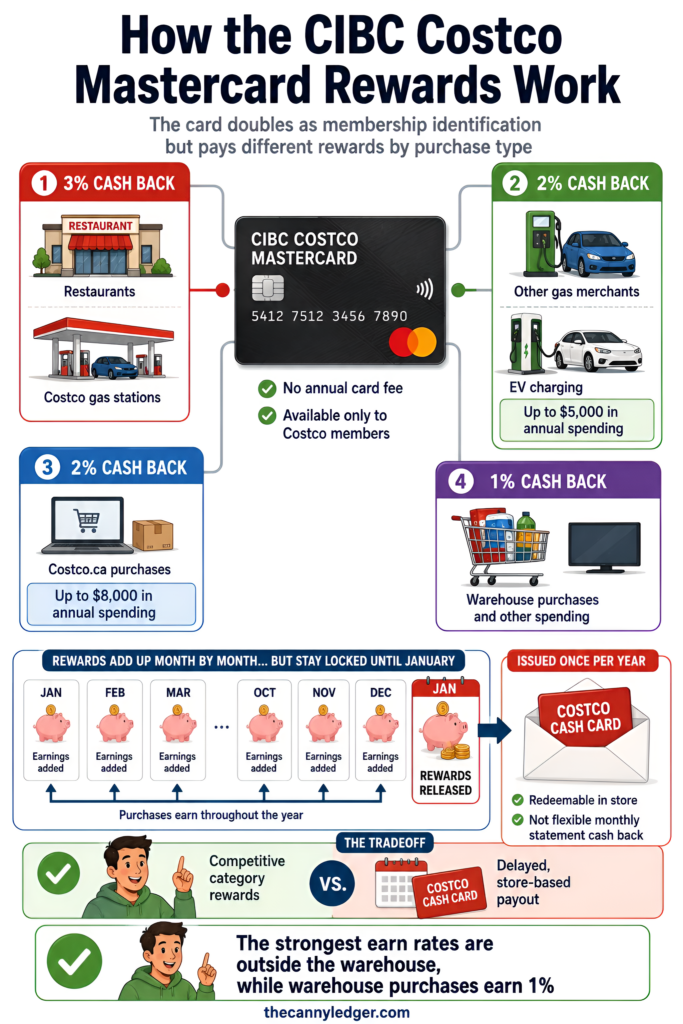
Costco Canada only accepts one type of credit card in its warehouses, and it’s the CIBC Costco Mastercard, a no-annual-fee card available exclusively to Costco members. It earns 3 percent cash back at restaurants and at Costco gas stations, 2 percent at other gas merchants and EV charging up to $5,000 in annual spending, 2 percent at Costco.ca up to $8,000 in annual spending, and 1 percent on everything else, including purchases made inside the warehouse itself.
The catch worth knowing before you apply: rewards accumulate through the year but only get issued once, as a Costco Cash Card mailed out each January, redeemable in-store. You’re effectively lending Costco your cash back for months at a time rather than seeing it show up on a monthly statement, which is a real tradeoff against a flexible cash-back card even though the earn rates themselves are competitive.
Who the Math Actually Works For
A family of four buying groceries, household staples, and gas regularly is the clearest case for Costco making sense in Winnipeg. The combination of bulk staple pricing, gas savings, and a large enough household to actually use bulk quantities before anything spoils stacks the math heavily in the membership’s favour.
A couple without kids sits in murkier territory. The gas savings alone can still justify Gold Star, but bulk grocery sizes only pay off if you have the freezer space and discipline to use perishables before they turn, and that’s a genuine household-specific variable rather than something a blanket recommendation can settle for you.
Someone living alone faces the steepest climb to make the math work, since most of Costco’s bulk sizing is built for larger households by default. It’s not impossible, particularly if gas and household staples make up a meaningful share of your spending, but it takes more deliberate planning to avoid waste than it does for a bigger family.
A small business owner has a separate path entirely through Costco’s Business Membership, also priced at $65 per year, which allows purchasing for resale and comes with its own Executive upgrade option. That’s a genuinely different value proposition than the consumer tiers and worth evaluating on its own terms rather than folding into a household grocery comparison.

Where Costco Loses to a Regular Winnipeg Grocery Run
Fresh produce and bakery items are the category where Costco’s bulk model works against smaller households most directly. Buying a five-pound bag of something you’d normally use half of in a week means either eating around it aggressively or watching part of it go to waste, which erodes the per-unit savings fast. A regular price comparison across Winnipeg’s grocery banners often beats Costco on smaller-format fresh items for exactly this reason.
Costco also doesn’t run weekly flyers or price-match the way conventional grocery stores do, so there’s no equivalent to a Safeway loss-leader promotion undercutting the warehouse’s regular price on a specific item that week. And Winnipeg’s farmers markets can beat Costco on in-season produce bought directly from a grower, particularly for a household that doesn’t need bulk quantities in the first place.

The Verdict
For a Winnipeg family that regularly buys gas, household staples, and groceries in volume, Costco membership earns its cost within the first few months and keeps paying off from there, and Executive is worth the extra $65 once your annual spending clears roughly $3,250. For a household of one or two people without a lot of storage space or a habit of using bulk perishables before they spoil, the case is weaker, and it’s worth running your own numbers against your typical monthly grocery bill before committing.
What to Actually Do Next
Before signing up, add up your household’s rough annual spending on gas, non-perishable groceries, and any pharmacy or optical needs, since that number tells you more than any generic recommendation can. If gas alone at your typical Winnipeg fuel spending would clear the $65 Gold Star fee, that’s often reason enough to start there and reassess the Executive upgrade at renewal time once you’ve seen a full year of actual receipts. And if the membership fee itself feels tight against your current cost of living, it’s worth comparing that $65 against a year of the small, repeated savings you might already be capturing through thrift shopping around the city instead.