

Most guides to student financial aid stop at the application and the repayment schedule. Manitoba’s system has a third act that a lot of students never hear about until years after they’ve graduated: a provincial tax rebate that pays back up to 60 percent of what you spent on tuition, specifically as a reward for staying and working in this province after you finish school. It’s worth knowing this exists before you even submit your first application, because it changes the real, long-term cost calculation of studying here in a way that most other provinces simply don’t offer. This guide walks through the application itself, what actually gets funded, and that back-end rebate most students discover far too late to plan around.
- What Manitoba Student Aid actually is
- Who qualifies, and how the system defines your status
- What’s actually covered: three distinct types of funding
- Applying: the practical steps
- What’s changing for the 2026-27 program year
- Repayment, and what happens if you’re struggling
- The part most students never hear about: the tuition rebate
- Rounding out your financial picture
- Before you file that first application
What Manitoba Student Aid actually is
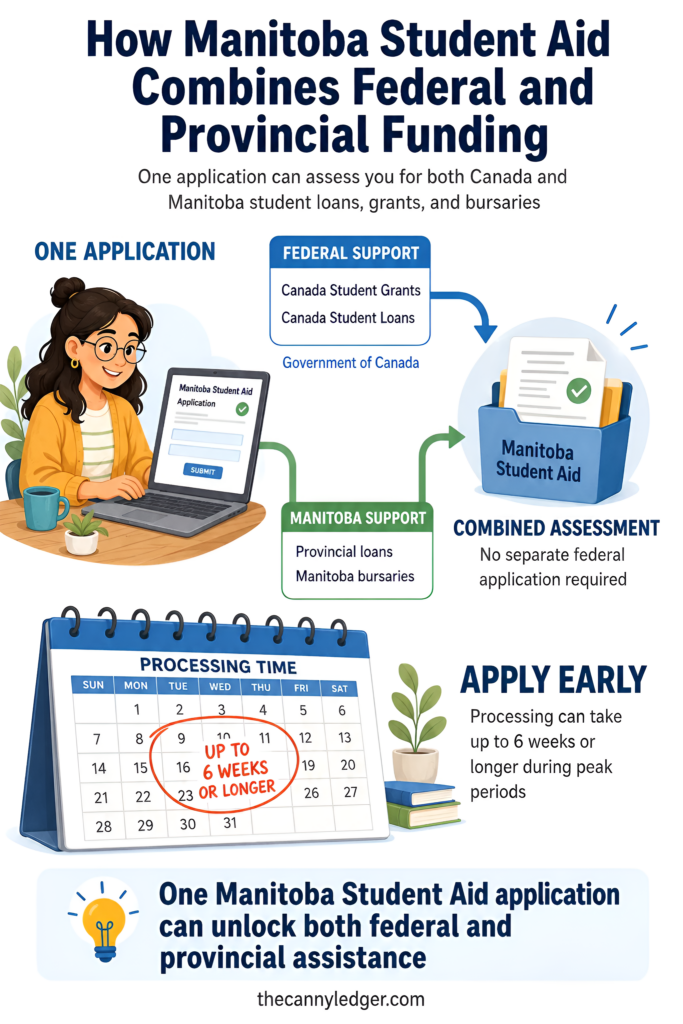
Manitoba Student Aid is the province’s student financial assistance program, and its defining feature is that it’s genuinely integrated with the federal system rather than running as a separate process you’d need to navigate twice. One application assesses your eligibility for both Canada Student Loans and Grants and Manitoba’s own provincial loans and bursaries simultaneously, which means you’re not filling out one form for Ottawa and a different one for the province. The application is administered online, and it’s worth knowing upfront that processing can take up to six weeks or longer during peak application periods, which makes applying early genuinely important rather than a generic piece of advice.
Who qualifies, and how the system defines your status
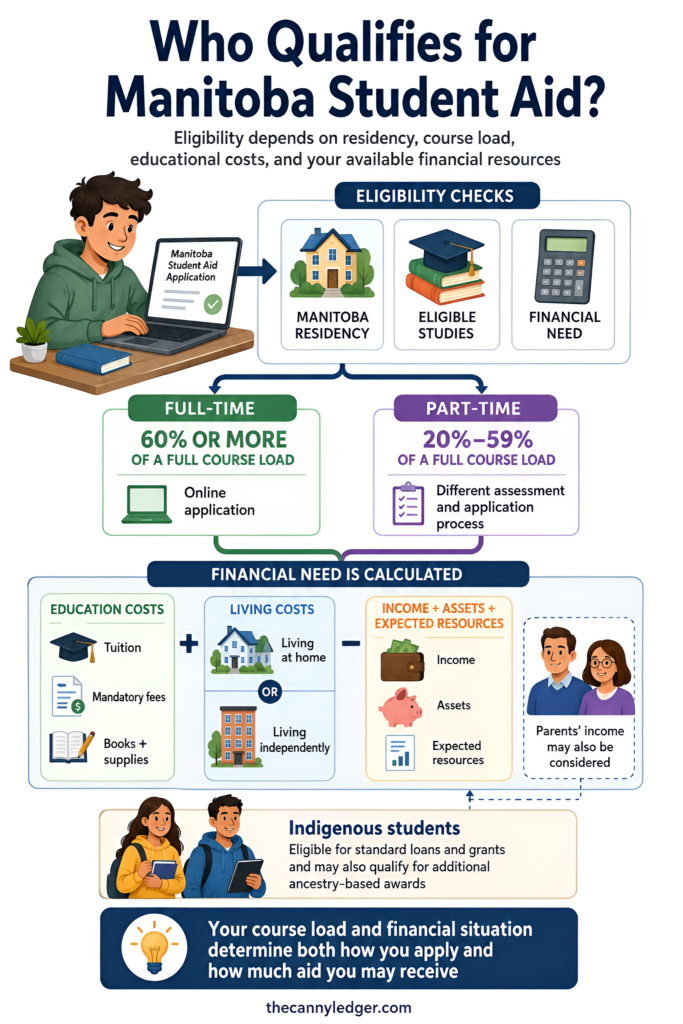
Eligibility depends on a combination of financial need, your course load, and your residency. Full-time status generally means 60 percent or more of a full course load; part-time status covers the 20 to 59 percent range, and it’s worth knowing the two are assessed somewhat differently, with the part-time application still requiring a form-based process rather than the fully online system full-time applicants now use. Your financial need is calculated from your educational costs, tuition, mandatory fees, books, and supplies, alongside your living costs, which differ depending on whether you’re living at home or independently, your own income and assets, and, if you’re considered a dependent student, your parents’ income as well.
Students of Canadian Indigenous ancestry are eligible for the same loans and grants as any other student, under the same limits, and may additionally qualify for specific grants or awards that take Indigenous ancestry into account, worth exploring directly through the program’s detailed funding options rather than assuming the standard package is the only one available.
What’s actually covered: three distinct types of funding
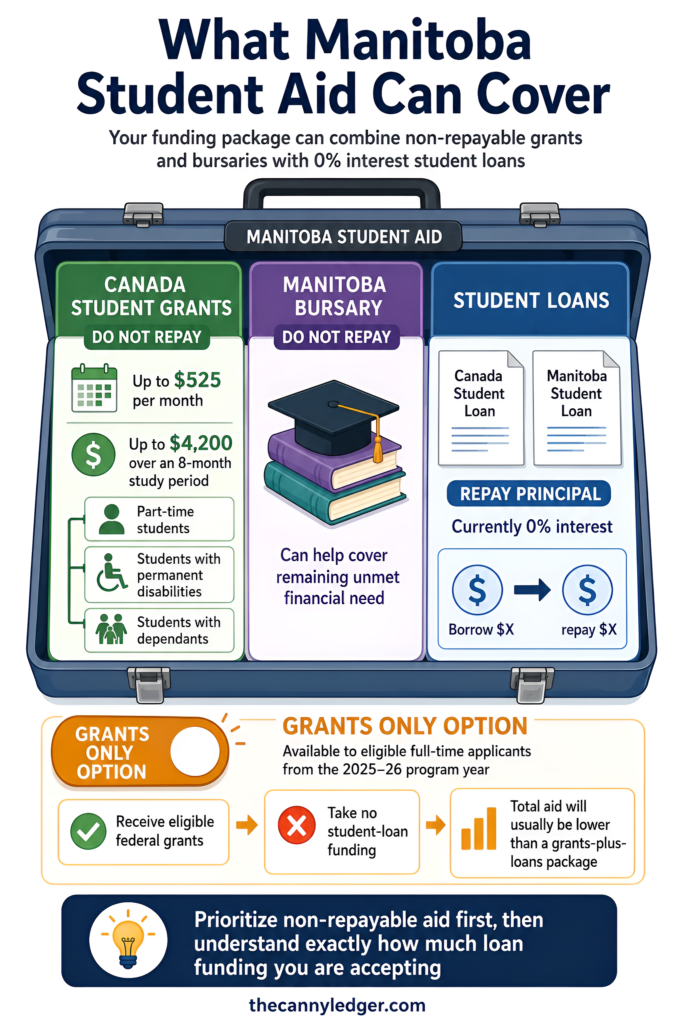
Canada Student Grants form the non-repayable core of federal support, and the current figures are worth knowing precisely. Full-time students can receive up to $525 a month, working out to as much as $4,200 across a standard eight-month academic period, with separate grant streams for part-time students, students with permanent disabilities, and students supporting dependants, each with its own specific maximum. None of this needs to be repaid, which makes it the most valuable single piece of the funding package for anyone who qualifies.
The Manitoba Bursary fills in behind federal grants and loans, calculated after your federal assessment to cover remaining unmet need, reducing how much you’d otherwise need to borrow. Like the federal grants, bursary funding doesn’t need to be repaid.
Student loans, both the federal Canada Student Loan and Manitoba’s own provincial loan, make up the repayable portion of the package, and both currently carry 0 percent interest, meaning what you borrow is exactly what you eventually repay, with no interest accumulating either while you’re studying or during standard repayment. This is a genuinely significant detail worth internalizing, since it means the real cost of a Manitoba student loan today is simply the principal itself, a meaningfully different proposition than borrowing at any positive interest rate.
A newer option worth knowing about specifically: starting with the 2025-26 program year, full-time applicants can choose a Canada Student Grants Only option, receiving whatever federal grants they qualify for without taking on any loan funding at all. This suits students who have partial funding from other sources, family support, savings, part-time work, or scholarships, and specifically want to top up with non-repayable grant money without committing to debt, even though total funding under this option will typically be lower than the full grants-plus-loans package.
Applying: the practical steps
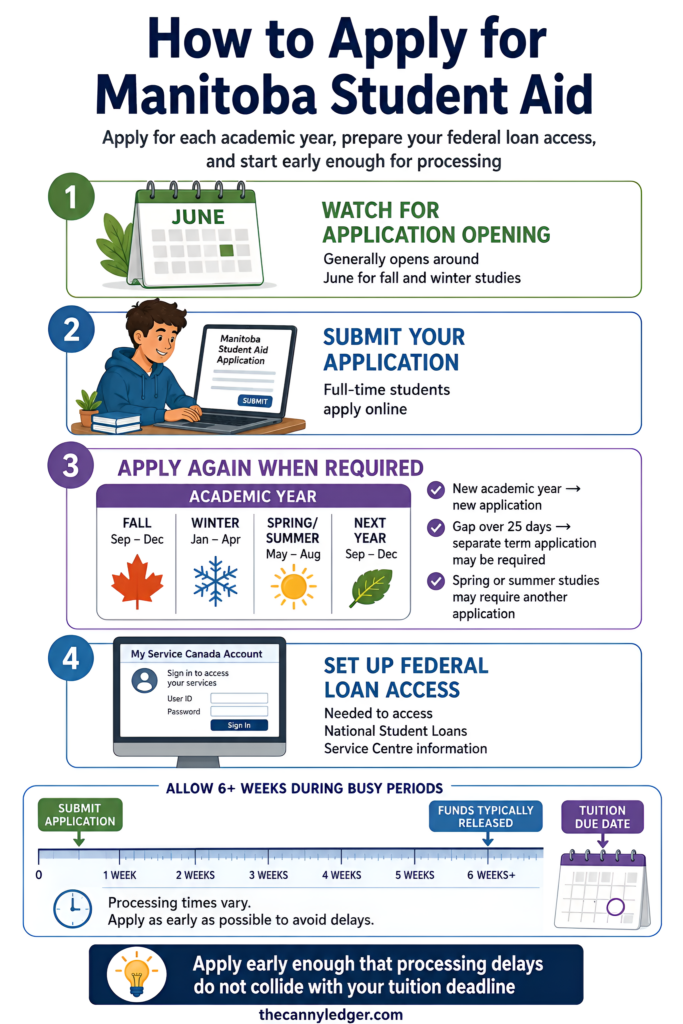
The application opens online each year, generally in June for students beginning fall or winter studies at universities, colleges, or approved private vocational or training schools. You’ll need to submit a separate application for each academic year, or for each individual term if the gap between terms exceeds 25 days, so a student attending across a full academic year and a separate spring or summer term should expect to apply more than once. Full-time students applying a second time within the same academic year can now complete this through the online portal directly, a recent simplification worth knowing about if your enrollment plans shift partway through the year.
Beyond the application itself, students using the National Student Loans Service Centre now need a My Service Canada Account to access their federal loan information, a change worth setting up early if you don’t already have one, since delays here can hold up your Manitoba Student Aid funding even when the provincial side of your application is otherwise complete.
What’s changing for the 2026-27 program year
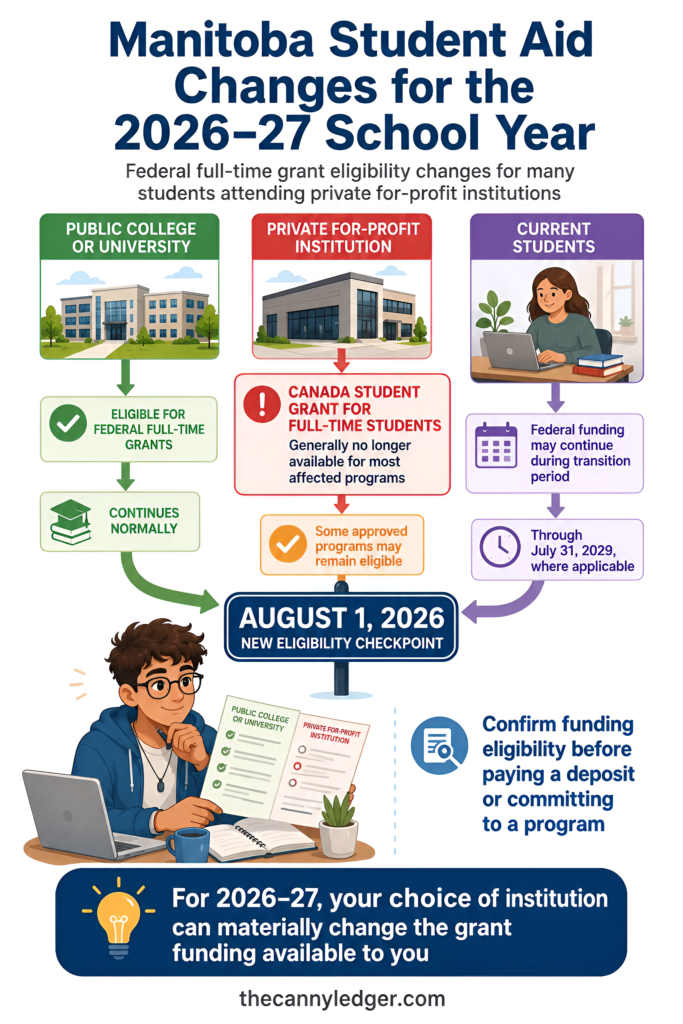
A notable shift is taking effect for study periods starting on or after August 1, 2026: most students attending private for-profit institutions will no longer be eligible for the Canada Student Grant for Full-Time Students, part of a broader push by both the federal and provincial governments to prioritize funding toward regulated programs with stronger completion and employment outcomes. Some specific programs may remain exempt subject to approval, and students already partway through an affected program can generally continue receiving federal funding through a transition period running to July 31, 2029. If you’re weighing a private institution against a public college or university specifically because of funding eligibility, this is worth confirming directly before committing, since it can materially change how much of your education gets covered.
Repayment, and what happens if you’re struggling
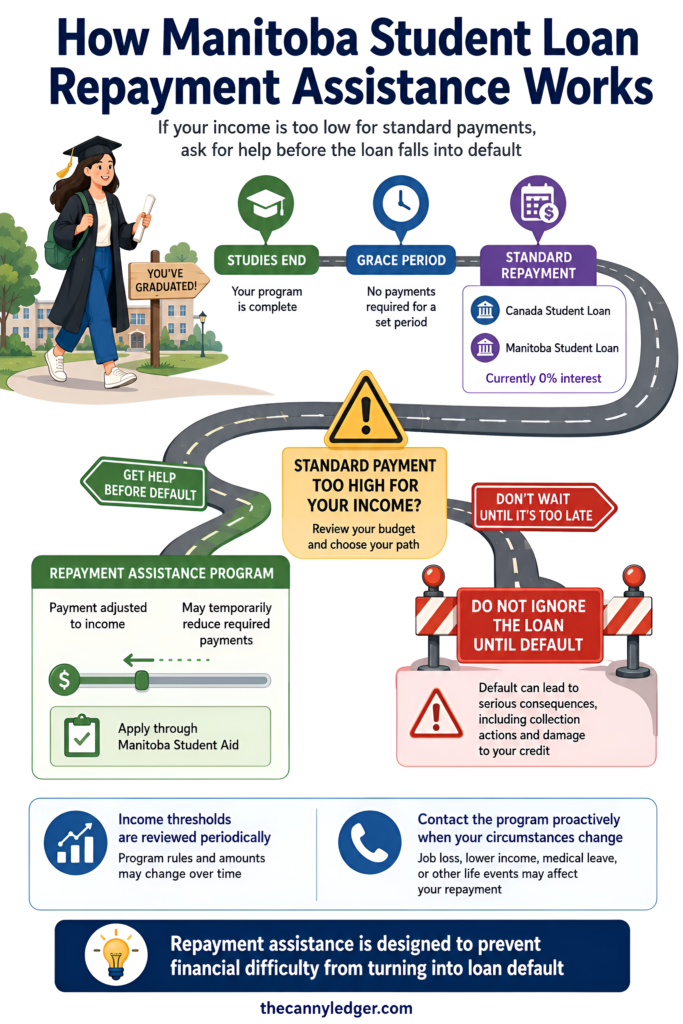
Repayment on both your federal and provincial loans generally begins after a grace period following the end of your studies, and Manitoba’s Repayment Assistance Program exists specifically for graduates whose income makes standard repayment genuinely difficult, adjusting or temporarily reducing required payments based on income thresholds that are reviewed periodically. This program is worth contacting proactively if repayment becomes a struggle rather than letting a loan fall into default, since the assistance program is specifically designed to prevent exactly that outcome. Our manitoba and Winnipeg personal income tax guide is worth reading alongside your repayment planning, since student loan interest, where it applies, and certain related amounts can factor into your broader tax picture.
The part most students never hear about: the tuition rebate
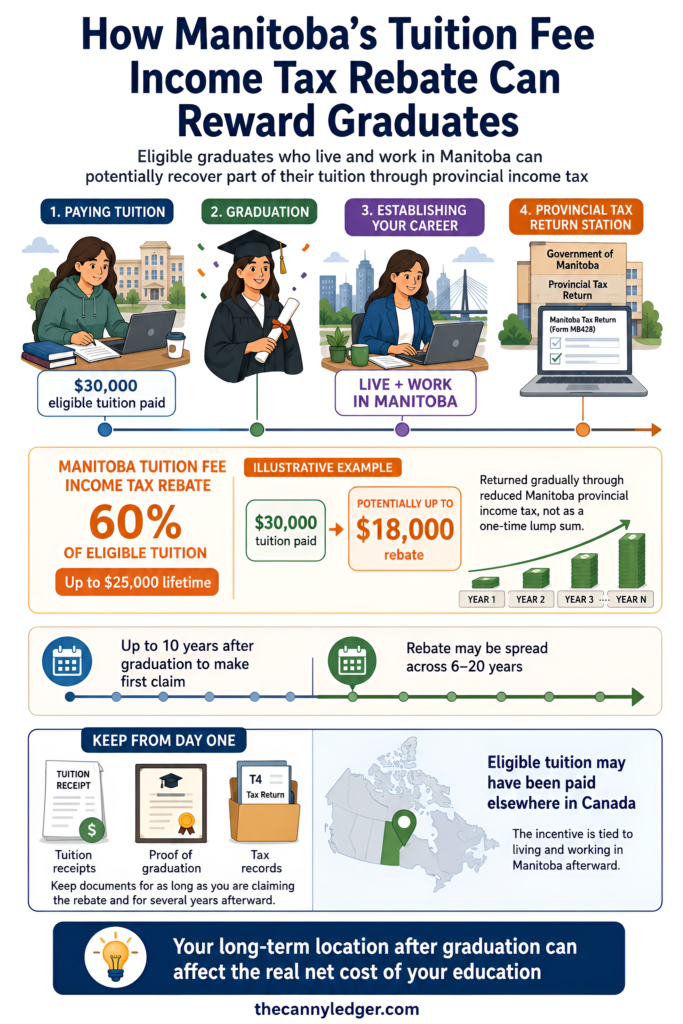
This is the piece worth building into your financial planning from day one rather than discovering years after graduation. The Manitoba Tuition Fee Income Tax Rebate offers a 60 percent income tax rebate on eligible tuition fees, up to a lifetime maximum of $25,000, to graduates who go on to live and work in Manitoba, regardless of whether they actually studied here or came to the province after finishing school elsewhere in Canada. On $30,000 in tuition paid over the course of a degree, that works out to as much as $18,000 coming back to you through reduced provincial tax owed over time, a genuinely substantial sum that most students never factor into their decision about where to study or where to settle afterward.
The mechanics are worth understanding precisely. You have up to ten years after graduation to make your first claim, and once you start, the full rebate can be spread across as few as six years or as many as twenty, claimed against your Manitoba income tax payable each year you file. It’s claimed directly on your personal tax return using a specific provincial form, and while formal documentation generally isn’t required at filing time, keeping your tuition receipts and proof of graduation on hand is worth doing in case it’s requested later. Because the rebate applies to eligible tuition paid anywhere in Canada as long as you’re now living and working in Manitoba, it’s a genuine incentive worth factoring into a decision to settle here after finishing a degree elsewhere, not just a benefit reserved for people who studied locally.
Rounding out your financial picture
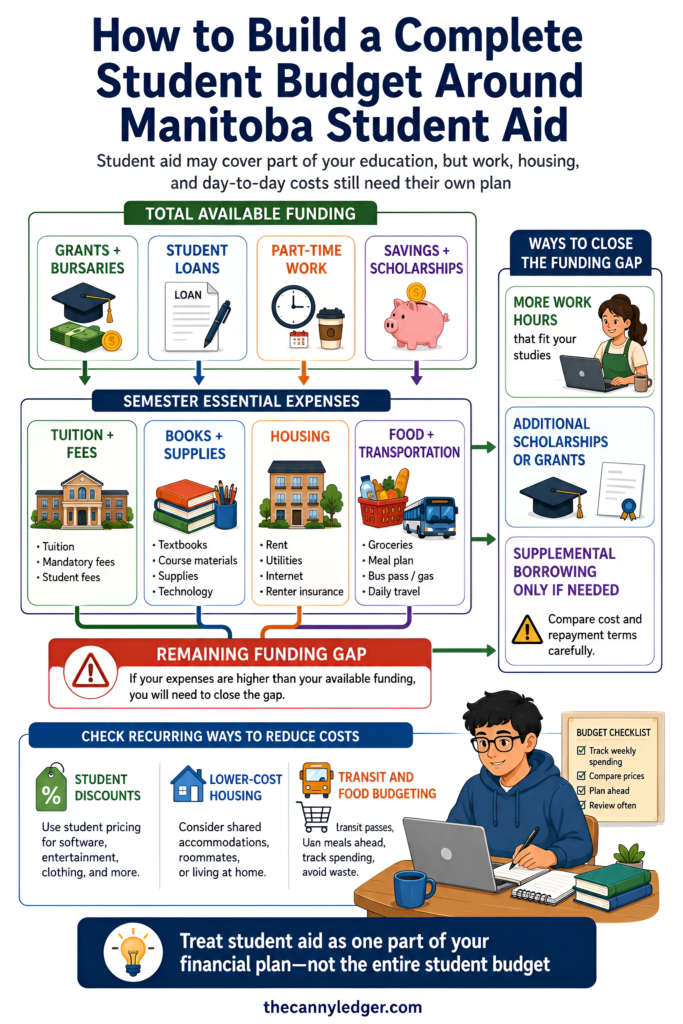
Manitoba Student Aid covers tuition, fees, and living costs directly, but it’s rarely the entire financial picture for a student balancing school with everything else. Our student jobs in Winnipeg guide covers part-time and campus-specific work worth pairing with your aid package, and our student housing in Winnipeg and cost of living in Winnipeg for international students guides are worth reading if housing and day-to-day budgeting are the pieces you’re still working out. If you’re weighing supplemental borrowing beyond what Manitoba Student Aid offers, our student line of credit in Winnipeg guide covers that specific option, and our student discounts in Winnipeg guide rounds out the practical side of stretching a student budget further.
Before you file that first application
Apply early, since processing delays during peak periods are real and can push funding arrival later than your tuition deadline. Understand clearly whether you’re being assessed as full-time or part-time, since the application process, funding amounts, and even the new grants-only option differ meaningfully between the two. And hold onto every tuition receipt from day one of your program, not because you’ll need it immediately, but because a document you kept without thinking twice about it is exactly what makes claiming up to $25,000 back through the tuition rebate straightforward a decade from now, long after most students have completely forgotten the paperwork existed.