

Calling Winnipeg’s furniture bank directly and asking for an appointment doesn’t work, no matter how genuine the need. Oyate Tipi Cumini Yape, the city’s dedicated furniture bank, operates entirely on referral, meaning a social service worker at one of its 23-plus partner agencies has to make the request on a client’s behalf before any furniture gets arranged. This surprises a lot of people expecting a straightforward application process the way a food bank or a government benefit might work, and not knowing this upfront can waste real time for someone who needs furniture urgently.
- Oyate Tipi: Winnipeg’s Dedicated Furniture Bank
- How the Referral Process Actually Works
- The Government Benefit Most People Don’t Know About
- Donating Furniture Instead of Receiving It
- Habitat for Humanity ReStore: Winnipeg’s Low-Cost Alternative
- Free vs Low-Cost: Matching the Right Option to Your Situation
- Other Places Worth Checking
- Common Questions About Furniture Assistance in Winnipeg
Free furniture in Winnipeg is available primarily through Oyate Tipi Cumini Yape, accessed only through a referral from a partner social service agency rather than direct application, alongside a lesser-known Manitoba government benefit called the Start-Up Allowance, worth up to $500 for essential furnishings in specific circumstances. For furniture at a steep discount rather than free, Habitat for Humanity ReStore runs three Winnipeg locations selling donated and surplus furniture, appliances, and building materials well below retail.
Oyate Tipi: Winnipeg’s Dedicated Furniture Bank
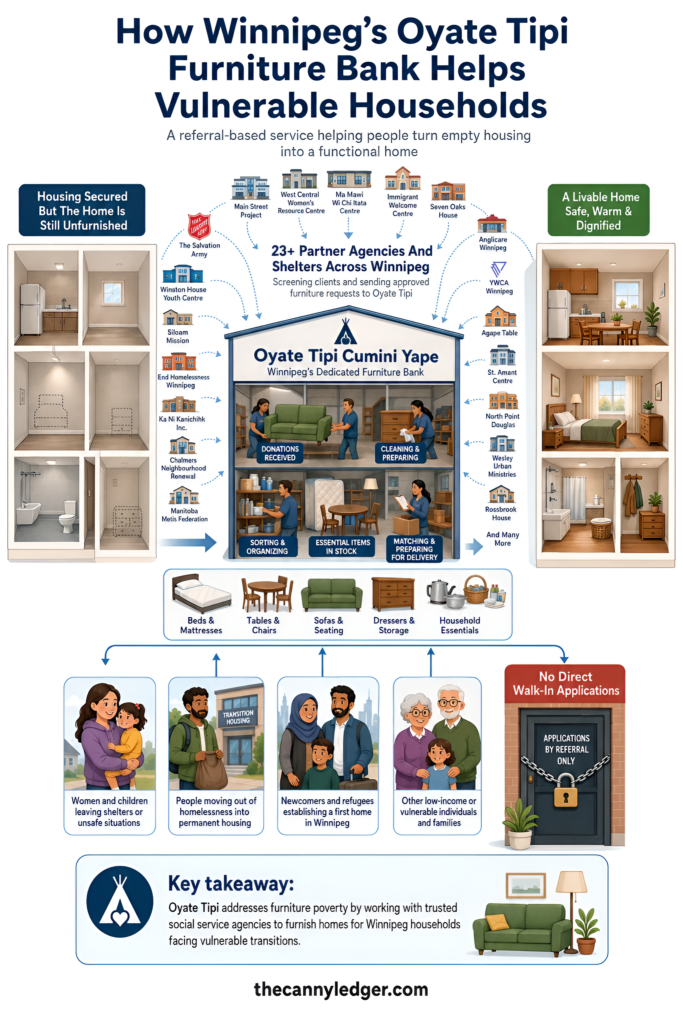
Oyate Tipi Cumini Yape exists specifically to address furniture poverty, the reality that a household can secure housing and still have no bed, no table, no basic means of actually living in that space. The organization’s mandate centers on women and children leaving shelters, people transitioning out of homelessness, and newcomers and refugees settling in Winnipeg, alongside individuals and families in a broader low-income or vulnerable position. Rather than operating as a single storefront a person walks into, Oyate Tipi works through a network of more than 23 partner agencies and shelters across the city, organizations already working directly with the populations most likely to need this kind of support, who handle the actual screening and referral process on Oyate Tipi’s behalf.
How the Referral Process Actually Works
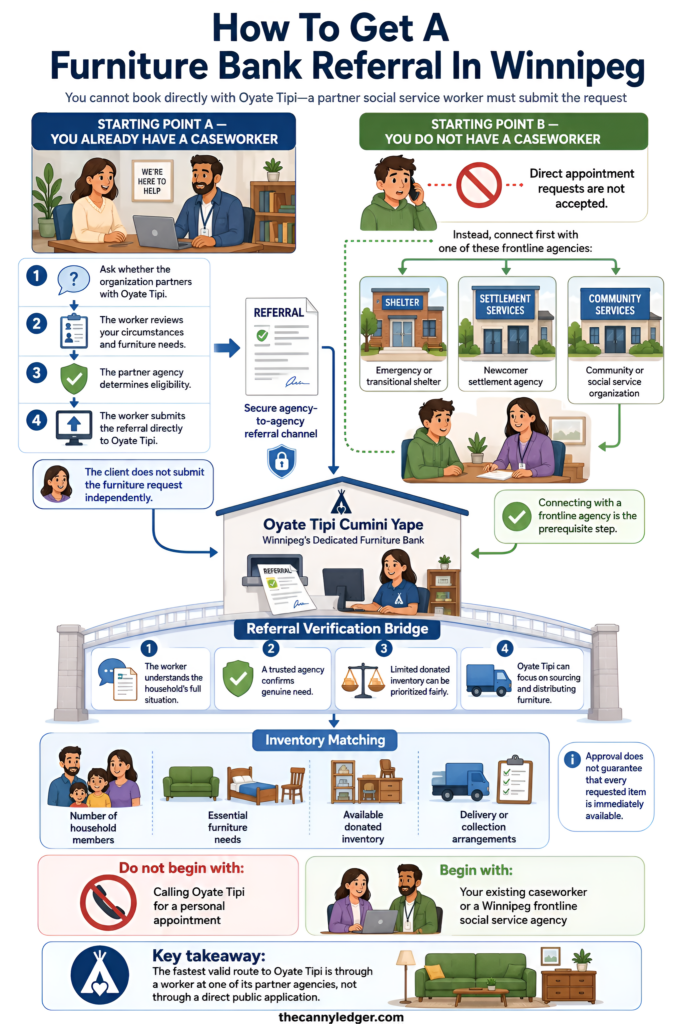
If you already have a caseworker through a shelter, settlement agency, or other social service organization, the first and most direct step is asking that worker whether their organization is one of Oyate Tipi’s partner agencies. If it is, the worker determines eligibility and submits the referral directly, a process built around the professional relationship already in place rather than requiring a household to navigate a new, unfamiliar application on their own during an already difficult transition. Someone without an existing caseworker relationship should start by connecting with a shelter, newcomer settlement service, or other frontline social service organization in Winnipeg, since establishing that relationship is effectively the prerequisite step before a furniture referral becomes possible at all. This structure exists deliberately: partner agencies already understand a client’s full situation and genuine need, which lets Oyate Tipi focus its limited furniture inventory on people a trusted frontline worker has already vouched for, rather than managing open, unscreened public applications directly.
The Government Benefit Most People Don’t Know About
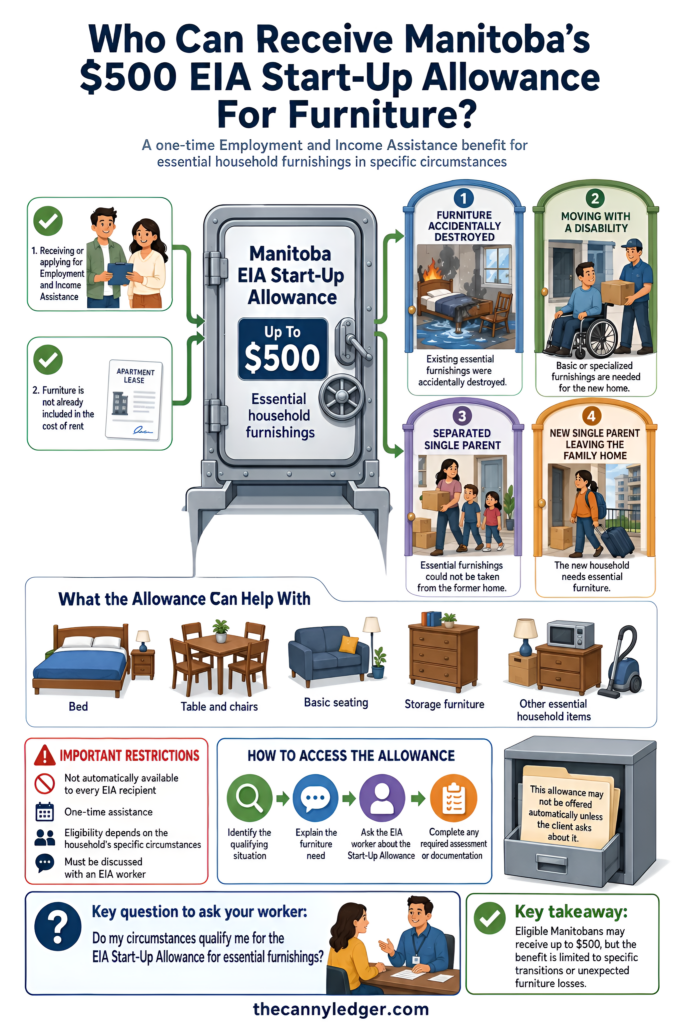
Beyond the charitable route, Manitoba runs its own furniture-specific benefit through the Employment and Income Assistance program that a lot of eligible people never realize exists. The Start-Up Allowance provides a one-time payment of up to $500 toward essential household furnishings when furniture isn’t included in the cost of rent, but it’s restricted to specific circumstances rather than available to every EIA recipient automatically: your existing furnishings were accidentally destroyed, in a fire or flood, for instance, you have a disability and are moving out of an institution or your parents’ home and need basic or specialized furniture for your own space, you’re a separated single parent unable to bring furnishings from your previous home, or you’re a new single parent moving out of your parents’ home into an independent place for the first time. Anyone already receiving or applying for EIA who fits one of these situations should ask their EIA worker directly about this allowance rather than assuming it doesn’t apply, since it isn’t something that gets offered automatically without being requested.
Donating Furniture Instead of Receiving It
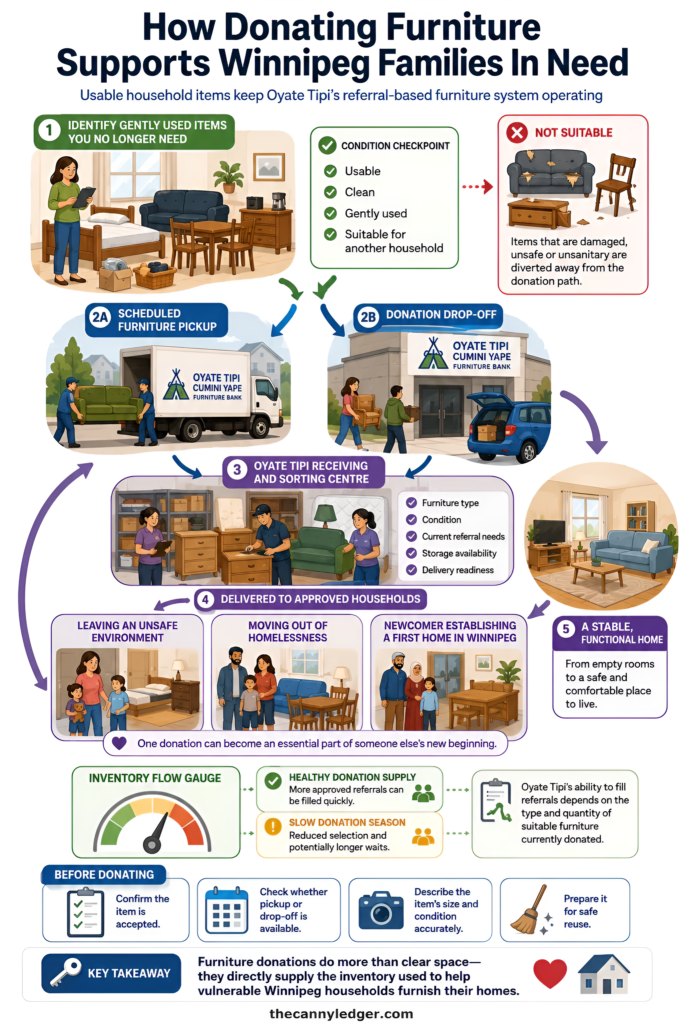
The same organization that distributes furniture also depends entirely on donations to keep doing so. Oyate Tipi accepts furniture and household goods through both pickup and drop-off, and anyone with usable, gently-used furniture taking up space is effectively feeding the same system that supports women leaving unsafe situations, families rebuilding after homelessness, and newcomers furnishing a first home in Winnipeg. This matters practically for the donation side too: a healthy, consistently stocked donation pipeline is what actually lets referral requests get filled quickly, so a slow donation season can mean longer waits even for approved referrals.
Habitat for Humanity ReStore: Winnipeg’s Low-Cost Alternative
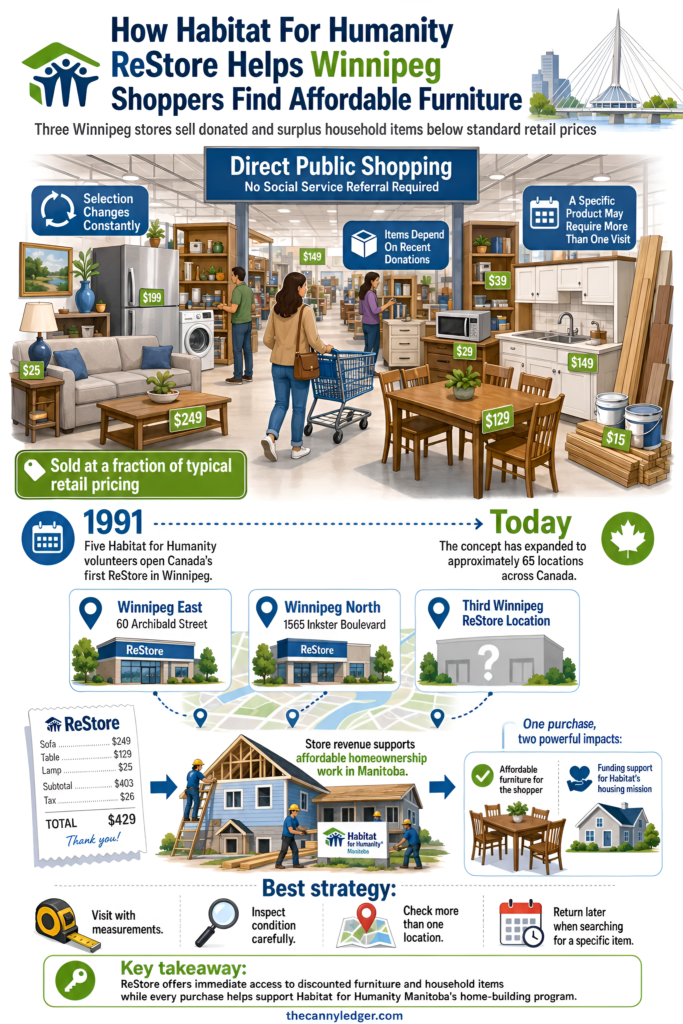
For anyone whose situation doesn’t fit a referral pathway, or who simply needs furniture at a steep discount rather than free, Habitat for Humanity’s ReStore is worth knowing about specifically because of its local history. Winnipeg was where five Habitat for Humanity volunteers opened Canada’s very first ReStore back in 1991, a concept that’s since expanded to 65 locations across the country. Winnipeg currently runs three ReStore locations, including Winnipeg East at 60 Archibald Street and Winnipeg North at 1565 Inkster Boulevard, selling new and gently used furniture, appliances, home décor, and building materials at a fraction of standard retail pricing. Every purchase supports Habitat for Humanity Manitoba’s home-building program directly, meaning furniture shopping there doubles as support for the organization’s broader affordable homeownership work, and inventory changes constantly since it depends entirely on what’s been donated that week, so a specific item worth hunting for might mean checking back more than once rather than expecting a predictable, static selection.
Free vs Low-Cost: Matching the Right Option to Your Situation

These aren’t interchangeable options, and picking the right one depends heavily on your specific circumstances and timeline. Oyate Tipi’s referral route fits someone in a genuinely vulnerable situation, leaving an unsafe home, exiting homelessness, or newly arrived in Canada, who has, or can connect with, a frontline social service worker to make that referral happen. Manitoba’s EIA Start-Up Allowance fits someone already in or applying for income assistance who meets one of the specific qualifying circumstances, a narrower door than Oyate Tipi’s broader vulnerability-based mandate, but one that provides direct funding rather than relying on whatever’s currently in donated inventory. Habitat for Humanity ReStore fits anyone who doesn’t qualify for either free option, or who needs a specific item faster than a referral-based system can guarantee, trading the fully free price tag for immediate, direct access to real furniture at a genuine discount.
Other Places Worth Checking
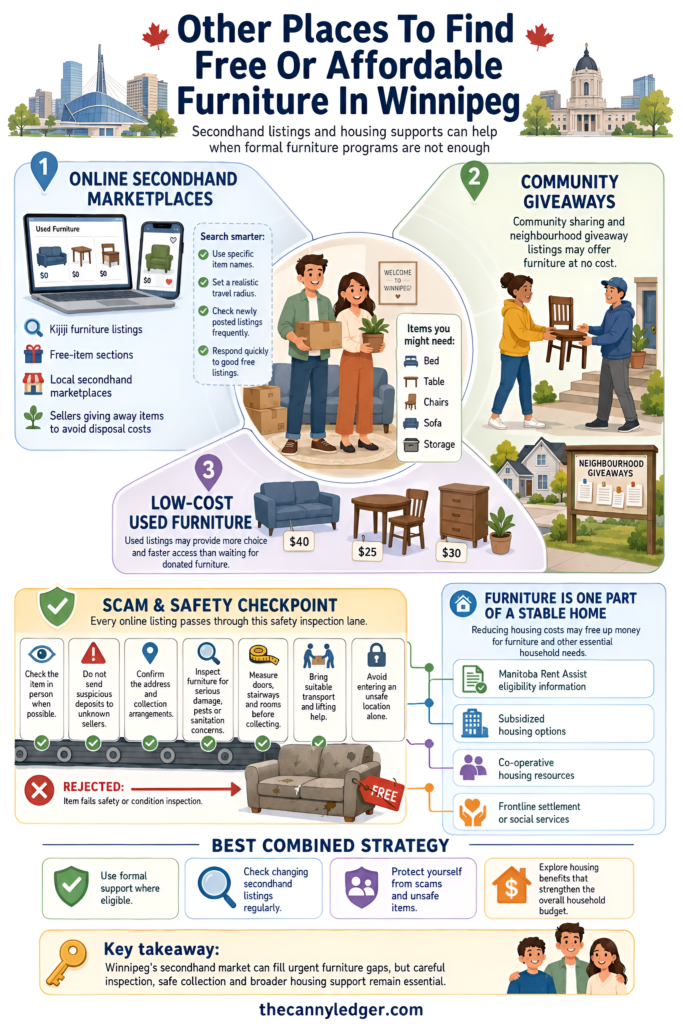
Beyond these three structured options, Winnipeg’s active secondhand marketplace scene remains a real resource for furniture specifically, and the same search strategies and scam-avoidance habits that apply to apartment hunting on Kijiji apply just as directly to furniture listings, including the free section many sellers use specifically to move items they’d otherwise have to pay to dispose of. For anyone navigating a broader housing transition alongside a furniture need, checking eligibility for Manitoba’s Rent Assist program or subsidized and co-op housing options can also help stabilize the bigger picture that furniture is usually just one piece of.
Common Questions About Furniture Assistance in Winnipeg
Can I request specific furniture items through Oyate Tipi, or is it whatever’s available? Availability depends entirely on current donation inventory rather than a catalogue to choose from, so a referral typically results in whatever essential furnishings are on hand at the time rather than a guarantee of specific requested pieces.
Is there a cost involved with an Oyate Tipi referral, even a small one? No, furniture provided through an approved Oyate Tipi referral is free, the organization’s entire model is built around eliminating furniture poverty for people who genuinely can’t afford it, not a reduced-cost program.
Does applying for the EIA Start-Up Allowance affect my regular monthly EIA benefits? No, it’s a separate, one-time benefit tied to a specific qualifying circumstance rather than a deduction from or addition to your ongoing monthly EIA amount, though it’s still worth confirming the specifics directly with your EIA worker given how each individual case gets assessed.
If you’re working with a caseworker already, ask directly whether their agency partners with Oyate Tipi before assuming furniture help isn’t available. If you’re on EIA and fit one of the Start-Up Allowance’s specific circumstances, raise it directly rather than waiting for it to be offered. And if neither applies, Habitat for Humanity ReStore and Winnipeg’s active secondhand marketplace both offer a genuine, immediate alternative without needing to wait on a referral at all.