

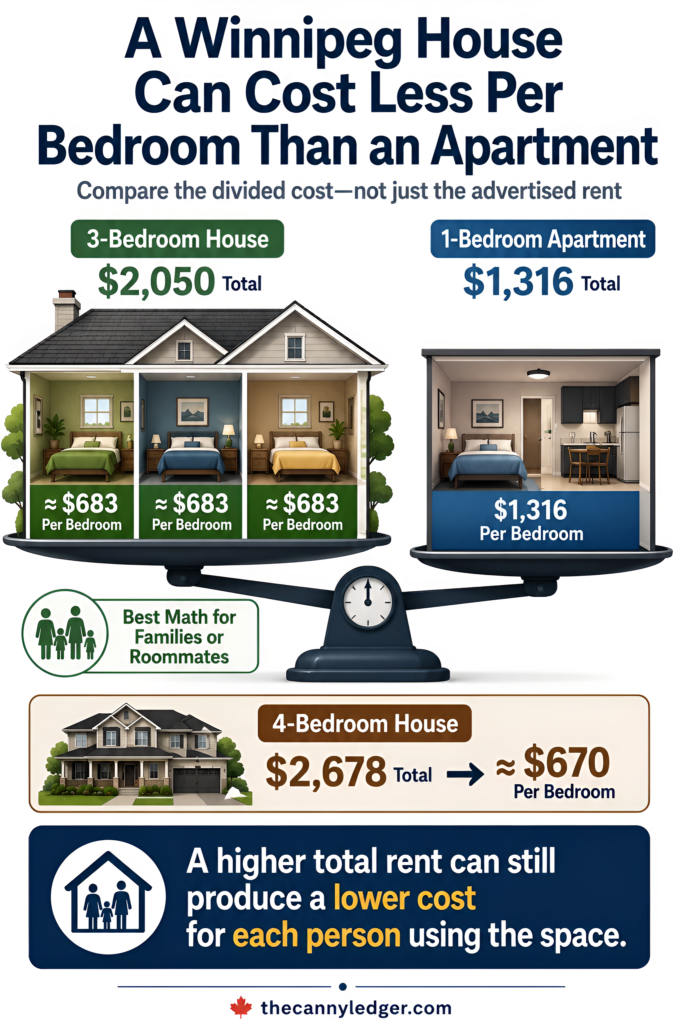
A lot of families searching for more space make the same comparison and draw the wrong conclusion from it: a 3-bedroom house at $2,050 a month looks brutal sitting next to a $1,316 one-bedroom apartment, so the house gets crossed off the list before the math actually gets done. Split three bedrooms across a family, or even just across two working parents each contributing, and that same house often lands cheaper per person than squeezing into a smaller unit built for one or two people. The sticker price on a family-sized rental tells you almost nothing until you divide it by who’s actually living there, and that single miscalculation pushes a lot of families toward cramped smaller units when a house was the better financial call all along.
- What 3 and 4 Bedroom Rentals Actually Cost in Winnipeg
- House vs Apartment: The Cost Comparison Nobody Runs
- The Responsibilities That Come With Renting a Whole House
- Where Family-Sized Houses Cluster in Winnipeg
- School Catchment: The Thing to Check Before You Search by Price Alone
- Finding Child Care Before You Sign, Not After
- Parking, Yards, and the Space an Apartment Can’t Offer
- If Market Rent Doesn’t Work: Manitoba Housing and Rent Assist for Families
- Where to Actually Find House Rentals
- Common Questions About Renting a Family-Sized House in Winnipeg
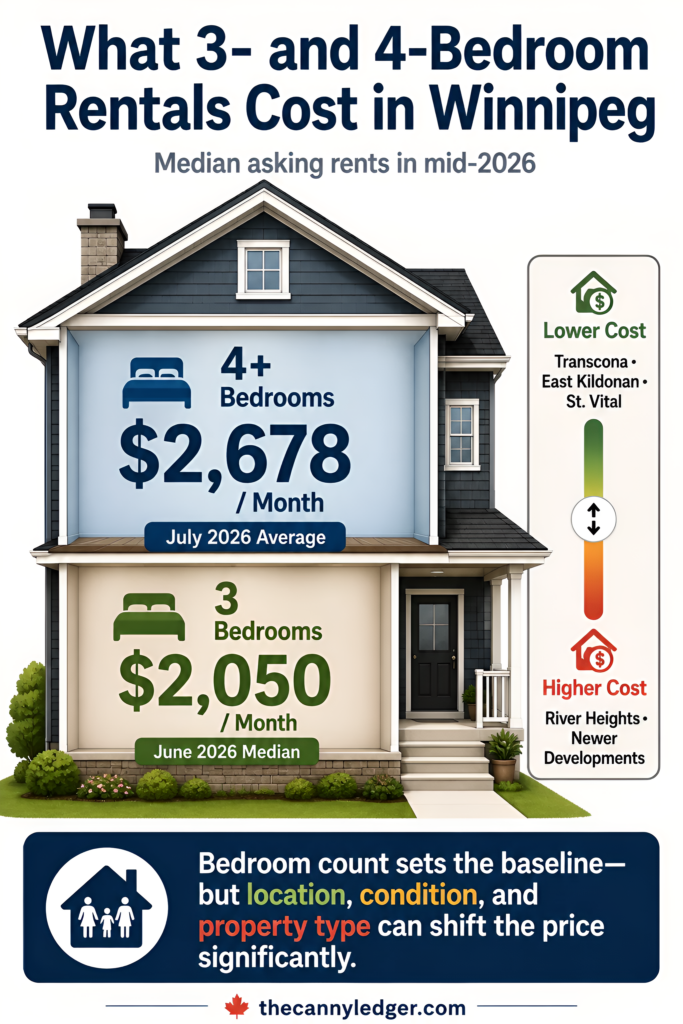
Here’s the direct answer: as of mid-2026, three-bedroom rentals in Winnipeg carry a median asking rent around $2,050 a month, while four-bedroom-plus rentals average roughly $2,678. Renting an entire house instead of an apartment also shifts real responsibilities, like snow removal and utilities, onto the tenant far more often than apartment living does, and those added costs and duties are worth mapping out before signing anything, not discovering after the first snowfall or the first utility bill lands.
What 3 and 4 Bedroom Rentals Actually Cost in Winnipeg
Winnipeg’s three-bedroom market carries a median asking rent of $2,050 a month as of June 2026, up 1.2 percent from the year before, a much slower pace of increase than the two-bedroom segment has seen recently. Four-bedroom-plus units, tracked separately by Zumper, average around $2,678 a month as of July 2026. That’s a meaningful jump from three to four bedrooms, but it also reflects a smaller, less standardized slice of the market, since four-bedroom rentals are almost always full detached houses rather than a purpose-built unit type landlords mass-produce at scale.
It’s also worth knowing that houses and condos don’t price identically even at the same bedroom count. Two-bedroom houses in Winnipeg carry a median asking rent of $1,612, actually slightly below the $1,645 median for two-bedroom condos tracked over the same period. That gap likely reflects condos skewing toward newer buildings with amenities baked into the price, while rental houses span a much wider range of ages and conditions, some of which pull the median down. The same dynamic likely carries into the three- and four-bedroom range, where a dated bungalow and a newly built two-storey can carry very different price tags despite an identical bedroom count.
Location swings these numbers considerably on top of that. A three-bedroom in River Heights or along Wellington Crescent, some of Winnipeg’s most sought-after residential streets, commonly runs $2,000 to $2,700. Family-oriented, more suburban areas like Charleswood, St. Vital, East Kildonan, and Transcona typically offer comparable square footage for less, trading a shorter commute to the downtown core for a lower monthly number, while newer developments in areas like Waverley West tend to command a premium for updated construction even outside the most established, expensive streets.
House vs Apartment: The Cost Comparison Nobody Runs
Run the actual per-bedroom math and family-sized houses often stop looking like the expensive option. A $2,050 three-bedroom house splits to roughly $683 per bedroom. A $1,316 one-bedroom apartment, by contrast, is entirely one person’s cost to carry. For a family of four, or for roommates splitting a house rather than each renting separately, the per-person cost of a house frequently beats stacking multiple smaller units, even though the total monthly number on the house looks much larger at first glance.
The four-bedroom math tells the same story with an even wider gap. At $2,678 a month, a four-bedroom house works out to about $670 per bedroom, essentially identical to the three-bedroom rate despite the extra room, since the jump in total rent from three to four bedrooms doesn’t scale one-to-one with the added space. Compare that to a family of five needing two separate two-bedroom apartments to fit everyone, which would run somewhere near $3,450 a month combined at current two-bedroom rates, and a single four-bedroom house isn’t just more convenient, it’s genuinely cheaper for the same number of people under one roof.
This math flips for a single person or a couple without kids, where a smaller unit almost always wins on raw cost. The comparison only favors the house once there are enough people actually splitting it to bring the per-person number down below what those same people would pay separately, which is exactly why this calculation matters more for families than for any other renter profile on this site.
The Responsibilities That Come With Renting a Whole House
Apartment living usually means a landlord or building handles snow clearing and yard upkeep as part of the building’s common responsibilities. Renting an entire house works differently under Manitoba law: the Residential Tenancies Act defaults snow removal and lawn care to the landlord, but landlords and tenants can agree in writing to shift that responsibility to the tenant, and this arrangement is common specifically for single-family homes where the tenant has exclusive use of the yard and driveway. Before signing a house lease, check the maintenance section directly rather than assuming it works the same way an apartment building does, since a house with no explicit clause defaults to the landlord’s responsibility, while one with a clear tenant clause means budgeting time, or a snowblower, into the deal.
Utilities follow a similar pattern. Apartment buildings sometimes bundle heat or water into rent, older walk-ups in areas like Osborne Village and West Broadway are more likely to include heat through a central boiler system, but a rented single-family house almost always puts every utility, heat, hydro, water, in the tenant’s name directly. That adds up to real money on top of the base rent. Manitoba households paying all their utilities separately typically spend somewhere between $235 and $545 a month combined, with winter months, when heating demand spikes, frequently landing closer to $330 to $685 depending on the house’s size and insulation. On top of that, Manitoba Hydro’s electricity rates rose 4.0 percent effective January 1, 2026, adding roughly $4 to $8 a month depending on whether a home uses electric space heating, and natural gas rates are reviewed quarterly rather than staying fixed year-round. The City of Winnipeg also bills water and sewer quarterly rather than monthly, and a typical family of four can expect that combined bill to land somewhere between $200 and $375 every three months, or roughly $65 to $125 a month averaged out. None of this shows up in the advertised rent, which is exactly why a house that looks like a great deal on paper needs its full utility picture added in before it’s compared fairly against an apartment that might bundle some of these costs into a single number.

Where Family-Sized Houses Cluster in Winnipeg
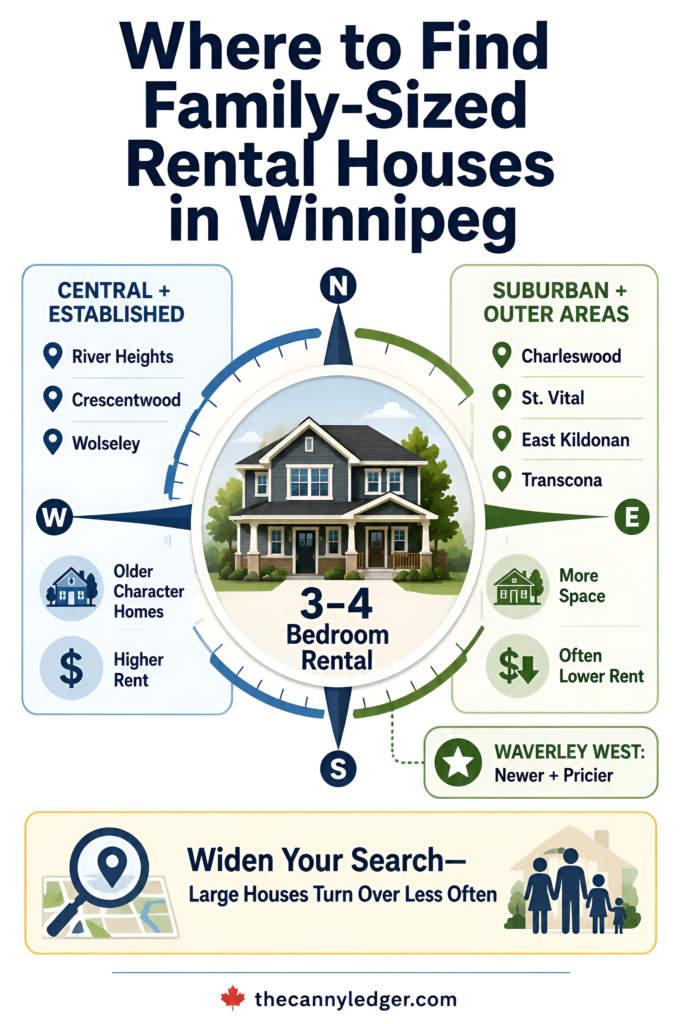
Family-sized rental houses show up across nearly every Winnipeg neighborhood, but availability and price both shift with location the same way smaller units do. The city’s more established, central neighborhoods, River Heights, Crescentwood, Wolseley, tend to carry older housing stock with mature trees and larger lots, but that character comes at a real premium. Suburban and outer-ring areas built up more recently, Charleswood in the southwest, St. Vital and Waverley West in the south, East and North Kildonan across the river, and Transcona further east, generally offer more modern floor plans, attached garages, and fenced yards at a noticeably lower monthly cost, trading a longer commute to downtown for both space and savings.
Checking Winnipeg’s cheaper rent-tracking zones is just as useful for a house search as an apartment one, since a family stretching a budget benefits from the same neighborhood-level price gaps that apply to smaller units, sometimes even more given how much a few hundred dollars a month matters on a family-sized lease. Since family-sized houses turn over less often than smaller apartments, it’s also worth widening the search to a few different neighborhoods rather than fixating on just one, since availability at any given moment can matter as much as price when the pool of listings is smaller to begin with.
School Catchment: The Thing to Check Before You Search by Price Alone
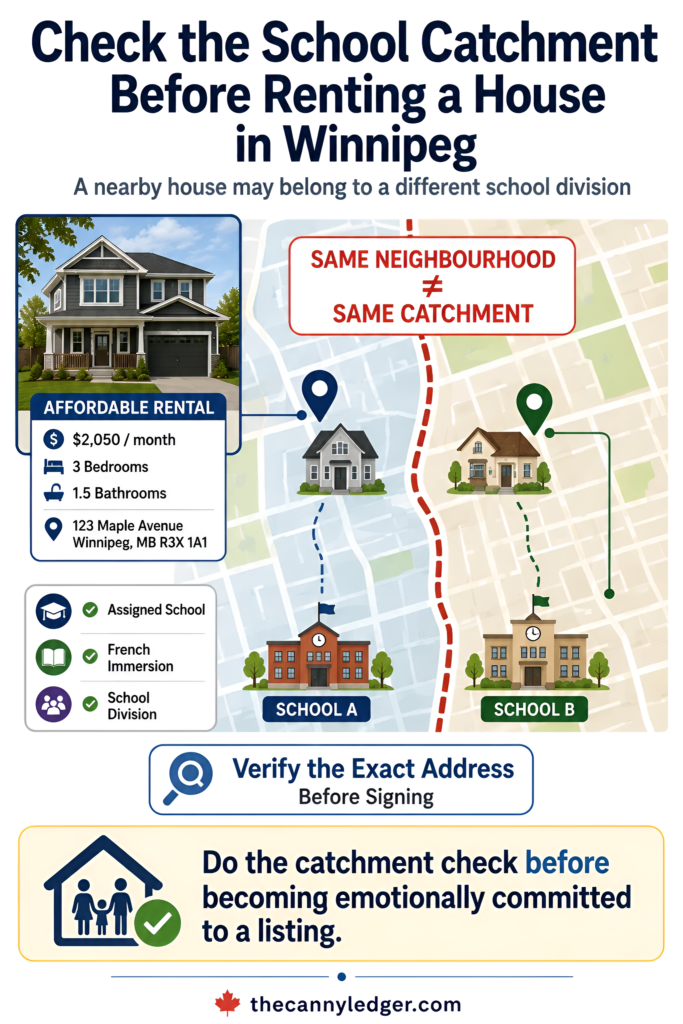
A detail that has nothing to do with rent but matters enormously for families: Winnipeg is split across seven public school divisions, Winnipeg School Division, Pembina Trails, River East Transcona, St. James-Assiniboia, Seven Oaks, Louis Riel, and Seine River, and which one a specific address falls into isn’t always obvious from a listing alone. Two houses a few blocks apart can sit in entirely different divisions with different schools, programs, and even different French Immersion availability. Confirming a prospective rental’s school catchment before signing, rather than after a child is already registered, avoids the scenario where an otherwise perfect, affordable house turns out to be zoned for a school on the other side of the city. This is a five-minute check worth doing before falling in love with a specific listing, not after.
Finding Child Care Before You Sign, Not After
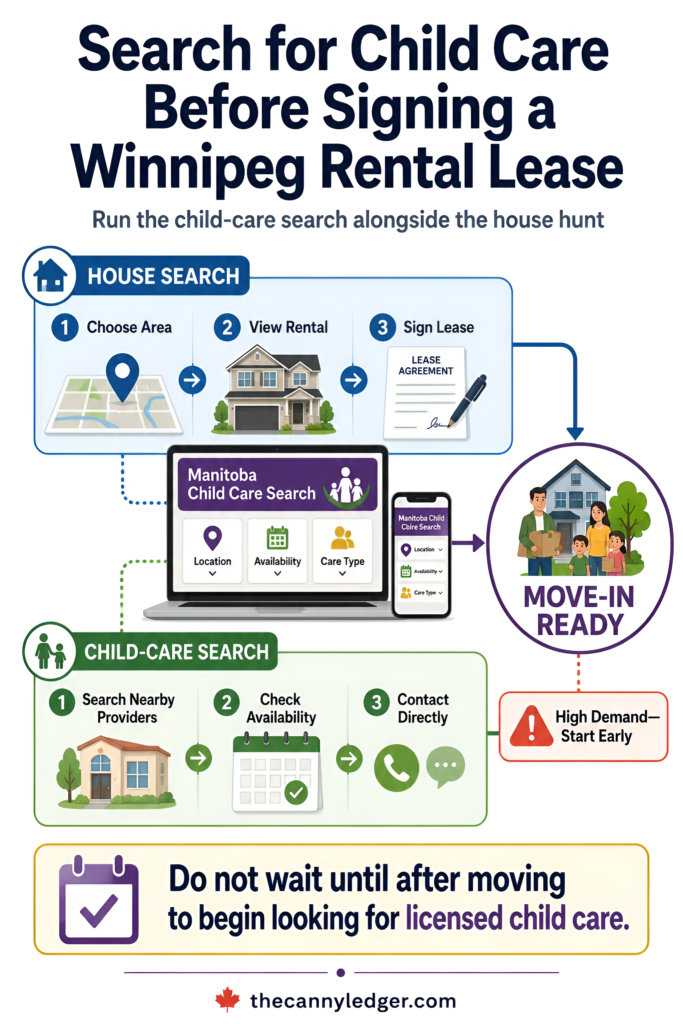
For families with a child too young for school, the search doesn’t stop at the lease. Manitoba runs a single, centralized tool for this, Manitoba Child Care Search, which replaced the province’s older Online Child Care Registry in 2021 specifically because the old system was inconsistently used and often out of date. The current tool lets families filter licensed centres and home-based providers by location, availability, and care type, then contact each one directly rather than sitting on a single passive waitlist and hoping for a call. Licensed child care in Manitoba is in high demand enough that waiting until after move-in to start this search often means months without a spot, so it’s worth running in parallel with the house hunt itself, not after the lease is signed.
Parking, Yards, and the Space an Apartment Can’t Offer
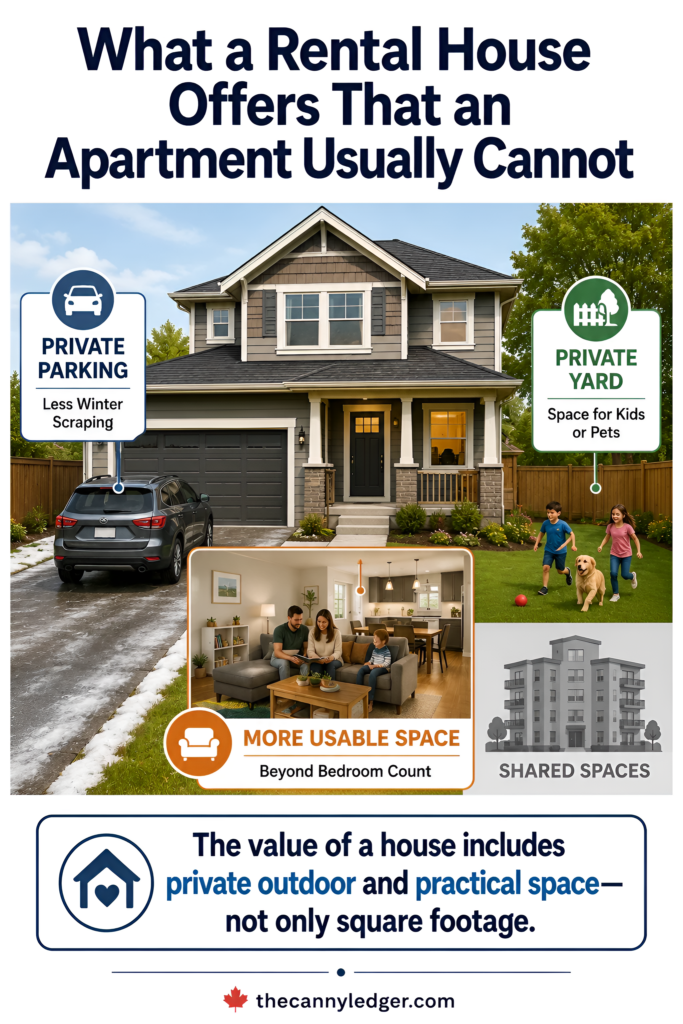
Beyond bedroom count, the practical case for a house over an apartment often comes down to space that doesn’t show up in a per-square-foot comparison. A driveway or attached garage means not scraping ice off a windshield in a shared apartment lot, and a fenced yard gives young kids or pets somewhere to be outside without supervision required the way a shared building courtyard usually does. None of this shows up in a straight rent comparison, but it’s frequently the deciding factor for families who could technically afford a comparable-sized apartment and choose a house anyway.
If Market Rent Doesn’t Work: Manitoba Housing and Rent Assist for Families
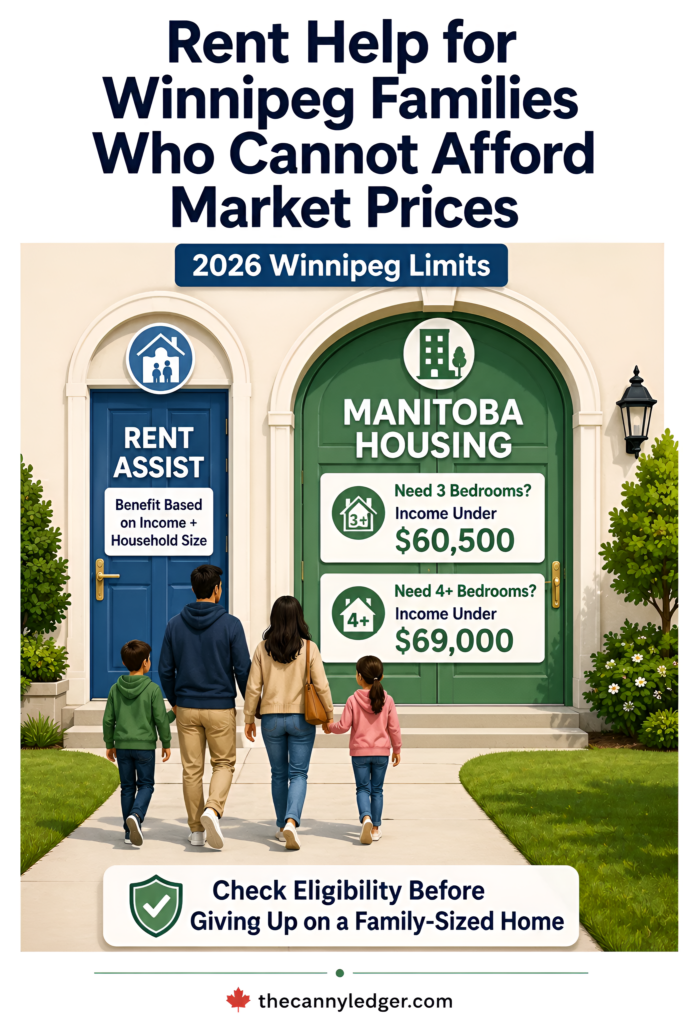
For families where even the lower end of the family-sized market is a stretch, two programs are worth checking before assuming private renting is the only path. Manitoba’s Rent Assist program scales its income thresholds up with household size, so a larger family isn’t held to the same limit as a single renter. Manitoba Housing’s own Social Housing Rental Program goes further, setting bedroom-specific income limits for Winnipeg: as of 2026, a household needing a three-bedroom unit qualifies with income under $60,500, while a household needing four or more bedrooms qualifies under $69,000, both considerably higher ceilings than the limits set for a bachelor or one-bedroom unit. The full picture of Manitoba Housing and co-op options covers how to apply and what else is available beyond the core public housing program.
Where to Actually Find House Rentals
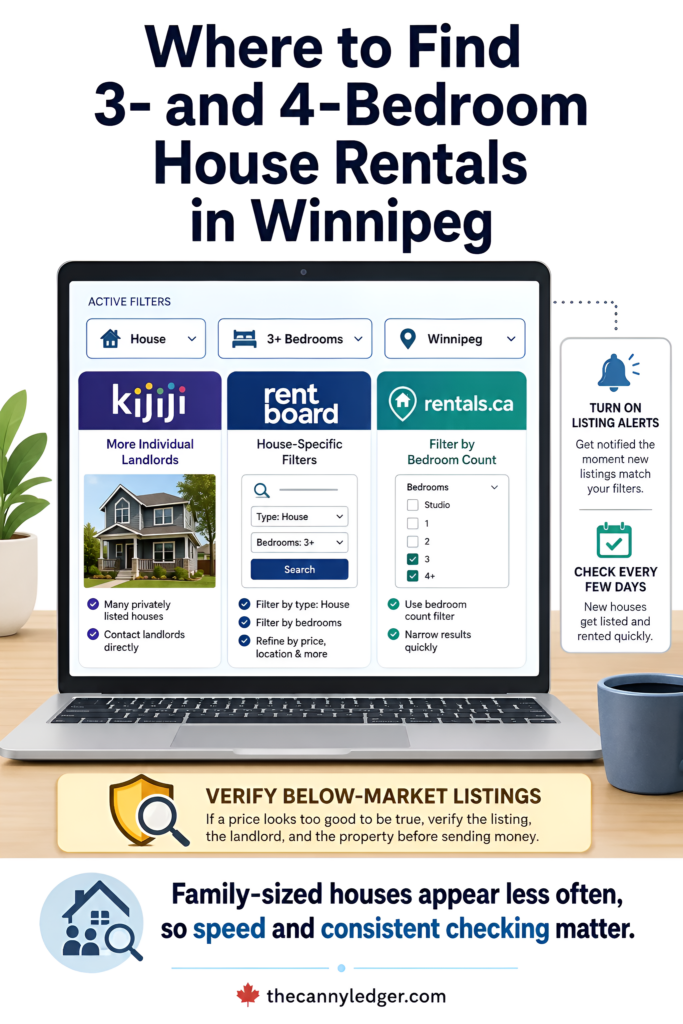
House listings tend to be split across a slightly different mix of sources than apartment listings. Kijiji still carries a large share of individually listed houses, especially from landlords who own just one or two rental properties rather than managing a large building, and the same verification habits that apply to apartment hunting on Kijiji apply just as much here, since a family-sized house with a below-market price is just as capable of being a scam listing as a one-bedroom apartment. RentBoard and rentals.ca both maintain dedicated house-specific listing categories that make it easier to filter directly by bedroom count and skip apartment-only results entirely, which saves real time compared to scrolling past dozens of smaller units on a general search. Because family-sized houses list less frequently than smaller apartments, checking these sources every few days rather than once is worth the extra effort, and setting up alerts wherever the platform allows it means finding out about a new listing the same day it goes up rather than a week later once the best options are already gone.
Common Questions About Renting a Family-Sized House in Winnipeg
Do larger families get any kind of priority for subsidized family-sized units? Availability for larger units tends to be more limited than smaller ones simply because there are fewer 3- and 4-bedroom units in the subsidized housing stock overall, so wait times can run longer for family-sized placements specifically, though eligibility itself is based on income and need rather than family size alone.
Is pet policy usually different for a rented house compared to an apartment? It varies by landlord rather than by property type specifically, since Manitoba landlords can restrict or refuse pets regardless of whether the rental is a house or an apartment. That said, a private landlord renting out a single house is sometimes more willing to negotiate pet terms directly than a large apartment complex working from a fixed corporate policy.
What’s a typical lease length for a rented house in Winnipeg? A one-year fixed-term lease is the most common arrangement for houses, more so than for apartments, where month-to-month arrangements show up more often. This partly reflects landlords wanting more stability for a larger, harder-to-re-rent property, so it’s worth confirming lease length expectations early if flexibility matters to your situation.
Does moving into a bigger house cost more upfront than moving into an apartment? Usually yes, beyond just a higher security deposit. A larger household typically has more furniture and belongings to move, which pushes up moving costs whether that means renting a bigger truck, hiring movers for a longer job, or simply needing more hands for the day. Building that into the initial move-in budget, on top of the deposit and first month’s rent, avoids the surprise of a move costing meaningfully more than the last one did in a smaller unit.
Run the per-bedroom math before ruling out a house purely on the total rent number, and confirm the maintenance clause, utility setup, and school catchment before signing, since those three details shape the real cost and daily reality of a family-sized rental far more than the listed price alone.