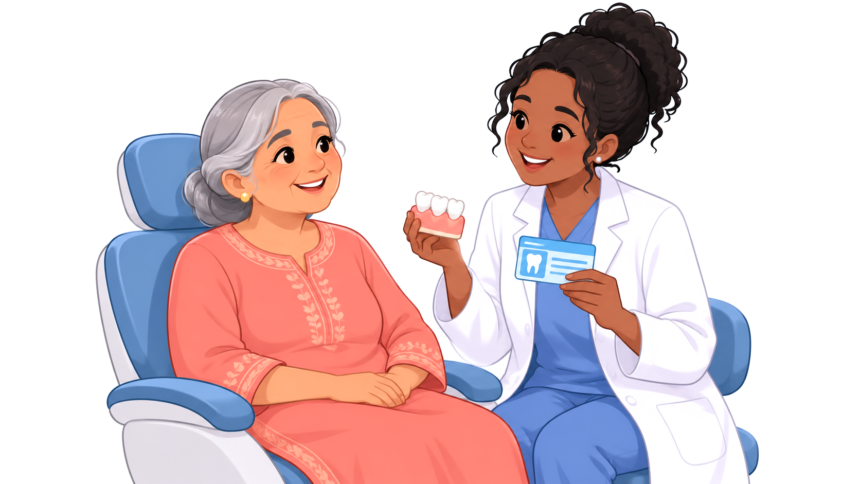
A surprising amount of content about senior dental coverage in Ontario gets one basic fact wrong, the assumption that a senior has to choose between the Ontario Seniors Dental Care Program and the federal Canadian Dental Care Plan, as if picking one automatically disqualifies the other. That’s not how it actually works. Ontario’s own current guidance states plainly that qualifying for the CDCP doesn’t affect OSDCP eligibility at all, and a senior meeting both programs’ criteria can hold coverage under both at once.
That single clarification matters more than it might seem, since a senior who assumed they had to pick just one might have walked away from real coverage they were actually entitled to. Understanding exactly what this provincial program covers, who qualifies, and where you can actually use it is worth working through in full before assuming you already know how it fits alongside everything else available to you.
Who Actually Qualifies
Eligibility requires being 65 years of age or older, an Ontario resident, and meeting the applicable income threshold, currently an annual net income of $25,480 or less for a single senior, or a combined annual net income of $42,290 or less for a couple. These are the same figures the province updated for the 2026 to 2027 benefit year, moved up from the previous $25,000 and $41,500 levels as part of a broader shift toward annually reviewing these income thresholds against inflation.
Beyond age, residency, and income, the program requires having no other form of dental benefits, with one specific and genuinely important exception, coverage through the Canadian Dental Care Plan doesn’t count against this requirement. Any other dental coverage does disqualify an applicant though, whether that’s private insurance through a former employer’s retiree benefits, or dental coverage tied to another government program such as Ontario Works, the Ontario Disability Support Program, or Non-Insured Health Benefits. Anyone weighing this alongside other programs administered through Ontario Works or the Ontario Disability Support Program should confirm which specific dental coverage, if any, comes bundled with those benefits before assuming OSDCP is automatically the better fit.
What This Program Actually Covers
The coverage list is genuinely broad for a free program, spanning routine check-ups including scaling, fluoride treatment, and polishing, repair of broken teeth and cavities, x-rays, oral surgery to remove teeth or abnormal tissue, anesthesia, treatment for infection and pain through endodontic services, and treatment for gum conditions through periodontal services. This isn’t a bare-bones cleaning-only benefit, it covers the kind of substantive dental work that actually keeps a senior’s oral health stable rather than just the preventive basics.
Dentures sit in a genuinely different category from everything else on that list. Prosthodontic services, including dentures, receive only partial coverage under the program, meaning a senior needing dentures will face some out-of-pocket cost even while covered, unlike the largely comprehensive treatment of the other listed services. Beyond that specific carve-out, certain dental procedures also carry limits tied to clinical and scientific criteria rather than a flat rule applying identically to every situation, details a participating provider can walk through based on your specific treatment needs.
Where You Can Actually Use This Coverage
This is the single most practical limitation of the whole program, and it’s the one most likely to surprise a new applicant. OSDCP coverage isn’t accepted at a typical private dental office the way many people assume a free dental care benefit would work, access runs specifically through public health units, partner Community Health Centres, and partner Aboriginal Health Access Centres rather than the dentist someone might already see privately.
That structural limitation means the actual range of available services can genuinely vary depending on where in Ontario you live, since not every public health unit or partner clinic offers identical service availability. Confirming what’s actually accessible through your specific local public health unit before assuming a particular procedure is readily available nearby is worth doing directly, since the program’s coverage on paper and what’s practically bookable in your immediate area aren’t automatically the same thing.
Applying Through Accerta Or By Mail
Applications go through two channels, an online portal run by the program’s administrator, Accerta, or a paper application submitted by mail. The online route requires your date of birth, a valid Ontario address, your Social Insurance Number or Temporary Taxation Number, and confirmation that you filed taxes the previous year, since income verification runs through your SIN rather than requiring separate income documentation to be submitted.
A detail worth flagging specifically for couples, if both spouses or common-law partners are applying, each person submits a completely separate application rather than one joint household form. Anyone without a SIN or who didn’t file taxes the previous year needs a different path entirely, applying by mail through a guarantor, someone from a specific list of recognized professionals and officials, ranging from doctors and lawyers to municipal clerks and religious officiants, who can confirm the applicant’s identity, age, and residency on their behalf.
How Coverage Renews Each Year
Once approved, coverage lasts up to one year but always ends on July 31 regardless of when during the year enrollment actually began, meaning someone approved in March gets a meaningfully shorter first coverage window than someone approved in September. For most enrolled seniors, eligibility gets reverified automatically each year to confirm continued participation, with notification arriving by mail either confirming renewal or explaining next steps if something’s changed.
Two specific situations break that automatic renewal, anyone who originally applied using a guarantor, and anyone who hasn’t filed taxes for the most recent relevant tax year, both need to actively reapply rather than assuming the program will simply carry their coverage forward. This is worth flagging directly to anyone in either situation, since assuming automatic renewal when it doesn’t actually apply risks a real coverage gap discovered only when trying to book an appointment.
Making The Most Of What’s Actually Available
Confirm your own eligibility against the current $25,480 single or $42,290 couple threshold directly, since these figures moved recently enough that older information circulating online may still reference the previous, lower amounts, a similar update to the one that recently reshaped the Ontario Drug Benefit program’s own income-tested thresholds. If you’re already receiving Canadian Dental Care Plan benefits, don’t assume that disqualifies you from OSDCP, apply for the provincial program too if you otherwise meet the criteria, since the two are explicitly allowed to run together.
And before booking anything, contact your local public health unit directly to confirm what services are actually available near you and how to get on any waiting list that might apply, since demand for these programs has genuinely outpaced availability in some regions. For a broader look at how dental coverage fits alongside other support available to Ontario seniors, our overview of benefits for Ontario seniors covers the fuller picture beyond dental care specifically.
What People Get Wrong About This Program
Does having Canadian Dental Care Plan coverage reduce what OSDCP will pay for? No, the two programs run independently rather than coordinating benefits or reducing one based on the other, and OSDCP eligibility explicitly allows for concurrent CDCP coverage without penalty.
If my income is slightly above the threshold, is there any partial coverage available? No, unlike some income-tested benefits that phase out gradually, OSDCP eligibility is a hard cutoff at the applicable income threshold, with no reduced or partial version of the program available above that line.
Can I switch from my current dentist to OSDCP coverage if I already have a regular dental provider? Only if that provider happens to be a participating public health unit, Community Health Centre, or Aboriginal Health Access Centre, since a private dental office you’ve used previously generally won’t accept OSDCP coverage regardless of how long you’ve been a patient there.