

Manitoba’s public home care program doesn’t ask what you earn. It asks what you need. That single design choice surprises a lot of families walking into this for the first time, since so many government support programs run on income testing that most people assume home care must work the same way. It doesn’t, and understanding that distinction early saves a lot of wasted worry about whether a parent’s pension or a household’s savings will disqualify them from help they’d otherwise qualify for.
- Manitoba’s Public Home Care Isn’t Income-Tested, It’s Needs-Tested
- How to Actually Get Assessed
- What WRHA Home Care Actually Covers
- Self and Family Managed Care Gives You More Control
- When Public Hours Aren’t Enough: Private Home Care Agencies
- Personal Care Homes Are a Different System Entirely
- Funding Sources That Can Offset Private Care Costs
- Building a Realistic Care Plan
- Common Questions
- Making the First Call Is the Actual Bottleneck
Home care services in Winnipeg run through three main channels: the Winnipeg Regional Health Authority’s publicly funded Home Care Program, which is free based on assessed need rather than income, private home care agencies that fill gaps beyond what public hours cover, and personal care homes for people who need more support than home-based care can provide. Getting the right mix usually starts with a call to WRHA’s intake line, not a private agency.
Manitoba’s Public Home Care Isn’t Income-Tested, It’s Needs-Tested
The Winnipeg Regional Health Authority’s Home Care Program has operated since 1974, built around what the WRHA describes as a “home is best” philosophy, the idea that most people recover better and live better staying in their own space rather than moving into an institutional setting the moment daily tasks get harder. Eligibility runs entirely on assessed need and a review of what support already exists informally through family or community, not on how much money is in a bank account or what a household reports on its tax return. That distinction matters enormously in practice. A retired professional with substantial savings and a newcomer family with almost none can both qualify for the exact same free services if their assessed care needs are similar, which isn’t how most Canadian social programs are built.
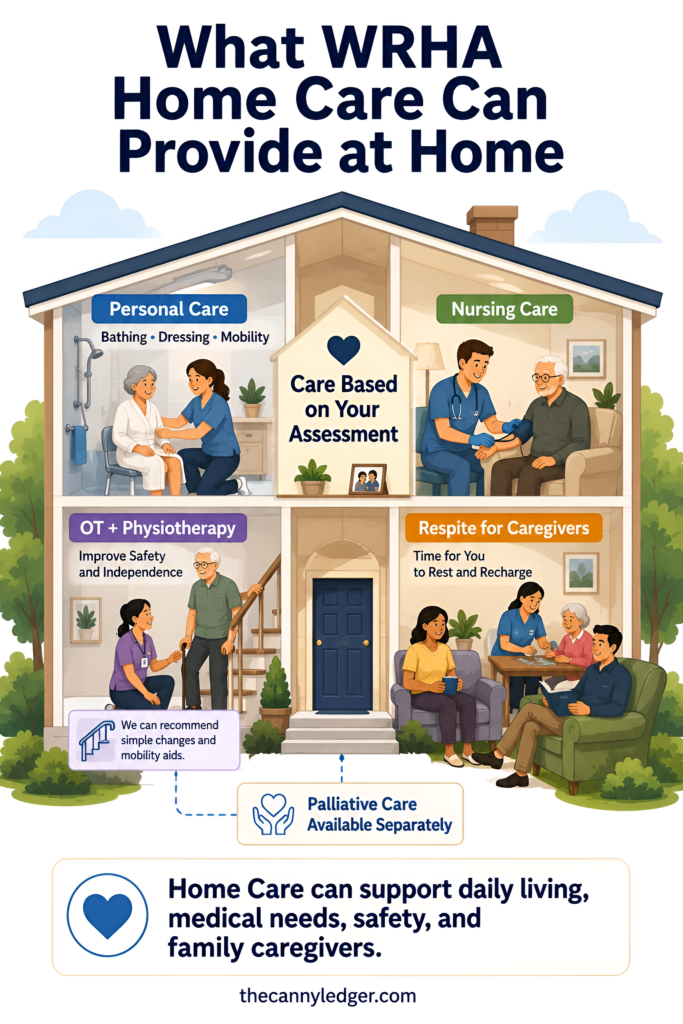
Services can run short term, under 60 days, for something like post-surgical recovery, or long term for chronic conditions and ongoing disability support. What’s actually covered is broad: personal care like bathing, dressing, and mobility assistance, nursing care, occupational and physiotherapy assessments, household assistance for tasks a client can no longer safely manage alone, and respite care that gives a family caregiver a genuine break rather than running them into burnout. The amount of care you receive is capped by what a Case Coordinator’s assessment determines you need, not by what a family might prefer, which is worth knowing upfront so the assessment conversation doesn’t come as a surprise later.

How to Actually Get Assessed
Getting started runs through a single point of contact rather than a complicated multi-step application. Call the WRHA Home Care Intake Line at 204-788-8330, or fax a request for information to 204-940-2227, and the request can come from you directly, from a family member, or from a physician on your behalf. From there, a Home Care Coordinator schedules an in-home visit to discuss actual care needs, and that conversation results in a personalized care plan rather than a generic package applied to everyone who calls.
It’s worth being honest about timing here rather than implying the process moves instantly. Demand for home care assessments in Winnipeg can mean a wait between the initial call and the in-home visit, particularly for non-urgent requests, so reaching out well before a crisis point, rather than the day a situation becomes unmanageable, gives the system more room to respond at a reasonable pace. If a situation is genuinely urgent, saying so directly on that first call matters, since urgent hospital-discharge-related requests are generally prioritized differently than a gradual, non-urgent request for support.

What WRHA Home Care Actually Covers
Beyond the basics of personal care and nursing, the program includes access to Community Therapy Services, consultative occupational therapy and physiotherapy delivered through a service purchase agreement with WRHA Home Care. A clinician can complete an in-home evaluation, recommend adaptive or specialized equipment, and help a client’s home get set up in a way that actually supports safety and independence rather than just checking a box that “equipment was discussed.” Referrals into this specific service can come through a family doctor or nurse practitioner, or a person already receiving Home Care services can self-refer by calling the Central Intake line directly.
Palliative care runs as its own dedicated sub-program within Home Care rather than being handled as a generic add-on to standard services, which matters because end-of-life care genuinely requires a different pace and approach than a routine home support visit. If a family is navigating that situation, asking specifically about the Palliative Care Sub-Program, rather than assuming standard Home Care automatically covers it the same way, gets a more accurate picture of what’s actually available.
Self and Family Managed Care Gives You More Control
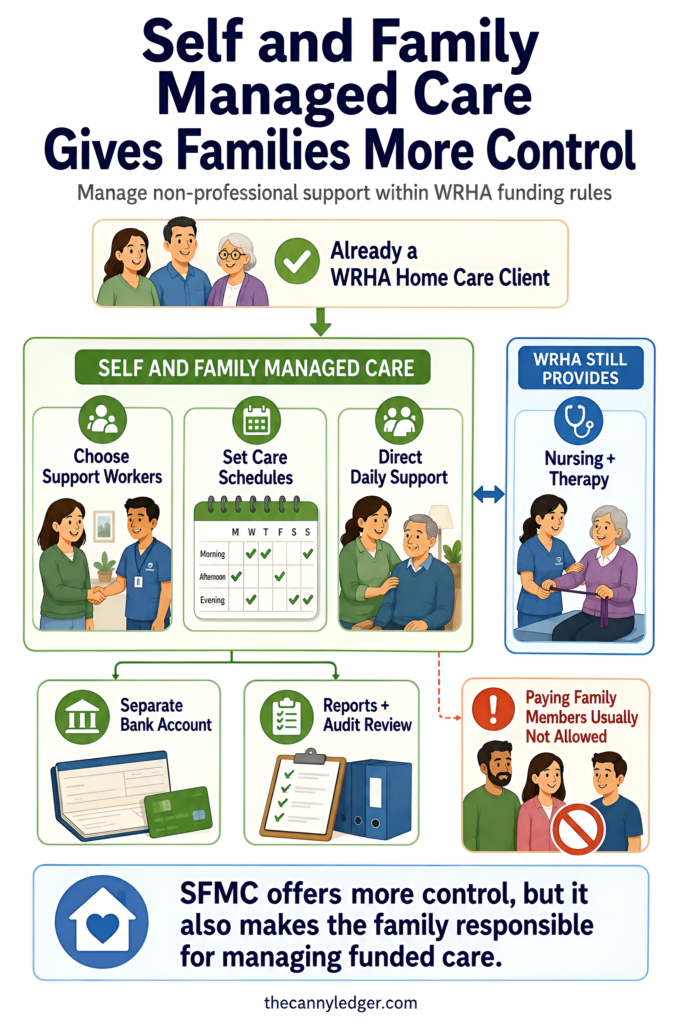
For families who want more say over exactly who provides care and when, WRHA offers Self and Family Managed Care, known as SFMC, as an alternative to the standard model where WRHA assigns staff directly. Under SFMC, a client or their family accepts responsibility for coordinating, managing, and directing the non-professional support services needed, either by hiring their own staff directly or contracting a private agency, while WRHA continues to handle the professional services like nursing and therapy through its regular channels.
A few structural details matter here before anyone assumes SFMC works like simply getting a cheque to spend freely. You must already be a WRHA Home Care client with an assessed need for attendant or homemaker services before applying, SFMC isn’t a separate front door into the system. Funding gets calculated based on a formal assessment, and Self or Family Managers are required to set up and maintain a separate bank account used solely for those funds, subject to semi-annual reports and audit review by WRHA. Hiring a family member as paid staff generally isn’t permitted except in unique, WRHA-approved circumstances, which surprises some families who assumed SFMC meant paying a spouse or adult child directly for care they were likely already providing informally. If SFMC sounds like the right fit, the practical next step is raising it with your existing Home Care Case Coordinator once you’re already enrolled, rather than trying to apply for it as a first move.
When Public Hours Aren’t Enough: Private Home Care Agencies
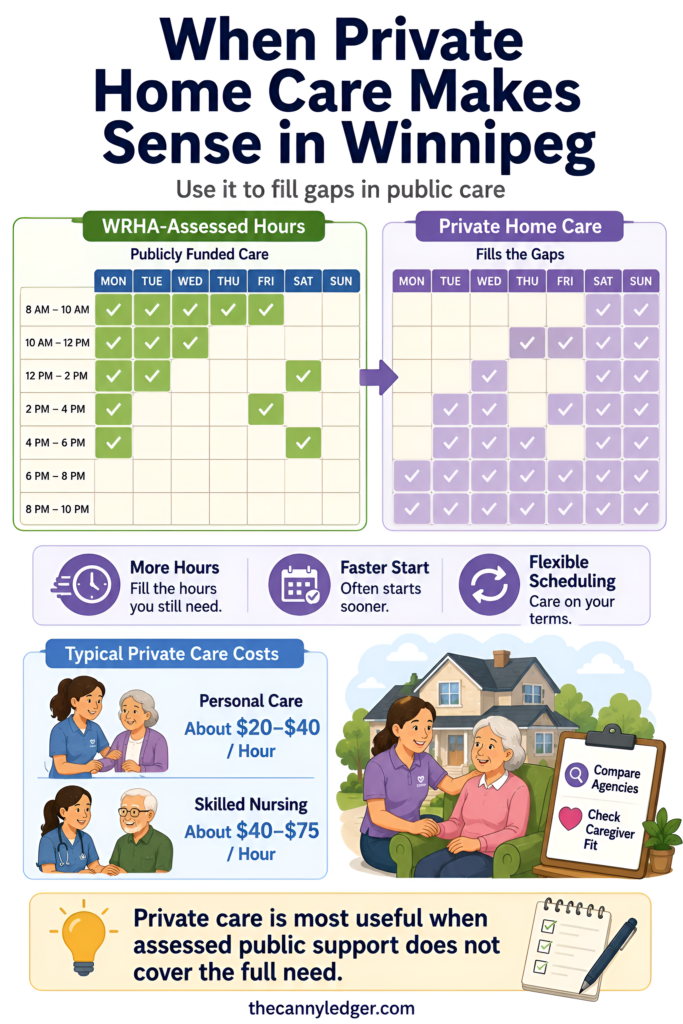
Public home care, however generous the province’s model is compared to other provinces, is still capped by an assessment, and plenty of families end up needing more hours, more flexibility, or care that starts faster than the public intake process allows. This is where private agencies fill a genuine gap rather than duplicating what WRHA already provides. Bayshore Home Health, Comfort Keepers, and Nurse Next Door all operate in Winnipeg, offering personal care, companionship, nursing support, dementia care, and in some cases around-the-clock coverage without the waitlist or formal assessment that public services require. Interestingly, Nurse Next Door’s Winnipeg location operates as a social enterprise of DASCH Inc., a local nonprofit that supports people with intellectual disabilities across more than 50 homes in the city, which is a distinctly Winnipeg-specific detail behind an otherwise national franchise name.
Cost varies by agency and by the type of care involved, but general benchmarks put standard personal care support somewhere in the range of $20 to $40 an hour, with skilled nursing visits running higher, often in the $40 to $75 an hour range depending on what’s required. Private care comes with real tradeoffs worth naming plainly: you’re paying directly, there’s no income-based subsidy the way there is with WRHA’s program, and quality and fit vary agency to agency, which makes asking for a consultation and being specific about your actual needs before committing to a provider worth the extra time it takes.
Personal Care Homes Are a Different System Entirely
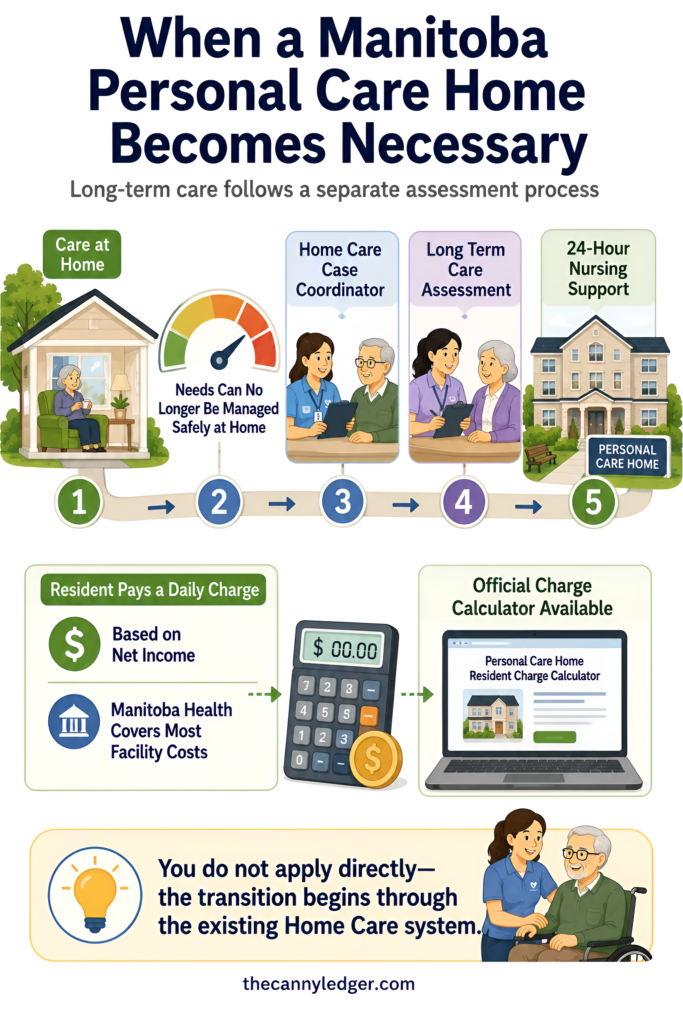
When care needs exceed what’s manageable at home even with maximum public and private support combined, personal care homes, Manitoba’s term for long-term care facilities, become the relevant option, and it’s worth understanding this runs through an entirely separate process from home care itself. Manitoba currently licenses 124 personal care homes across the province, with the WRHA overseeing 37 of them in Winnipeg specifically, plus the St. Amant health care facility, together totalling more than 5,200 beds citywide. Eligibility isn’t something you apply for directly. It runs through your existing Home Care Case Coordinator, who can request a consult with the WRHA’s Long Term Care Access Centre once a client’s needs have progressed to requiring 24-hour nursing support and the person is assessed as medically, functionally, and behaviourally stable enough for that transition.
Cost works differently here too. Manitoba Health covers the majority of the actual facility cost, and the resident pays a daily Residential Charge calculated from their net income, and their spouse’s income if applicable, as reported on the most recent Canada Revenue Agency Notice of Assessment. This rate is reviewed and set annually, currently reflected in the province’s 2025-2026 rate table effective from August 1, 2025 through July 31, 2026, and the province maintains an official online Residential Charge Calculator specifically so families can estimate their own likely daily rate before committing to anything, rather than guessing based on a friend’s experience or an outdated figure. The system is also built to guarantee residents keep a minimum amount of disposable income for personal expenses after the daily charge is deducted, a detail that matters for anyone worried this charge could consume an entire pension with nothing left over.
Funding Sources That Can Offset Private Care Costs
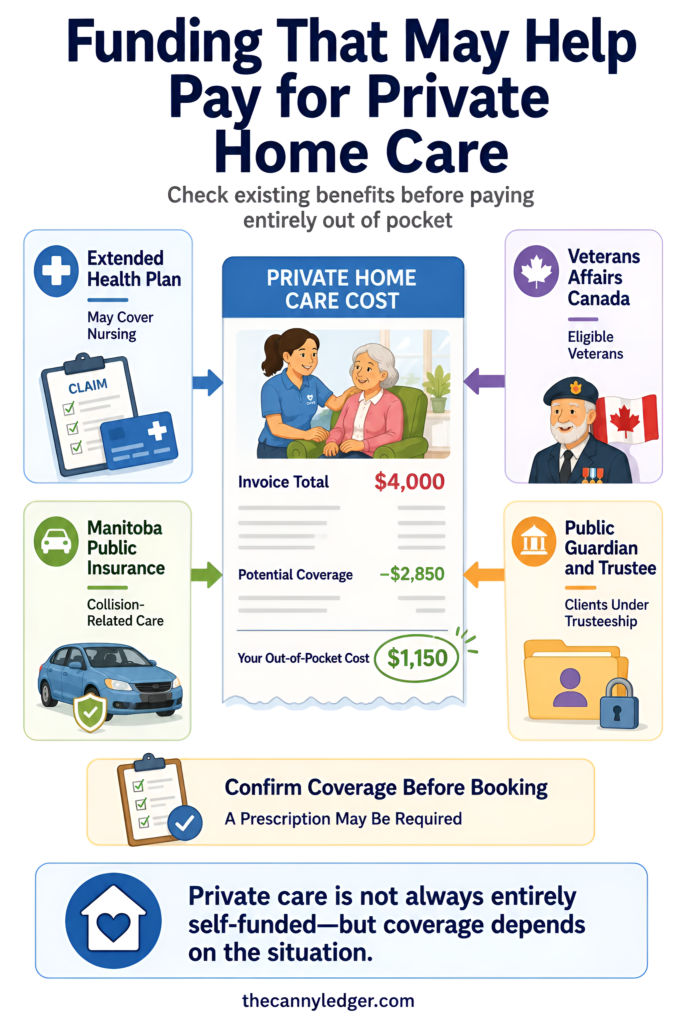
Before assuming private home care has to come entirely out of pocket, it’s worth checking whether any existing coverage already applies. Manitoba Blue Cross and other private extended health plans sometimes cover a portion of home care costs, particularly nursing services, though coverage details and any requirement for a doctor’s prescription vary by plan and are worth confirming directly with the insurer rather than assuming. Manitoba Public Insurance covers home care costs connected to injuries from a motor vehicle collision specifically, Veterans Affairs Canada has its own home care benefit program for eligible veterans, and the Public Guardian and Trustee of Manitoba can be a relevant funding contact for clients under public trusteeship. None of these apply universally, but checking each one against your specific situation before assuming a private agency bill is entirely your own responsibility is worth the extra few phone calls.
Building a Realistic Care Plan
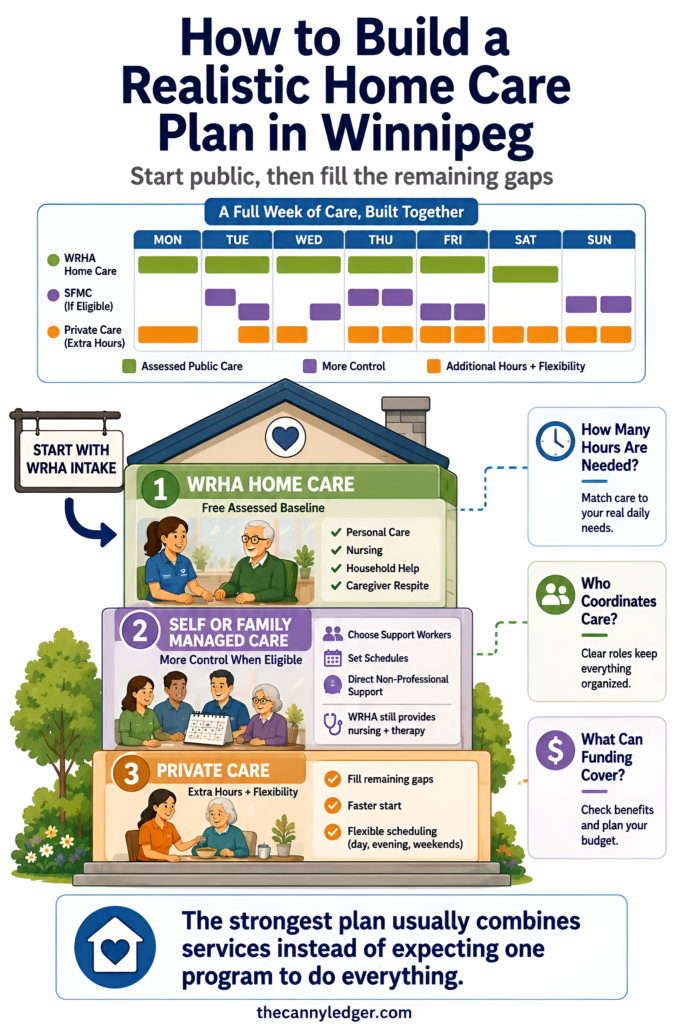
The families who navigate this most smoothly tend to treat public and private care as complementary rather than an either-or choice. WRHA Home Care covers the baseline, assessed, professionally coordinated support, at no direct cost, and private agencies or SFMC funding fill whatever gap remains between that baseline and what a specific family’s situation actually requires, whether that’s more hours, more flexibility in scheduling, or simply starting support faster than the public intake process allows on its own. Starting with the WRHA Home Care Intake Line first, even if you suspect you’ll eventually need private support too, still makes sense, since establishing that public baseline is what makes SFMC and other funding pathways available at all down the line. For a family also weighing whether to keep a parent in their own apartment versus a move, our guide to 55-plus and affordable senior apartments in Winnipeg covers a related housing decision that often comes up alongside a home care conversation, and if the person receiving care has a qualifying disability, our guide to the Disability Tax Credit in Winnipeg covers a separate benefit worth checking alongside any home care arrangement.
Common Questions
Can I get private home care while also receiving WRHA Home Care services? Yes, this is common. Many families use WRHA’s assessed hours for baseline support and supplement with a private agency for anything beyond that, without needing to choose one system exclusively.
Does having a family member as an informal caregiver reduce what WRHA will approve? Assessed need factors in existing informal support, including what family already provides, but this affects the level approved rather than disqualifying you outright, and it’s a conversation worth having directly with your Case Coordinator rather than guessing.
How is the personal care home Residential Charge different from a private facility’s fees? The Residential Charge only applies to the client’s portion of a publicly funded personal care home’s costs, calculated from income. A fully private facility outside this system would set its own rates entirely independent of Manitoba’s income-based calculation.
Making the First Call Is the Actual Bottleneck
Every path covered here, whether it ends at a WRHA care plan, a private agency arrangement, or eventually a personal care home, starts with the same single phone call to the WRHA Home Care Intake Line, and delaying that call rarely makes the underlying situation easier to manage later. Whether the need feels urgent or is still gradually building, getting an assessment on the books early gives every other option covered in this guide, from Self and Family Managed Care to eventual long-term care access, room to actually work when the time comes.