A bad credit personal loan and a bad credit car loan sound like variations on the same problem, but they’re not, and treating them the same way is how people end up in real trouble. With a personal loan, the worst case is usually an expensive rate on money you already spent. With a car loan, you’re carrying that same expensive rate on an asset that starts losing value the moment you drive it off the lot, and if the loan outpaces what the car is actually worth, you can end up owing more than you could sell it for even while making every payment on time. That’s a risk unique to auto financing, and it’s exactly the risk that some lenders and dealers serving this specific market are structured to profit from rather than protect you against.
- What subprime auto rates actually look like right now
- Where a subprime auto loan actually comes from, and why the source matters
- The negative equity trap, and why your down payment matters more here than on any other loan
- The Manitoba-specific check almost nobody does before signing
- Getting your financing lined up before you set foot on a lot
- If you’re already in a loan that isn’t working
- Before you sign anything
What subprime auto rates actually look like right now
Canadian auto lenders sort borrowers into credit tiers that shift the rate dramatically. Buyers with excellent credit, generally 720 and above, are seeing rates in the roughly 4 to 7 percent range in 2026. Near-prime borrowers in the 620 to 669 range are typically looking at somewhere around 9 to 15 percent. Below 620, subprime rates commonly start around 11 percent and can climb toward the high 20s or beyond for deep subprime files, though every legitimate lender in Canada is bound by the same federal ceiling covered in our bad credit loans in Winnipeg guide: the Criminal Code’s cap of 35 percent APR, effective since January 2025. If an auto loan offer works out to more than that once every fee and add-on is included, it isn’t just expensive, it’s illegal, regardless of how the paperwork presents it.
The gap between tiers isn’t abstract. On a $20,000 loan over five years, a borrower with strong credit might pay somewhere around four thousand dollars in total interest, while a deep subprime borrower on the same loan amount and term can end up paying three or four times that, sometimes an extra hundred and fifty or more dollars a month compared to what a prime borrower would owe for the identical vehicle.
Where a subprime auto loan actually comes from, and why the source matters
Credit unions are worth checking first, and it’s genuinely underused advice in this category specifically. Because Manitoba credit unions weigh a member’s full account relationship rather than a credit score in isolation, some will work with a damaged credit history on auto financing more flexibly than a bank would, sometimes with a co-signer or a slightly larger down payment bridging the gap. Our Winnipeg credit unions compared guide is worth a call before you assume your credit rules this option out.
Dealership-arranged financing is the most common path for subprime buyers, and it’s worth understanding exactly how it works before assuming the dealer is doing you a neutral favour. Most dealerships work with a network of lenders behind the scenes and can often place buyers that a bank would decline outright, but the dealer typically earns a commission, sometimes called a dealer reserve, built into the rate they arrange, meaning the number you’re quoted isn’t necessarily the lowest one actually available to your file. It’s genuinely worth negotiating this the same way you’d negotiate the vehicle’s price, and comparing it against a pre-approval you’ve already secured elsewhere.
Buy-here-pay-here lots, independent dealers that finance their own inventory directly rather than working through outside lenders, represent the most accessible but also the riskiest tier of this market. Approval is often close to guaranteed regardless of credit history, but the rates tend to sit at the very top of the legal range, the vehicles themselves are sometimes priced above their actual condition, and some of these lots install GPS tracking or starter-interrupt devices as a condition of financing, legal in most cases but worth knowing about upfront rather than discovering the first time a payment runs a few days late and the car simply won’t start. Treat this tier as a genuine last resort rather than a starting point.
Online subprime lending platforms fill a middle ground, letting you compare pre-approval offers from several lenders through one application before you ever set foot on a lot, which at minimum gives you a number to negotiate against once you do.
The negative equity trap, and why your down payment matters more here than on any other loan
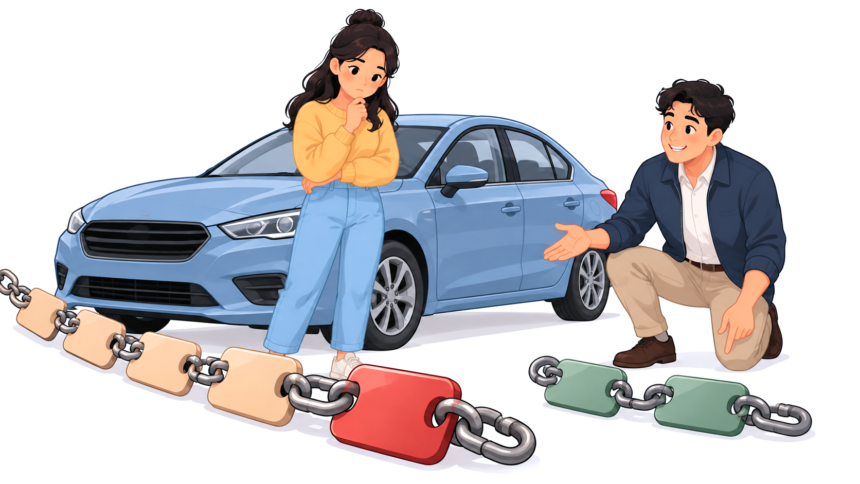
A new vehicle can lose fifteen to twenty percent of its value the moment it’s driven off the lot, and a used vehicle depreciates on its own, steadier curve from there. Stack a long loan term and a high subprime interest rate on top of that depreciation, and it’s entirely possible to owe more on the loan than the car is worth for a meaningful stretch of the repayment period, a position commonly called being underwater or upside down. If the vehicle is written off in an accident or needs to be sold before the loan catches up with its depreciation, you can be left owing money on a car you no longer have.
A larger down payment is the single most effective tool against this, both because it lowers your loan-to-value ratio from day one and because it reduces the total interest a subprime rate compounds against over the loan’s life. Term length matters just as much: stretching a loan to seven or eight years to shrink the monthly payment might make the math work on paper today, but it also means paying subprime interest for years longer and staying underwater for a longer stretch of that term. A shorter term with a higher monthly payment, if your budget genuinely allows it, almost always costs meaningfully less in total than a longer term chosen purely to make the payment look manageable.
The Manitoba-specific check almost nobody does before signing
Before you commit to any used vehicle, whether through a dealer or a private seller, run a lien search through Manitoba’s Personal Property Registry, administered by Teranet Manitoba. This registry shows whether a lender still holds a registered security interest in the vehicle you’re about to buy, and if one exists and you buy the car without clearing it, that debt can follow the vehicle rather than the seller: the lienholder can legally repossess the car from you even though you paid the seller in full and had no idea the lien existed. This check costs a modest fee and takes only a few minutes, and it’s genuinely one of the highest-value few dollars you can spend in this entire process, particularly if you’re considering a private sale or an unfamiliar independent lot rather than an established, licensed dealership.
This connects to a related warning worth taking seriously: curbstoning, where someone who is effectively running an unlicensed dealership poses as a private individual selling their own car, often flipping a high volume of vehicles with hidden mechanical or financial problems and none of the consumer protection obligations that licensed dealers are legally required to meet. Our buying a used car in Winnipeg guide covers this pattern in more depth alongside a fuller pre-purchase inspection checklist worth running through regardless of how the financing side of the deal is structured. Licensed Manitoba dealers are required to disclose known facts about a vehicle’s history and condition before you buy; a private seller carries no such legal obligation, which is exactly why the lien search and an independent vehicle history report matter more, not less, the more informal the sale feels.
Getting your financing lined up before you set foot on a lot
The single most effective negotiating position in this entire process is walking in with financing already arranged rather than letting the dealer be the first and only source of a rate quote. Get pre-approved through a credit union or a bank first, know the actual rate you qualify for, and use that number as your baseline. If the dealer’s financing beats it, genuinely great, take it. If it doesn’t, you already have a fallback that doesn’t depend on accepting whatever number lands in front of you under the pressure of a showroom floor. This single habit does more to protect a subprime borrower from an inflated dealer-arranged rate than almost anything else described in this guide.
If you’re already in a loan that isn’t working
Refinancing becomes a genuine option once your credit has improved even modestly from where it stood when you originally signed, and it’s worth checking in periodically rather than assuming the original rate is permanent. A credit union relationship you’ve built since that original purchase, the same kind covered in our car loans in Winnipeg guide, can sometimes offer a meaningfully better rate a year or two into a subprime loan, particularly if you’ve made every payment on time in the meantime.
If the loan itself isn’t the core problem but part of a broader debt picture that’s grown unmanageable, our debt consolidation in Winnipeg guide covers how an auto loan fits alongside other debts in a consolidation plan, and a free conversation with a non-profit counsellor through our credit counselling in Winnipeg guide is worth having before assuming your only options are keep paying or default.
Before you sign anything
Confirm the actual APR, not just the monthly payment, since a low monthly number stretched across a long term can hide a genuinely expensive rate. Run a Personal Property Registry lien search on any used vehicle, private sale or otherwise, before money changes hands. Get pre-approved elsewhere before you negotiate with a dealer. And if a lot’s approval feels too easy relative to your credit history, that ease is often the clearest signal of where the real cost of the deal is hiding. A car loan is one of the few debts that can actively work against you even when every payment lands on time, purely through the mechanics of depreciation outrunning what you owe, and the handful of checks in this guide are what stand between a workable bad-credit purchase and one that quietly gets more expensive with every month that passes.