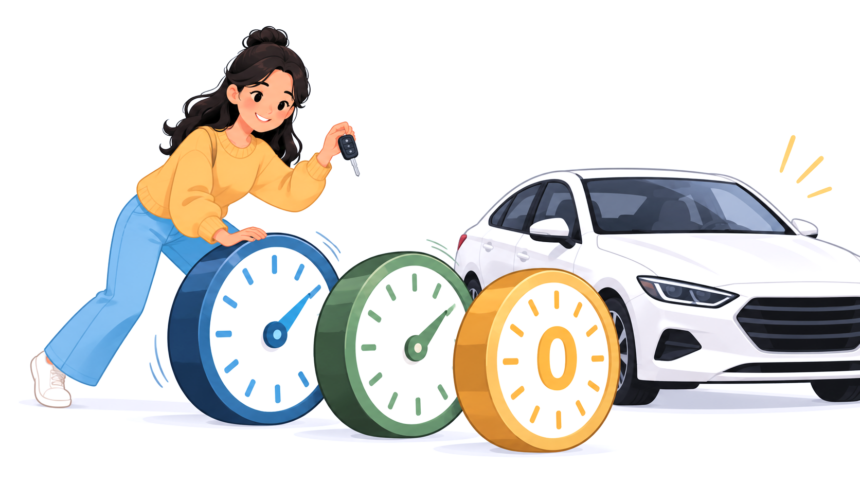
“0% financing” is one of the most persuasive phrases in retail, and it’s also one of the most misunderstood. Manufacturers don’t hand out free money. When you see 0 percent advertised on a new vehicle, what’s actually happening is that the manufacturer is paying the lender the interest on your behalf, usually by quietly declining to offer you the cash rebate they’d otherwise hand you for taking a normal loan. Understanding that trade-off, rather than treating 0 percent as an automatic win, is the single most useful thing this guide can do before you sit down in a finance office.
- What 0% financing actually is, and who actually qualifies
- The math that decides whether 0% or the rebate actually wins
- The trap hiding inside a longer 0% term
- Where the actual interest rate you’ll be quoted comes from
- New versus used: why the loan itself behaves differently
- Gap insurance, and when it’s actually worth adding
- Getting your financing lined up before you negotiate anything
- If leasing is actually a better fit than financing at all
- The bottom line
What 0% financing actually is, and who actually qualifies
A 0 percent offer means you pay no interest over the life of the loan, full stop, which sounds unambiguously better than any interest rate above zero. The catch is eligibility: these offers are typically reserved for buyers with genuinely excellent credit, often a score in the 750 range or higher, and they usually apply only to new vehicles rather than used ones, since manufacturers are subsidizing the deal specifically to move new inventory. Term length matters too. Many 0 percent promotions cap out around 60 months, and stretching to a longer term, or in some cases any term at all beyond the promotional window, forfeits the 0 percent rate entirely.
If your credit doesn’t clear that bar, the decision largely makes itself: you won’t qualify for the promotional rate regardless of how appealing it looks in the advertisement, and your comparison shifts to weighing a rebate against whatever rate you do qualify for through a bank, credit union, or dealer-arranged loan.
The math that decides whether 0% or the rebate actually wins
Here’s a concrete way to think through it. Say you’re financing a $35,000 vehicle, and the manufacturer is offering either 0 percent financing over 60 months or a cash rebate applied to the purchase price if you finance elsewhere at a normal rate. Financing the full $35,000 at 0 percent costs you nothing in interest, full stop, a genuine and real saving. Taking the rebate instead means financing $33,000, and if the best rate you can secure through a bank or credit union sits somewhere around 5 to 6 percent, the interest on that $33,000 over the same term can easily run higher than the $2,000 you saved upfront, meaning the 0 percent deal actually wins in this scenario even though the rebate looked like free money on its own.
Now flip the rebate amount higher. If that same manufacturer instead offers a $5,000 rebate against the same 0 percent option, and your outside financing rate is in the 4 to 5 percent range, the math tips the other way: the interest you’d pay financing the smaller, rebate-reduced amount can come in below what you saved by skipping the rebate for 0 percent. There’s no single universal answer here, which is exactly why running your specific numbers, the actual vehicle price, the actual rebate offered, and the actual rate you’d qualify for elsewhere, matters more than defaulting to whichever option sounds better on a billboard. A basic loan calculator and ten minutes is genuinely all it takes to settle this for your specific deal.
The trap hiding inside a longer 0% term
Dealers know that a 0 percent rate advertised alongside a 72- or 84-month term produces an eye-catching low monthly payment, and that combination is worth real caution rather than automatic excitement. Stretching any loan out that far, even at zero interest, means you’re paying down principal more slowly relative to how quickly the vehicle depreciates, which increases the window during which you’d owe more than the car is actually worth if you needed to sell or if it was written off. A shorter 0 percent term, even with a higher monthly payment, almost always leaves you in a healthier equity position throughout the loan than a longer one chosen purely to shrink the number on the payment sticker.
Where the actual interest rate you’ll be quoted comes from
Outside of promotional 0 percent offers, Canadian auto rates sort heavily by credit tier. Buyers with excellent credit are generally seeing rates in the roughly 4 to 7 percent range through 2026, a figure that tracks fairly closely with the Bank of Canada’s overnight rate, which has held at 2.25 percent through several consecutive announcements this year, keeping borrowing costs relatively stable compared to the sharper swings of a couple of years earlier. Good credit typically lands somewhere in the high single digits to low double digits, and anything below that moves into the territory covered in more depth in our bad credit car loans in Winnipeg guide, since subprime financing carries its own distinct set of risks worth understanding separately from the mainstream rate-shopping covered here.
Credit unions are consistently worth checking first regardless of your credit tier, and it’s advice that gets repeated across every kind of Manitoba lending for good reason: because credit unions weigh a member’s full relationship rather than a credit score in isolation, they frequently beat bank rates on auto loans for members with an established history. Our Winnipeg credit unions compared guide breaks down how Assiniboine, Cambrian, Access, and Steinbach differ specifically on this kind of lending.
Dealer-arranged financing remains convenient, and it’s sometimes genuinely competitive, particularly when a manufacturer’s own promotional rate is in play, but a dealer typically earns a commission on financing arranged through their network of outside lenders, meaning the rate they quote first isn’t automatically the lowest one actually available to your file. Comparing it against a pre-approval secured elsewhere before you walk onto the lot remains the single most effective way to make sure you’re seeing the real number rather than the first one offered.
New versus used: why the loan itself behaves differently
New vehicle loans commonly stretch up to 96 months at some lenders, though stretching that far carries the negative equity risk described above regardless of the rate attached. Used vehicle loans are generally capped at shorter terms tied to the vehicle’s age, since most lenders won’t finance a car much beyond roughly ten years old, meaning an eight-year-old used vehicle might only qualify for a two-year loan term regardless of how much you’d prefer to spread the payments out. If you’re cross-shopping new against used specifically on financing terms rather than price alone, our buying a used car in Winnipeg guide is worth reading alongside this one, and it’s worth confirming the maximum term available on each vehicle you’re considering before assuming the monthly payment math will look the same.
Gap insurance, and when it’s actually worth adding
Gap insurance covers the difference between what you owe on a loan and what your regular insurance payout would be if the vehicle is written off or stolen, a real concern specifically in the earlier years of a loan when depreciation typically outpaces how quickly you’re paying down principal. It’s worth genuinely considering if you financed with a small down payment, a longer term, or rolled negative equity from a previous vehicle into this loan, all of which widen the gap this coverage protects against. If you put a substantial amount down and chose a shorter term, the gap this coverage protects against may already be small enough that it isn’t worth the added cost. It’s a conversation worth having directly with your insurance provider rather than assuming the dealer’s finance office is offering you the best-priced version of this specific coverage, and our what is MPI guide is a useful starting point for understanding how your baseline Autopac coverage interacts with any gap coverage you’re considering on top of it.
Getting your financing lined up before you negotiate anything
The most effective negotiating position available to any car buyer, prime or subprime, is walking in with financing already arranged. Get a pre-approval from your bank or credit union before you set foot on a lot, and use that number as the baseline every other offer needs to beat. This does two things simultaneously: it protects you from accepting a dealer-arranged rate that’s quietly padded with a commission, and it keeps the price negotiation and the financing negotiation separate, since a dealer offering a fantastic promotional rate has less room to also give ground on the vehicle’s price, and knowing your outside rate in advance lets you see through that trade-off clearly rather than getting steered by whichever number the finance office leads with.
If leasing is actually a better fit than financing at all
Not every car purchase decision should default to a loan in the first place. If lower monthly payments, driving a newer vehicle more often, and less concern about long-term resale value matter more to you than building equity in something you’ll own outright, our car leasing in Winnipeg guide covers how that alternative path compares directly against the financing math worked through in this article, and it’s worth reading before you commit to either one.
The bottom line
A 0 percent offer is genuinely valuable when you qualify for it and the rebate on the table is small, but it isn’t automatically the winning choice just because the interest rate reads as zero, and a longer term attached to that 0 percent rate can quietly work against you even while technically costing nothing in interest charges. Run the actual numbers on your specific deal, get pre-approved before you negotiate, and treat the price of the vehicle and the cost of financing it as two separate negotiations rather than one bundled number the finance office hands you at the end. That’s the whole difference between a genuinely good deal and one that just sounds like it.