



The Disability Tax Credit is a non-refundable federal credit worth $1,448 for 2026, combined with Manitoba’s own provincial portion for a total value of roughly $3,152 annually for an approved Manitoba resident, claimed by having a medical practitioner certify Form T2201 and submitting it to the CRA. Approval can also unlock access to the Registered Disability Savings Plan, the Child Disability Benefit, and the newer Canada Disability Benefit.
- The Two Ways to Actually Qualify
- What the Credit Is Actually Worth in Manitoba
- Applying: The T2201 Form and What Happens After
- The $100 Fee Cap That Isn’t Actually Being Enforced
- What DTC Approval Unlocks Beyond the Tax Credit Itself
- If the Credit Goes Unused: Transferring to a Supporting Family Member
- Manitoba-Specific Filing Mechanics
- Common Questions About the Disability Tax Credit in Winnipeg
The Two Ways to Actually Qualify
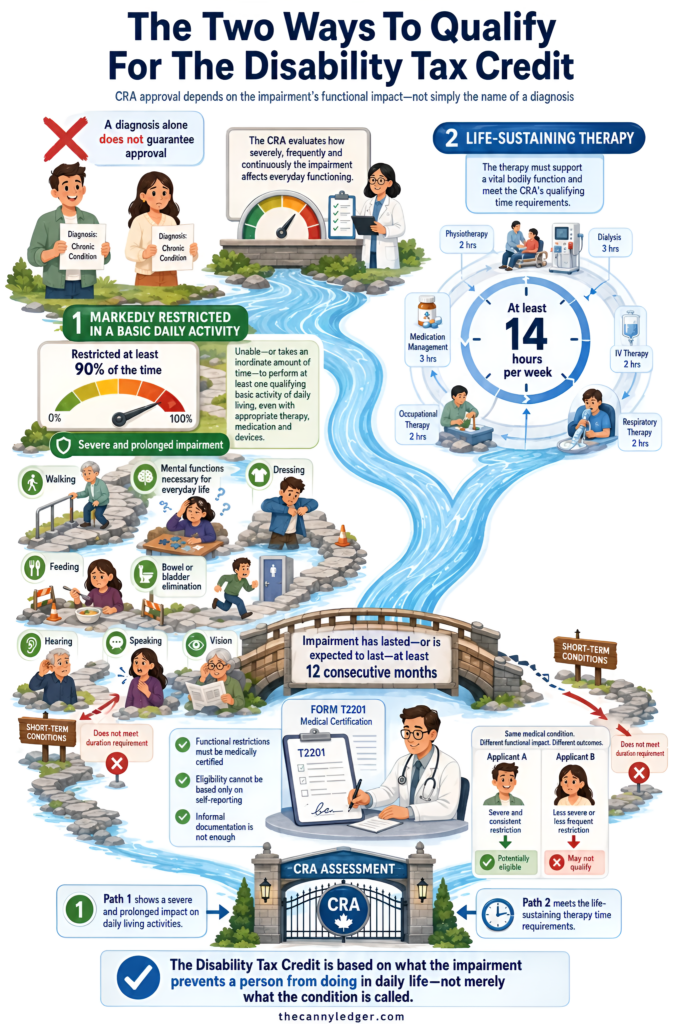
CRA eligibility for the DTC runs through one of two distinct pathways, and approval is based entirely on functional impact, not on any specific diagnosis. The first pathway requires a severe and prolonged impairment that markedly restricts a basic activity of daily living, walking, mental functions, dressing, feeding, bowel or bladder elimination, hearing, speaking, or vision, at least 90 percent of the time. The second pathway applies to anyone requiring life-sustaining therapy for at least 14 hours a week to support a vital function. Either way, the impairment has to have lasted, or be expected to last, at least 12 consecutive months, and it must be certified on Form T2201 by a qualified medical practitioner, not simply self-reported or diagnosed informally. The CRA doesn’t approve or deny based on a medical condition’s name, two people with the identical diagnosis can receive different DTC decisions depending on how severely and consistently that condition actually restricts daily functioning.
What the Credit Is Actually Worth in Manitoba
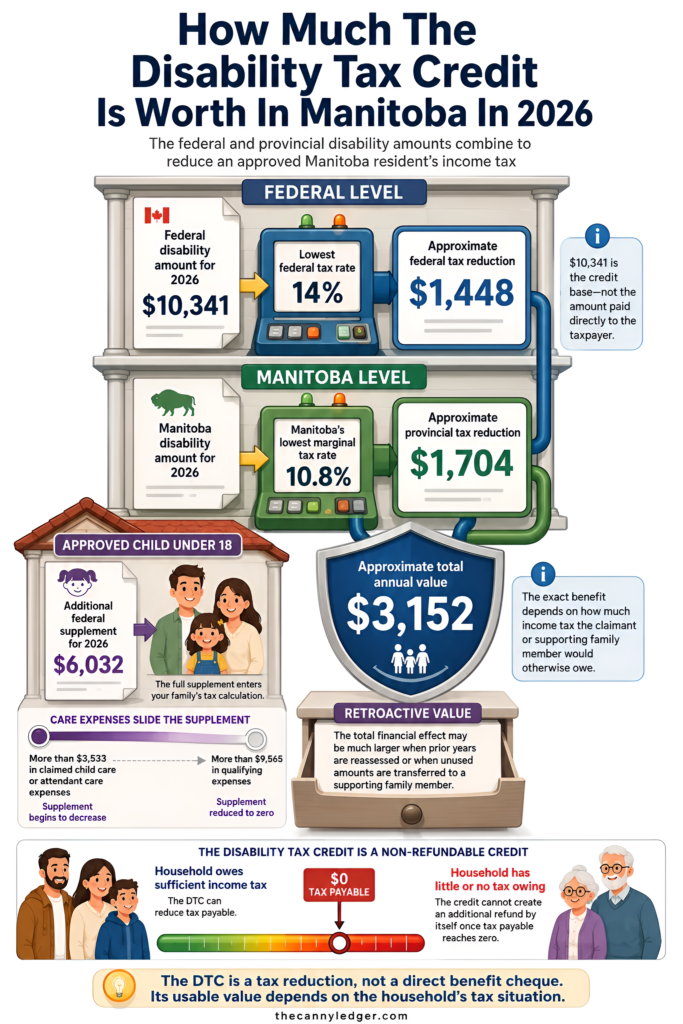
For 2026, the federal disability amount sits at $10,341, and since the credit is calculated at the lowest federal tax rate of 14 percent, that works out to an actual federal tax reduction of $1,448. Manitoba’s provincial portion works the same way using the province’s own lowest marginal rate of 10.8 percent, adding roughly $1,704 on top, for a combined annual value of approximately $3,152 before any retroactive years or transfers are factored in. Families with a child under 18 who qualifies can claim an additional supplement, $6,032 for 2026, though that supplement shrinks if more than $3,533 in child care or attendant care expenses were also claimed for that child, and disappears entirely once those expenses exceed $9,565. Since the DTC is non-refundable, it reduces tax payable to zero but can’t generate a refund beyond that on its own, which matters for anyone with very low or no taxable income trying to estimate what the credit is actually worth to their specific household.
Applying: The T2201 Form and What Happens After
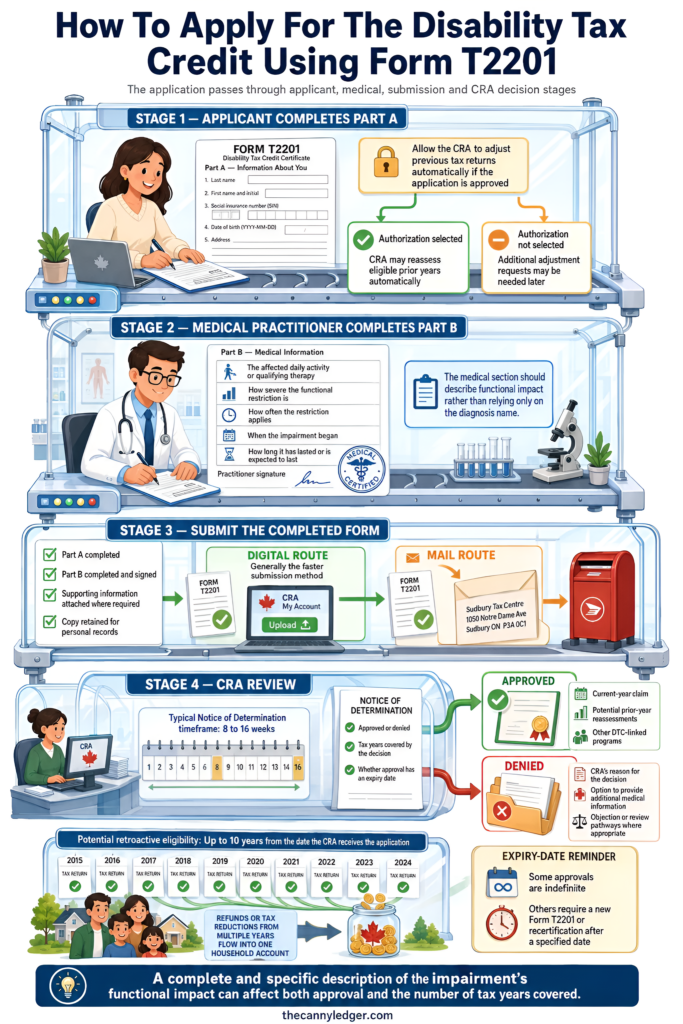
Form T2201 splits into two parts: Part A, filled out by the applicant with basic identifying information, including a box authorizing the CRA to automatically reassess prior years if the application is approved, and Part B, completed and signed by a qualified medical practitioner describing the functional impact of the impairment. Once both parts are complete, the form gets submitted to the CRA either by mail to the Sudbury Tax Centre or uploaded digitally through a CRA My Account, with digital submission generally processing faster. A Notice of Determination typically arrives 8 to 16 weeks later, stating whether the application was approved, for which specific tax years, and whether the approval carries an expiry date requiring future recertification. If approved, eligibility can be applied retroactively for up to 10 years from the date the CRA receives the application, potentially triggering reassessments and refunds for multiple prior tax years at once rather than just the current one.
The $100 Fee Cap That Isn’t Actually Being Enforced
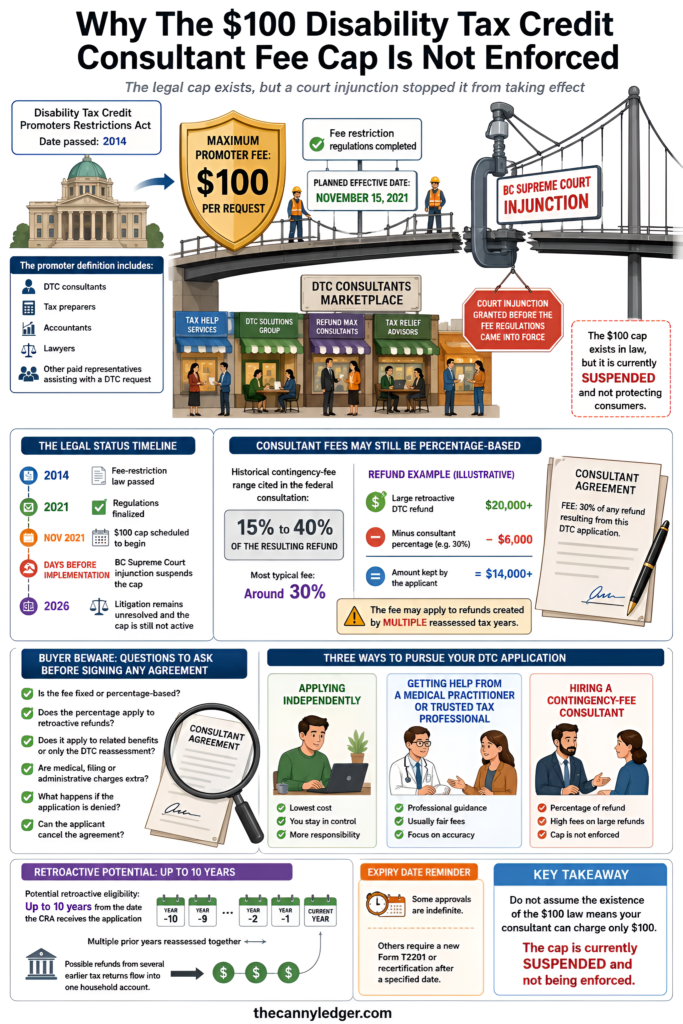
This is the detail most DTC guides skip entirely, and it matters directly for anyone in Winnipeg weighing whether to pay a consultant for help with an application. The Disability Tax Credit Promoters Restrictions Act was passed in 2014 specifically to cap fees charged by “promoters,” a legally defined term covering tax preparers, consultants, accountants, and lawyers who help with a DTC request, at $100 per request. Regulations setting that cap were finalized and scheduled to take effect November 15, 2021. They never did. A BC Supreme Court injunction granted days before that date suspended the fee cap pending a ruling on whether the law is constitutional, and that litigation remains unresolved. Before this law was even proposed, the federal government’s own consultation noted that promoters commonly charged contingency fees ranging from 15 to 40 percent of a client’s resulting refund, with 30 percent being the most typical figure. With the cap currently suspended, nothing legally prevents a consultant from continuing to charge fees in that same range today, which makes this a genuine buyer-beware situation rather than a settled consumer protection.
What DTC Approval Unlocks Beyond the Tax Credit Itself
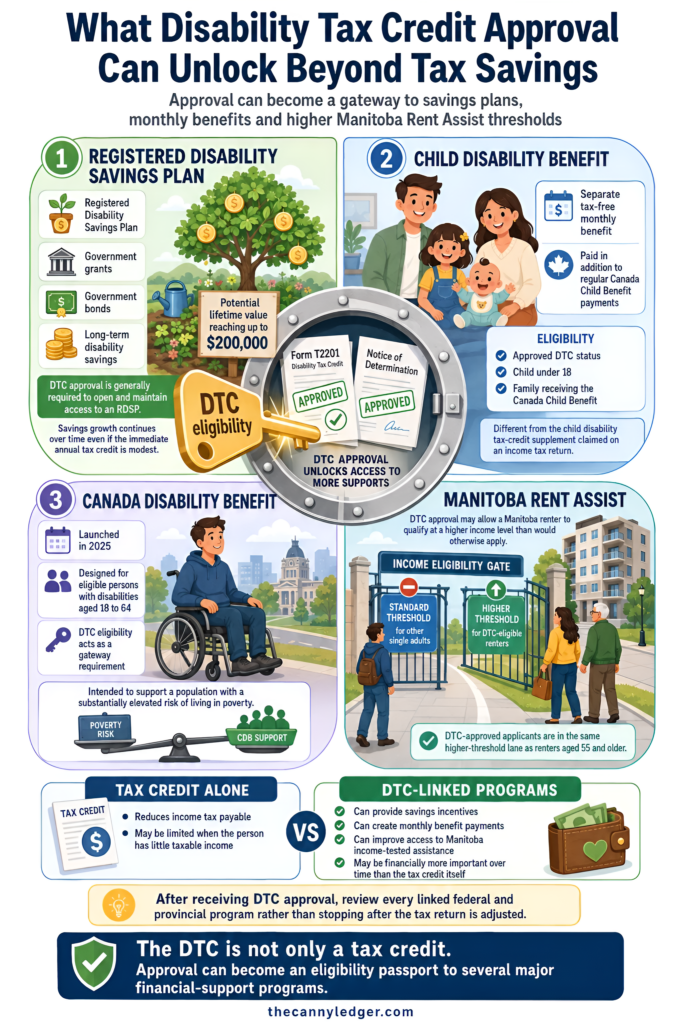
The tax credit itself is often the smaller part of what DTC approval actually provides access to. Eligibility opens the door to a Registered Disability Savings Plan, which can accumulate government grants and bonds worth up to $200,000 over a beneficiary’s lifetime, a significant long-term savings vehicle most families wouldn’t otherwise qualify for. Families with a DTC-eligible child under 18 who also receive the Canada Child Benefit become eligible for the Child Disability Benefit, a separate monthly tax-free payment on top of regular CCB payments. More recently, DTC eligibility became a gateway to the Canada Disability Benefit, launched in 2025 specifically for working-age persons with disabilities between 18 and 64, a population the federal government has noted is twice as likely to live in poverty than people without disabilities. For Manitoba renters specifically, DTC eligibility also raises the income threshold for Rent Assist, placing DTC-eligible applicants in the same higher income bracket as renters 55 and older, rather than the lower threshold that applies to other single adults.
If the Credit Goes Unused: Transferring to a Supporting Family Member
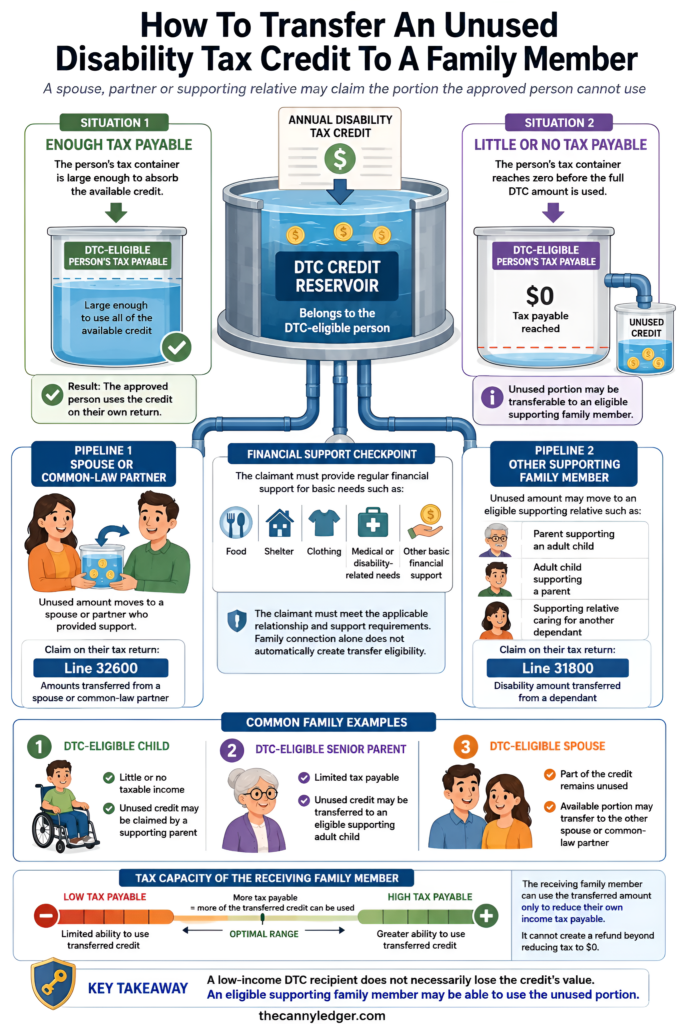
Not every DTC-eligible person has enough taxable income to use the full credit themselves. When that happens, the unused portion can be transferred to a spouse, common-law partner, or another supporting family member, a parent or adult child, for instance, who provided financial support during the year. The specific line used depends on the relationship: a spouse or common-law partner claims the transferred amount on Line 32600, while any other supporting family member claims it on Line 31800. This transfer mechanism means a DTC-eligible child, senior parent, or other dependant with little or no income of their own doesn’t leave the credit’s value unused simply because they personally owe little or no tax.
Manitoba-Specific Filing Mechanics
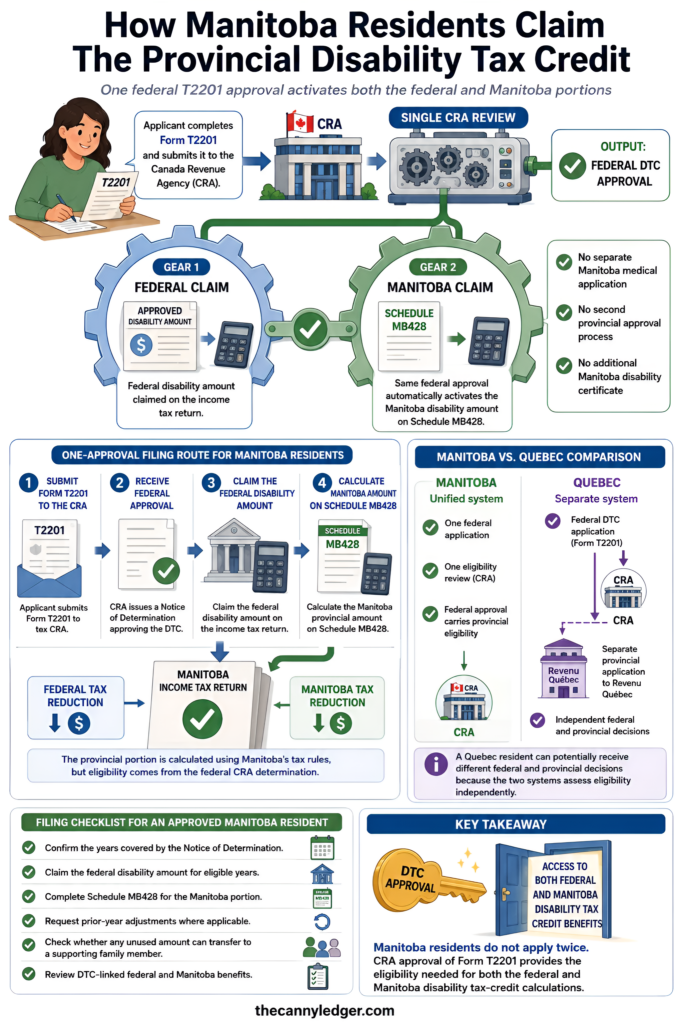
Once the federal T2201 is approved, Manitoba’s provincial portion of the DTC applies automatically, calculated on Schedule MB428 alongside the federal claim, with no separate provincial application or approval process required. This puts Manitoba in the same boat as every province and territory except Quebec, where residents have to separately apply to Revenu Québec using its own distinct form, and where it’s genuinely possible, though uncommon, to be approved federally while being denied provincially because the two governments run independent reviews. Manitoba residents don’t face that dual-review risk, one federal approval carries the provincial portion along with it automatically.
Common Questions About the Disability Tax Credit in Winnipeg
Can I apply for the DTC myself without paying a consultant? Yes, completely. Nothing about the application process requires a paid promoter, Form T2201 and its instructions are freely available directly from the CRA, and a family doctor or other qualified medical practitioner completing Part B is the only professional involvement genuinely required. Given the currently suspended fee cap, this is worth strongly considering before agreeing to a contingency-fee consultant.
What happens if my T2201 gets denied? A denial can be appealed, and it’s worth asking the certifying medical practitioner whether the specific wording used in Part B fully captured the severity and consistency of the functional restriction, since denials sometimes stem from the form’s description being less specific than the actual situation warrants, rather than genuine ineligibility.
Does DTC approval automatically qualify a family for the Canada Disability Benefit? DTC approval is a requirement to access the Canada Disability Benefit, but it isn’t the only eligibility criterion for that separate program, which has its own income thresholds and application process specifically for working-age applicants. Approval for one doesn’t guarantee approval for the other, though it’s a necessary first step. Confirm both eligibility pathways honestly before applying, get Part B completed by a medical practitioner who understands exactly how detailed the functional description needs to be, and think carefully before paying a consultant a large contingency fee for help that’s genuinely available to complete without one. The $100 legal cap exists on paper, but it isn’t protecting anyone from a large fee right now, which makes an informed decision the only real protection currently available.