



Two people can walk into the same bank on the same afternoon and walk out with two different mortgage rates. Same lender, same day, sometimes even the same loan officer. The number posted on the bank’s website was never actually the rate either of them ended up with, it was a starting point, and what each person paid came down to their credit score, how much they put down, whether they asked for a better number, and whether anyone told them a broker could shop the same deal across dozens of lenders instead of one. People search for “the best mortgage rate” the way they’d search for a flight price, expecting a single public number. It doesn’t work that way, and treating it like it does is the single most expensive assumption a borrower can make.
- Posted Rates Are a Starting Position, Not an Offer
- Why a Broker Can Often Beat a Bank, and When a Bank Wins Anyway
- Your Credit Score Decides Which Rates You’re Even Offered
- Locking a Rate Before You’ve Found a Home
- What Gets Overlooked While Everyone’s Focused on the Rate
- Now What
- Frequently Asked Questions
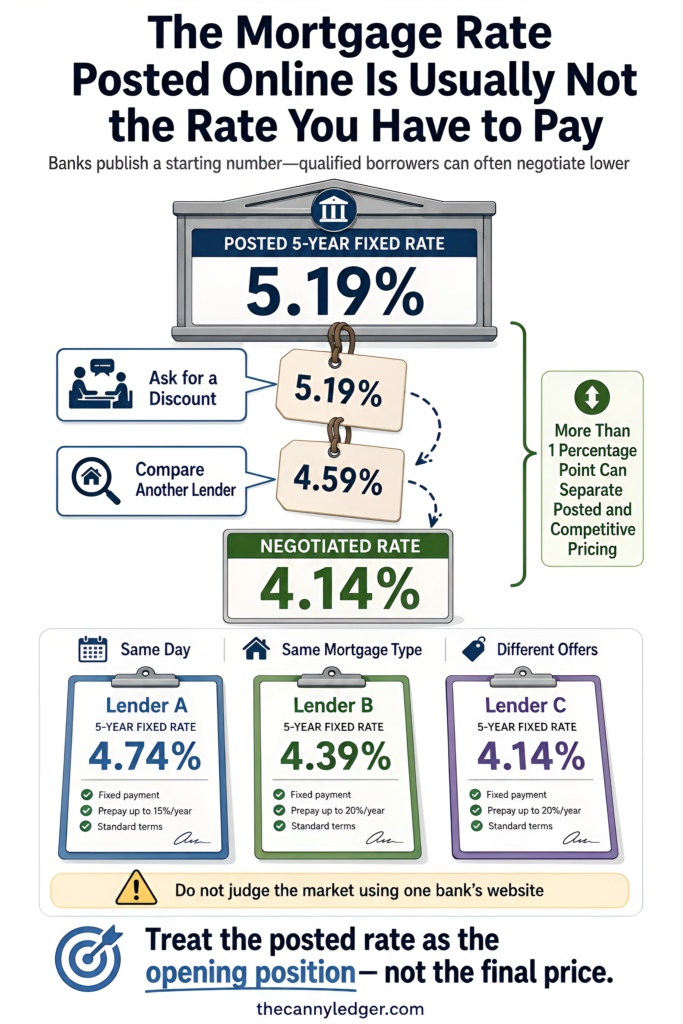
Right now, the lowest advertised insured five-year fixed rates in Canada sit around 3.94% to 4.04%, and the lowest insured variable rates run closer to 3.4%. Those are the numbers you’ll see on comparison sites and broker homepages. What you’ll rarely see advertised is that a Big Six bank’s own posted rate for the same product can run a full percentage point or more above that, and the gap between what’s posted and what’s actually available closes only if you ask, compare, or go through someone whose job is to compare for you.
Posted Rates Are a Starting Position, Not an Offer
Banks publish a posted rate for every mortgage product, and almost nobody who’s done their homework actually pays it. It exists partly as a reference point for calculating mortgage penalties, and partly as a number a loan officer can discount from during negotiation, which means the real opening move in getting a good rate is simply knowing the posted number isn’t the real number.
The spread between banks can be surprisingly wide even before any negotiating happens. Big bank rate comparisons regularly show one lender’s insured five-year fixed sitting well over a full point above another’s on the exact same day, for the exact same borrower profile. That gap alone is reason enough to get quotes from more than one source before assuming your bank’s first offer is competitive.
Why a Broker Can Often Beat a Bank, and When a Bank Wins Anyway
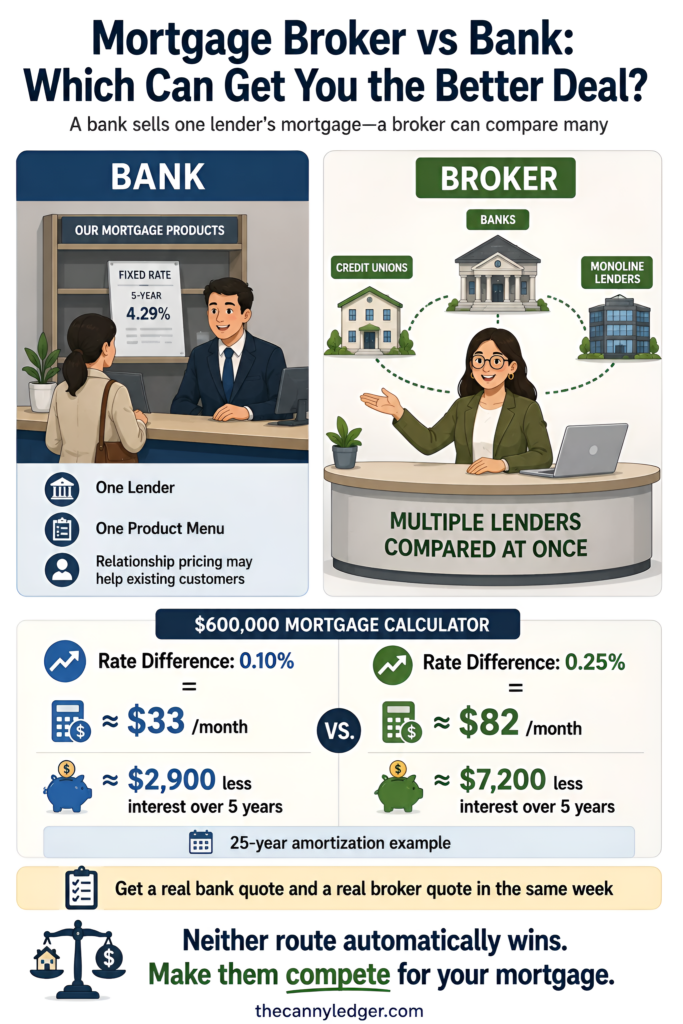
A bank’s mortgage specialist can only offer what that one bank sells. A broker works differently, submitting your application across a network of lenders that typically includes the Big Six banks, credit unions, and monoline lenders (mortgage-only lenders that operate without branches or the overhead of a full-service bank, which lets them price more aggressively). Because a broker’s business depends on volume across many lenders rather than loyalty to one, they often have leverage to negotiate a rate a single bank wouldn’t offer a walk-in customer.
The dollar difference is worth putting in real terms rather than leaving as an abstract percentage. On a $600,000 mortgage at a 25-year amortization, a rate that’s 0.10 percentage points lower adds up to roughly $33 less on your monthly payment and around $2,900 less in interest paid over a five-year term. Push that gap to 0.25 percentage points and the monthly difference grows to about $82, with roughly $7,200 saved in interest across the same five years. That’s not life-changing money on its own, but it’s also not nothing for a phone call and a few extra quotes.
None of this means a broker automatically wins. Banks sometimes offer relationship pricing to existing customers, shaving a bit off the rate if you bundle your mortgage with a chequing account, savings account, or investment products already held there. That discount can occasionally match or beat what a broker brings back. The only way to actually know which route wins for your specific situation is to get a quote from both at the same time and compare the real numbers side by side, not the advertised ones.
Your Credit Score Decides Which Rates You’re Even Offered
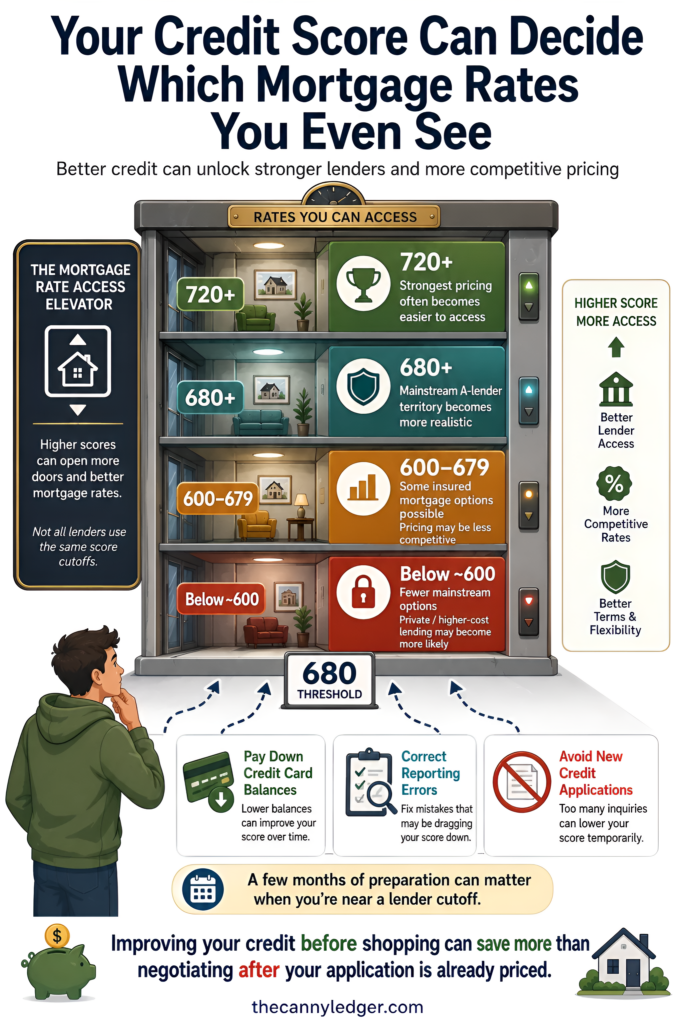
Rate shopping only gets you so far if your credit score puts you outside the tier where the best pricing lives. Most A-lenders, meaning the Big Six banks, credit unions, and monoline lenders that offer the lowest advertised rates, look for a credit score of 680 or higher for an uninsured mortgage, with scores of 720 and above qualifying for the most competitive pricing available. CMHC will insure a mortgage for a borrower with a score as low as 600, but a score sitting in the 600 to 679 range often means paying a noticeably higher rate even within the insured category, and a score below that pushes a borrower toward B-lenders or private lenders, where rates run well above anything an A-lender would offer.
The part that surprises people is how much that gap actually costs. Someone with a 680 score isn’t shut out of the market, but they’re realistically looking at a rate premium over what a 720-plus borrower gets quoted for the identical mortgage, and that premium compounds the same way any rate difference does across a five-year term. If your score is sitting close to one of those thresholds, checking it before you start shopping and giving yourself a few months to nudge it up, paying down a credit card balance, fixing an error on your file, avoiding new credit applications, can be worth more than any amount of broker negotiating.
Locking a Rate Before You’ve Found a Home
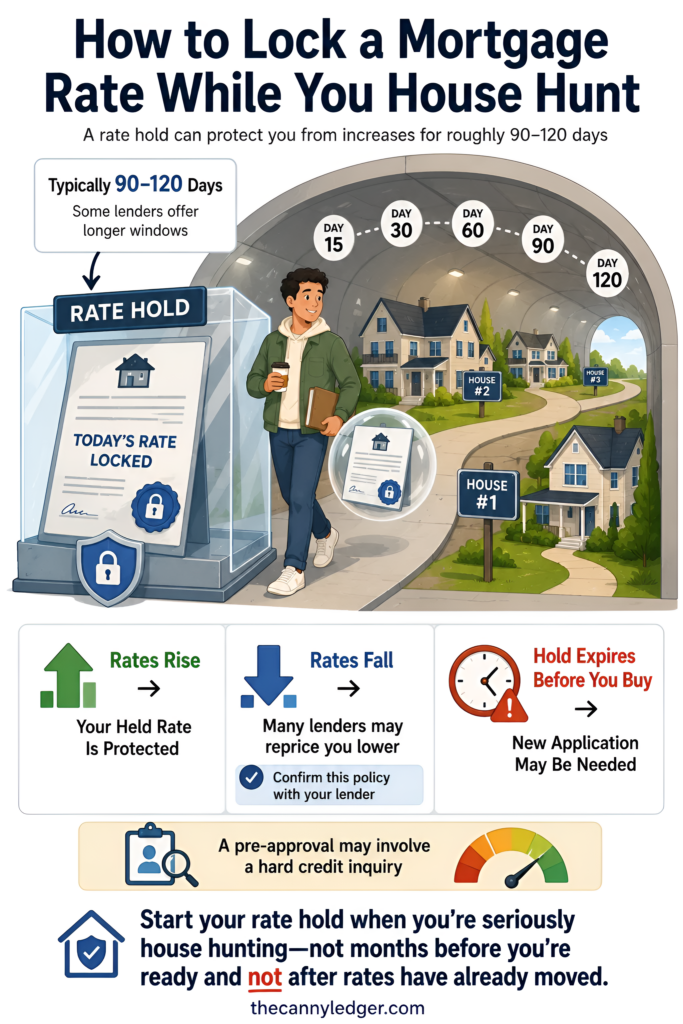
A rate hold, sometimes called a pre-approval, lets you freeze today’s rate for a set window while you keep house hunting, typically 90 to 120 days depending on the lender, with a handful offering as long as 150. It costs nothing, it doesn’t commit you to that lender, and at most lenders, if rates drop before you close, you get repriced down to the lower number rather than being stuck at the rate you locked. The only real cost is a hard credit inquiry, which can knock a few points off your score temporarily, not enough to change what you qualify for, but worth knowing about before it happens.
The mistake people make with rate holds runs in both directions. Locking one too early means it can expire before you’ve actually found a property, forcing a fresh application and another credit pull. Waiting too long to get one at all means shopping with no price protection in a market where rates can move meaningfully in the weeks it takes to find and close on a home. The sweet spot is starting the hold once you’re seriously looking, not before you’ve settled on a budget and not after you’ve already found the house.
What Gets Overlooked While Everyone’s Focused on the Rate
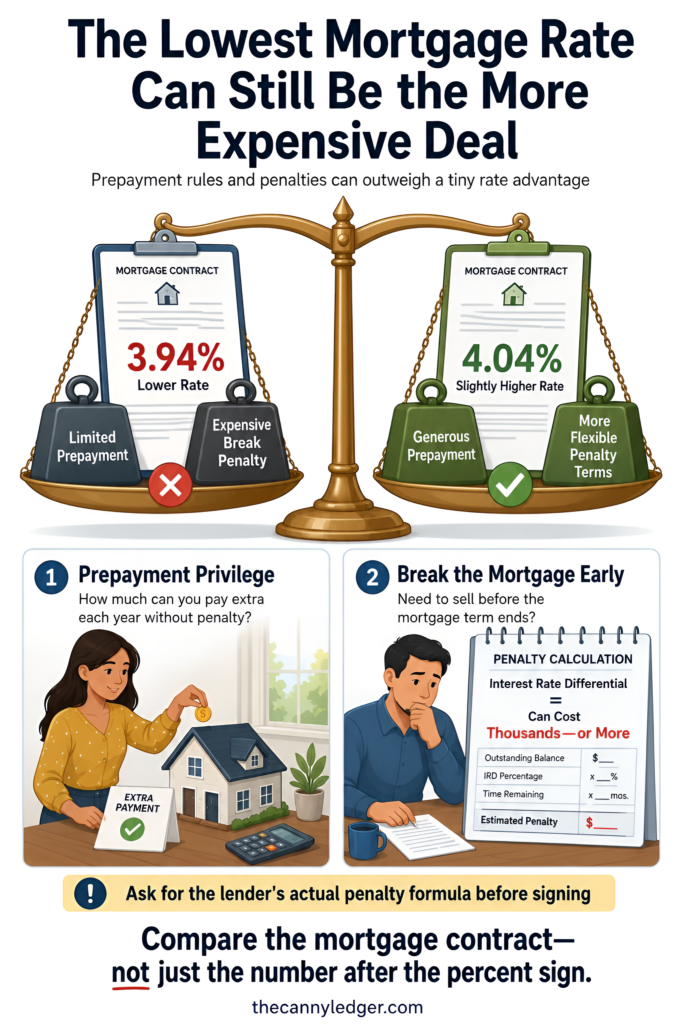
A lower rate that comes with worse terms isn’t automatically the better deal, and this is where a lot of rate shopping goes wrong. Prepayment privileges, meaning how much extra you’re allowed to pay toward your principal each year without penalty, vary significantly between lenders and rarely get mentioned in a rate comparison. A mortgage with a slightly higher rate but generous prepayment terms can end up cheaper over time than the lowest number on the page if you’re someone who plans to pay down extra whenever you can.
Penalty structure matters just as much, particularly for fixed-rate mortgages. Breaking a fixed mortgage early triggers an interest rate differential calculation that can run into the thousands, sometimes tens of thousands, depending on how far rates have moved since you signed. A monoline lender offering the lowest headline rate on the market isn’t doing you any favours if their penalty calculation is unusually aggressive and you end up needing to break the mortgage for a job move or a sale. Ask what the penalty formula actually is before signing, not after you need to use it.
Now What
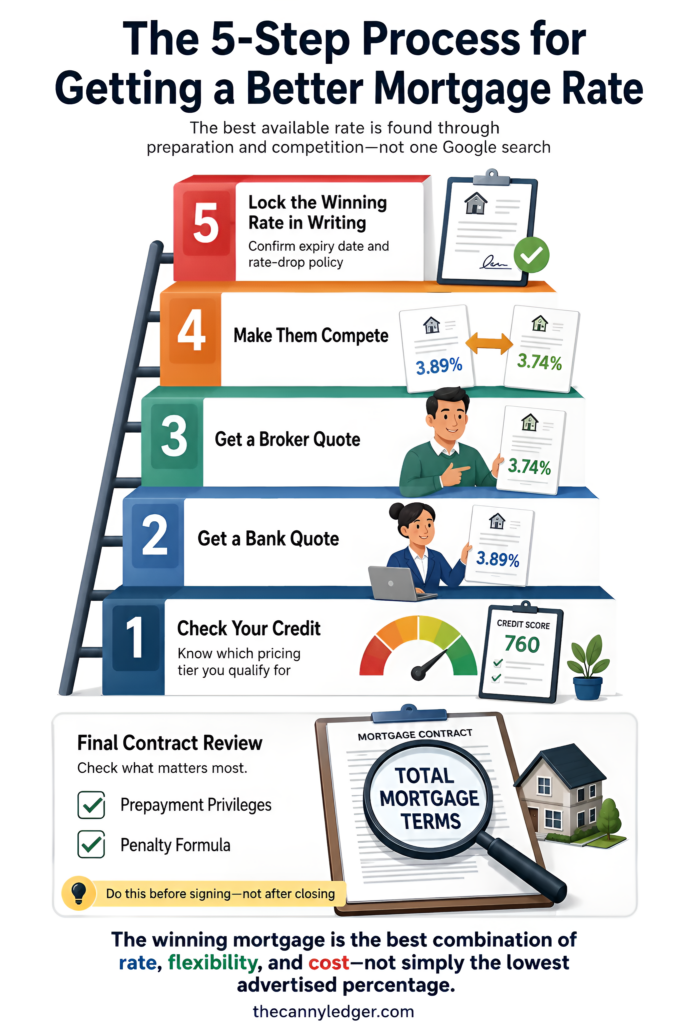
Getting the best available rate isn’t a one-step search, it’s a short process worth actually running through rather than skipping to save time. Start by pulling your credit report and confirming which tier you’re sitting in, since that determines the entire pool of rates you’re eligible for before any negotiating happens. Get quotes from at least one bank and one broker in the same window, so you’re comparing real numbers rather than advertised ones, and ask each one directly whether they can beat the other’s offer. Once you’ve settled on a lender, request the rate hold in writing along with the exact expiry date, and confirm in advance whether that lender reprices you downward if rates fall before closing. And before signing anything, ask about prepayment privileges and the penalty formula specifically, since the lowest rate on paper isn’t always the cheapest mortgage once those two details are factored in.
Frequently Asked Questions
Is the rate a bank advertises online the rate I’ll actually get? Rarely. Advertised and posted rates are a starting point, and most borrowers with reasonable credit can negotiate a lower number directly or get a better offer through a broker comparing multiple lenders at once.
Does using a mortgage broker cost extra? No. Brokers are typically paid a commission by the lender once your mortgage funds, not by you directly, so comparing multiple lenders through a broker generally costs nothing out of pocket.
How much does my credit score actually affect my rate? Meaningfully. Falling below the roughly 680 threshold most A-lenders use can push you toward higher-rate insured products or B-lender territory entirely, and even within the qualifying range, scores closer to 720 and above tend to get better pricing than scores sitting just above the minimum.
Should I get a rate hold before I’ve found a home? Yes, once you’re seriously looking. A rate hold is free, doesn’t obligate you to a lender, and protects you from rate increases while you search, though it typically expires in 90 to 120 days, so timing it to when you’re actually house hunting matters.
For more on the numbers behind these rates, our guides to current mortgage rates in Canada, fixed mortgage rates in Canada, and mortgage rates by province go deeper into current pricing. Our piece on mortgage brokers and professionals in Canada walks through how to actually pick one, and our mortgage affordability calculator can help you confirm what a given rate means for your specific approval amount before you start shopping in earnest. If you’re weighing the broader picture of where rates are headed, our Canada mortgage rate forecast is worth reading before you lock anything in.