

A collection call is designed, whether anyone at the agency would put it this way or not, to make you feel like you have no leverage at all. The voice on the other end usually sounds calm, certain, and slightly impatient, as if the outcome is already decided and you’re just the last person to find out. Almost none of that is actually true. Manitoba has specific, enforceable rules about what a collector can and can’t do, a real limit on how long a debt can hang over you legally, and a real government office whose entire job is fielding complaints about the agencies that cross the line. This is what those rules actually say, and how to use them.
- What a collector is legally required to tell you before anything else
- The specific things a Manitoba collector is not allowed to do
- The two-year clock almost nobody knows changed
- What actually happens if a creditor does sue you
- Your right to dispute a debt you don’t recognize
- How and where to actually file a complaint
- When the calls are legally required to stop entirely
- The one thing worth remembering the next time the phone rings
What a collector is legally required to tell you before anything else
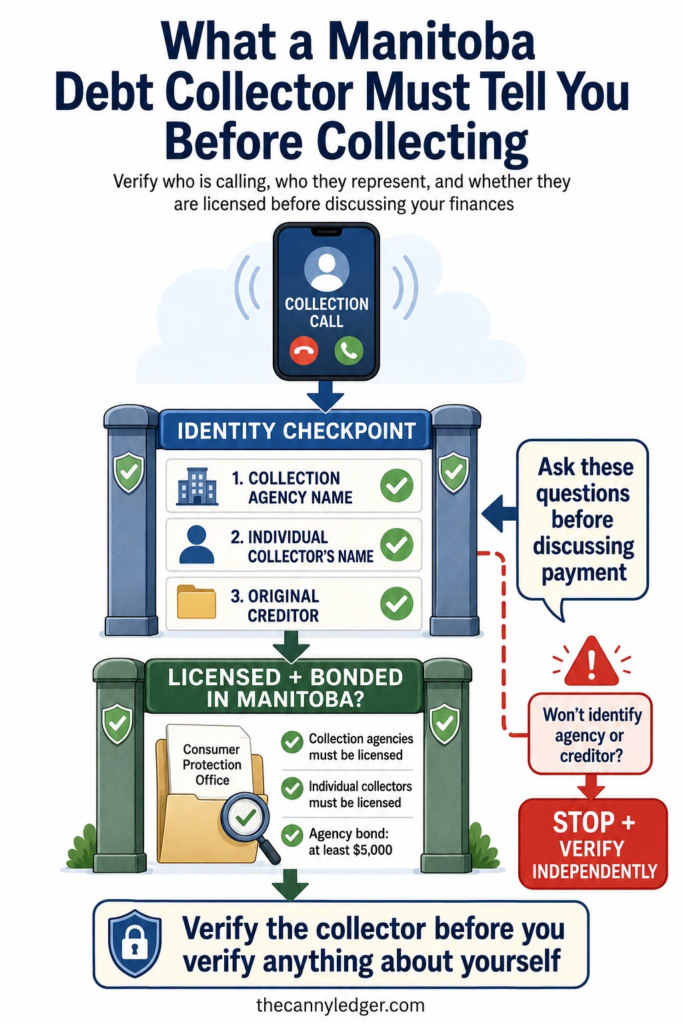
Before a licensed collection agency can properly pursue you in Manitoba, it’s required to identify itself clearly: the name of the agency, the name of the individual collector you’re speaking with, and the name of the original creditor they’re collecting on behalf of. If someone calls claiming to be collecting a debt and won’t give you a straight answer to any of those three basic questions, that alone is worth treating as a red flag rather than a technicality.
Every collection agency and every individual collector operating in this province must also be licensed and bonded through Manitoba’s Consumer Protection Office, which requires agencies to post a bond of at least five thousand dollars specifically as a form of financial accountability to the province. Asking a collector directly whether they’re licensed, and confirming it independently with the Consumer Protection Office if anything feels off, is a completely reasonable thing to do before you disclose anything about your finances to them.
The specific things a Manitoba collector is not allowed to do
The Consumer Protection Act lays out a fairly detailed list of prohibited collection practices, and knowing the specifics matters more than knowing the general idea, because a lot of pressure tactics work precisely by testing whether you know where the actual line sits.
Calling hours are restricted to between 7:00 a.m. and 9:00 p.m., Monday through Saturday, with no calls permitted at all on Sundays or statutory holidays. A collector phoning you at ten at night or on a long weekend Monday isn’t just being rude, they’re breaking the law.
A collector cannot disclose your debt to your employer, your family, your neighbours, or anyone else not legally entitled to that information, and cannot repeatedly contact people in your life in an attempt to pressure or embarrass you into paying. Contacting a third party solely to locate you is treated differently than discussing the debt itself with that person, so it’s worth knowing the distinction if a collector claims they were “just trying to reach you” after calling your workplace.
A collector cannot threaten you with legal action they have no actual authority or intention to pursue, cannot use documents deliberately designed to look like official court paperwork when they aren’t, and cannot demand or collect more than what’s actually owed, including tacking on unauthorized fees or charges that weren’t part of the original agreement. If a letter looks like a summons but isn’t one, or a collector claims a sheriff is about to show up over a routine credit card balance, that’s a scare tactic, not a description of an imminent legal process.
Repossession without proper legal authority is also prohibited. A creditor can only seize property that was pledged as collateral on the original loan, or property a court has specifically authorized them to seize through a judgment, and even then there are rules around how that process has to unfold.
Violations of any of these rules can be reported directly to the Consumer Protection Office, and the penalties involved are real rather than symbolic, ranging from roughly one thousand to twenty thousand dollars per violation for agencies and individual collectors found to have broken them.

The two-year clock almost nobody knows changed
Here’s a piece of information that a surprising number of collection-related websites still get wrong, because it changed relatively recently and a lot of older content simply never got updated. Prior to September 30, 2022, Manitoba’s limitation period for suing over an unsecured debt was six years. As of that date, Manitoba’s new Limitations Act replaced the old patchwork of rules with a single basic limitation period of two years from the date the debt was discovered, meaning the date you missed a payment or otherwise should reasonably have known a claim existed, bringing Manitoba in line with most other Canadian provinces. There’s also a longer fifteen-year ultimate limitation period that applies in narrower circumstances, but the two-year window is the number that matters for the overwhelming majority of ordinary consumer debts.
Practically, this means a creditor generally has two years from the point a debt went into default to actually sue you over it, not to keep calling you, which they can do indefinitely, but specifically to obtain a court judgment. There’s an important trap built into this, though: if you acknowledge the debt in writing, or make even a partial payment, the clock resets and starts over from that date. This is exactly why some collectors push hard for a small “good faith” payment on an old debt that might otherwise be close to unenforceable, since accepting even twenty dollars can restart a limitation period that had almost run out, a pattern that shows up especially often with old payday loan balances that have been resold between collection agencies more than once. If you’re dealing with a debt that’s been dormant for a long time and suddenly resurfaced, it’s worth understanding this mechanism clearly before agreeing to anything, even something that sounds small and harmless.

What actually happens if a creditor does sue you
If a debt is still within its limitation period and a creditor decides to pursue it formally, the process starts with being served a statement of claim, and you’d typically have a defined window, commonly around twenty days, to file a response or defence. Ignoring that notice doesn’t make the process stop, it usually results in a default judgment being granted against you without your side ever being heard.
Once a judgment exists, a creditor gains access to enforcement tools including wage garnishment, liens against property, and in some cases seizure of specific assets, all of which move considerably faster once a court has already ruled than they could beforehand. This is one of the biggest reasons responding to a lawsuit, even just to acknowledge it and ask questions, tends to matter more than people expect when they’re tempted to ignore paperwork that feels overwhelming.
If a garnishment is already underway or actively threatened, it’s worth reading alongside our broader debt relief and debt help in Winnipeg guide, which covers Manitoba’s specific wage protection rules under the Garnishment Act and how quickly a consumer proposal or bankruptcy filing can bring an active garnishment to a stop.

Your right to dispute a debt you don’t recognize
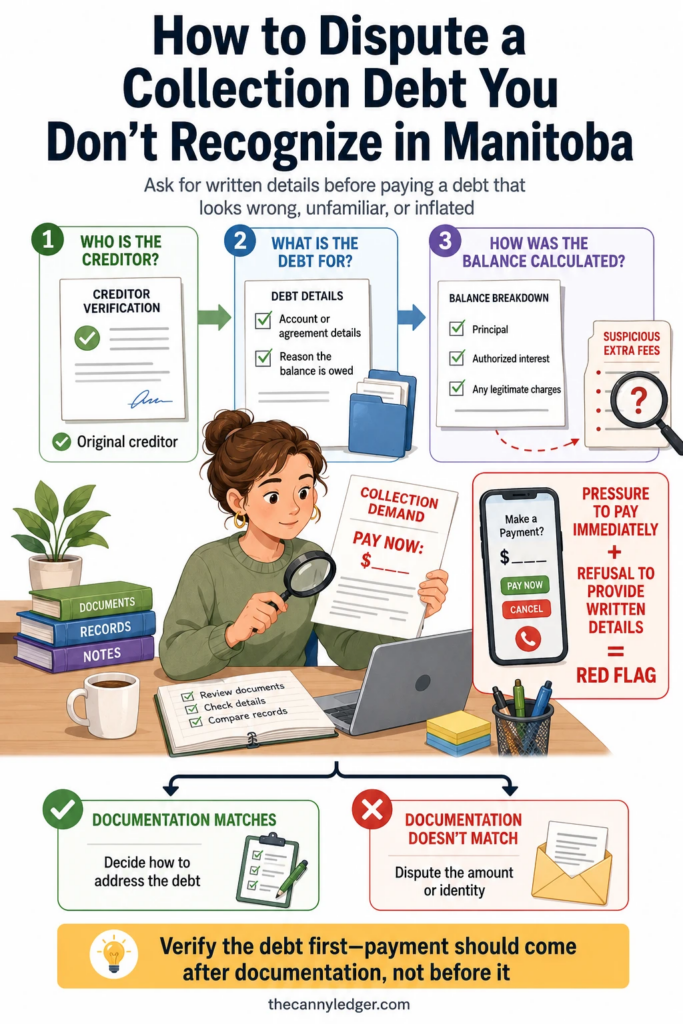
Not every collection call is chasing a legitimate, accurately calculated debt. Accounts sometimes get sold between agencies with errors intact, identities occasionally get confused, and amounts sometimes include unauthorized fees layered on top of what was originally owed. You’re entitled to ask a collector to provide written confirmation of exactly what’s owed, to whom, and why, before making any payment, and a legitimate agency should be able to produce that documentation without resistance. If a collector pressures you to pay immediately over the phone while refusing to send anything in writing first, that pressure itself is worth treating with real suspicion rather than giving in to out of a desire to just make the calls stop.
How and where to actually file a complaint
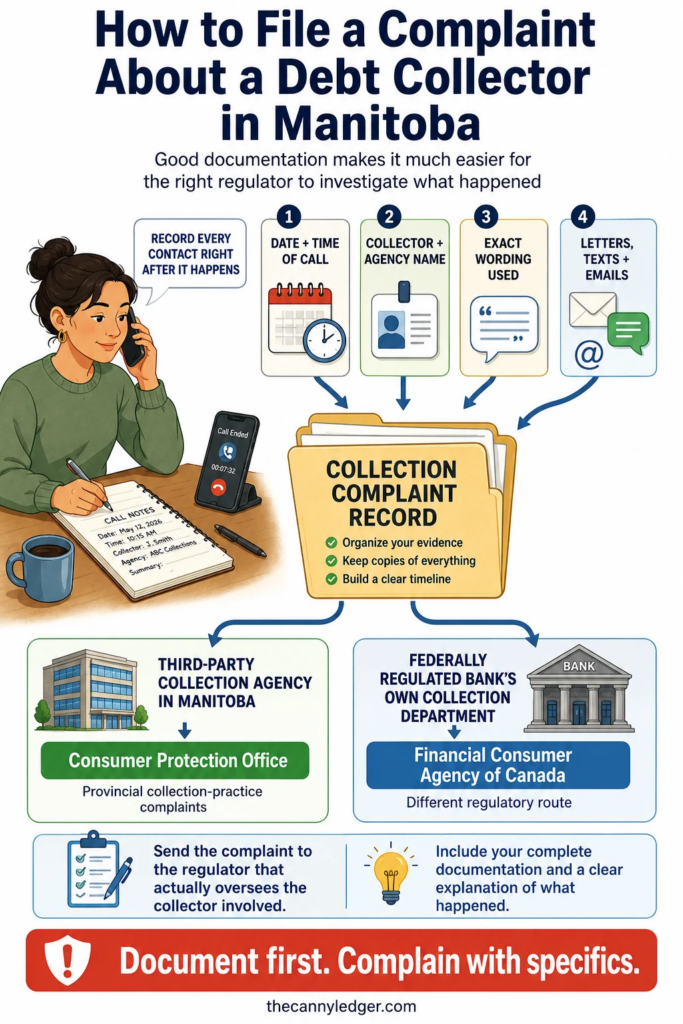
Manitoba’s Consumer Protection Office is the body responsible for investigating collection practice complaints, and it’s a real, usable resource rather than a symbolic one. Complaints can be filed by phone or email, and the office has the authority to investigate, and where warranted, penalize agencies and individual collectors who’ve broken the rules described above. If the debt in question involves a federally regulated bank or credit union’s own internal collections department rather than a third-party agency, the Financial Consumer Agency of Canada is the more appropriate body to contact instead, since federally regulated institutions fall slightly outside provincial jurisdiction on this specific point.
Documenting everything as it happens makes a complaint dramatically more effective. Note the date, time, and content of every call, save every letter and text message, and if a collector says something that sounds like a clear violation, write down the exact wording as soon as you can afterward while it’s still fresh. Manitoba Justice has periodically reminded residents of these exact rights specifically because so many people don’t realize how detailed the rules already are.
When the calls are legally required to stop entirely
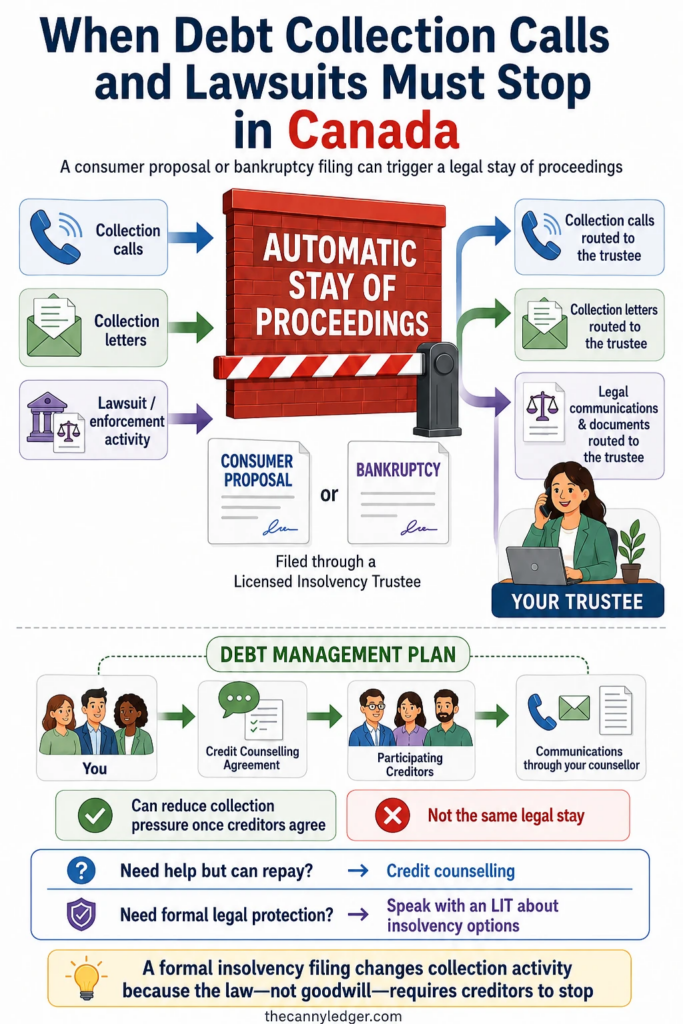
Short of paying a debt off completely, there’s exactly one tool that legally forces all collection activity, calls, letters, and lawsuits alike, to stop immediately and completely: filing a consumer proposal or an assignment in bankruptcy through a Licensed Insolvency Trustee. The moment either is filed, an automatic stay of proceedings takes effect, and creditors are legally required to redirect all communication to your trustee rather than continuing to contact you. Our bankruptcy in Winnipeg guide walks through exactly how that process works and what it protects, and our debt consolidation in Winnipeg guide covers the less drastic options worth exploring first, including a debt management plan through a non-profit counsellor, which tends to bring collection activity to a stop on a more voluntary basis once your creditors have agreed to the arrangement. If you’re not sure which of these actually fits your situation, our credit counselling in Winnipeg guide covers where to get a free, judgment-free first conversation before committing to anything, and our 211 Manitoba page is a reasonable place to start if you’d rather be pointed toward the right resource than choose blind.
The one thing worth remembering the next time the phone rings
A collector’s entire approach depends on you not knowing the rules well enough to push back. You now know the calling hours, the disclosure limits, the fee restrictions, and the two-year window that a lot of collection scripts are built to quietly work around. None of that erases a debt you genuinely owe, and it isn’t a substitute for actually addressing the underlying situation through consolidation, counselling, or a formal legal process if the numbers call for it. But it does mean the next call doesn’t have to feel like a conversation you’re losing before it starts.