
Spend $50,000 building a secondary suite for an aging parent, and you might assume claiming every possible tax credit on that same renovation maximizes your return. It doesn’t work that way. The Canada Revenue Agency specifically excludes costs already claimed under the Home Accessibility Tax Credit or the Medical Expense Tax Credit from also being claimed under the newer Multigenerational Home Renovation Tax Credit, meaning stacking these federal credits requires genuinely separating which expenses go where rather than assuming every dollar spent qualifies for every program at once.
- The Two Federal Credits Most Manitoba Homeowners Miss
- The Multigenerational Home Renovation Tax Credit Explained
- The Home Accessibility Tax Credit Explained
- Why You Can’t Claim Both Credits on the Same Expense
- Manitoba’s Own Provincial Layer: Efficiency Rebates and the Green Energy Tax Credit
- The Greener Homes Grant Is Gone, Here’s What’s Replacing It
- Stacking These Programs on a Single Renovation
- How to Actually Claim These on Your Tax Return
- Common Questions
- Plan the Paper Trail Before You Plan the Renovation
Manitoba homeowners planning a renovation have access to two major federal tax credits, the Multigenerational Home Renovation Tax Credit worth up to $7,500 and the Home Accessibility Tax Credit worth up to $1,500 annually, alongside Manitoba’s own provincial layer of Efficiency Manitoba rebates and a separate Green Energy Equipment Tax Credit for Manitoba-manufactured geothermal systems. Combined and properly sequenced across a single larger project, these programs can realistically return thousands of dollars, though the specific rules governing which expenses qualify for which credit require careful attention to avoid losing value through incorrect claims.
The Two Federal Credits Most Manitoba Homeowners Miss
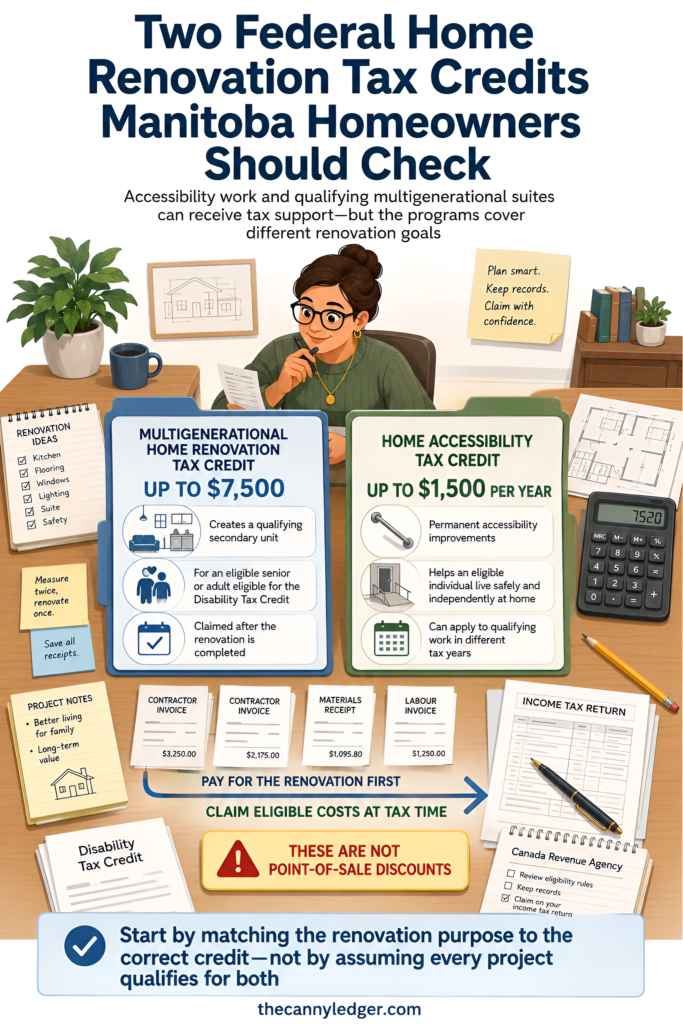
Both the Multigenerational Home Renovation Tax Credit and the Home Accessibility Tax Credit are refundable federal credits available to homeowners across Canada, Manitoba included, yet both remain genuinely underused simply because a lot of homeowners don’t realize either program exists until well after a renovation is already complete. Since both credits get claimed on your income tax return rather than applied at the point of sale the way a rebate typically works, the practical difference is real: you pay full price upfront during the renovation itself, then recover a portion of that cost when you file your taxes for the year the work was completed.
The Multigenerational Home Renovation Tax Credit Explained
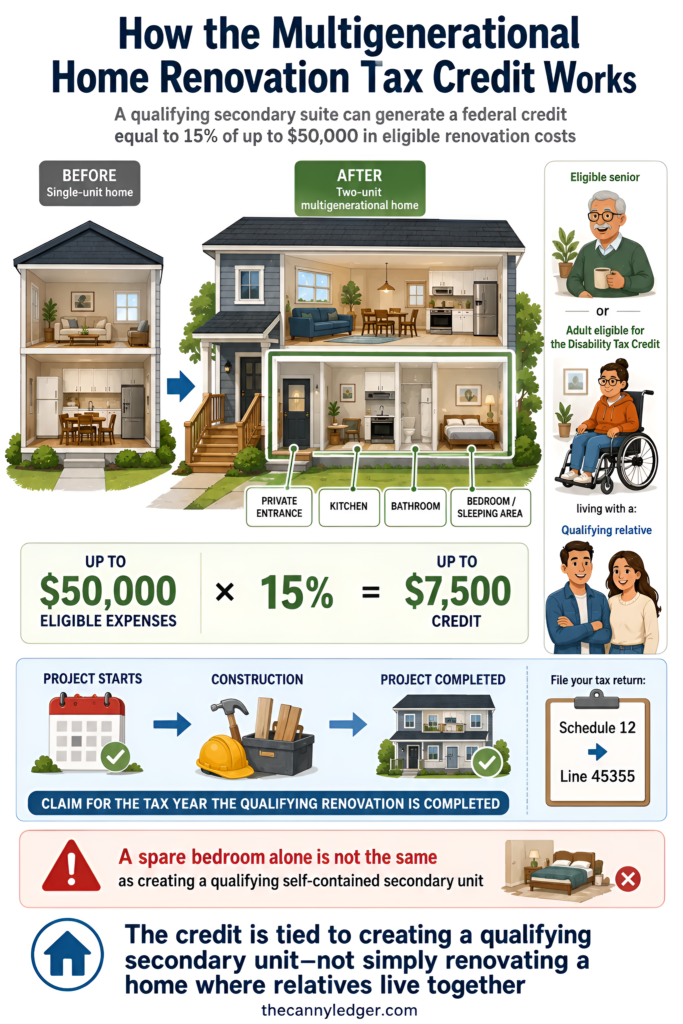
The Multigenerational Home Renovation Tax Credit provides a refundable credit worth 15 percent of eligible expenses, up to a maximum of $50,000 in qualifying costs, working out to a maximum credit of $7,500 for a single qualifying renovation. To qualify, the renovation needs to create a genuinely self-contained secondary unit, complete with its own private entrance, kitchen, bathroom, and bedroom, specifically allowing a senior or an adult eligible for the Disability Tax Credit to live together with a qualifying relative rather than in an entirely separate residence. The credit gets claimed on line 45355 of your T1 return specifically for the tax year the renovation was actually completed, regardless of when individual expenses within that renovation were originally incurred, meaning a project started in one calendar year but finished in the next gets claimed based on its completion date, not its start date.
The Home Accessibility Tax Credit Explained
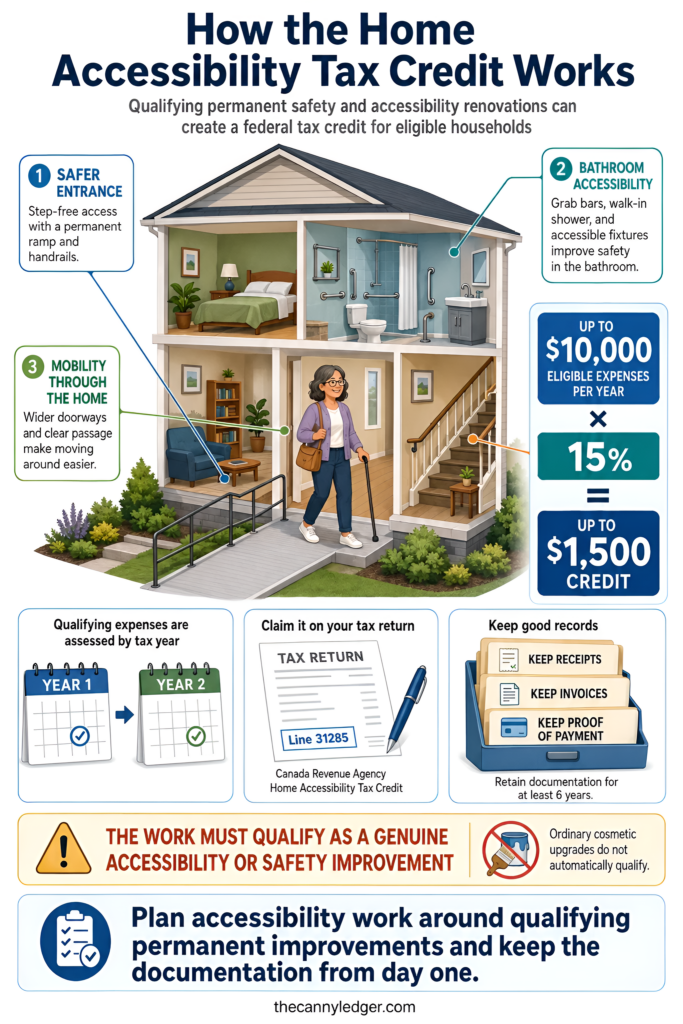
The Home Accessibility Tax Credit works on a similar 15 percent structure but with a meaningfully different cap, applying to up to $10,000 in eligible expenses per calendar year per eligible dwelling, producing a maximum annual credit of $1,500. Unlike the Multigenerational credit’s one-time, project-based structure, this credit renews annually, meaning a homeowner making accessibility improvements across multiple years can potentially claim this credit repeatedly, provided each year’s expenses qualify independently under the program’s rules. Eligible work needs to be a permanent renovation genuinely enabling a qualifying individual to remain safely in their home, and it gets claimed on line 31285 of your federal return, with receipts and invoices needing to stay on file for at least six years in case the CRA requests documentation during a review.
Why You Can’t Claim Both Credits on the Same Expense
The CRA’s rules specifically exclude any expense already claimed under the Home Accessibility Tax Credit, or the Medical Expense Tax Credit, from also being eligible under the Multigenerational Home Renovation Tax Credit, closing off the possibility of claiming the same dollar spent twice across different credits. For a renovation project that genuinely spans both categories, creating an accessible secondary suite for an aging parent, for instance, this means deliberately allocating specific costs to whichever single credit produces the better outcome for your household’s actual tax situation, rather than assuming every eligible-sounding expense can simply be claimed everywhere it might technically qualify.

Manitoba’s Own Provincial Layer: Efficiency Rebates and the Green Energy Tax Credit
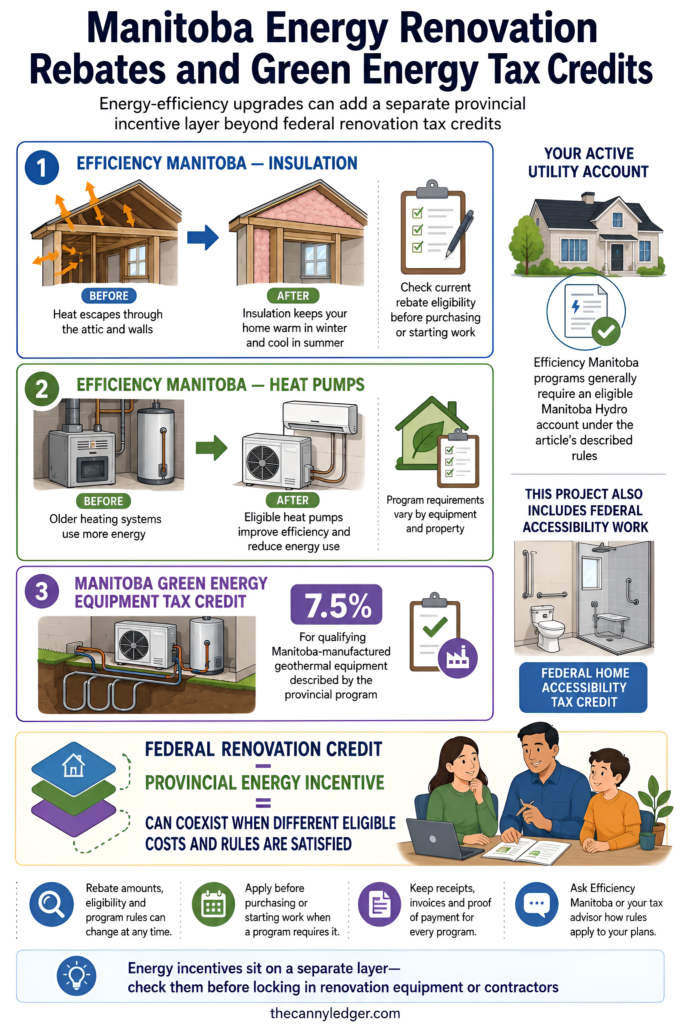
Beyond these two federal credits, Manitoba homeowners have access to a genuinely separate provincial layer specifically targeting energy efficiency upgrades, administered through Efficiency Manitoba’s insulation and heat pump rebate programs, open to any homeowner with an active Manitoba Hydro account regardless of household income. Manitoba also offers its own Green Energy Equipment Tax Credit, worth 7.5 percent specifically for geothermal heat pump systems manufactured in Manitoba for use in the province, a distinct provincial credit that operates entirely separately from both the federal renovation credits covered above and Efficiency Manitoba’s own rebate structure. A renovation combining accessibility upgrades with a geothermal heating system installation could genuinely touch all three of these programs simultaneously, provided each specific expense gets properly allocated to the program it actually qualifies under.
The Greener Homes Grant Is Gone, Here’s What’s Replacing It
The federal Canada Greener Homes Grant and its companion Greener Homes Loan both closed in late 2025, meaning any Manitoba homeowner still budgeting around that specific program needs to know it’s no longer available for new applications. Its replacement, the Canada Greener Homes Affordability Program, is being developed specifically to target low-to-moderate income households, and Manitoba was confirmed as the first province to sign a co-delivery agreement for this new program in 2026, positioning the province ahead of most others in actually rolling out the replacement locally. Given the program’s details continue developing, confirming its current status and specific eligibility directly with the federal government or Efficiency Manitoba before assuming any particular benefit applies to your household is worth doing rather than relying on early program descriptions that may shift before full rollout.

Stacking These Programs on a Single Renovation
A single, well-planned renovation genuinely can combine several of these programs at once, a secondary suite build incorporating accessibility features and an efficient heating system upgrade might touch the Multigenerational credit, Efficiency Manitoba’s heat pump rebate, and potentially the Green Energy Equipment Tax Credit simultaneously, provided the project is planned and documented correctly from the start. The practical challenge is sequencing and documentation, keeping clean, separated records for which specific costs apply to which specific program, since attempting to claim overlapping expenses across programs that explicitly exclude double-claiming can result in a reduced or rejected claim rather than the maximized return a homeowner might expect. Our guide to the disability tax credit in Winnipeg covers a closely related eligibility question worth understanding directly, since Disability Tax Credit eligibility specifically factors into who counts as a qualifying individual for the Multigenerational credit.

How to Actually Claim These on Your Tax Return
Both federal credits get claimed directly on your T1 income tax return for the year the relevant renovation work was completed or the relevant expenses were incurred, with the Multigenerational credit using Schedule 12 to calculate the specific amount before it flows through to line 45355, and the Home Accessibility credit reported directly on line 31285. Keeping every receipt, invoice, and proof of payment organized throughout the renovation itself, rather than trying to reconstruct documentation after the fact at tax time, genuinely simplifies this process considerably, particularly for a larger project spanning multiple contractors, permits, and payment stages. Our guide to the Manitoba and Winnipeg personal income tax guide covers how these federal credits interact with your broader provincial tax return, and our guide to budgeting for a basement suite in Winnipeg is worth reading alongside this guide specifically if a secondary suite renovation is what you’re actually planning.

Common Questions
Can I claim the Multigenerational credit more than once in my lifetime? Generally each eligible person can claim this credit once for a genuinely qualifying renovation, so confirming your specific situation directly with the CRA before assuming a second future renovation would also qualify is worth doing rather than assuming repeat eligibility.
Does the Home Accessibility Tax Credit require the qualifying individual to have a documented disability? Eligibility generally covers seniors and individuals eligible for the Disability Tax Credit specifically, so confirming your own or your family member’s eligibility status directly with the CRA before starting a renovation you’re planning around this specific credit protects you from an unexpected claim rejection later.
If my renovation spans two calendar years, which year do I claim it in? For the Multigenerational credit specifically, you claim based on the year the renovation was actually completed, not the year individual expenses were incurred, while the Home Accessibility credit’s annual cap means expenses genuinely do need to be tracked by the specific calendar year they occurred in.
Plan the Paper Trail Before You Plan the Renovation
Before starting any renovation you’re hoping to offset through these programs, map out which specific costs you expect to claim under which specific credit or rebate, and keep separated documentation from day one rather than trying to sort it out after the project wraps. Confirming current program status directly with the CRA, Efficiency Manitoba, or a qualified tax professional before finalizing your renovation budget is the genuinely necessary step for making sure the return you expect on paper actually materializes once you file.