

A lot of homeowners and even some builders assume Manitoba requires new home warranty coverage the same way Ontario, British Columbia, and Alberta do, since those provinces all made it a legal condition of building and selling a new home. Manitoba actually passed legislation in 2013 that would have done exactly that, requiring every new home builder to register and provide warranty coverage before a building permit could be issued. That law was repealed before it ever took effect, after the province decided the roughly 250 regulatory requirements it created were too burdensome, and warranty coverage in Manitoba remains entirely voluntary to this day. The New Home Warranty Program of Manitoba’s own FAQ confirms this plainly: membership is strictly voluntary, and not every builder even qualifies to join.
- New Home Warranty in Manitoba Is Actually Voluntary
- What Course of Construction Insurance Actually Covers
- What It Costs, and Why It’s Priced as a Percentage
- General Liability Still Needs to Run Alongside It
- Wrap-Up Liability for Larger Projects
- WCB Coverage Applies Here Too, and It’s Not Optional
- The Builders’ Lien Act Isn’t Insurance, But It Matters
- Equipment and Tools Need Their Own Coverage
- Building Your Project’s Coverage Stack
- Common Questions
- Confirm Warranty and Insurance Status Before Signing Anything
Construction and renovation insurance in Winnipeg covers several genuinely distinct categories rather than one single policy. Course of construction insurance, also called builder’s risk, protects the physical structure and materials during the build itself, typically costing 1 to 4 percent of total project value. Commercial general liability covers third-party injury and property damage claims, WCB coverage protects workers on the job, and larger projects sometimes require wrap-up liability coverage spanning every party involved from start to finish.
New Home Warranty in Manitoba Is Actually Voluntary
Manitoba’s abandoned New Home Warranty Act would have covered most new homes, including condominiums, for seven years and up to $100,000, with mandatory builder registration and an online public registry homeowners could check before buying. None of that ever came into force. Today, builders can voluntarily register with the New Home Warranty Program of Manitoba, a not-for-profit organization operating since 1975, or with another approved provider like WBI Home Warranty, but no law requires them to do so, and municipalities issuing building permits don’t mandate proof of warranty coverage the way they might in a province where this kind of legislation actually took effect. The Manitoba Home Builders’ Association requires its own member builders to carry third-party warranty coverage on every new home as a condition of membership, which means checking whether a specific builder belongs to that association is a genuinely useful proxy for warranty coverage, even though it’s an industry standard rather than a legal requirement.

What Course of Construction Insurance Actually Covers
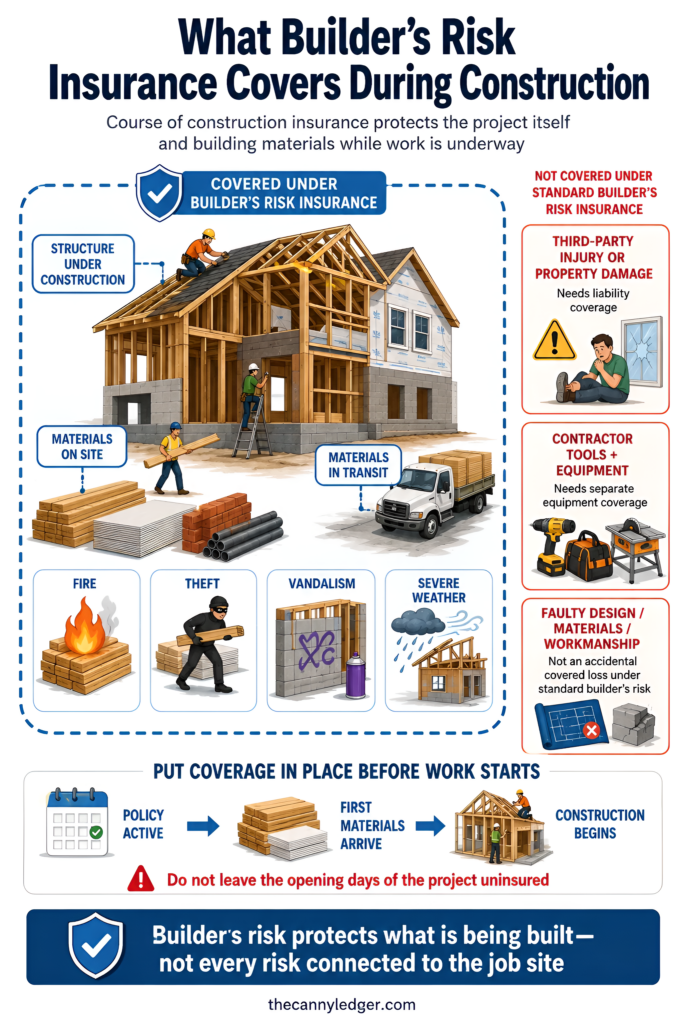
Course of construction insurance, interchangeably called builder’s risk insurance, is a specialized form of property insurance protecting a building and its materials throughout the construction or renovation process itself, covering losses from fire, theft, vandalism, and severe weather to both the structure and materials waiting to be installed, whether they’re already on site or still in transit. What it explicitly doesn’t cover matters just as much as what it does. Builder’s risk insurance won’t pay for third-party injury or property damage claims, tools and equipment used during construction, or defects arising from faulty design, materials, or workmanship rather than an actual accident. Getting this policy in place before the first shovel hits the ground matters directly, since a coverage gap at the very start of a project is a common and costly mistake, one insurers and brokers alike flag as genuinely avoidable with basic planning.
What It Costs, and Why It’s Priced as a Percentage
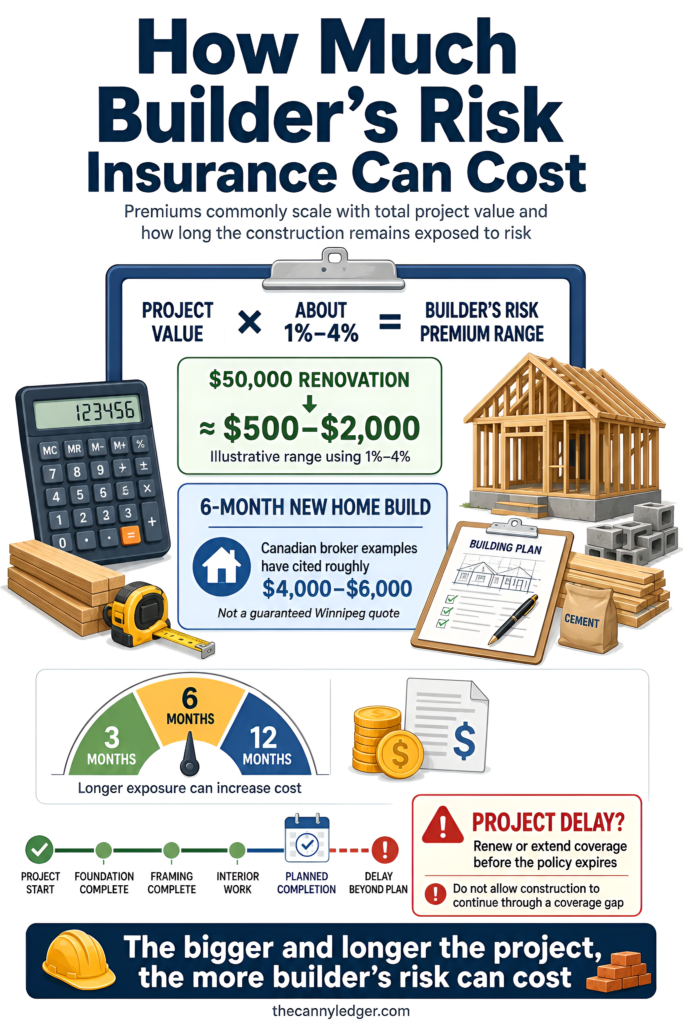
Builder’s risk premiums typically run 1 to 4 percent of total project value rather than a flat dollar figure, which means the cost scales directly with what you’re actually building. A $50,000 renovation might cost $500 to $2,000 to insure through the course of construction, while a six-month new home build has run closer to $4,000 to $6,000 in real quotes cited by Canadian brokers. Project duration is one of the most influential factors in that final number, since a shorter build window naturally reduces the time window in which an accident could actually occur. Policies commonly run in 3, 6, or 12-month terms depending on the project’s expected timeline, and if construction stretches beyond the original term, the policy typically needs renewing rather than lapsing into a coverage gap partway through.
General Liability Still Needs to Run Alongside It
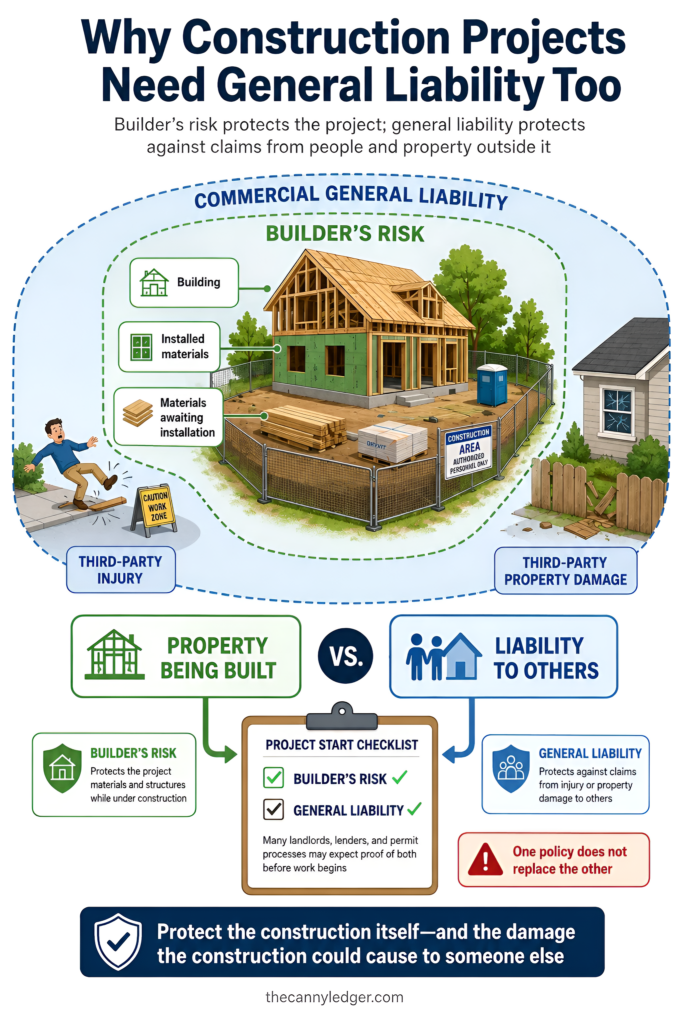
Since builder’s risk insurance specifically excludes third-party bodily injury and property damage claims, commercial general liability coverage still needs to run alongside it as a separate policy for any contractor or project owner. This is the same core coverage category our broader guide to small business insurance in Winnipeg covers in depth, and construction specifically tends to sit toward the higher end of general liability pricing given the elevated physical risk involved compared to a typical office-based business. Most commercial landlords, lenders, and municipal permit offices treat proof of both coverages, builder’s risk and general liability, as a practical prerequisite before work begins, even in situations where neither is technically mandated by provincial law.
Wrap-Up Liability for Larger Projects
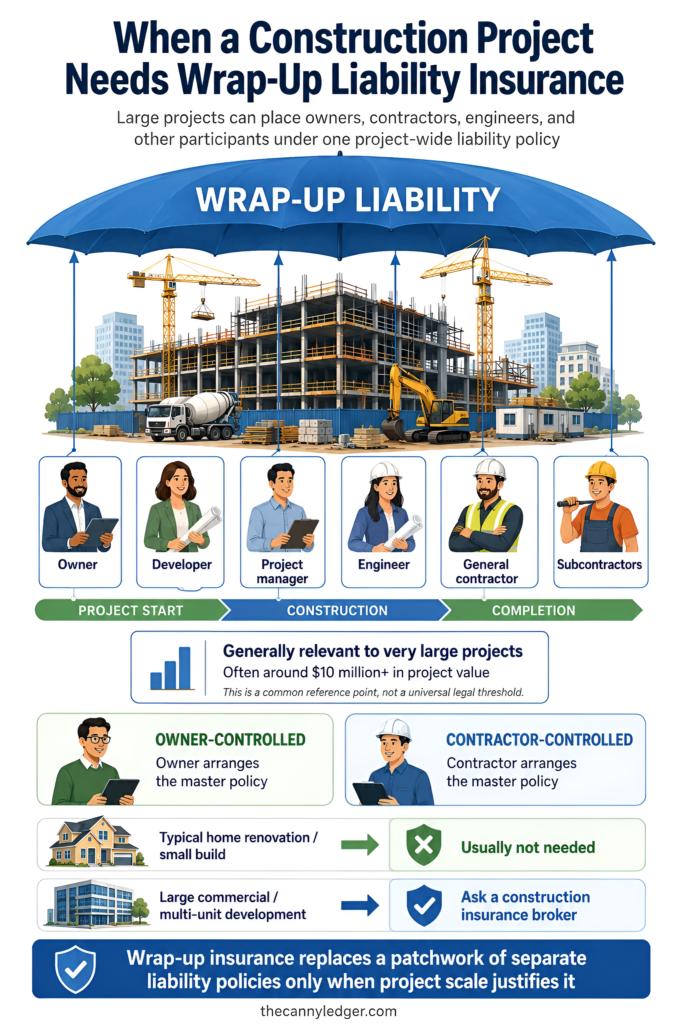
For genuinely large construction jobs, generally projects worth $10 million or more, wrap-up liability insurance replaces the patchwork of individual policies each contractor and subcontractor might otherwise carry separately, insuring every party involved, owners, engineers, project managers, developers, and contractors, under one unified liability policy covering the entire project from start to finish. This structure comes in two forms, contractor-controlled and owner-controlled, depending on which party arranges and administers the master policy. For most Winnipeg residential renovations and smaller commercial builds, wrap-up liability simply won’t be relevant given the project scale threshold, but for a major commercial development or large multi-unit residential project, it’s worth raising directly with a broker experienced in construction insurance specifically.
WCB Coverage Applies Here Too, and It’s Not Optional
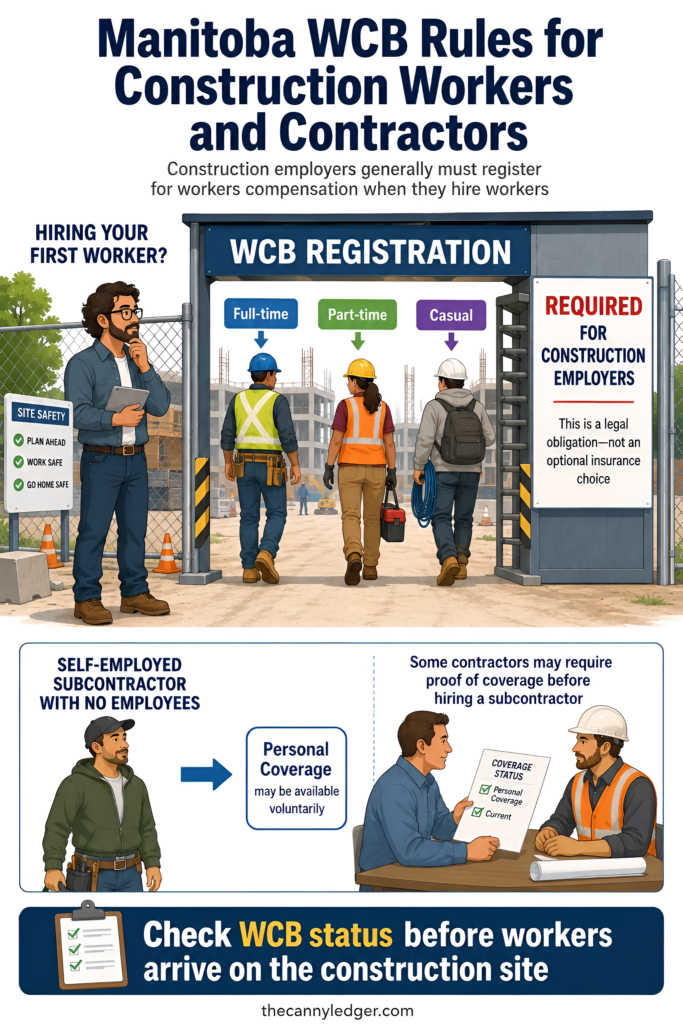
Construction is explicitly one of the industries Manitoba’s Workers Compensation Board treats as mandatory, meaning any contractor hiring workers, full-time, part-time, or casual, needs to register for WCB coverage the moment that first hire happens, a legal requirement rather than a business choice. Our guide to small business insurance in Winnipeg covers WCB registration mechanics in full, including how self-employed subcontractors without employees can still voluntarily purchase Personal Coverage, a detail that matters enormously in construction specifically, since many principal contractors won’t hire an uninsured subcontractor at all given the liability exposure of taking on an uncovered worker under their own WCB account.
The Builders’ Lien Act Isn’t Insurance, But It Matters
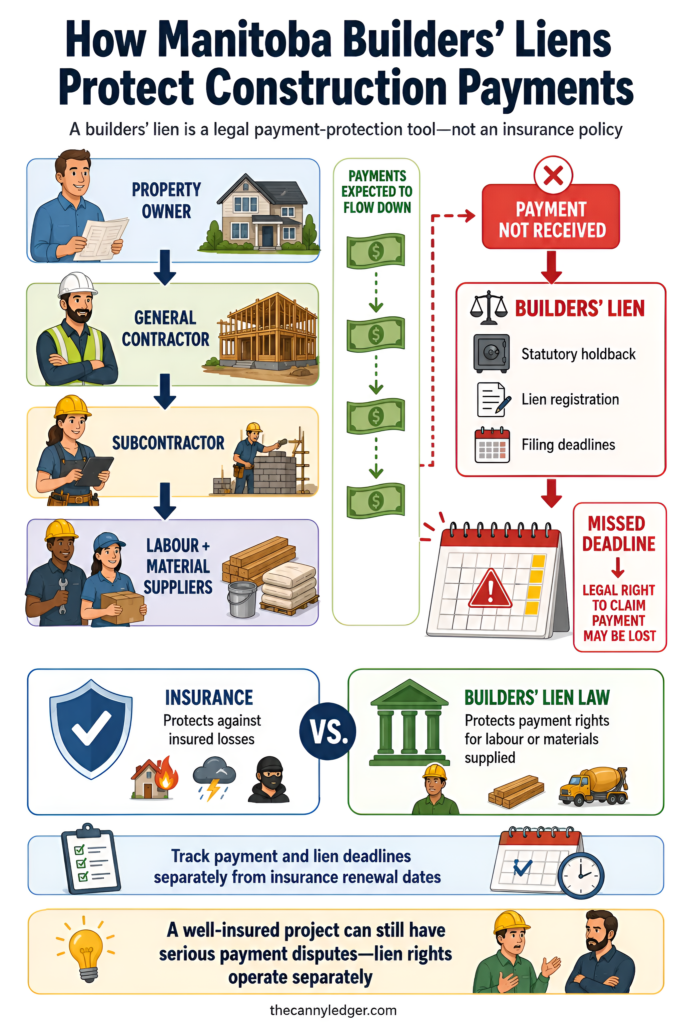
Separate from insurance entirely, Manitoba’s Builders’ Liens Act governs a legal mechanism protecting anyone who supplies labour or materials to a construction project from going unpaid, through statutory holdback requirements, lien registration, and strict filing deadlines. This isn’t a policy you purchase, but it’s a legal framework every Manitoba contractor, subcontractor, and property owner working on a construction project needs to understand alongside their actual insurance coverage, since a missed lien deadline can mean losing the legal right to recover payment for completed work entirely, regardless of how well the project itself was insured.
Equipment and Tools Need Their Own Coverage
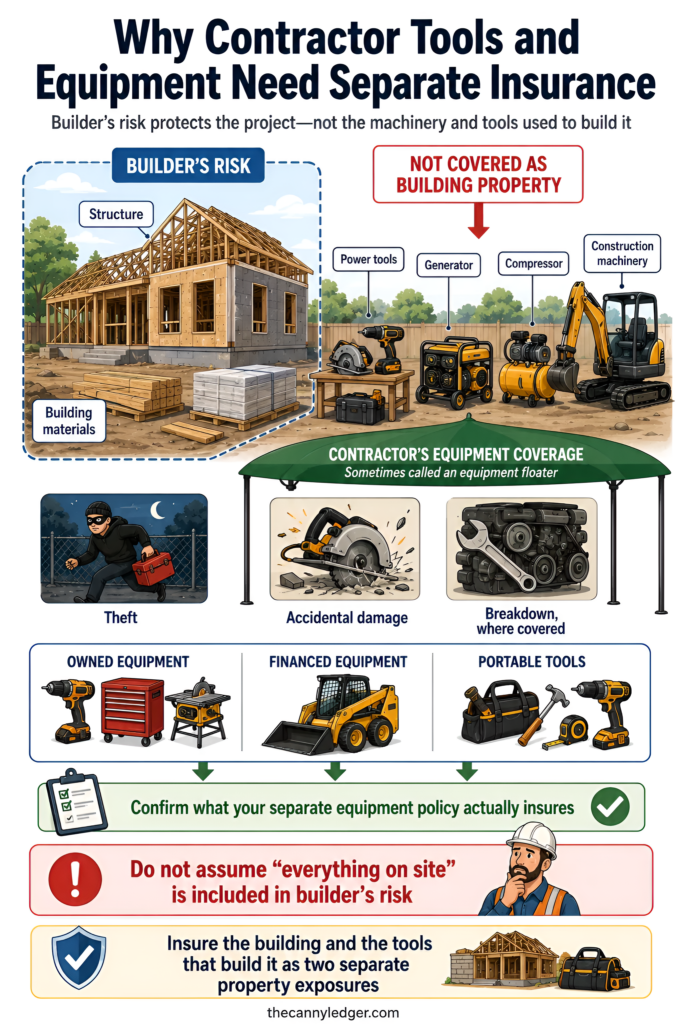
Since builder’s risk insurance specifically excludes tools and equipment used in construction, a contractor’s own machinery, whether owned outright or financed, generally needs separate equipment coverage, sometimes called a contractor’s equipment floater, protecting against theft, damage, or breakdown of the actual tools doing the work rather than the structure being built. This gap catches some newer contractors off guard specifically, since it’s easy to assume a comprehensive-sounding builder’s risk policy covers everything on site, when in reality the equipment itself sits entirely outside that coverage and needs its own dedicated policy.

Building Your Project’s Coverage Stack
For a typical Winnipeg construction or renovation project, the realistic sequence starts with confirming WCB registration status first, since that’s a legal requirement rather than a choice for most construction work, then securing course of construction insurance before any work begins, adding general liability alongside it, and layering in equipment coverage and, for larger commercial projects specifically, wrap-up liability as the project scale actually warrants it. Our directory of Winnipeg insurance companies and brokers and guide to choosing an insurance broker in Winnipeg both cover finding a broker with genuine construction insurance experience, since this category benefits more than most from working with someone who understands the specific overlap between builder’s risk, liability, and equipment coverage rather than treating each as an isolated purchase.
Common Questions
If I hire a builder who isn’t registered with a warranty program, am I taking on more risk? Yes, meaningfully so, since a builder’s own informal warranty is only as reliable as that company’s willingness and ability to honour it, while third-party warranty coverage through an approved provider remains in place even if the builder later goes out of business or becomes unwilling to complete repairs.
Does builder’s risk insurance cover a renovation the same way it covers new construction? Yes, the same core coverage applies to renovation projects, protecting the portion of the structure and materials involved in the renovation itself, though it’s worth confirming with your insurer exactly how the policy treats the parts of the home not under active renovation during that same period.
Can a single builder’s risk policy cover multiple projects throughout the year? Yes, a blanket builder’s risk policy covers all of a contractor’s projects over a 12-month period under one policy rather than insuring each project separately, and for contractors running several projects a year, this structure is often more cost-effective and easier to manage than buying individual policies repeatedly.
Confirm Warranty and Insurance Status Before Signing Anything
Whether you’re a homeowner hiring a builder or a contractor planning your own coverage, the single most useful step before any construction or renovation project begins is confirming warranty registration status and insurance coverage directly, in writing, rather than assuming either is automatically in place. Given that Manitoba doesn’t legally require new home warranty coverage the way some other provinces do, that confirmation step falls entirely on the parties involved to actually verify, not on any regulatory requirement doing that checking for you.