
- Property Tax Rates at a Glance
- Income Tax Rates at a Glance
- Sales Tax Rates at a Glance
- Putting It All Together: A Hypothetical Partial Tax Calculation
- Which Tax Actually Takes the Biggest Bite
- Why Headline Rates Cannot Rank Every Household
- Rates That Move Every Year vs Rates That Don’t
- Common Questions About Winnipeg’s Combined Tax Rates
Winnipeg’s tax rates cover three different bases: income earned, property assessed and taxable purchases. Federal and Manitoba income taxes apply to income, municipal and school taxes apply to property, and GST and RST apply to eligible spending. Adding their headline percentages does not produce a household tax rate.
For 2026, the municipal property-tax mill rate is 13.372 and school-division rates vary by address. Manitoba’s provincial income-tax rates are 10.8%, 12.75% and 17.4%. A purchase subject to both general sales taxes has 5% GST and 7% RST. Credits and exemptions affect each calculation separately.
Property Tax Rates at a Glance
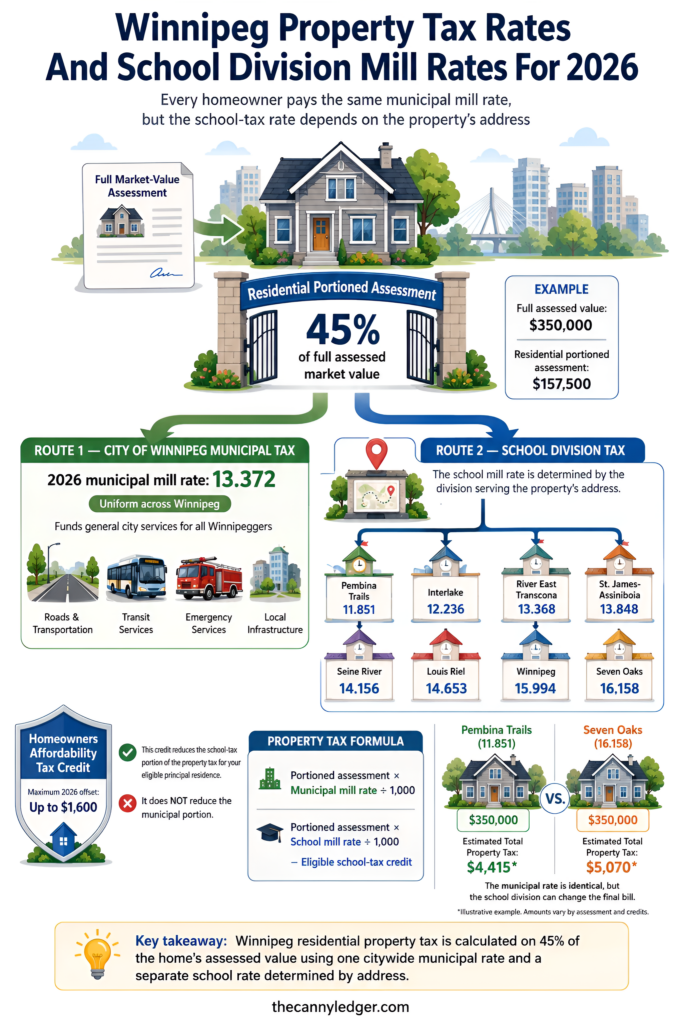
The City’s 2026 municipal and school mill rates are shown below. One mill means $1 per $1,000 of portioned assessment. Identify the school division on your bill before selecting a rate.
| School Division | 2026 Mill Rate |
|---|---|
| Pembina Trails | 11.851 |
| River East Transcona | 13.368 |
| St. James-Assiniboia | 13.848 |
| Interlake | 12.236 |
| Louis Riel | 14.653 |
| Seine River | 14.156 |
| Winnipeg | 15.994 |
| Seven Oaks | 16.158 |
Residential property is generally portioned at 45% of assessed market value. Multiply that portioned assessment by the applicable mill rate and divide by 1,000.
The 2026 Homeowners Affordability Tax Credit is limited to the lesser of $1,600 and qualifying gross school taxes. Principal-residence conditions apply. Use your property’s actual assessment in a property-tax estimate. Other charges and adjustments may affect the bill.
Income Tax Rates at a Glance

Manitoba’s provincial tax brackets apply to portions of taxable income. The rates below are before non-refundable credits and other adjustments.
| Taxable Income | 2025 & 2026 Manitoba Rate |
|---|---|
| First $47,000 | 10.80% |
| Over $47,000 through $100,000 | 12.75% |
| Over $100,000 | 17.40% |
The maximum Manitoba Basic Personal Amount is $15,780, subject to the income-based reduction. It calculates a non-refundable credit; it is not a deduction from taxable income. Federal tax is calculated separately. The personal income-tax guide explains the distinction and year-specific limits.
Sales Tax Rates at a Glance
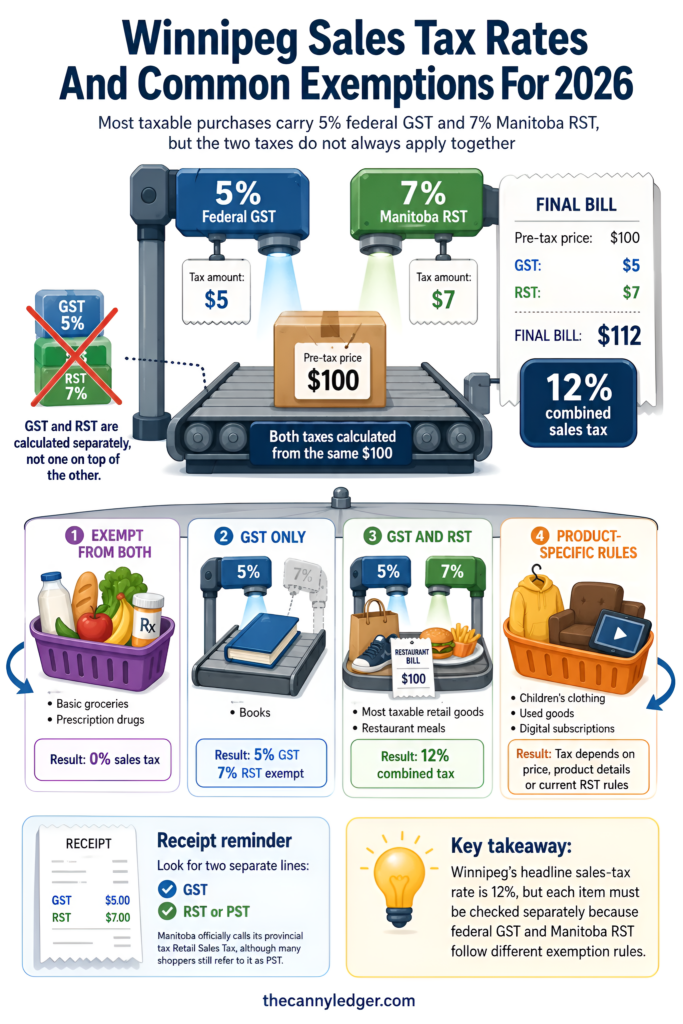
Manitoba’s general RST rate is 7%, calculated separately from 5% GST on the applicable pre-tax price. Both do not apply to every purchase. Basic groceries are generally zero-rated for GST, while RST exemptions have separate rules.
Use the classification of the item rather than treating all spending as taxable at 12%. The sales-tax comparison addresses differences between the two systems.
Putting It All Together: A Hypothetical Partial Tax Calculation
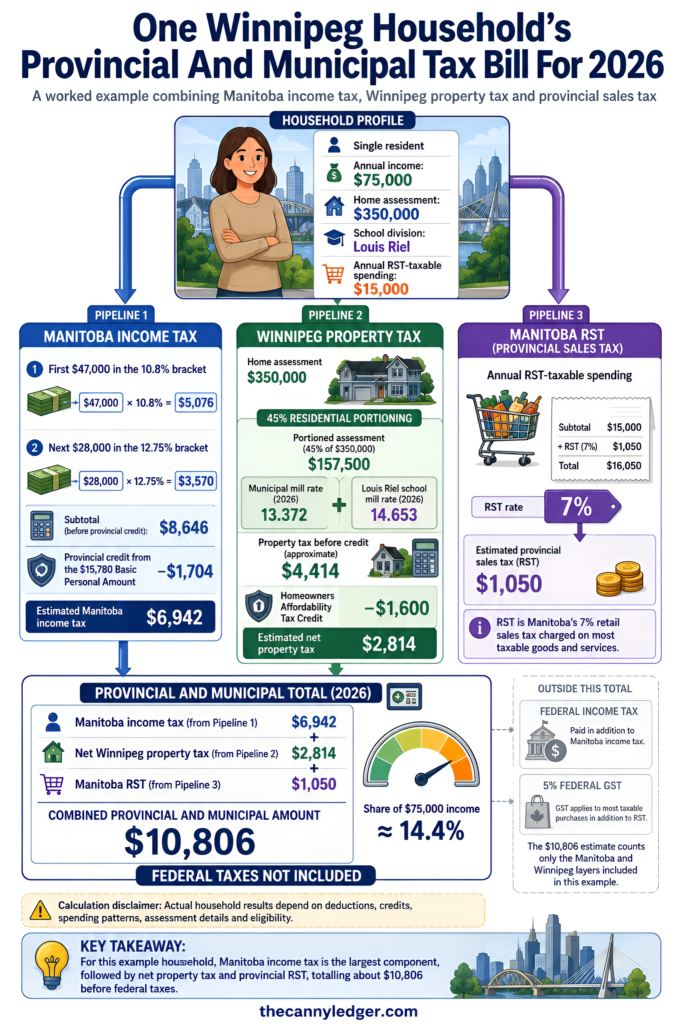
Consider a hypothetical single resident with $75,000 of taxable income, a principal residence assessed at $350,000 in Louis Riel School Division, and $15,000 of spending subject to 7% RST. Assume full entitlement to the maximum Manitoba BPA and the $1,600 homeowners credit. This is an illustration, not a documented household.
Provincial income tax before other credits is $6,941.76: ($47,000 × 10.8%) + ($28,000 × 12.75%) − ($15,780 × 10.8%). Actual tax may be lower because this example omits other credits and deductions.
Property tax using the stated municipal and Louis Riel rates is $350,000 × 45% × (13.372 + 14.653) ÷ 1,000 = $4,413.94. After the assumed $1,600 credit, the result is $2,813.94, excluding other bill items. RST is $15,000 × 7% = $1,050.
The three illustrative amounts total $10,805.70. This is a partial calculation. It excludes federal income tax, GST, payroll contributions and other taxes, and is not the household’s effective total tax rate. All amounts are Canadian dollars.
Which Tax Actually Takes the Biggest Bite
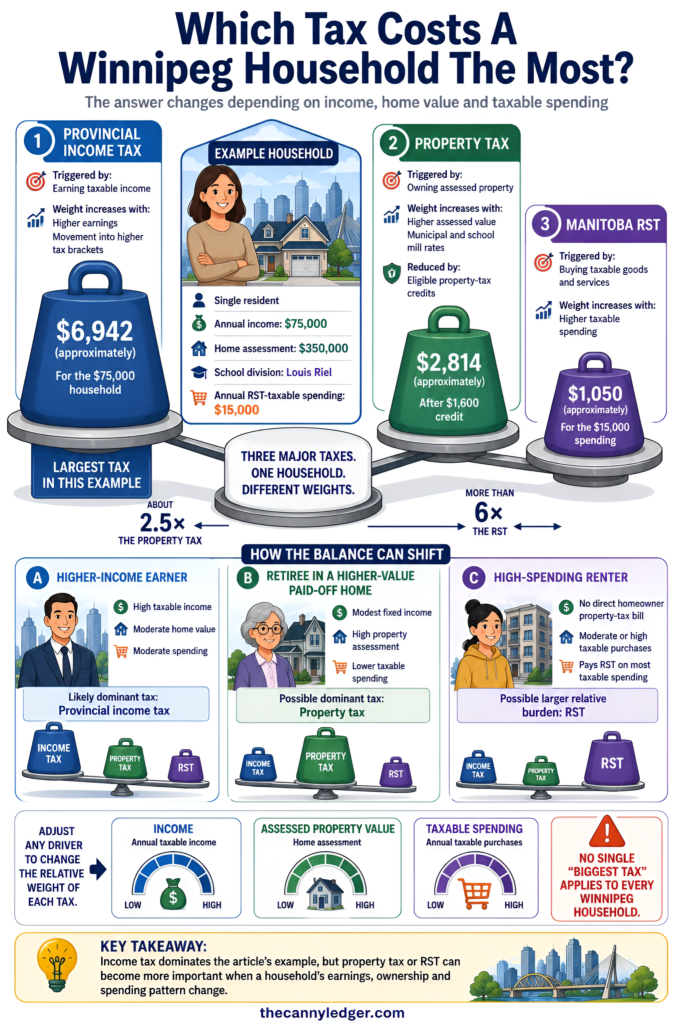
In this example, provincial income tax is larger than the other two amounts. Change taxable income, assessed value or taxable spending and the balance changes. A household renting rather than owning would also need a different analysis. Use the comparison to identify which inputs matter, without treating one model as representative of every resident.
Why Headline Rates Cannot Rank Every Household
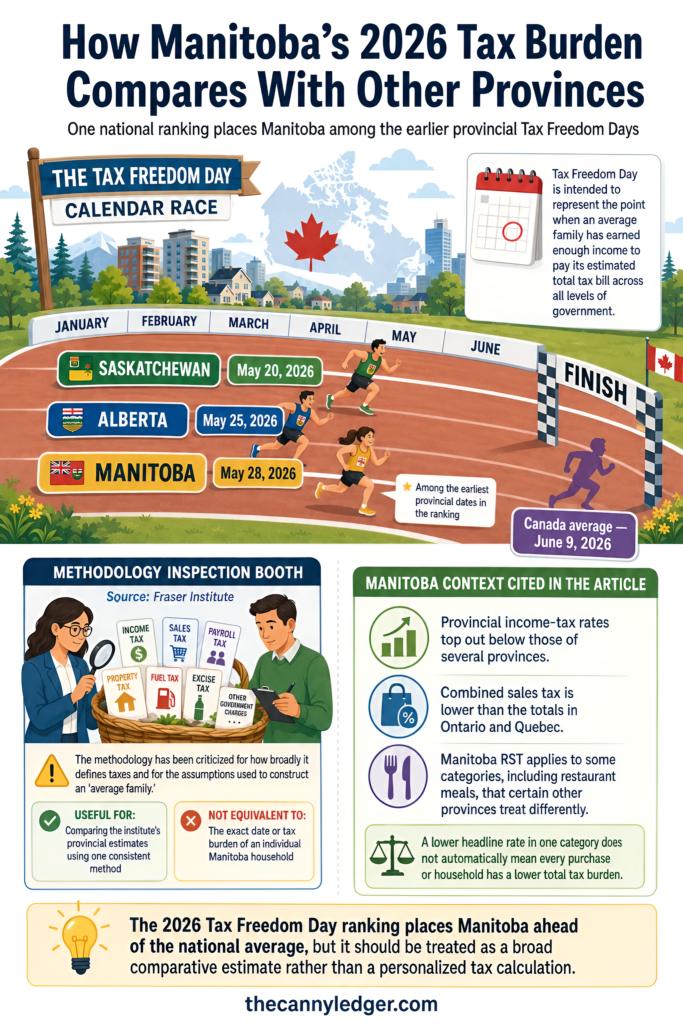
A province’s top income-tax rate or general sales-tax rate cannot establish which household pays the least overall. A useful comparison holds income type, household composition, property and spending assumptions constant. It also includes credits, benefits and the services or costs relevant to the decision.
Broad rankings based on an average family do not substitute for that household-level calculation.
Rates That Move Every Year vs Rates That Don’t

Property mill rates can change annually. General property assessments occur every two years, and a new assessment is separate from a new tax rate. Manitoba’s income-tax thresholds and sales-tax rules follow their own legislative schedules.
For example, cloud computing became RST-taxable on January 1, 2026 without changing the general 7% rate. A stable rate therefore does not mean an unchanged tax bill.
Common Questions About Winnipeg’s Combined Tax Rates
Do Winnipeg property-tax rates apply elsewhere in Manitoba?
No. Provincial income tax and RST have province-wide rules, but municipal and school property rates depend on location. Use the bill and rates for the actual property.
For a personal estimate, collect the applicable year’s taxable income, property assessment, school division and eligible spending. Calculate each tax separately, then apply the credits you qualify for. Compare the result with actual assessments and receipts before relying on it for a budget.