

Someone who became eligible for an FHSA back in 2023 but only opened their account this year doesn’t have three or four years of room stacked up waiting for them. They have $8,000. That single misunderstanding is genuinely the most expensive one people make with this account, and it comes from a reasonable but incorrect assumption, that eligibility and actual room work the same way.
- The Numbers Themselves Haven’t Moved Since Launch
- Your Actual Room Depends Entirely On When You Opened The Account
- What Your Room Actually Looks Like By Opening Year
- Deductions Work On A Stricter Calendar Than Your RRSP Does
- There’s No Buffer If You Go Over
- Getting Your Own Numbers Right
- What People Get Wrong About FHSA Limits Most Often
The actual room you have depends on when you opened your account, how the annual and lifetime limits have held steady since this program started, and what genuinely differs from how RRSP contribution deadlines work, all covered below in real detail.
The Numbers Themselves Haven’t Moved Since Launch
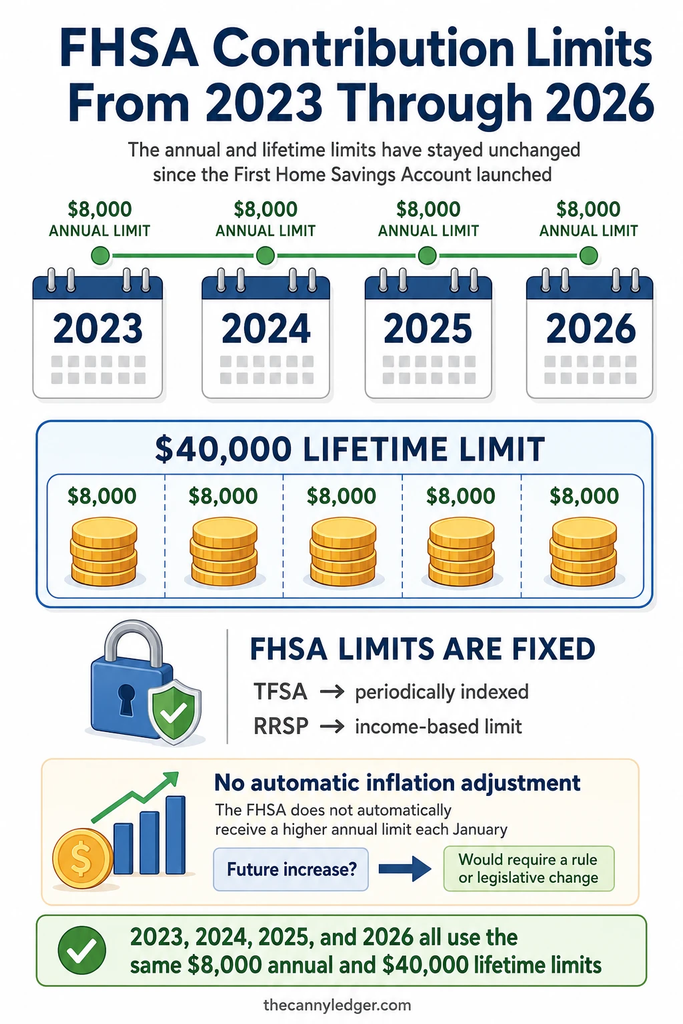
The FHSA annual contribution limit is $8,000, with a $40,000 lifetime limit, and both figures have stayed exactly the same every year since the program launched in 2023 through the current 2026 tax year. Unlike the TFSA or RRSP, which both get adjusted periodically to keep pace with inflation, the FHSA’s limits are fixed dollar amounts set in the legislation itself, with no built-in mechanism pushing them higher as prices rise.
That distinction matters for anyone assuming this account works the same way as the others. A TFSA holder gets used to checking each year for a possible increase to the annual limit, but an FHSA holder checking for the same kind of update every January is checking for something that, based on the program’s design since 2023, simply hasn’t happened and isn’t structured to happen automatically the way TFSA indexing is.
Your Actual Room Depends Entirely On When You Opened The Account
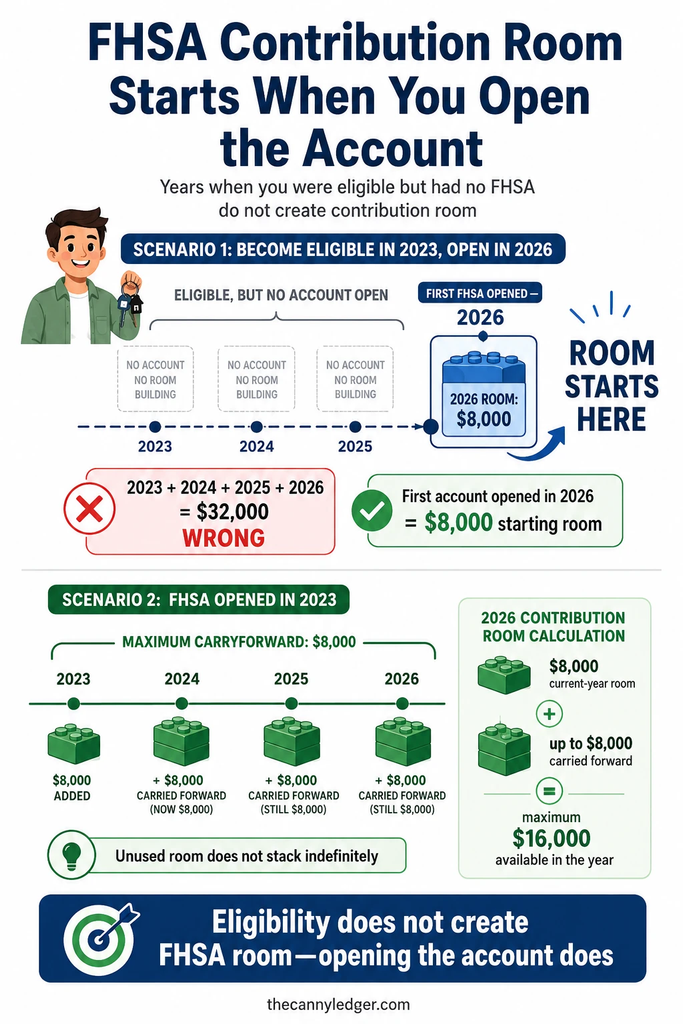
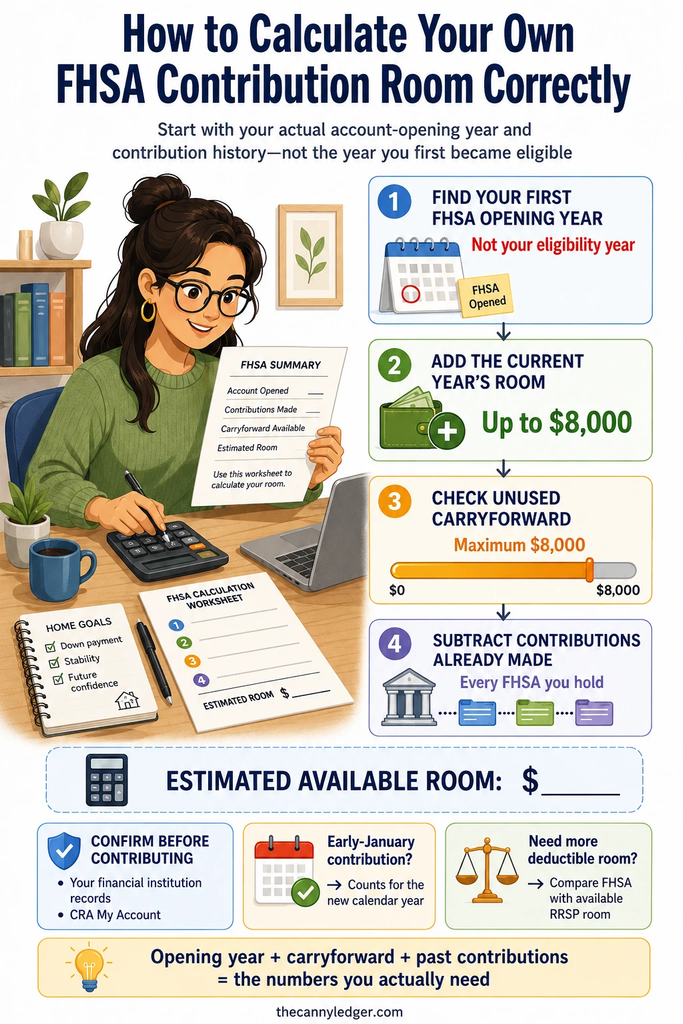
Get this wrong and the miscalculation compounds fast. Participation room doesn’t start accumulating when you turn 18, when you first become eligible, or when the FHSA program itself launched in 2023, it starts the specific year you personally open your first FHSA. In that opening year, your available room is exactly $8,000, full stop, regardless of how many years you were technically eligible before actually opening the account.
Someone who opened their FHSA in 2023 and never contributed a dollar would carry a maximum of $16,000 into 2026, the current year’s $8,000 plus the single year of $8,000 carryforward the rules allow, not $32,000 reflecting every year since the program began. That’s because unused room only carries forward one year’s worth at a time, capped at $8,000, which means opening the account in 2023, 2024, or 2025 and contributing nothing along the way all land at the exact same $16,000 ceiling in 2026, since the carryforward cap prevents room from stacking up indefinitely no matter how long the account has technically existed.
What Your Room Actually Looks Like By Opening Year
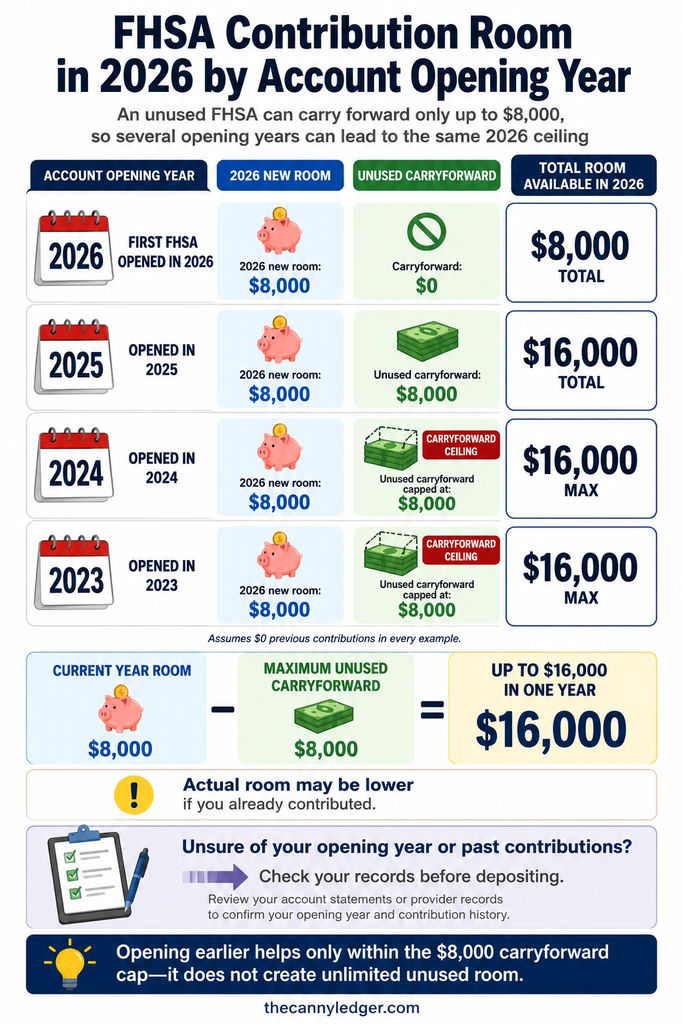
Someone opening their very first FHSA in 2026 starts with $8,000 in room for this year alone, nothing more, regardless of how long they’ve been eligible on paper. Someone who opened in 2025 and contributed nothing that year carries the maximum $16,000 into 2026, and the same $16,000 ceiling applies whether the account was actually opened in 2023, 2024, or 2025, since the one-year carryforward cap means additional years of an untouched account don’t add any further room beyond that ceiling.
This is exactly why the account opening date, not your age or your eligibility date, is the number worth tracking directly rather than assuming years of theoretical eligibility translate into actual usable room. If you’re not certain when your own FHSA was actually opened, or whether you’ve made any contributions since, checking directly through your financial institution or CRA My Account is worth doing before assuming a specific figure applies to your situation.
Deductions Work On A Stricter Calendar Than Your RRSP Does
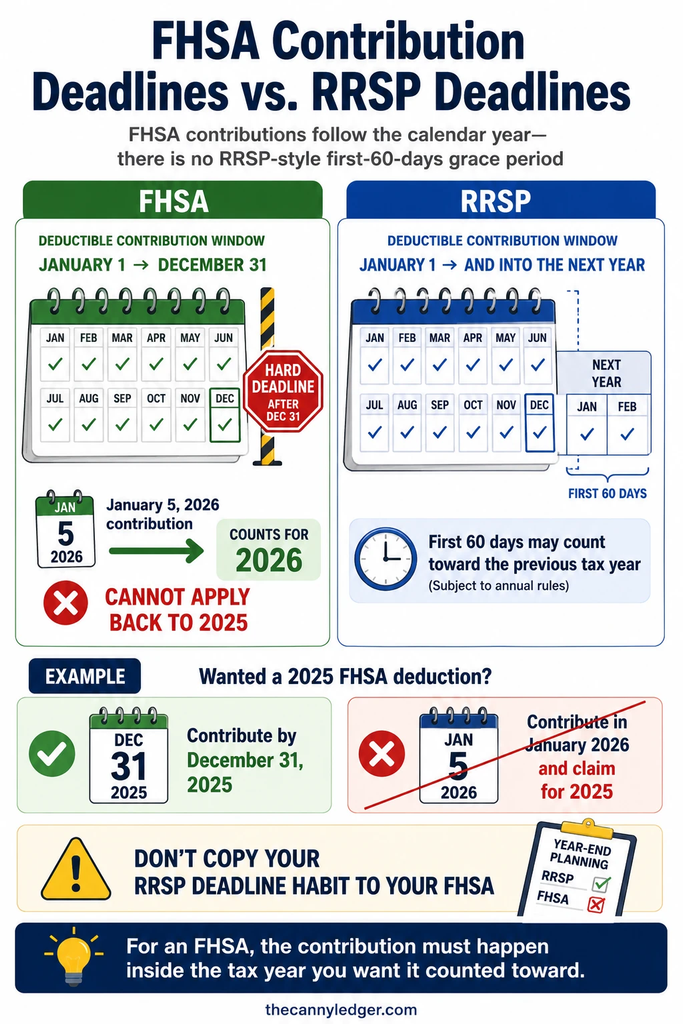
This is a genuinely important difference from how RRSP contributions work, and it catches people who assume the same flexibility applies to both accounts. RRSP contributions made in the first 60 days of a new year can still be deducted against the prior year’s tax return, but FHSA contributions carry no equivalent grace period at all, a contribution has to be made within the calendar year itself, January 1 through December 31, to be deductible for that specific tax year.
A contribution made on January 5, 2026 counts toward your 2026 room and gets deducted on your 2026 return, it cannot be applied back to 2025 the way an equivalent RRSP contribution made in early January could be. Anyone used to the RRSP’s early-year grace period needs to specifically unlearn that habit for FHSA contributions, since assuming the same flexibility applies here is exactly how a contribution ends up landing in the wrong tax year from what was actually intended.
There’s No Buffer If You Go Over
Unlike an RRSP, which carries a lifetime $2,000 cushion before overcontribution penalties apply, the FHSA has no equivalent buffer at all. Any amount contributed above your actual available room starts accruing a 1 percent monthly penalty tax immediately, calculated on the full excess rather than only the portion above some forgiving threshold the way RRSP overcontributions work.
This makes double-checking your actual room before contributing genuinely more important with an FHSA than with an RRSP, since there’s no small margin for error built into the system the way the RRSP’s buffer provides. If you hold more than one FHSA at different institutions, the $8,000 annual and $40,000 lifetime limits apply combined across every account you have, not separately to each one, a detail worth confirming directly if you’ve opened accounts with more than one provider.

Getting Your Own Numbers Right
Confirm the exact year your FHSA was actually opened, not the year you first became eligible, since that opening date is what genuinely determines your room rather than your age or how long the program has existed. If you’re planning a contribution in the first few weeks of a new year, remember it applies to that new year’s return specifically, not the year just ended, unlike the flexibility your RRSP contribution room gives you through its 60-day extension.
And if you’re weighing how the FHSA’s fixed limits stack up against your RRSP’s larger, income-based room, our broader comparison of RRSP versus FHSA covers how the two accounts work together beyond just the contribution figures covered here.
What People Get Wrong About FHSA Limits Most Often
If I don’t open an FHSA until years after becoming eligible, do I lose that unused room permanently? Yes, participation room only begins the year you actually open the account, and years of prior eligibility without an open account don’t retroactively add to your available room once you finally do open one.
Will the $8,000 annual limit eventually increase like the TFSA limit does? Not automatically, since the FHSA’s limits are fixed in the legislation rather than indexed to inflation, meaning any future increase would require a specific legislative change rather than happening through the same annual formula that adjusts the TFSA.
Can I contribute more than $8,000 in a single year if I have carryforward room available? Yes, provided you have unused room carried forward from a prior year, up to an additional $8,000, bringing your maximum for that specific year to $16,000 combined between the new annual room and the carried forward balance.