

Ontario’s 2026 Budget quietly raised the threshold for receiving your entire annual benefit as a single lump sum rather than spread across 12 monthly payments, moving it from $360 up to $500. Most Ontarians claiming the Energy and Property Tax Credit have no idea this changed, and it genuinely affects how and when the money actually shows up in their account starting with the 2026 to 2027 benefit year.
- What The OEPTC Actually Covers
- The Real Maximum Amounts For This Benefit Year
- How The Calculation Actually Works Step By Step
- The Income Thresholds Vary By Household Type
- Who Actually Qualifies
- Applying Through Form ON-BEN
- When The Money Actually Arrives
- Getting Your Own Claim Right
- What People Miss Most Often About This Credit
The Ontario Energy and Property Tax Credit, OEPTC for short, is the largest and most commonly misunderstood piece of the broader Ontario Trillium Benefit, and it’s also the one most people accidentally skip entirely when filing their taxes. Understanding exactly how it gets calculated, who actually qualifies, and what a missed checkbox on your tax return can cost you is worth far more time than most people give it.
What The OEPTC Actually Covers
The credit exists specifically to help Ontario residents with two distinct cost categories, hence the name. The energy component offsets the sales tax embedded in home energy costs, while the property tax component offsets a portion of what you actually paid in property tax or, if you rent, an equivalent occupancy cost calculated from your rent. Both components get combined into a single annual figure, then divided into monthly payments as part of the broader Ontario Trillium Benefit alongside the Ontario Sales Tax Credit and, for eligible northern residents, the Northern Ontario Energy Credit.
This is the specific piece of the Trillium Benefit that requires extra paperwork to claim, and that extra step is exactly where most missed claims happen. The Ontario Sales Tax Credit gets calculated automatically from your tax return with no additional form required, which means someone who files taxes normally but skips the OEPTC-specific form still receives an OTB payment, just a meaningfully smaller one than they were actually entitled to. That partial payment looks legitimate enough on paper that most people never realize they left money on the table, an outcome worth comparing against how a mismanaged Senior Homeowners Property Tax Grant claim can create similar confusion for older applicants.

The Real Maximum Amounts For This Benefit Year
For the 2026 to 2027 benefit year, the confirmed maximum OEPTC amounts are $1,307 for non-senior adults aged 18 to 64 and $1,488 for seniors aged 65 and older. Those maximums aren’t arbitrary round numbers, they’re built directly from the CRA’s own published calculation sheets, where the energy component caps at $290 regardless of age or family situation, and the property tax component caps differently depending on your category, $1,017 for a non-senior with a child in their care, or $1,198 for a senior, before the two components get added together.
The gap between the senior and non-senior maximums, $181 a year, reflects a higher property tax component built specifically into the senior calculation sheets, recognizing that older Ontarians are statistically more likely to be long-term homeowners carrying higher property tax bills relative to income. Reaching either maximum requires both a high enough occupancy cost, rent or property tax, to hit the relevant cap, and an income low enough that the phase-out reduction covered below doesn’t eat into the total.

How The Calculation Actually Works Step By Step
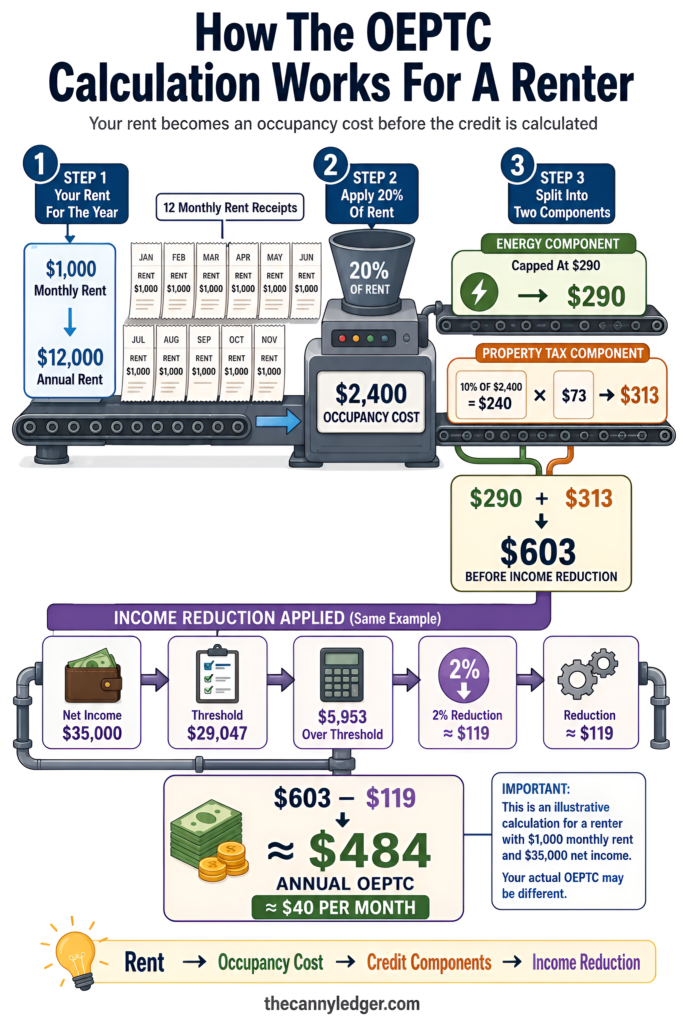
The CRA’s own calculation sheet for a single individual with no children starts with your occupancy cost, calculated as 20 percent of any rent you paid in Ontario plus the full amount of any property tax paid directly. From there, the energy component takes that occupancy cost and caps it at $290, while the property tax component takes 10 percent of the same occupancy cost, caps that at $581, adds a flat $73, and caps the entire result at the occupancy cost itself. Adding the two components together gives your total credit before any income-based reduction applies.
Working through an actual example makes this far more concrete than the formula alone. Someone renting in Ontario for $1,000 a month, $12,000 a year, has an occupancy cost of $2,400, which is 20 percent of that rent. The energy component hits its $290 cap immediately since $2,400 comfortably exceeds it. The property tax component works out to $313, 10 percent of $2,400 plus the flat $73 addition. Combined, that’s $603 in total credit before any income reduction. If that same renter reported $35,000 in net income against the applicable $29,047 threshold, the $5,953 in excess income gets reduced at 2 percent, subtracting roughly $119 from the total and leaving an annual OEPTC entitlement of about $484, paid out at roughly $40 a month alongside whatever else the broader Trillium Benefit provides.
The Income Thresholds Vary By Household Type
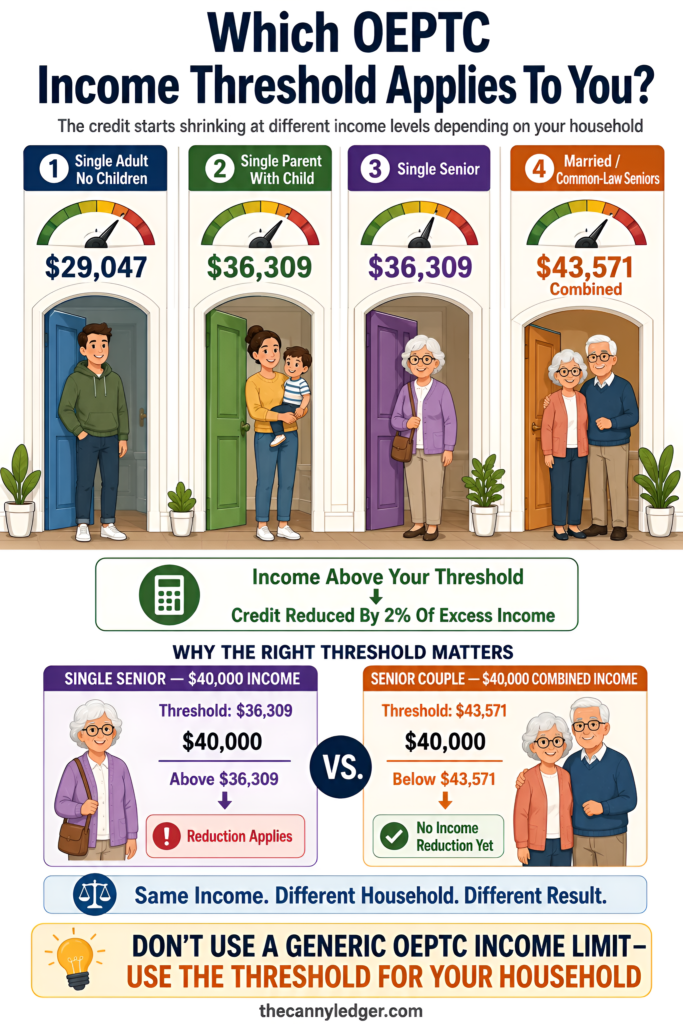
The phase-out threshold for a single individual with no children sits at $29,047 for the 2026 to 2027 benefit year, while a single parent with at least one child in their care faces a higher threshold of $36,309, reflecting the additional cost of supporting dependents. Single seniors with no children share that same $36,309 threshold, while married or common law seniors get a meaningfully higher threshold of $43,571, since that figure accounts for combined household income rather than a single person’s earnings alone.
Every one of these thresholds reduces the credit at the same 2 percent rate once income exceeds the applicable line, but where that line sits genuinely changes how much room a household has before the credit starts shrinking. A single senior earning $40,000 sits comfortably above their $36,309 threshold and is already losing a meaningful chunk of their entitlement to the reduction, while a married senior couple with combined income of $40,000 sits below their higher $43,571 threshold entirely and keeps their full calculated amount. Knowing which specific threshold applies to your actual household situation, not just a generic OEPTC number floating around online, is the only way to estimate your own entitlement with any real accuracy.
Who Actually Qualifies
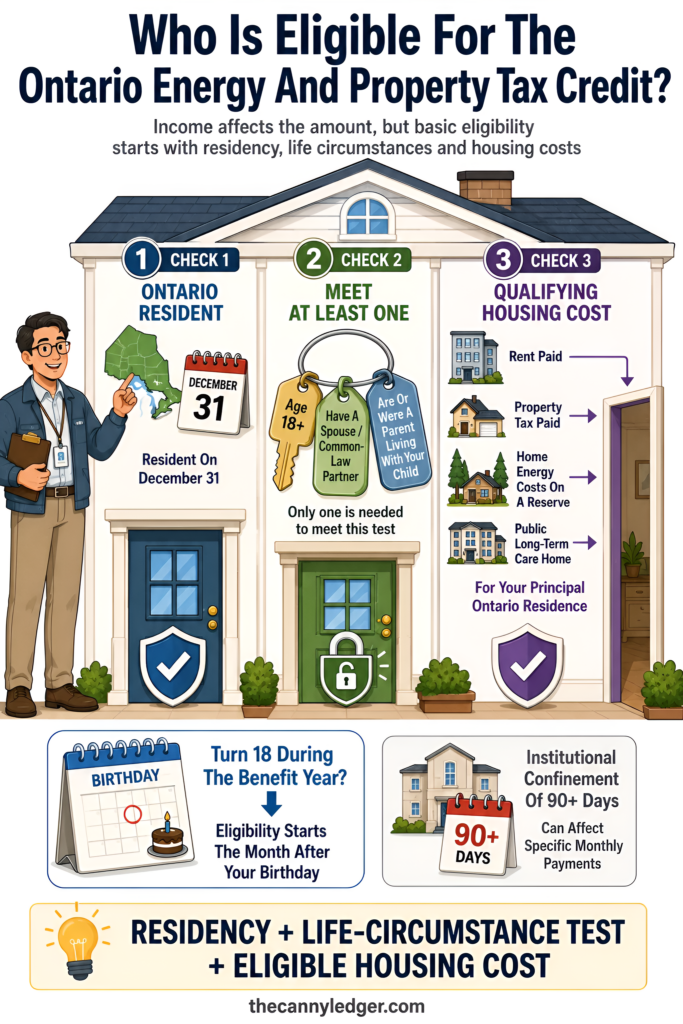
Eligibility hinges on a combination of residency and a basic life circumstance test rather than income alone, since the income thresholds above only affect how much you receive, not whether you qualify at all. You need to have been an Ontario resident on December 31 of the relevant tax year, and you need to meet at least one of three conditions, being 18 years of age or older, having a spouse or common law partner, or being a parent who lives or has lived with your child. On top of that, you need to have actually paid rent, property tax, or home energy costs on a reserve for your principal Ontario residence, or lived in a public long-term care home, during the year in question.
Someone who turns 18 partway through the benefit year doesn’t miss out entirely, but their eligibility only starts the month following their birthday, prorated rather than backdated to the start of the benefit year. A resident confined to a prison or similar institution for 90 days or more spanning the first day of a given payment month loses eligibility for that specific month’s payment, a narrow but real exclusion worth knowing if it applies to your situation or someone you’re helping navigate this process.
Applying Through Form ON-BEN
Claiming the OEPTC requires filing your annual tax return and specifically completing Form ON-BEN, the Application for the Ontario Trillium Benefit, attached to that return, even if you have no income to report at all. This is the single step that trips up the most people, since a tax return filed without ON-BEN attached still gets processed normally and still generates an Ontario Sales Tax Credit payment automatically, creating the illusion that everything was claimed correctly when the larger OEPTC component was simply never applied for.
On the form itself, renters report their total rent paid for the year along with their landlord’s name, while homeowners report their actual property tax paid. Receipts aren’t required at the time of filing, but keeping them, along with bank statements or e-transfer records showing rent payments, matters if the CRA ever requests verification after the fact. The form needs to be completed fresh every single year alongside that year’s tax return, since the CRA doesn’t carry an OEPTC claim forward automatically the way some other credits work.

When The Money Actually Arrives
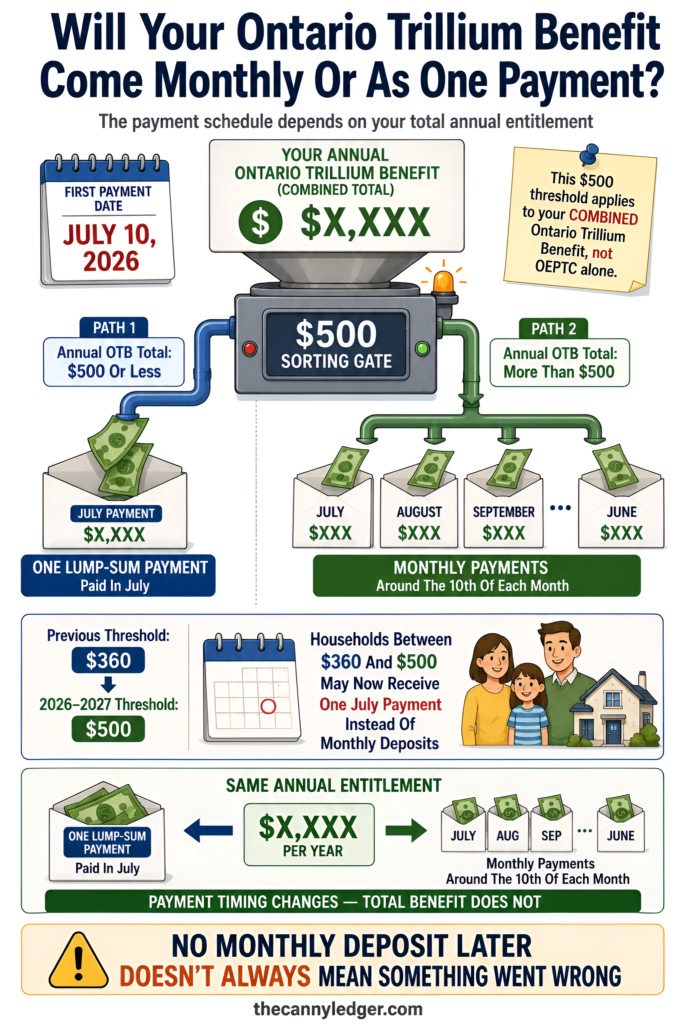
The first monthly Ontario Trillium Benefit payment for the 2026 to 2027 benefit year, which includes any OEPTC entitlement, was issued on July 10, 2026, with subsequent payments arriving monthly around the 10th of each month. That monthly schedule isn’t universal though, and the 2026 Budget change mentioned at the top of this piece genuinely matters here. If your combined annual OTB entitlement across all three components comes to $500 or less, the CRA now issues the entire amount as one lump sum in July rather than spreading it across 12 separate deposits, a real change from the previous $360 threshold that pulled more households into lump sum territory than the old rule did.
For anyone whose total entitlement lands somewhere in that expanded range between $360 and $500, this change means an experience genuinely different from what happened in prior benefit years, one larger July deposit instead of a dozen smaller monthly ones. Neither approach changes the total amount you’re entitled to, but it’s worth knowing which one applies to your own situation before assuming a missing monthly deposit later in the year means something went wrong, when it may simply mean your full amount already arrived back in July.
Getting Your Own Claim Right
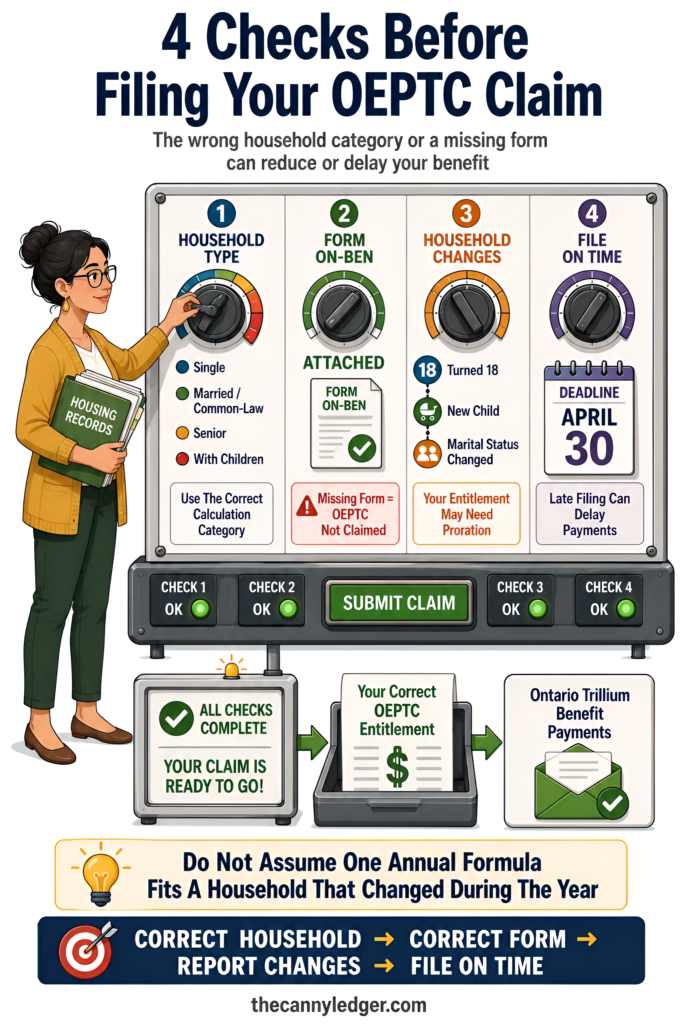
Confirm which calculation sheet actually applies to your household, single or married, senior or non-senior, with or without children, since using the wrong one produces a genuinely different result than your real entitlement. If you’re filing your own taxes rather than using software that handles this automatically, double check that Form ON-BEN is actually attached before submitting, since this remains the single most common reason eligible Ontarians receive a smaller OTB payment than they should, similar to how missing the paperwork for the Ontario Child Benefit can quietly shrink a family’s total support.
And if your household situation changed partway through the year, a new child, a change in marital status, or turning 18, keep in mind your entitlement may need to be calculated across more than one sheet or prorated across the months each situation actually applied, rather than assumed as a flat annual figure from a single scenario. Filing on time, by the standard April 30 deadline, keeps your payments arriving without the delay that comes from a return assessed later in the year, and using a paycheque calculator alongside your OEPTC estimate gives a fuller picture of your household’s real annual cash flow.
What People Miss Most Often About This Credit
Does renting versus owning change which components of the OEPTC I can claim? No, both renters and homeowners can claim the full credit, the calculation simply uses your rent converted through the 20 percent occupancy cost formula for renters, or your actual property tax paid for homeowners, arriving at a comparable figure either way.
If I forgot to complete Form ON-BEN on a past tax return, can I still claim the OEPTC I missed? Generally yes through a tax return adjustment, since the CRA allows amendments to previously filed returns going back several years, though the sooner you catch a missed claim the sooner any owed amount actually gets issued.
Does the OEPTC count as taxable income the following year? No, the Ontario Trillium Benefit and all of its components are non-taxable, so receiving OEPTC payments throughout a benefit year has no impact on your income tax owed or your eligibility for other income-tested benefits calculated from taxable income.