

A GIC earning the exact same rate produces a completely different after-tax result depending on which account it sits in, and the gap is bigger for a GIC than it is for almost any other investment type. Interest income gets taxed at your full marginal rate with no preferential treatment at all, unlike a capital gain or an eligible dividend, which is exactly why where you hold a GIC matters more than it does for most other things you could put inside a TFSA.
- Why the Tax Treatment Matters More for a GIC Specifically
- Cashable Versus Non-Redeemable, the Real Tradeoff
- How CDIC Insurance Actually Applies to a TFSA GIC
- Laddering Solves the Liquidity Problem Non-Redeemable GICs Create
- What Still Uses Up Your Contribution Room
- Choosing the Right GIC for Your TFSA
- Questions Worth Sorting Out Before You Buy
A GIC held inside a TFSA works exactly like a GIC held anywhere else, a fixed-term deposit paying a set interest rate, except every dollar of that interest grows and gets withdrawn completely tax-free. The broader mechanics of how that tax-free treatment actually works apply here the same way they apply to any other TFSA holding. The GIC still uses up your TFSA contribution room the same way cash or any other investment does, and the specific type of GIC you choose, cashable or non-redeemable, determines whether you can access the money before it matures. Understanding those mechanics matters more for a GIC than for most TFSA holdings, since the tradeoffs are more rigid than they are with a stock or an ETF.
Why the Tax Treatment Matters More for a GIC Specifically
This is worth understanding clearly before anything else, since it’s the actual reason a GIC pairs so well with a TFSA in the first place. Interest income earned outside a registered account gets added directly to your taxable income and taxed at your full marginal rate, with none of the partial exemptions that apply to capital gains or the dividend tax credit that applies to eligible Canadian dividends. A GIC earning a flat rate held in a non-registered account loses a real, immediate chunk of that return to tax every single year it’s held, an outcome interest income specifically can’t avoid the way other investment types sometimes can.
Someone holding a GIC paying a 4% rate in a non-registered account, sitting in a hypothetical 40% marginal tax bracket, keeps only 2.4% after tax, while the identical GIC at the identical rate held inside a TFSA keeps the full 4%. That gap is exactly why a GIC is one of the specific investment types most consistently recommended for TFSA space ahead of a non-registered account, when someone’s deciding what to prioritize sheltering first.

Cashable Versus Non-Redeemable, the Real Tradeoff
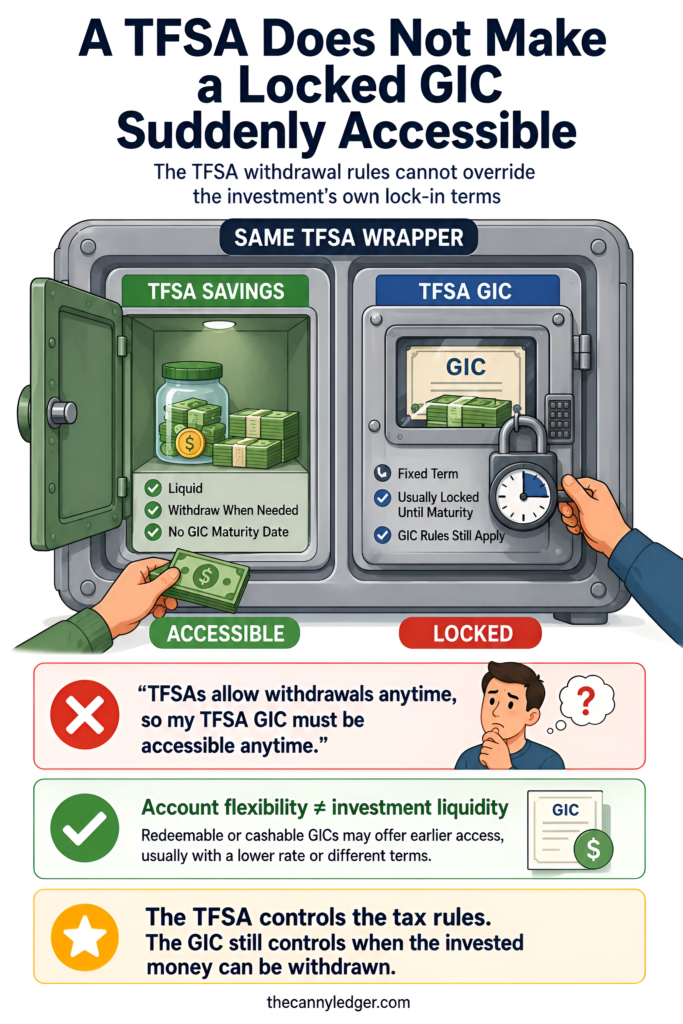
This is the single most important decision within the GIC itself, and it determines how much flexibility you actually have with money that’s otherwise locked into a fixed term. According to Ratehub’s own explanation of GIC types, a redeemable or cashable GIC lets you access your money before the term ends, often without a waiting period, but that flexibility comes at a real cost, a lower stated rate than the same institution would offer on a non-redeemable version of the same term. TD’s own GIC product page confirms this same cashability distinction directly, offering both options across its own TFSA-eligible GIC lineup. A non-redeemable GIC locks your funds in completely for the full term in exchange for typically the higher of the two rates.
That tradeoff isn’t a minor detail, it’s the entire decision to make before choosing a specific GIC. Money you’re honestly confident you won’t need before maturity earns more sitting in a non-redeemable GIC, while money you might need access to on short notice belongs in a cashable GIC, or in a TFSA holding cash directly instead, even at a somewhat lower headline rate.

How CDIC Insurance Actually Applies to a TFSA GIC
This is a detail worth understanding directly, since it’s easy to assume deposit insurance works the same way regardless of which account holds the GIC. According to a detailed breakdown of CDIC coverage categories, the Canada Deposit Insurance Corporation insures eligible deposits up to $100,000 per depositor, per separately insured category, at each CDIC member institution, and a TFSA is treated as its own distinct category, separate from a non-registered deposit, an RRSP, or a joint account held at the same institution. That structure means someone with $100,000 in a non-registered GIC and $100,000 in a TFSA GIC at the same bank has both amounts fully insured separately, rather than the two balances being combined against a single $100,000 ceiling.
One caveat worth flagging directly, CDIC coverage applies specifically to CDIC member institutions, which covers Canada’s major banks and most online banks, but credit unions typically operate under their own separate provincial deposit insurance system instead, with coverage terms that can differ meaningfully from CDIC’s federal framework. Confirming which insurance regime actually applies before committing a large GIC balance to any specific institution is worth the extra step.

Laddering Solves the Liquidity Problem Non-Redeemable GICs Create
A GIC ladder is the standard way to capture a non-redeemable GIC’s higher rate without giving up all access to your money for years at a time. The strategy splits a total investment across several GICs with staggered maturity dates, one year, two years, three years, and so on, so that a portion of the money becomes available every year rather than all of it being locked away simultaneously. As each individual GIC matures, reinvesting it into a new longer-term GIC keeps the ladder running while providing a predictable, recurring point of access to at least part of the total balance.
Inside a TFSA specifically, laddering carries one extra advantage worth knowing, since every GIC in the ladder grows and matures completely tax-free, there’s no need to account for the tax hit that would otherwise apply each time a non-registered GIC matures and its interest gets reported as income.
What Still Uses Up Your Contribution Room
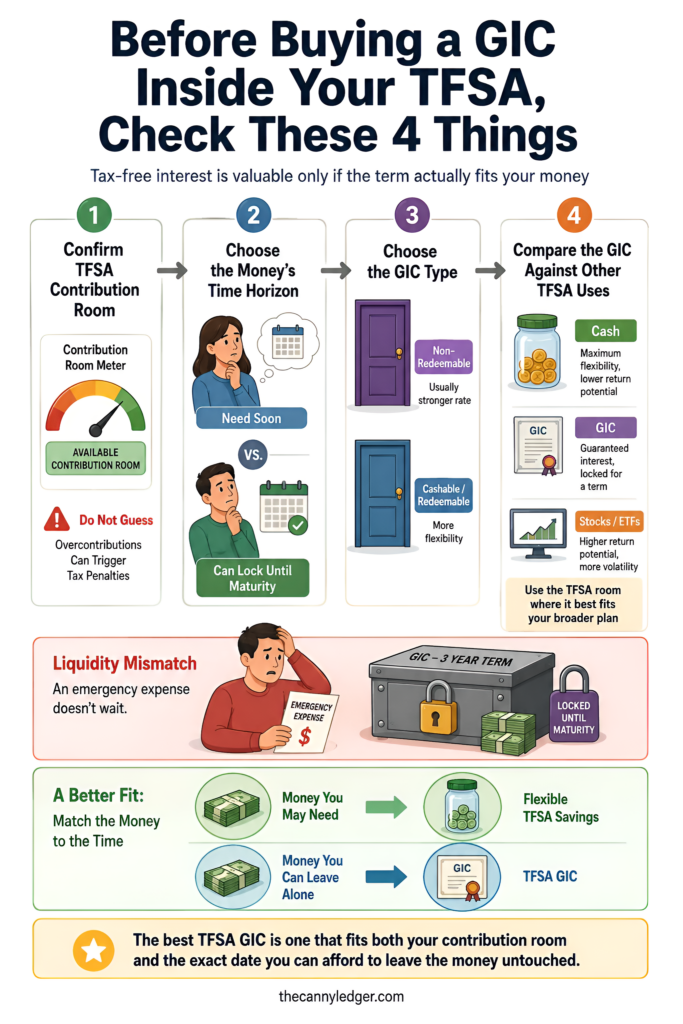
A GIC inside a TFSA doesn’t behave any differently from cash or a stock when it comes to contribution room, the amount you deposit into the GIC counts against your available room exactly the same way any other TFSA contribution would. The full mechanics of how that room actually gets calculated apply identically whether the money sits in a GIC, an ETF, or plain cash, since the room calculation tracks dollars contributed, not what those dollars are eventually invested in.
Withdrawing from a matured GIC follows the same TFSA withdrawal timing that applies to any other holding too, the amount withdrawn doesn’t become available room again until January 1 of the following calendar year, a mechanic worth understanding in full before assuming a GIC’s own maturity date and your own TFSA room recalculate together, since they don’t.

Choosing the Right GIC for Your TFSA
Decide how much of the money going into a TFSA GIC you can honestly commit to leaving untouched before choosing between cashable and non-redeemable, since that single decision determines both your rate and your real flexibility for the entire term. Comparing where different institutions actually offer TFSA GICs is worth doing directly rather than defaulting to whichever bank already holds your chequing account. If a large balance is involved, confirm your specific institution is a CDIC member and understand that your TFSA category is insured separately from any non-registered holdings at the same bank. And if locking everything into one long non-redeemable term feels too rigid, build a simple ladder instead, splitting the total across a few different maturities rather than treating it as an all-or-nothing choice.
Questions Worth Sorting Out Before You Buy
Does a TFSA GIC pay interest differently than a regular GIC? No, the GIC itself calculates and pays interest exactly the same way regardless of which account holds it, the difference is entirely in whether that interest gets taxed, not in how or when it’s calculated.
Can I hold more than one GIC inside the same TFSA? Yes, there’s no limit on how many separate GICs you can hold within a single TFSA, as long as the total amount contributed across all of them stays within your available contribution room.
What happens if I need to break a non-redeemable GIC early inside a TFSA? Generally nothing different from breaking one outside a TFSA, most non-redeemable GICs simply don’t allow early withdrawal at all regardless of which account holds them, which is exactly why confirming cashability before committing matters more than the account type itself.