


Most Canadians have never actually seen their real FICO score, despite it being the number roughly 90% of top lenders and credit unions in this country rely on to make lending decisions. What shows up on Borrowell or Credit Karma isn’t necessarily that number either. To see the actual FICO score a lender is about to pull, a Canadian consumer generally has to go through a hard credit check themselves, the same kind that happens when applying for real credit, which is a strange position to be in for the single most consequential number in most lending decisions.
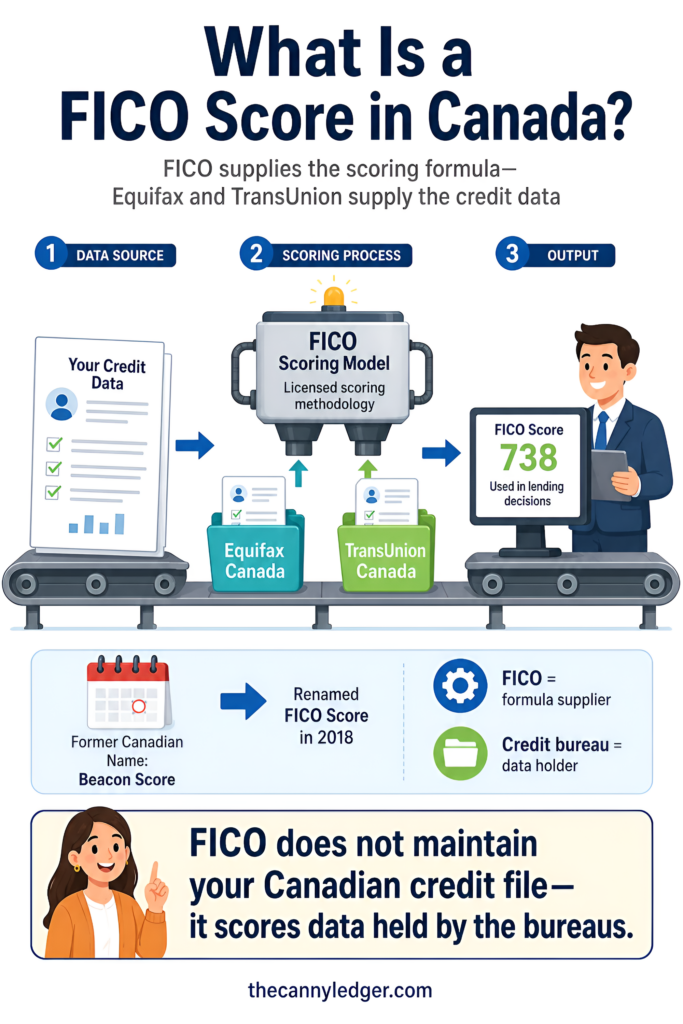
FICO, short for the Fair Isaac Corporation, is an American analytics company that licenses its scoring methodology to Equifax Canada and TransUnion Canada rather than acting as a bureau itself. It doesn’t collect credit data on Canadians directly. Roughly 90% of top Canadian lenders and credit unions use a FICO-based score, currently built on the FICO Score 10 model introduced in Canada in 2022. Understanding that FICO is a formula supplier, not a data holder, explains a lot of confusion about why the number you check yourself doesn’t always match what a lender actually sees.
What FICO Actually Is
FICO isn’t a Canadian company and isn’t a credit bureau. It develops scoring formulas and licenses them to companies that do hold consumer data, which in Canada means Equifax Canada and TransUnion Canada. This licensing relationship in Canada goes back decades, and for most of that history the score built on FICO’s formula was marketed here under a different name entirely, Beacon, a brand most people who’ve been checking their credit for a while still recognize.
That changed formally in 2018. According to FICO’s own announcement of an extended distribution agreement with Equifax Canada, the Beacon Score was renamed to FICO Score in the Canadian market as part of that renewal. The underlying methodology and the relationship itself weren’t new, but the branding Canadians actually see when they check their score shifted from Beacon to FICO Score at that point, and older explainers that still describe Beacon as the current name are working from outdated terminology even if the mechanics they describe are accurate.
FICO Score 10, What Actually Changed
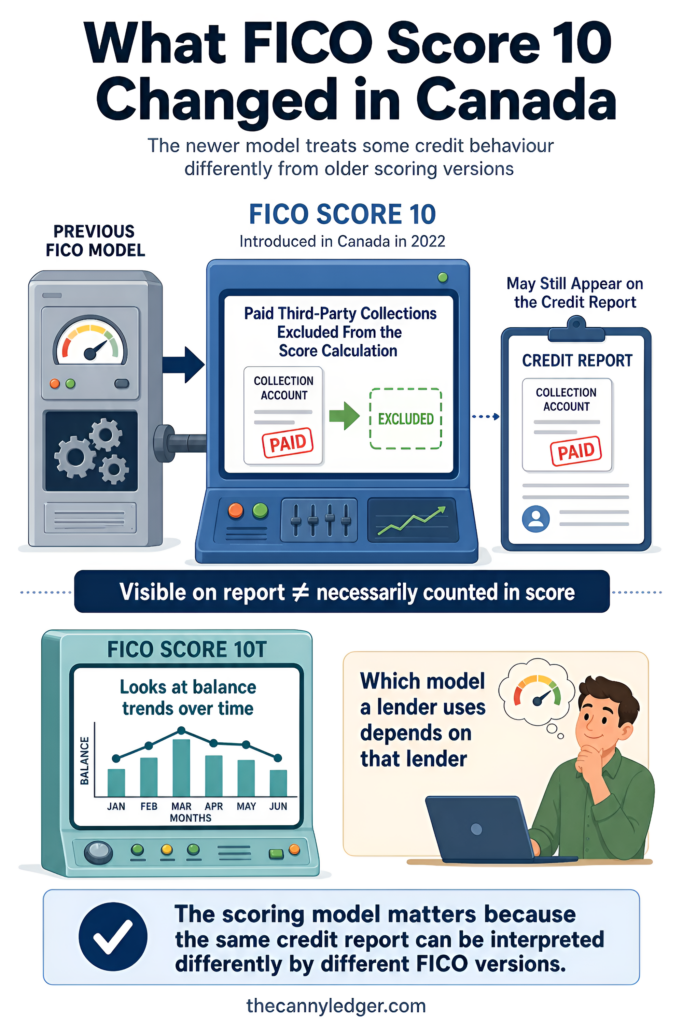
The version currently in use matters, since FICO updates its formula periodically and each version behaves differently in ways that affect real people. FICO introduced FICO Score 10 in Canada in 2022, built in partnership with both Equifax Canada and TransUnion Canada, replacing the prior version lenders had been using. According to Equifax Canada’s own product page for the model, FICO Score 10 includes an enhanced collections treatment that excludes paid third-party collections debt entirely from the calculation, based on FICO’s own research showing that ignoring settled collections improves the score’s predictive accuracy.
That detail matters in a very concrete way for anyone who’s paid off an old collection account and assumed it was still dragging their score down. Under the current model, once a collection is actually paid, it stops factoring into your risk score, even though it can remain visible on the credit report itself for years afterward under the standard retention rules. A version called FICO Score 10T also exists, adding trended data that looks at how your balances have moved over time rather than a single snapshot, though which version a specific lender pulls depends entirely on that lender’s own setup rather than any rule that applies uniformly across the industry.
Why You Can’t Just Look Up Your Own FICO Score
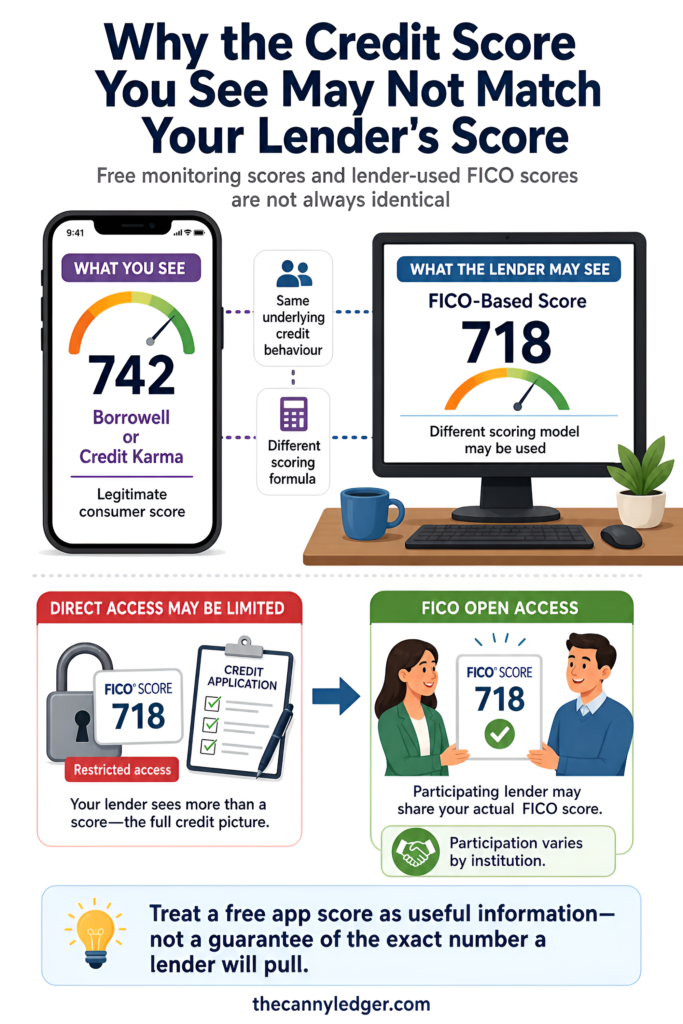
This is the part that catches almost everyone off guard the first time they try. CBC News Marketplace investigated this directly and found that Canadian consumers generally can’t access their FICO score on their own, since lenders are contractually restricted from sharing a copy of the FICO-generated report with the customer who requested credit. To actually see it, a consumer typically has to go through a hard credit check, the exact kind that happens during a real credit application, which isn’t something most people want to trigger just to satisfy curiosity.
What most people check instead, Borrowell for an Equifax-based number or Credit Karma for a TransUnion-based one, are legitimate scores, but they’re not guaranteed to be the FICO-based score that a specific lender will actually pull for a specific application. FICO does run an Open Access program that lets participating lenders share a consumer’s actual FICO score with them for free, but participation is voluntary on the lender’s side, so whether it’s available to you depends entirely on whether your bank or credit union has signed on. Ask directly rather than assuming either way.
A Provincial Wrinkle Worth Knowing
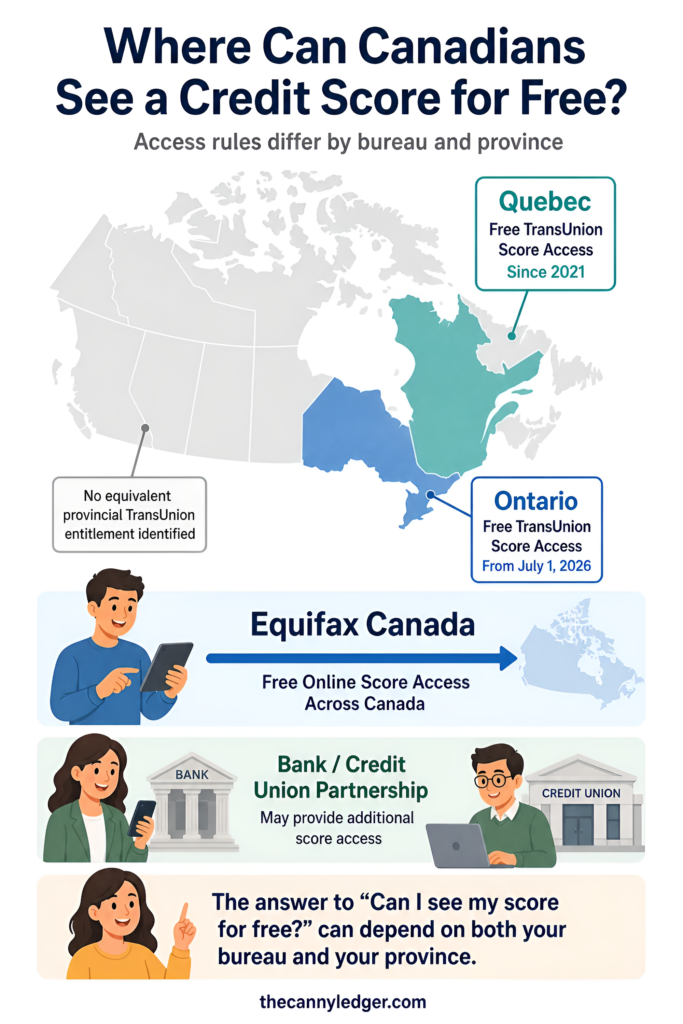
Where you live in Canada actually changes what score access looks like, and not just for FICO specifically. According to TransUnion Canada’s own credit score page, consumers in Quebec have been entitled by provincial legislation to see their credit score for free as part of their Consumer Disclosure since 2021, and Ontario residents gained that same legal entitlement effective July 1, 2026. Residents of every other province currently have no equivalent legal right to a free TransUnion score outside of a paid subscription or a bank partnership program, which means the exact same question, can I see my real score for free, has a different honest answer depending entirely on which province you’re in.
Equifax Canada took a different approach and extended free online score access to all Canadians regardless of province, which is worth knowing if TransUnion’s provincial patchwork is the one that applies to you.
What the National Number Actually Looks Like
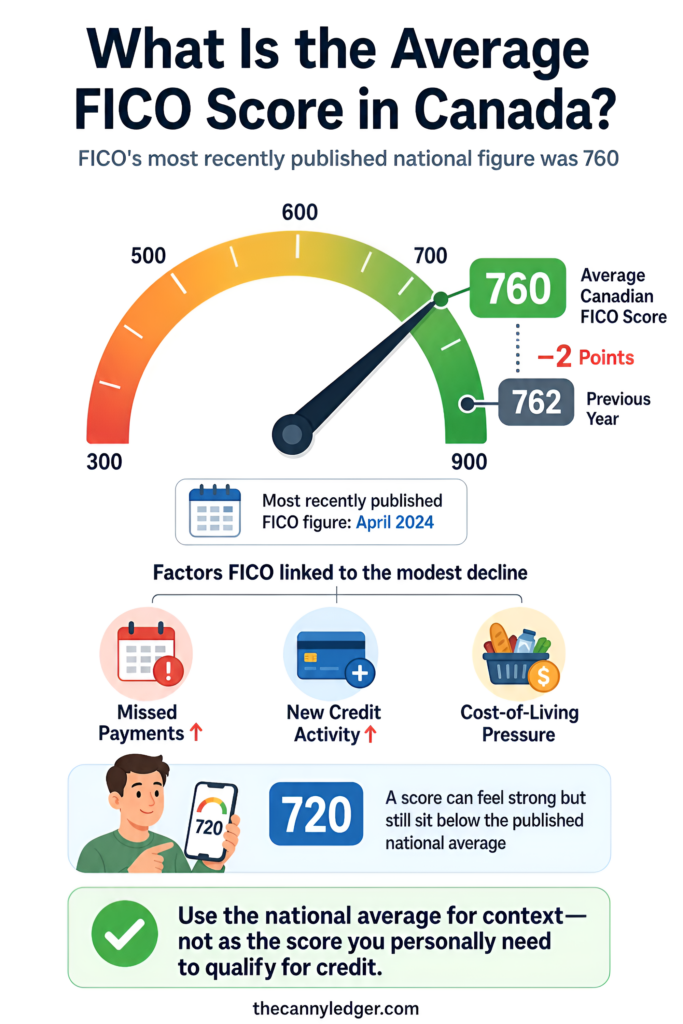
FICO itself tracks and publishes a national average as a barometer of overall Canadian credit health. According to FICO’s own November 2024 data release, the average Canadian FICO Score sat at 760 as of April 2024, down two points from 762 the year before, a shift FICO attributed to rising missed payments and growing new credit activity as consumers worked to manage debt amid a higher cost of living. That’s the most recent figure FICO has published as of this writing, and it’s worth checking FICO’s own newsroom directly for anything more current before treating it as up to date.
That average matters less as a target to hit and more as context for where a specific score actually sits. A 720 sounds solid in isolation, but landing meaningfully below a national average built from tens of millions of files says something a bare number on its own doesn’t.
Where This Shows Up Beyond a Personal Credit Card
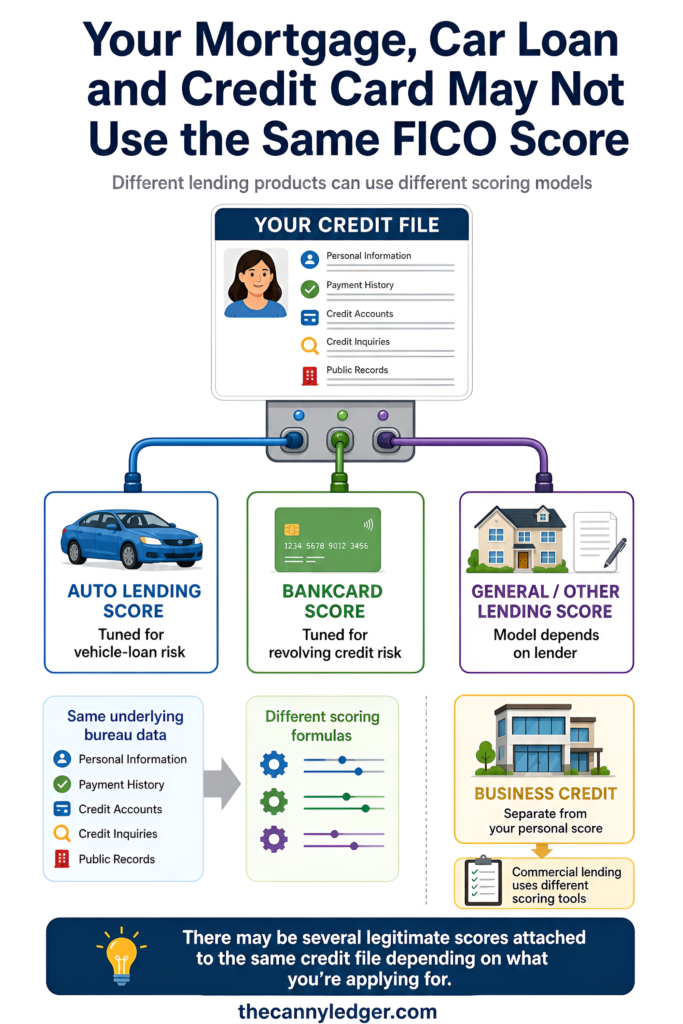
FICO’s methodology extends past the general-purpose score most people think of first. Industry-specific versions exist tuned for particular lending categories, including scores built specifically for auto lending and bankcard risk, which some lenders use instead of the general-purpose score depending on whether they’re evaluating a dealership auto loan or a personal loan. FICO also licenses scoring tools used in commercial and small business lending contexts, a separate system entirely from the personal score, and distinct from the business credit bureau products Equifax Canada, TransUnion Canada, and Dun & Bradstreet Canada sell directly to lenders assessing a company rather than an individual.
None of these industry-specific versions are something a typical consumer needs to chase down or monitor. What matters practically is knowing they exist, since a car loan and a mortgage application might actually be scored by different formulas behind the scenes, even when both are pulling from the same underlying Equifax or TransUnion file.
What This Actually Means for You
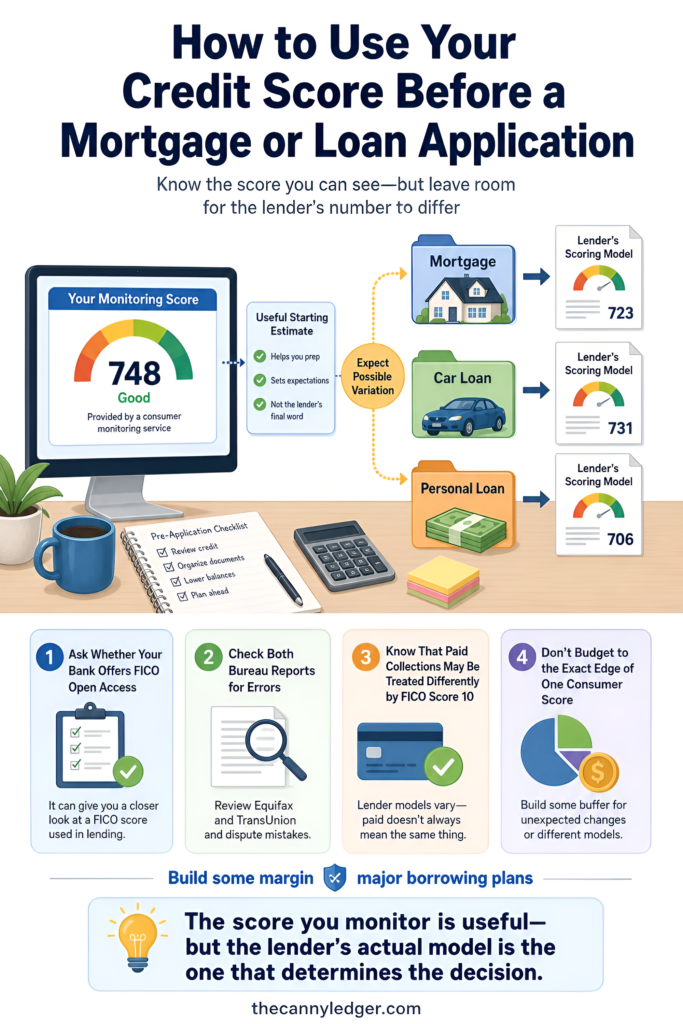
Stop assuming the number on a free monitoring app is identical to what a lender is about to see, since it’s a reasonable estimate built on real data, not a guarantee of the exact FICO-based figure behind a specific application. Ask your bank or credit union directly whether they participate in FICO’s Open Access program before assuming you have no path to your real number. If an old collection account is paid off, know that it’s no longer factored into your score under the current model even while it’s still visible on your report, so don’t let a visible old account convince you it’s still actively hurting you. And whether you’re comparing mortgage rates, shopping car loans, or just trying to understand where you actually stand, treat the score you check yourself as a strong estimate rather than the literal number a lender will pull, and budget a little room for the two to differ.
A Few Questions Worth Answering
Is a FICO score different from a credit score? No, not conceptually. A FICO score is simply a credit score built on FICO’s specific formula, one of the scoring methodologies Equifax Canada and TransUnion Canada use, rather than a separate category of score entirely.
Does checking my Borrowell or Credit Karma score hurt my chances with a FICO-based lender check? No. Both are soft inquiries and have no bearing on your score, regardless of which formula a lender eventually uses when you actually apply for something.
If my bank doesn’t participate in FICO Score Open Access, is there any other way to see my real number? Beyond a hard credit application, not reliably. This is exactly the gap that keeps most Canadians relying on Borrowell or Credit Karma estimates instead, and it’s worth asking a financial advisor or your bank directly if you’re preparing for a major application and want the most accurate possible picture beforehand.