
Anyone can pull a report on your business without asking your permission first. A supplier deciding whether to extend payment terms, a landlord screening a commercial tenant, a competitor doing due diligence, none of them need your consent the way a lender needs it before pulling your personal file. That single difference sets the tone for everything else about how business credit works in Canada, and it catches a lot of new business owners off guard the first time they find out.
- Why This Isn’t Protected the Way Personal Credit Is
- The Three Bureaus Tracking It
- What Actually Feeds the File
- Sole Proprietorship Versus Incorporation Changes the Whole Picture
- The Personal Guarantee Reality
- A Concrete Example Worth Knowing About
- Building a File Deliberately Rather Than by Accident
- What to Actually Do With This
- Questions Worth Answering Next
A business credit score in Canada is generated by Equifax Canada, TransUnion Canada, or Dun & Bradstreet Canada, based on payment history with suppliers and lenders, public records, and how the business is structured. Unlike a personal credit score, it isn’t protected by consumer consent requirements, and for a sole proprietorship, it can be functionally identical to the owner’s own personal file. Building one deliberately, rather than letting it happen by accident, matters more than most new business owners realize until they’re sitting across from a lender.
Why This Isn’t Protected the Way Personal Credit Is
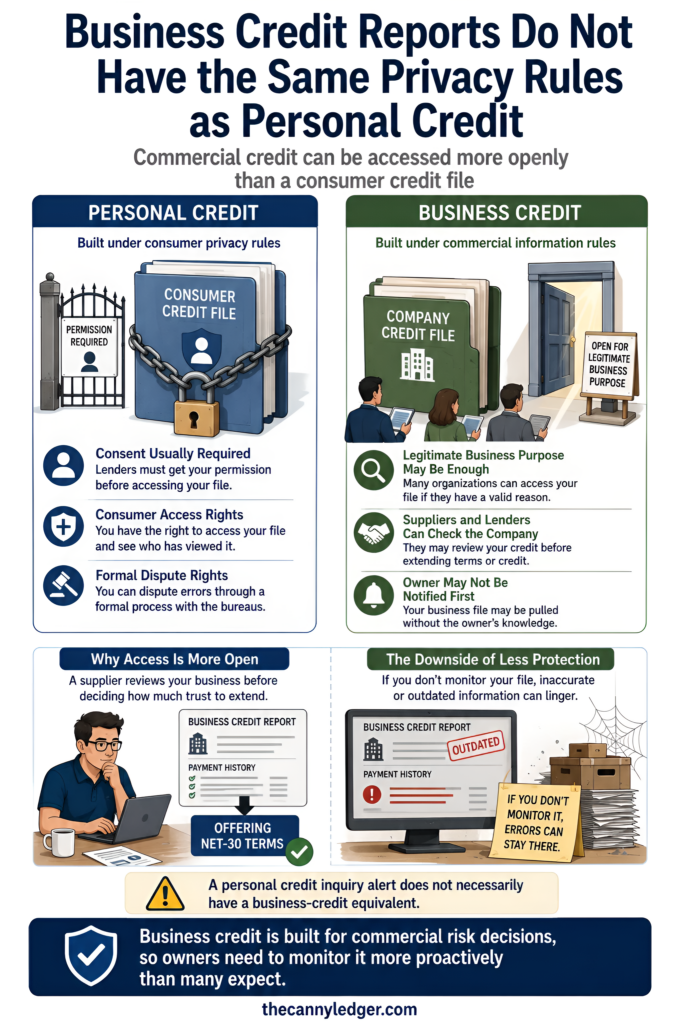
Personal credit reports in Canada come with real consumer protections built around consent, a lender generally needs your authorization before pulling your file, and you have clear rights to access and dispute what’s on it. Business credit reports operate under a different set of rules entirely, since a business isn’t a consumer in the eyes of that framework. Anyone with a legitimate business reason, and sometimes anyone willing to pay a fee, can pull a report on a company without notifying the owner first.
That openness cuts both ways. It means a supplier can check your business before extending net-30 terms without asking, which speeds up commercial relationships considerably. It also means an inaccurate or outdated file can sit uncorrected for a long time if nobody at the business is actively monitoring it, since there’s no automatic notification the way there is when a lender pulls your personal report.
The Three Bureaus Tracking It
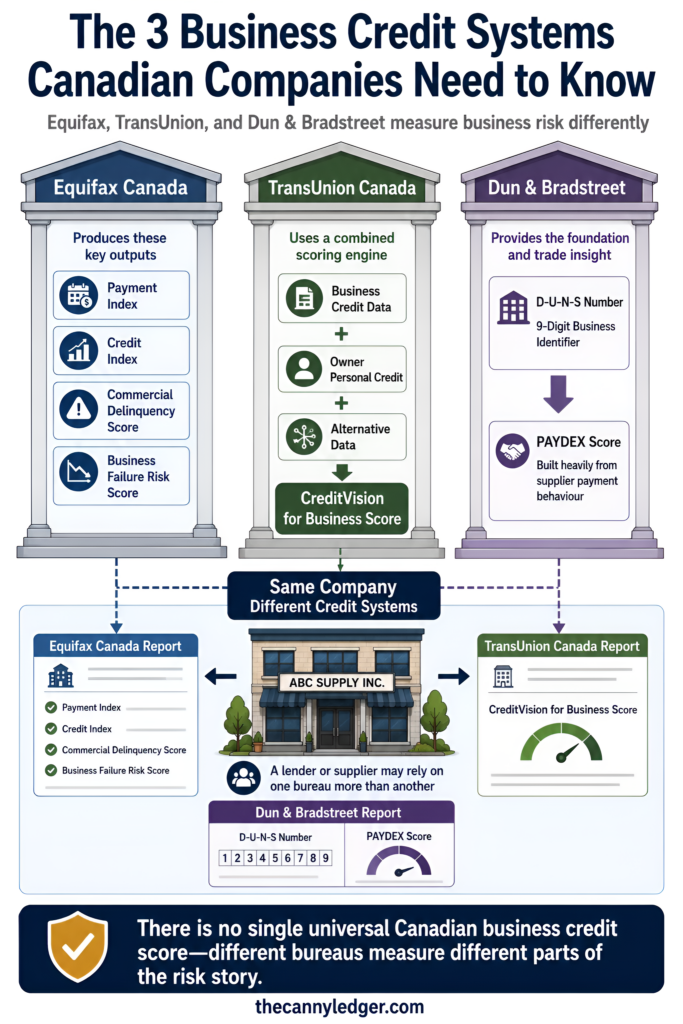
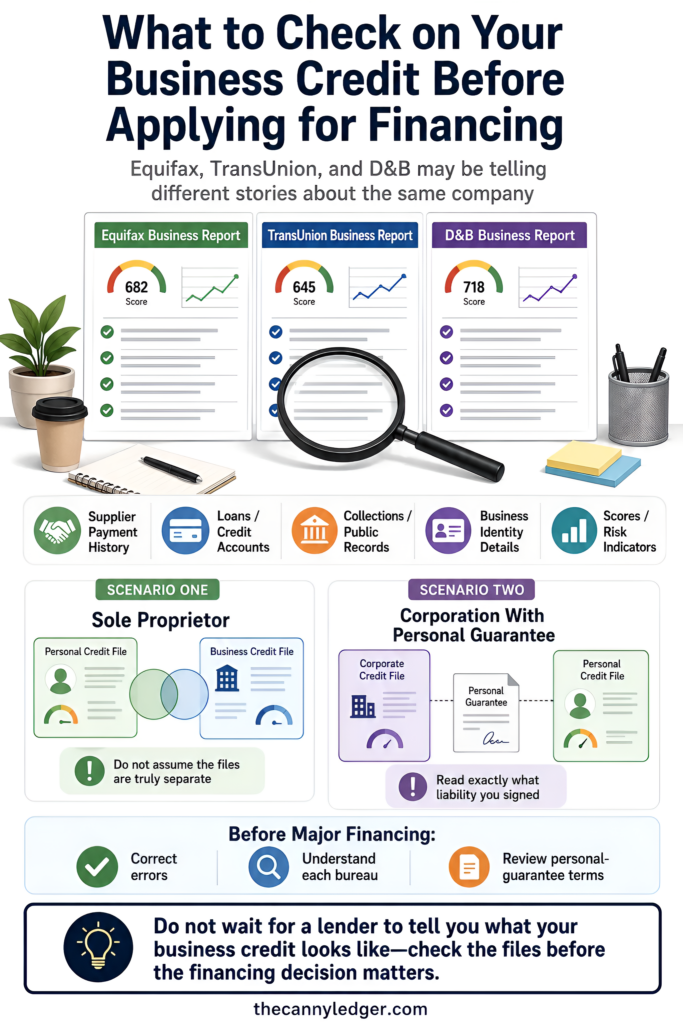
Three separate organizations generate business credit information in Canada, and unlike the personal side, where Equifax and TransUnion dominate, all three matter here in different ways. According to Equifax Canada’s own guidance for business owners, its business credit report includes a Payment Index measuring how promptly a business pays its creditors, a Credit Index measuring overall business risk, and predictive scores including a Commercial Delinquency Score and a Business Failure Risk Score that estimate the health of a company over the following year.
TransUnion Canada takes a somewhat different approach with its business scoring. According to TransUnion Canada’s own product page, its CreditVision for Business Score combines business credit data with personal credit data from the business owner, plus alternative data sources, into a single score designed specifically to work for businesses with limited credit history of their own. That blending matters enormously for a new business, since it means an owner’s strong personal credit history can meaningfully support a thin business file rather than the two being treated as entirely separate stories.
Dun & Bradstreet operates on a global system built around a unique identifier rather than a bureau-style report alone. According to D&B’s own Canadian site, every business gets a D-U-N-S Number, a nine-digit identifier separate from any personal identity, which connects to the company’s credit file including its PAYDEX score, a payment-behaviour score built specifically from trade payment history with suppliers rather than loan repayment alone.
What Actually Feeds the File
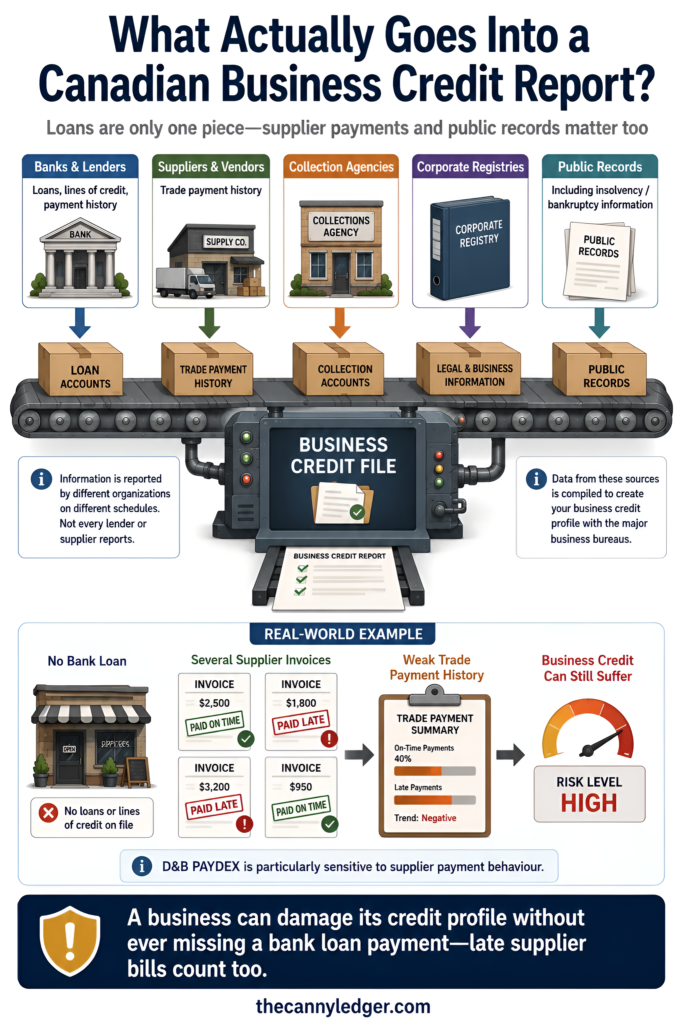
Payment history with financial institutions is only part of what builds a business credit profile. Equifax Canada’s own materials describe pulling data from banks, industry groups, collection agencies, and corporate registries, along with public record items like bankruptcy filings tracked through the Office of the Superintendent of Bankruptcy. Trade references, meaning how promptly a business pays its own suppliers and vendors, carry real weight too, particularly in the D&B system, where PAYDEX is built almost entirely from that kind of payment data rather than loan or credit card history.
This is the detail that surprises a lot of business owners who assume their file only reflects loans and lines of credit the way a personal score does. A business that’s never taken out a loan but pays its suppliers late every cycle can still build a weak profile, since that payment behaviour gets reported and weighted the same way a missed loan payment would be.
Sole Proprietorship Versus Incorporation Changes the Whole Picture
This is the single most consequential fork in how business credit actually works in Canada, and it’s worth understanding before anything else on this list. According to BDC’s own explanation of business structures, a sole proprietor is personally liable for all the debts and functions of the business, since there’s no legal separation between the owner and the business itself. Practically, that means a sole proprietorship’s credit behaviour and the owner’s personal credit behaviour are frequently one and the same file, or close enough to it that lenders treat them as inseparable.
Incorporation changes that relationship structurally. A corporation is its own legal entity, and in principle its debts stay with the corporation rather than following the owner home. In practice, this protection gets voluntarily set aside constantly through personal guarantees, which brings us to the part that actually determines how much that legal separation is worth in a real lending situation.
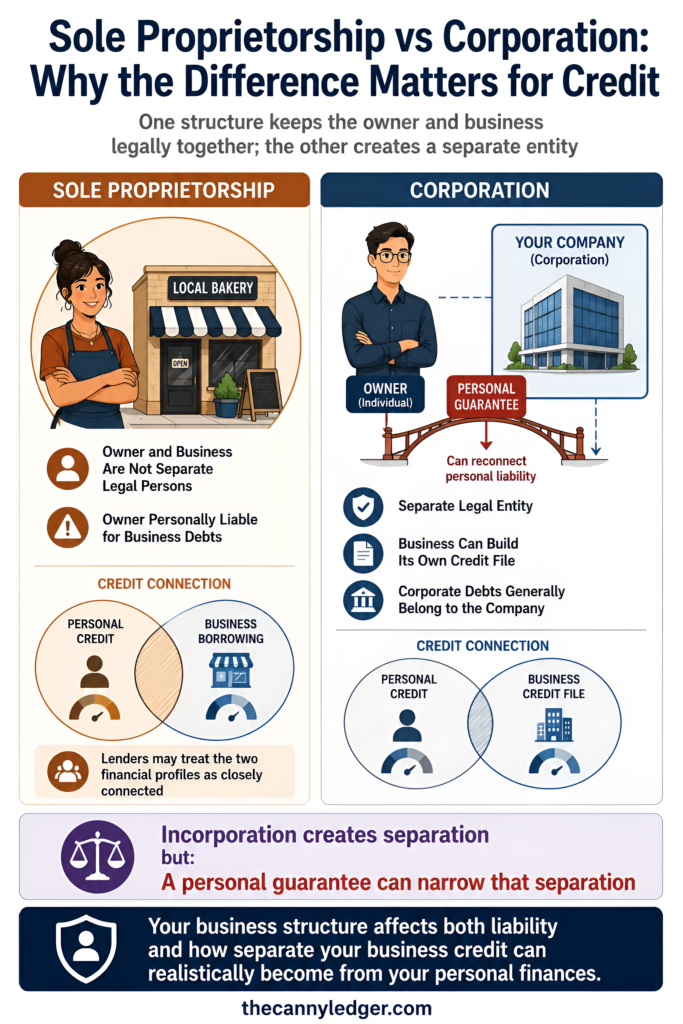
The Personal Guarantee Reality
A personal guarantee connects an owner’s personal finances to business debt even when the business itself is incorporated, and it’s common enough in Canadian small business financing that assuming it away is a real mistake. Whether one is required depends heavily on the lender and the loan structure rather than being automatic across the board. Banks and many small business credit card issuers commonly require one from the primary applicant, particularly for a newer business without an established file of its own.
The federal government’s own guidelines for the Canada Small Business Financing Program spell out exactly how far this liability extends for that specific program. A borrower operating as a sole proprietorship or partnership is liable for the full repayment of a CSBF loan, and a personal guarantee doesn’t preclude a lender from also pursuing other security like an assignment of shareholder loans. This is about as direct a confirmation as exists that the corporate veil offers real but limited protection, and it disappears entirely the moment a business isn’t incorporated in the first place.
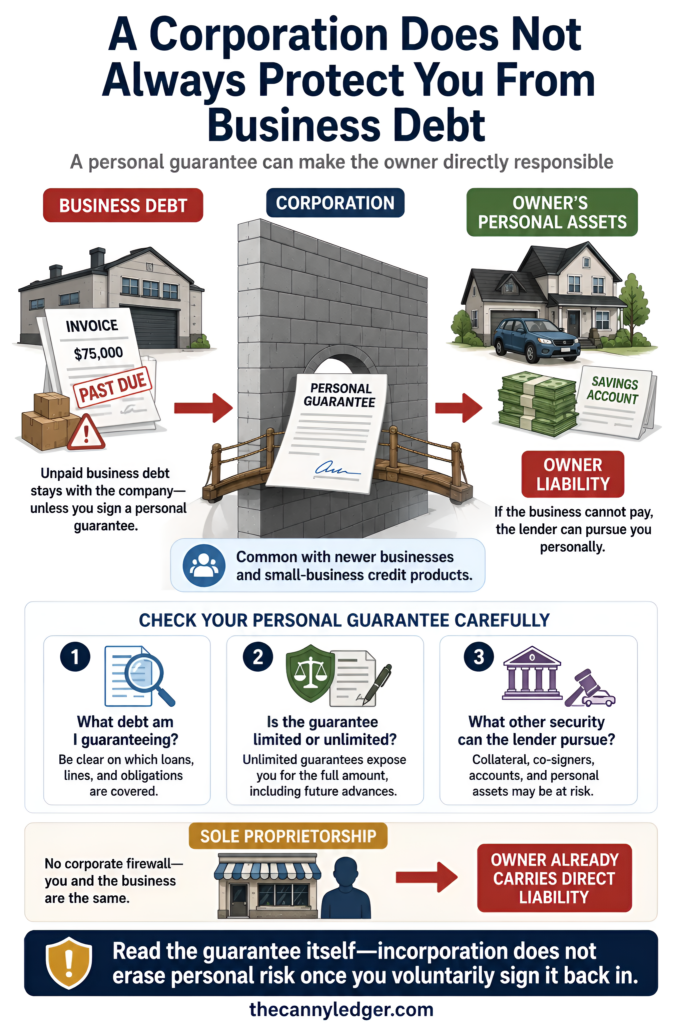
A Concrete Example Worth Knowing About
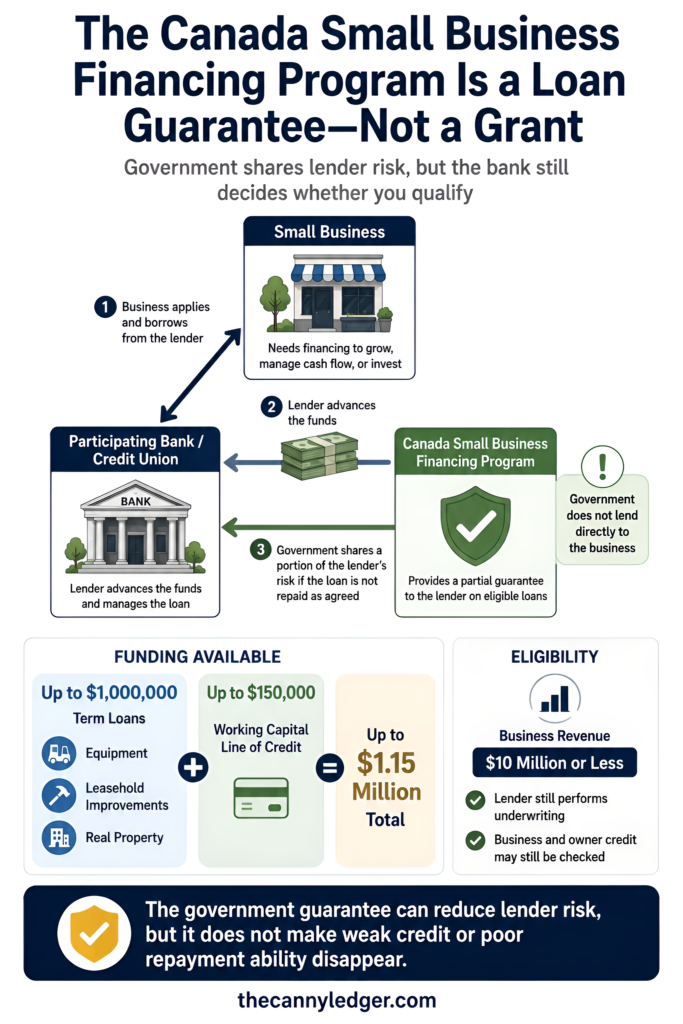
The Canada Small Business Financing Program is worth understanding on its own terms too, since it’s one of the more useful and underused federal programs directly tied to how business credit and lending intersect in this country. According to the program’s own overview, it’s a loan guarantee program, not a grant, meaning the government shares risk with participating banks and credit unions rather than lending money directly, which lets lenders approve businesses they might otherwise decline. A borrower can access up to $1.15 million total, structured as up to $1 million for term loans covering equipment, leasehold improvements, or real property, plus a separate $150,000 working capital line of credit, and eligibility extends to businesses with gross annual revenues of $10 million or less.
This matters for the business credit conversation specifically because lenders participating in CSBFP still perform their own underwriting, including a credit check on the business and often the owner personally, even though the government guarantee reduces the lender’s exposure if the loan defaults. A weak or thin business credit file doesn’t disappear as a factor just because a program shares the risk, it just changes how much that risk costs the lender to take on.
Building a File Deliberately Rather Than by Accident
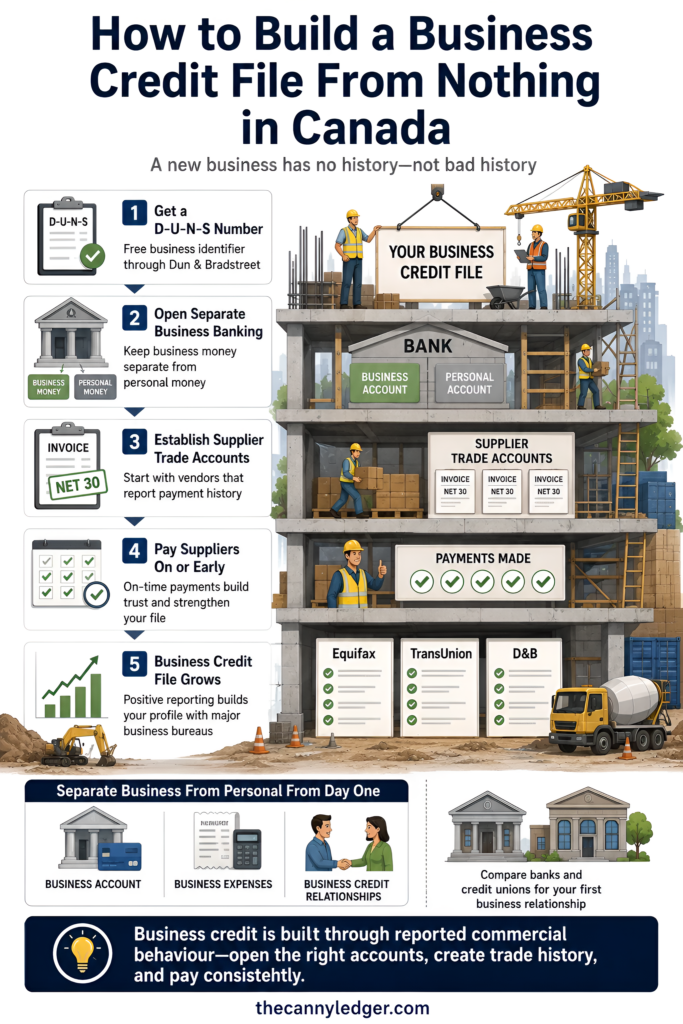
A new business with no credit history isn’t starting from a bad position, it’s starting from no position at all, which is a meaningfully different problem to solve. Registering for a D-U-N-S Number directly through Dun & Bradstreet Canada is free and gives a new business its first real anchor point in the system, even before any credit relationships exist to report against it. Opening business banking separate from personal accounts matters here too, not just for bookkeeping cleanliness, since a business’s own banking relationship becomes part of what gets reported over time.
Working with suppliers willing to extend net terms and then paying consistently on or ahead of schedule builds trade reference history faster than most owners expect, particularly relevant to D&B’s PAYDEX scoring. Comparing a credit union against a national bank for that first business account is worth the extra time too, since smaller institutions sometimes offer more flexibility to a business with no track record yet than a standardized national onboarding process does.
What to Actually Do With This
Pull your own business credit reports from Equifax Canada, TransUnion Canada, and D&B Canada rather than assuming they’re all telling the same story, since they truly aren’t built the same way and a lender could be looking at any one of them. If you’re operating as a sole proprietor and treating your business and personal credit as separate concepts, that assumption is worth revisiting directly, since in practice they’re often functionally the same file until you incorporate, and a thin or damaged business file can be worth addressing the same way you’d approach rebuilding personal credit or talking to a credit counsellor about the underlying debt. And before signing anything with a personal guarantee attached, whether it’s a small business loan or a line tied to business insurance requirements, read exactly what’s being guaranteed rather than assuming incorporation alone is doing the protective work it’s often assumed to do. Talking to a financial advisor before a major financing decision is worth the cost here specifically, since the sole proprietorship versus incorporation question has real, lasting consequences that go well beyond the credit file itself.
Questions Worth Answering Next
Does opening a business credit card affect my personal credit score? It depends on the issuer and whether a personal guarantee was required. Many small business credit cards do require one, which means missed payments can show up on the owner’s personal file even though the card is technically a business product.
Can I check my business credit report for free? D&B Canada offers a free Credit Insights plan that includes directional changes to core scores. Equifax Canada and TransUnion Canada’s business reports are generally paid products, unlike the free personal report access both bureaus provide to individual consumers.
If my business fails, does that show up on my personal credit too? For a sole proprietorship, yes, since there’s no legal separation to begin with. For an incorporated business, it depends almost entirely on whether a personal guarantee was signed on the debts involved, which is exactly why that detail deserves more attention than it usually gets before financing is arranged.