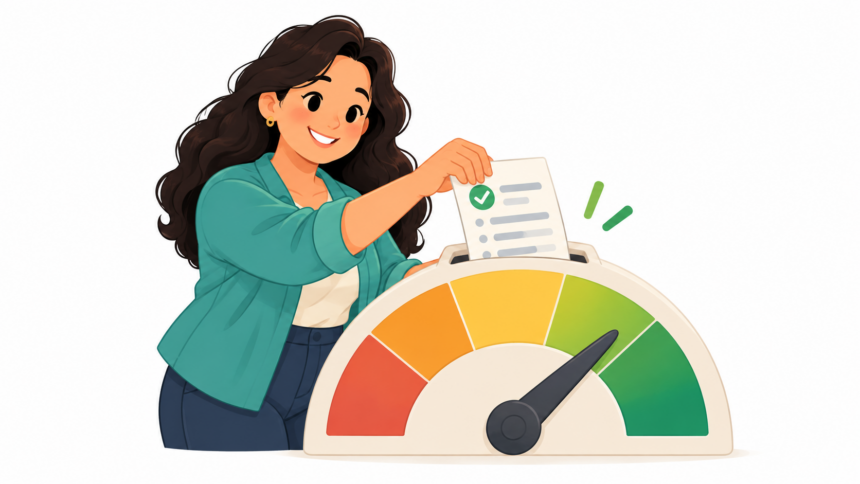
Paying your credit card bill by the due date protects you from interest charges. It does almost nothing for your credit score. The number that actually gets reported to Equifax and TransUnion each month comes from your statement closing date, typically two to three weeks before your due date, and whatever balance sits on your card that specific day is the balance the bureaus see, regardless of whether you pay it off in full a week later. Most Canadians have never been told this distinction exists, which means a lot of people are managing their credit card the right way for their wallet and the wrong way for their score.
- The Statement Date Is The Lever Most Canadians Never Use
- Utilization Gets Scored Per Card, Not Just Overall
- A Missed Payment Isn’t Permanent, But It Isn’t Quick Either
- Disputing A Genuine Error Moves The Number Directly
- Space Out New Applications, Even When Rate Shopping
- The Myths Worth Actively Ignoring
- What Each Lever Actually Costs You In Time
- Putting The Actual Plan Together
Improving an existing score comes down to a handful of specific, controllable levers, not a vague push to “be more responsible.” This piece covers each one in real depth, what actually moves the number, by how much, and how quickly.
The Statement Date Is The Lever Most Canadians Never Use
The mechanic works like this. Your credit card issuer reports your balance to the bureaus based on what you owe on your statement closing date, not your payment due date, and the Financial Consumer Agency of Canada’s own guidance recommends keeping that reported figure under 30 percent of your limit. Say your card has a $5,000 limit and you’re carrying a $3,500 balance on the day your statement closes, 70 percent utilization, even if you fully intend to pay it off before the due date arrives. That 70 percent is what gets reported and scored. Pay the balance down to $500 a few days before that closing date instead, and the reported utilization drops to 10 percent, with zero change to how much you actually spent that month.
This means you don’t need to carry a permanently low balance to benefit. You need a low balance on one specific day each cycle. Making an extra payment a few days before your statement closes, even splitting one monthly payment into two smaller ones spaced through the month, keeps the reported number low without changing your actual spending habits at all. Find your statement closing date on your online account or your last paper statement, since it’s genuinely the single most actionable piece of information in this entire topic.
Utilization Gets Scored Per Card, Not Just Overall
This is the part that trips up people who think they’ve already optimized. Scoring models evaluate your utilization on each individual card as well as your combined total across every account, which means one maxed-out card can drag your score down even if your overall ratio looks perfectly reasonable. A household with $4,500 owed on a $5,000-limit card and nothing on a second card with a $10,000 limit shows a combined utilization of 30 percent, technically inside the recommended range, while that first card alone is sitting at 90 percent and likely suppressing the score on its own. The fix isn’t shuffling the balance between cards, since that leaves the combined total unchanged. It’s paying down the specific card that’s spiking, even if the household’s overall number already looks fine on paper.
Requesting a credit limit increase on an existing card is a legitimate second lever here, since a higher limit against the same spending immediately lowers your reported ratio with no change in behaviour required. Ask directly whether the increase can be processed with a soft inquiry rather than a hard one, since many issuers can do this without pulling your file, and a soft pull means the request itself costs you nothing.
A Missed Payment Isn’t Permanent, But It Isn’t Quick Either
Payment history carries more weight than any other single factor, and a genuine slip has a real, measurable cost attached. A single late payment on an otherwise strong file can knock a score down by 60 to 110 points, and recovering that ground takes considerably longer than losing it did, typically months of consistent on-time payments rather than a single good cycle. The mark itself stays visible on your report for roughly six years, but its actual weight on your score fades well before it disappears entirely, front-loaded in the first year or two and diminishing steadily after that as newer, positive history accumulates on top of it.
Setting up automatic minimum payments on every account you hold removes the risk of a payment slipping through simply because a due date was forgotten during a busy month, and it costs nothing to set up once.
Disputing A Genuine Error Moves The Number Directly
If something inaccurate is dragging your score down, an account you don’t recognize, a payment marked late that was actually on time, that’s a direct, no-cost lever rather than a slow behavioural change. Both bureaus are legally required to investigate a dispute you file, and correcting a genuine error can move your score meaningfully in a single reporting cycle rather than the months most other improvements take. It’s worth pulling your full report periodically specifically to check for this, since a mistake sitting quietly on your file does nothing but cost you until you catch it.
Space Out New Applications, Even When Rate Shopping
Every hard inquiry costs a small amount on its own, but the real damage comes from stacking several in a short window, which can read to a scoring model as a household under sudden financial pressure. Genuine rate shopping for a single product, comparing mortgage or auto loan offers across several lenders within a tight window, generally gets treated as one inquiry rather than several, but that grace period doesn’t extend to applying for multiple unrelated credit cards or loans in the same stretch. If you’re not actively rate shopping for one specific product, spacing new credit applications at least six months apart protects a score that’s already trending in the right direction from an unnecessary setback.
The Myths Worth Actively Ignoring
A few persistent pieces of advice do nothing or actively hurt. Carrying a small balance instead of paying in full doesn’t build credit faster, it only adds interest cost for no scoring benefit, since utilization is measured against whatever balance gets reported, not whether you paid it off completely. Closing your oldest card once you don’t use it anymore feels like tidying up, but it shortens your average account age and removes available credit from your utilization calculation, both of which can lower your score rather than help it. And chasing every tactic simultaneously, a limit increase, a dispute, a new card, and a debt consolidation move all inside the same month, makes it genuinely hard to tell which change actually worked, which matters if something doesn’t move the way you expected and you need to figure out why.
What Each Lever Actually Costs You In Time
Utilization changes are the fastest movers on this whole list, since a lower reported balance can show up as soon as your next statement cycle, generally within 30 to 90 days depending on how quickly your issuer reports. A corrected dispute moves almost as fast once the investigation resolves. Payment history recovery is the slowest lever by a wide margin, measured in months of consistent behaviour rather than a single fix, and new credit inquiries fade from meaningful score impact within roughly a year even though they remain visible on your file for three.
Putting The Actual Plan Together
Find your statement closing date on every card you carry a balance on and start paying down before that date rather than the due date, since this single change costs nothing and often moves the number fastest. Check with Winnipeg’s own banks or credit unions about whether a limit increase can go through as a soft pull if utilization is your main issue. If one specific card is running high utilization even while your overall ratio looks fine, target that card directly instead of spreading payments evenly across accounts that don’t need it. Set automatic minimum payments on everything to remove the risk of an accidental miss, and if you’re carrying enough revolving debt that utilization alone won’t fix the picture, a conversation about debt consolidation, a personal loan to convert revolving debt into installment debt, or a session with a credit counsellor can restructure the underlying debt rather than just managing its timing. And if a mortgage or affordability calculation is on the calendar, start these changes at least a few statement cycles before you actually apply, since utilization improvements need at least one full reporting cycle to show up in the number a lender actually sees.