

Checking your credit score in Canada used to mean filling out a paper form, mailing it to a bureau in Montreal or Hamilton, and waiting several weeks for an envelope to come back. That process still technically exists and still technically works, but it’s no longer how almost anyone actually does this. The gap between the process people picture in their head and the process that’s actually available today is exactly why so many Canadians still avoid checking their score altogether, out of a lingering sense that it’s more complicated than it is.
Knowing what you need before you start, the fast route versus the formal one, how to actually read what comes back, and what to do if something looks wrong once you’re looking at it, closes that gap completely.
What You Need Before You Start
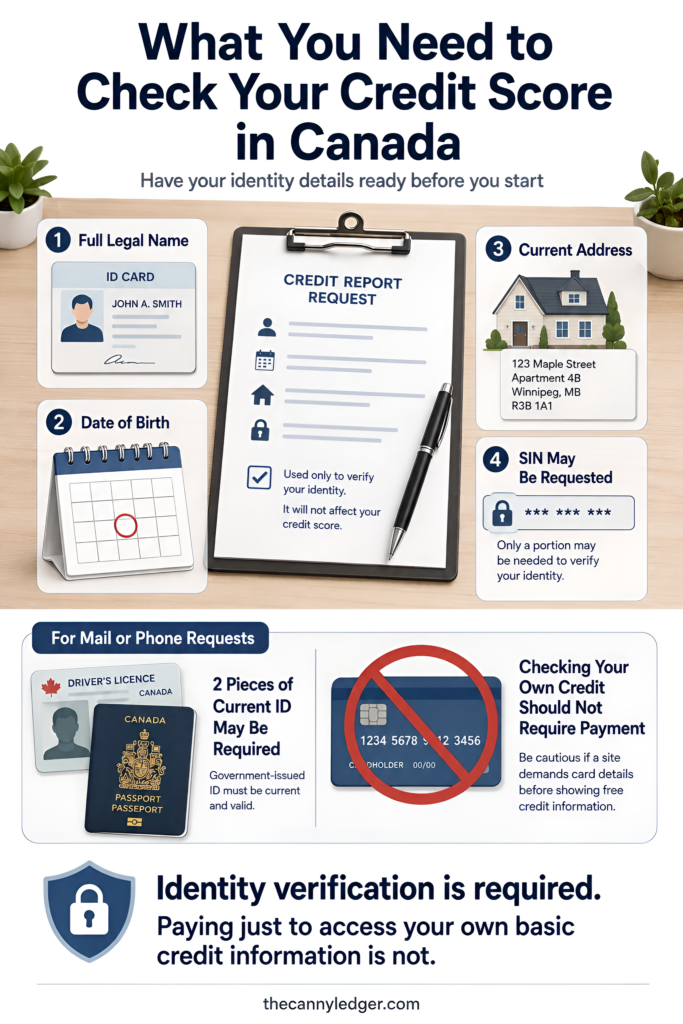
Whichever route you take, you’ll need to prove you’re actually you. For any free app or online request, that typically means your full legal name, date of birth, current address, and sometimes a portion of your Social Insurance Number to confirm identity against the bureau’s records. For a mailed or phone request directly through Equifax or TransUnion, you’ll generally need two pieces of acceptable identification, government issued and current, along with the same basic personal details. None of this costs anything regardless of which method you choose, and requesting your own information never requires a credit card number for legitimate services, worth remembering if a site asks for one before showing you anything.
The Fast Route Most Canadians Actually Use
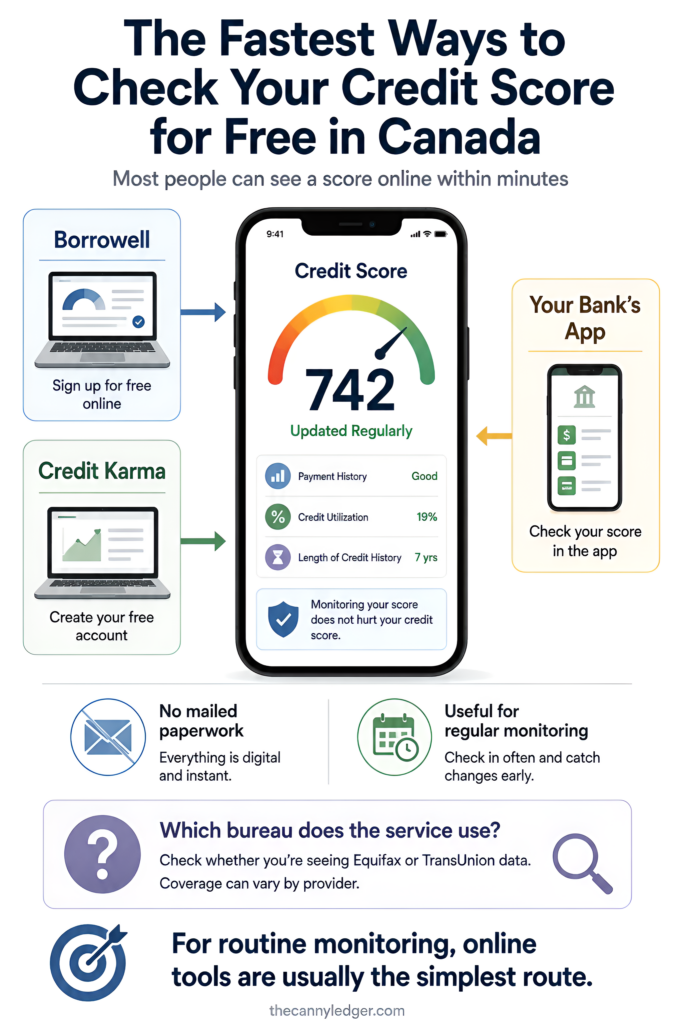
For a genuinely free, ongoing look at your actual number rather than just your underlying report, apps like Borrowell and Credit Karma get you a result in a few minutes with no mailed paperwork at all. Most major banks also offer a version of this built directly into online banking. Our full breakdown of where to check your credit score for free covers exactly which service pulls from which bureau and the specific tradeoffs between them, since that comparison deserves its own space rather than a summary here.
The Formal Route Straight Through The Bureaus
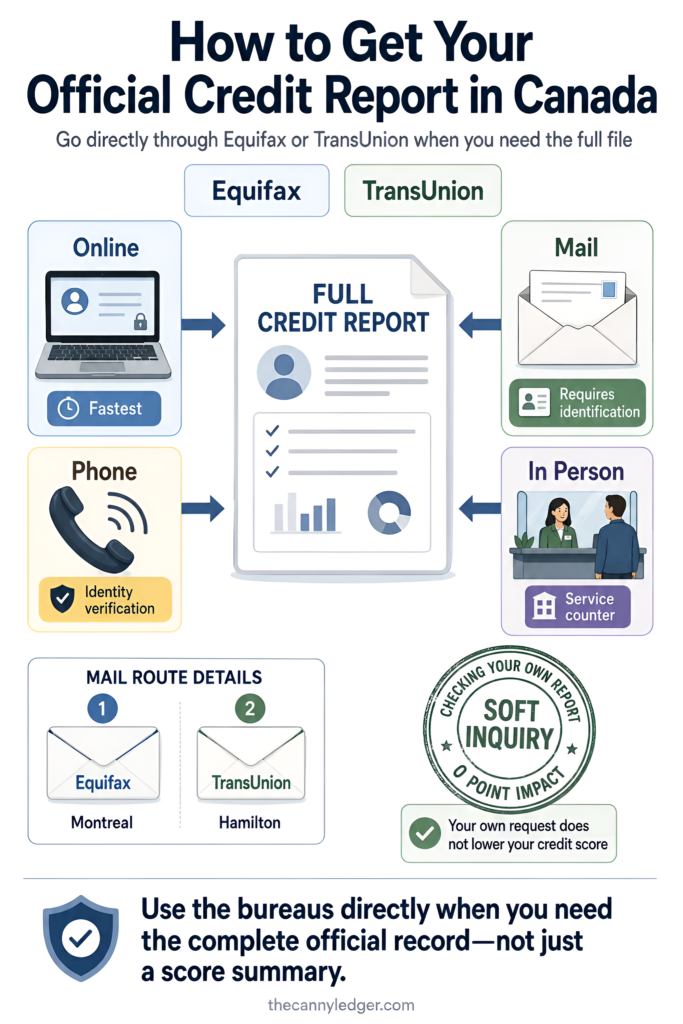
If you want your full official report rather than a third-party app’s summary, or if you specifically need documentation for a dispute or a legal matter, going directly through Equifax or TransUnion is worth doing at least once. Both bureaus let you request your report online, by mail, by phone, or in person, and the online version updates monthly, with results available immediately rather than after a wait.
For a mailed request, Equifax’s form goes to their National Consumer Relations office in Montreal, while TransUnion’s goes to their Consumer Relations Centre in Hamilton, and both require the two pieces of ID mentioned above. Phone requests work similarly, with Equifax’s automated line asking for your SIN to verify identity and TransUnion’s requiring a short series of personal and financial verification questions. Whichever channel you pick, requesting your own report or score through any of these official routes counts as a soft inquiry and has zero effect on the number itself, a fact worth internalizing fully if worry about hurting your own score has ever been the reason you put this off.
What You’re Actually Looking At Once It Arrives
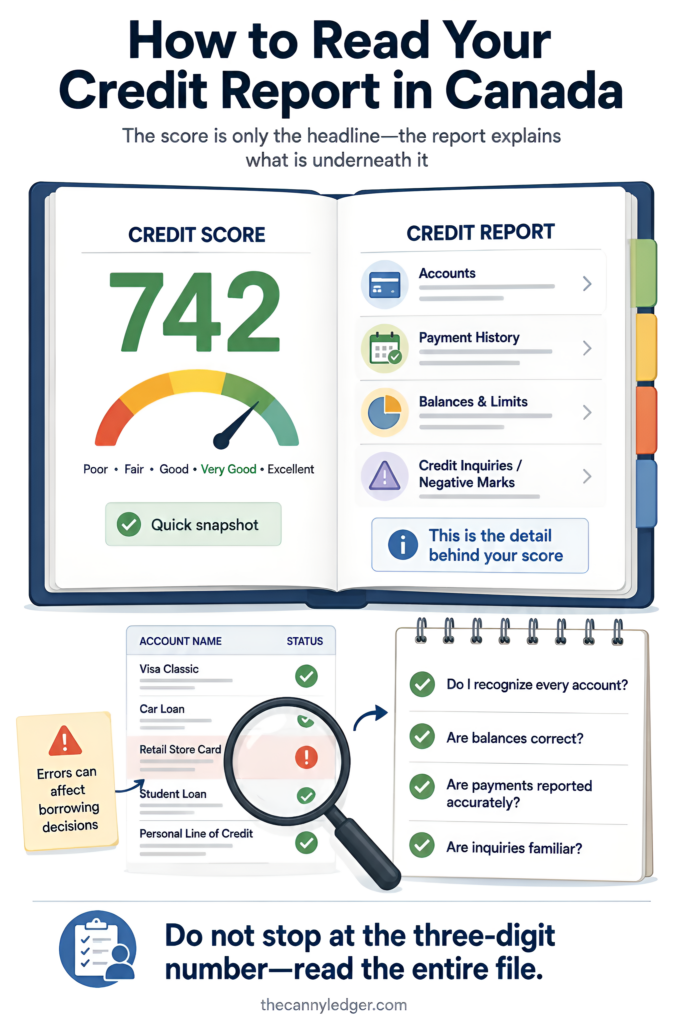
The result you get back has two genuinely different parts worth telling apart. The score itself is the three-digit number, and it comes with a plain-language tier label, poor, fair, good, very good, or excellent, depending on where it falls. Our guide to credit score ranges in Canada covers exactly where those boundaries sit and why they differ between Equifax and TransUnion specifically. The report underneath the score is the longer document, listing every account reporting to that bureau, your payment history on each one, your current balances against your limits, and any inquiries or negative marks attached to your file. Our full breakdown of how credit scores are calculated explains how the report’s contents actually translate into the number sitting at the top of it.
Read through every account listed rather than just glancing at the score and closing the tab. About one in four Canadian credit reports contain at least one error, which makes this genuinely the only reliable way to catch a mistake before it costs you something, and worth the ten minutes it takes to actually scroll through the whole thing.
What To Do If Something Looks Wrong
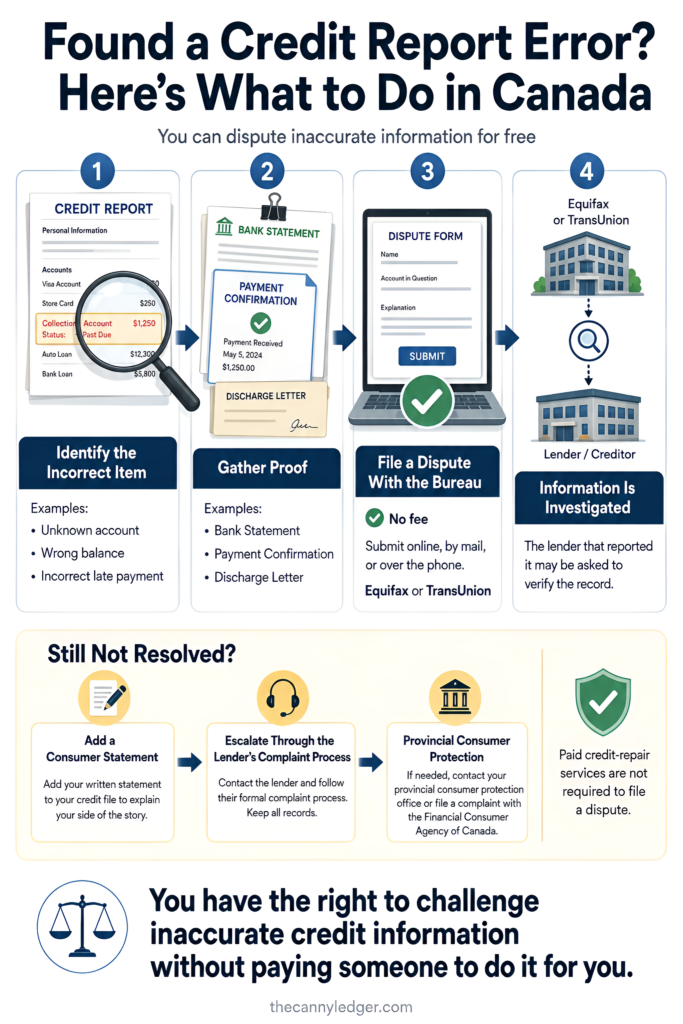
If you spot an account you don’t recognize, a balance that doesn’t match your own records, or a payment marked late that you know was made on time, you have a real, legally backed right to dispute it, and the process costs nothing. The Financial Consumer Agency of Canada confirms both bureaus are required to investigate disputed information, typically within 30 days, contacting whichever lender reported the item to verify it’s accurate. You can usually file the dispute directly through each bureau’s online portal by selecting the specific item, describing what’s wrong, and attaching any supporting documents you have, a bank statement, a payment confirmation, a discharge letter, whatever proves your version of events.
If the investigation doesn’t resolve in your favour and you still believe you’re right, you’re not out of options. You can add a brief written statement to your own credit file explaining your side, which any future lender reviewing your report will see alongside the disputed item. You can also escalate through your bank’s own complaint procedure if a specific institution reported the error, or raise it with your provincial consumer protection office if the bureau itself won’t budge. None of these paths cost anything, and none of them require hiring a paid credit repair service, which is worth remembering given how many of those exist specifically to charge for something the law already gives you access to for free.
Building A Regular Habit Instead Of A One-Time Check
Checking once and never again defeats most of the point. A monthly or quarterly glance through a free app catches problems while they’re still fresh and easy to dispute, rather than months later when you’re mid-application for something that actually matters. If you’re using an app tied to only one bureau, pair it with the other bureau’s equivalent, whether that’s a second app or your bank’s own tool, since Canada’s two credit bureaus genuinely don’t always show the same picture. And if the process of actually pulling and reading your file feels unfamiliar the first time through, that discomfort fades fast, most people find the second and third check take a fraction of the time the first one did, once they know exactly what they’re looking for and where to find it.