

A furnace dying in a Winnipeg January isn’t a minor inconvenience, it’s a same-day problem with a bill attached, and nobody’s landlord is coming to fix it. That’s the gap generic emergency fund advice leaves wide open. The standard line every Canadian bank repeats, save three to six months of expenses, was built around a household that rents, where a burst pipe or a failed roof is somebody else’s balance sheet problem. Homeownership changes the math in ways most of that advice never accounts for, and getting the number wrong in either direction, too little saved or too much sitting idle, costs real money.
- Why the standard advice undercounts homeowners
- The two funds a homeowner actually needs
- Sizing the emergency fund side for your actual housing costs
- What Employment Insurance actually buys you, and what it doesn’t
- Why mortgage-specific risk deserves its own line of thinking
- Where to actually keep this money
- A worked example
- Building toward the actual number
This isn’t a case for throwing out the three-to-six-month rule entirely. It’s a case for treating it as a starting point and then adding the pieces that only apply once you actually own the place you live in.
Why the standard advice undercounts homeowners
Most emergency fund guidance, including the Financial Consumer Agency of Canada’s own recommendation to save three to six months of regular expenses, is written for a general audience and treats housing as a single, fairly predictable monthly line item, a starting point RBC’s own guide to emergency funds frames the same way. For a renter, that’s roughly accurate. Rent is rent, and a landlord absorbs the risk of anything structural going wrong with the building itself.
A homeowner’s housing costs are neither single nor predictable. Your mortgage payment is fixed for now, but property tax, home insurance premiums, utilities, and the building itself all carry their own separate risk of a sudden spike or a sudden failure, and every one of those falls entirely on you, a real cost of carrying household debt that renters simply don’t share. That’s not a reason to panic. It’s a reason to build your fund in two distinct pieces instead of one blended number, a point the standard advice rarely makes explicit.

The two funds a homeowner actually needs
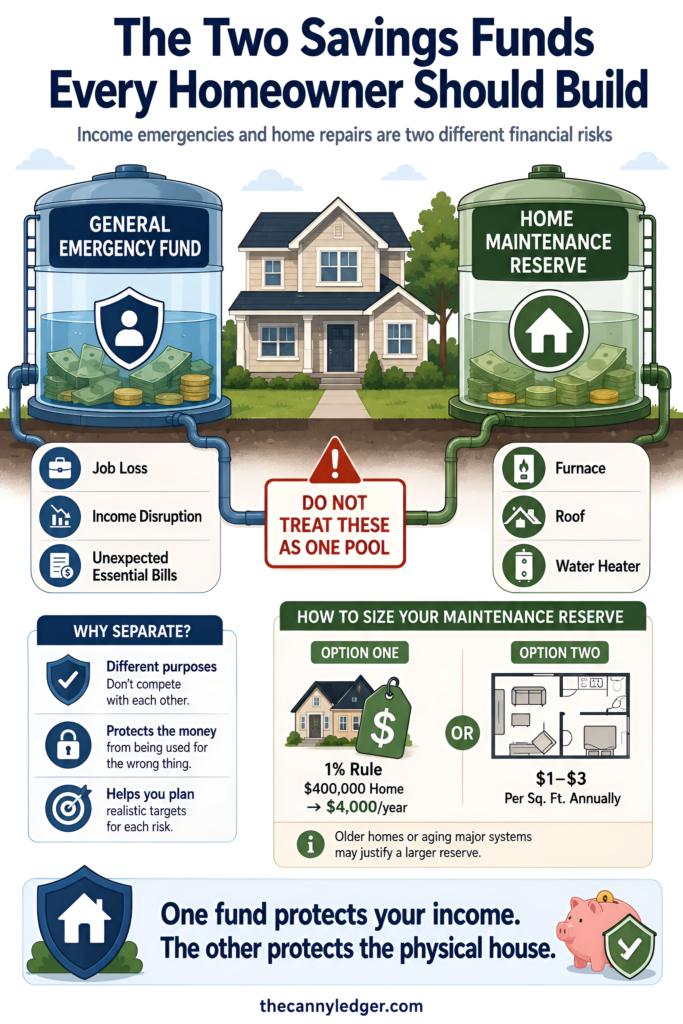
The first piece is the same emergency fund anyone should have, sized to cover job loss, illness, or any other income disruption. The second is a home maintenance reserve, a completely separate pool of money specifically for the physical building itself. Conflating the two is where a lot of homeowners get into trouble, either underfunding both or accidentally raiding one to cover the other.
For the maintenance reserve specifically, the most commonly cited starting point is the one percent rule, setting aside roughly one percent of your home’s value every year for repairs and upkeep. On a $400,000 home, that’s $4,000 a year, and on an older property or one with an aging roof or furnace, some contractors and financial planners recommend pushing that closer to two or three percent instead. An alternative version scales with square footage rather than price, budgeting roughly one to three dollars per square foot annually, which can be a more accurate starting point for a smaller home in an expensive market where the one percent rule would badly overstate the real repair costs. Either method gets you to the same place, a dedicated, separate reserve that exists specifically to absorb the furnace, the roof, and the water heater, not general emergencies.
Sizing the emergency fund side for your actual housing costs
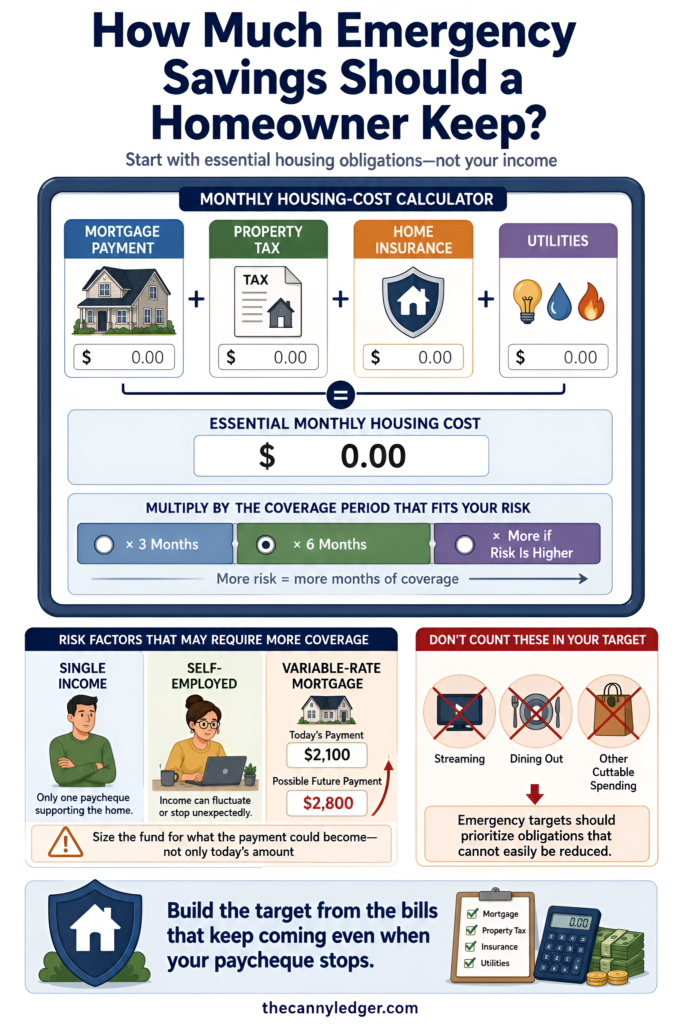
For the general emergency fund, start from your genuine monthly obligations rather than your income, since obligations are what actually need covering if the paycheque stops. That means your mortgage payment, property tax if it isn’t already rolled into your payment, home insurance, utilities, and any other fixed monthly cost, not your grocery budget or your streaming subscriptions, which can be cut hard in a genuine emergency in a way a mortgage payment can’t.
Multiply that essential monthly total by three to six months for a stable, dual-income household, and lean toward the higher end, or beyond it, if you’re a single income household, self-employed, or carrying a variable-rate mortgage where the payment itself isn’t fixed, and confirm your actual home insurance cost is included rather than estimated. That last point deserves its own weight for homeowners specifically. If you’re holding a variable-rate mortgage, your monthly housing obligation isn’t actually fixed the way a renter’s is, and your emergency fund needs to be sized against what your payment could become, not just what it is today.
What Employment Insurance actually buys you, and what it doesn’t
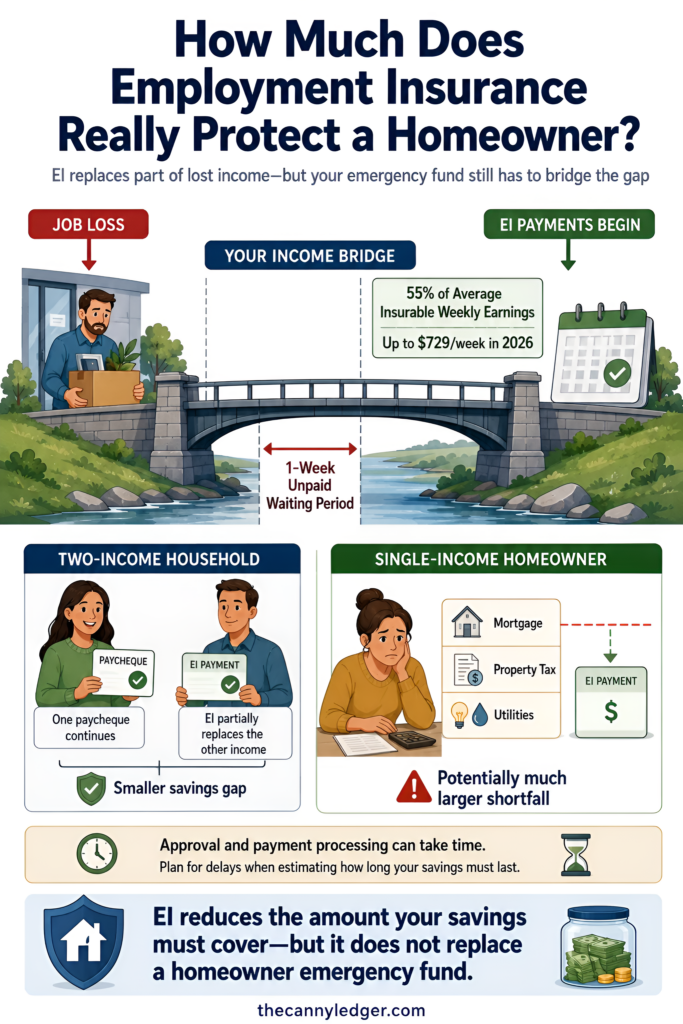
A genuine job loss is the scenario emergency funds most often exist for, and it’s worth knowing exactly what safety net already exists underneath your own savings before deciding how much more to build. Employment Insurance regular benefits replace 55 percent of your average insurable weekly earnings, up to a maximum of $729 a week as of 2026, roughly $37,908 a year at the ceiling. For a household with two working adults, that partial income replacement for the person who lost their job meaningfully reduces how much emergency savings needs to bridge the gap. For a single-income homeowner, that same $729 weekly maximum against a mortgage payment, property tax, and utilities can still leave a real shortfall, particularly in an expensive housing market where the mortgage payment alone can eat most of that benefit.
There’s also a mandatory one-week unpaid waiting period before EI payments begin, and benefits themselves take time to get approved and flowing, which is exactly the gap a homeowner’s emergency fund needs to cover on its own before any government support arrives.
Why mortgage-specific risk deserves its own line of thinking
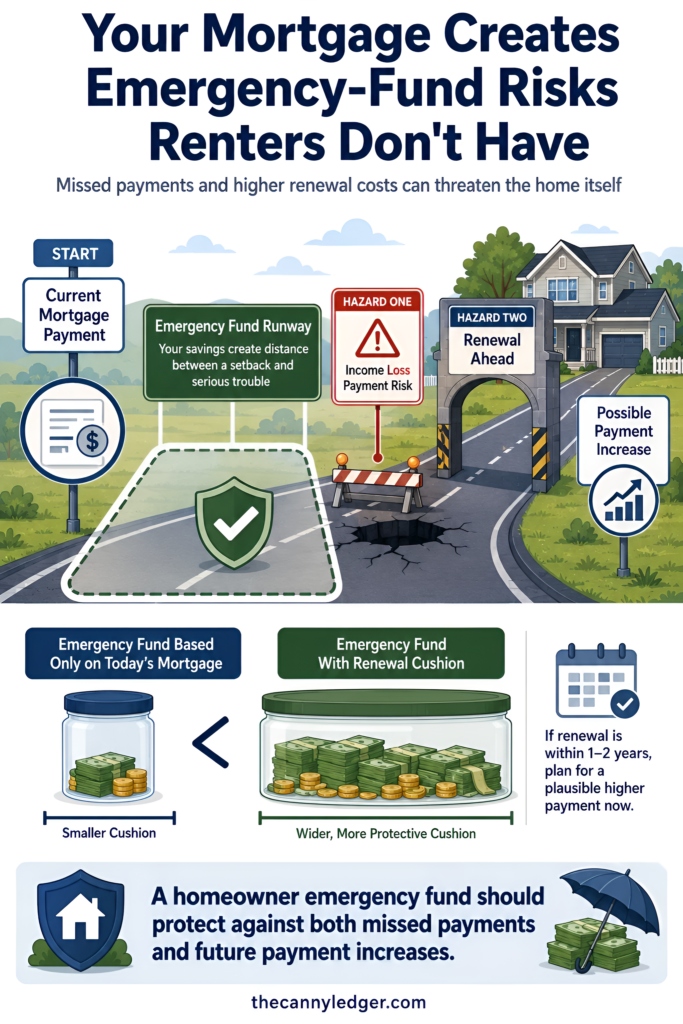
Homeownership carries a risk renters simply don’t face, the possibility of falling behind on payments and losing the home itself through legal proceedings, not just a stressful conversation with a landlord. Our full breakdown of mortgage delinquency in Canada walks through exactly what that process looks like and how much runway you actually have if a payment gets missed, but the emergency fund conversation belongs earlier than that, as the thing that prevents you from ever getting there in the first place.
Anyone with a renewal coming up in the next year or two carries an extra layer of this risk worth planning around specifically, since a higher renewal rate can raise your monthly obligation by a meaningful amount with very little notice. Building your emergency fund target around your current payment without accounting for a plausible renewal increase is a common blind spot, and padding your target by even a modest percentage to cover that scenario costs you very little in exchange for real protection.
Where to actually keep this money
An emergency fund that isn’t genuinely accessible within a day or two isn’t doing its job, no matter how large the balance looks on paper. A high-interest savings account is the standard home for this money, since it stays fully liquid while still earning something, and comparing what different institutions are currently offering is worth the ten minutes it takes, including what local credit unions are quoting against the larger banks, since the gap between them is sometimes larger than people expect.
The home maintenance reserve can afford to sit slightly less liquid than the pure emergency fund, since a furnace failure gives you a few days to act even if it doesn’t give you a few months, which makes a short-term GIC ladder a reasonable option for part of that specific pool. Keep the two funds in genuinely separate accounts even if they’re at the same institution, since a shared pool has a way of quietly shrinking toward whichever need feels most urgent in the moment, usually not the one that was actually most important.

A worked example
Take a Manitoba household with a $2,200 monthly mortgage payment, $250 in monthly property tax, $150 in home insurance, and $300 in utilities, a combined $2,900 in essential housing costs before groceries or anything else gets added in. A six-month emergency fund built around that housing baseline alone, before adding other essential non-housing costs, already lands north of $17,000. Layer on a home maintenance reserve at even a conservative one percent of a $400,000 home, another $4,000 a year building toward a rolling reserve, and the two funds together represent a serious, multi-year savings goal, not something to assemble in a single year.
That’s precisely why treating this as two funds with two different purposes matters. A household that hits $17,000 in general emergency savings but has nothing set aside for the roof is still one bad winter away from raiding the fund meant to cover a job loss, right when a job loss is exactly the kind of thing that tends to cluster with a run of bad luck.

Building toward the actual number
Calculate your own essential monthly housing costs first, not your full budget, and multiply by the months of coverage that fit your specific job stability and mortgage structure. Set the home maintenance reserve up as a completely separate account from day one, even if you’re starting both from zero, so the two funds never blur into each other under pressure. If a renewal is on the horizon, build in a cushion for a higher payment now rather than discovering the gap the month the new rate takes effect. And if you’re ever unsure whether your existing safety net actually covers your real exposure as a homeowner rather than a renter’s version of the same advice, running your specific numbers against your average local housing costs is a better use of an afternoon than trusting a single generic percentage to have already done that work for you.