

Two apartments with the exact same floor plan, the exact same rent, and the exact same square footage can turn out to be completely different living experiences depending entirely on the building they sit inside. One has a superintendent who answers a maintenance request the same afternoon; the other has a property management company that takes three weeks and two follow-up emails. One was built in 2022 with modern insulation that handles a Winnipeg February without a fight; the other is a converted 1960s low-rise where the radiator clanks all night and the hallway carpet hasn’t been replaced since the Jean Chrétien years. Choosing a unit is the easy part. Choosing the building underneath it is where the real decision actually lives, and it’s the part most apartment-hunting advice skips past entirely.
- Start with what Winnipeg’s vacancy numbers actually mean for you
- The research step almost nobody does before signing
- Understanding who actually owns and runs the building
- What building era tells you about what you’re actually getting
- Running the real budget math, not just the sticker rent
- What to actually look for on a tour
- Matching the building to your specific situation
- Before you sign anything
Start with what Winnipeg’s vacancy numbers actually mean for you
Winnipeg’s rental vacancy rate has been sitting in the high 2 percent range through 2026, according to the most recent industry tracking, a meaningful loosening from the sub-2 percent conditions that defined the market a few years earlier but still tight enough that desirable units in good buildings move fast. What’s genuinely useful to know is that this loosening hasn’t been even across the market. Newer buildings, particularly those completed after 2020, are carrying noticeably higher vacancy than older, stabilized stock, and units in those newer buildings are reportedly taking longer to fill, in some cases months rather than weeks. That gap is worth using strategically: if you’re touring a newer building with visible vacancy, that’s genuine leverage to negotiate on move-in incentives, a slightly lower rent, or a longer rent-free period during a lease-up, leverage that simply doesn’t exist in an older, fully occupied building with a waitlist.
Family-sized units and units in well-maintained, established buildings remain the tightest segment of the market regardless of the citywide vacancy trend, so if you’re searching for a two- or three-bedroom in a building with a strong reputation, plan to move quickly once you find one rather than assuming the broader loosening applies evenly to your specific search.

The research step almost nobody does before signing
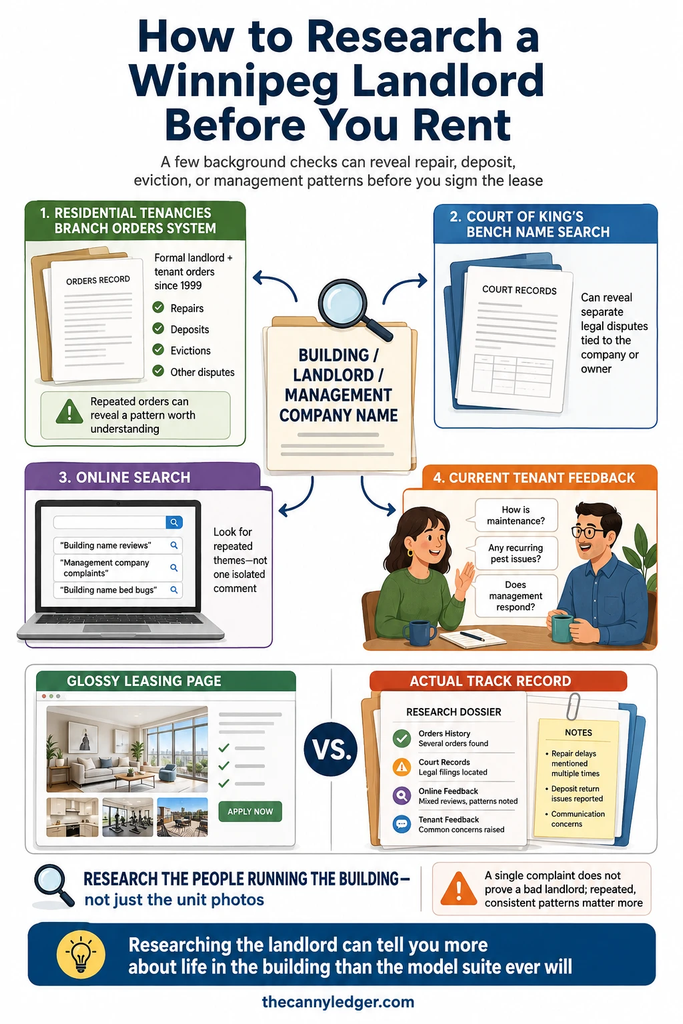
Manitoba actually makes it possible to check a landlord’s track record before you commit to a lease, and it’s a resource that goes almost entirely unused by renters. The province’s Residential Tenancies Branch maintains an Orders System, a registry of every formal order issued to landlords and tenants since 1999, covering disputes over repairs, deposits, evictions, and other conflicts that escalated far enough to require a ruling. Individuals can search it in person at the Winnipeg branch office for a small per-visit fee, and while it takes a bit more effort than scrolling reviews, a management company or landlord with a long, repeated history of orders against them in this system is telling you something concrete that a glossy leasing website never will. Pairing that with a Court of King’s Bench name search, which can surface separate small claims or legal history tied to a property management company, gives you a genuinely fuller picture than online reviews alone, which can be sparse, outdated, or occasionally planted.
Short of an in-person records search, a straightforward online search of a building or management company’s name alongside words like “reviews,” “complaints,” or “bed bugs” takes two minutes and regularly turns up patterns worth knowing about before you sign anything, particularly for larger property management companies that operate multiple buildings across the city under one name.
Understanding who actually owns and runs the building
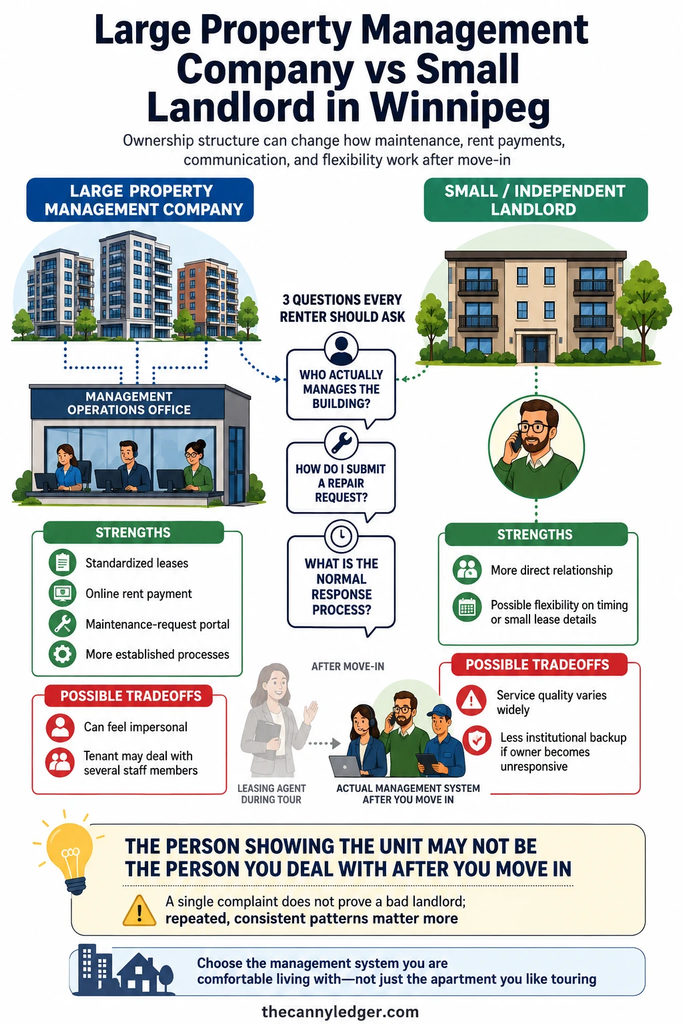
Winnipeg’s rental stock breaks down roughly into two ownership models, and knowing which one you’re dealing with shapes almost everything about your day-to-day experience as a tenant. Large property management companies operate portfolios of buildings across the city, typically offering standardized leases, an online portal for maintenance requests and rent payment, and a level of process that can feel impersonal but tends to be more consistent and less prone to a single landlord’s personal financial troubles disrupting your tenancy. Smaller, independently owned buildings, sometimes a single low-rise owned by one family or a small local investor, can offer a more personal relationship and occasionally more flexibility on things like move-in timing or minor lease terms, but service quality varies enormously from one owner to the next, and there’s less institutional backstop if that owner becomes unresponsive or the building changes hands.
Neither model is inherently better, but it’s worth asking directly during a tour or application who actually owns the building and how maintenance requests get handled, since the answer tells you a lot about what your relationship with this landlord will actually look like eighteen months into a lease, long after the leasing agent who charmed you during the tour has moved on to filling the next vacancy.
What building era tells you about what you’re actually getting
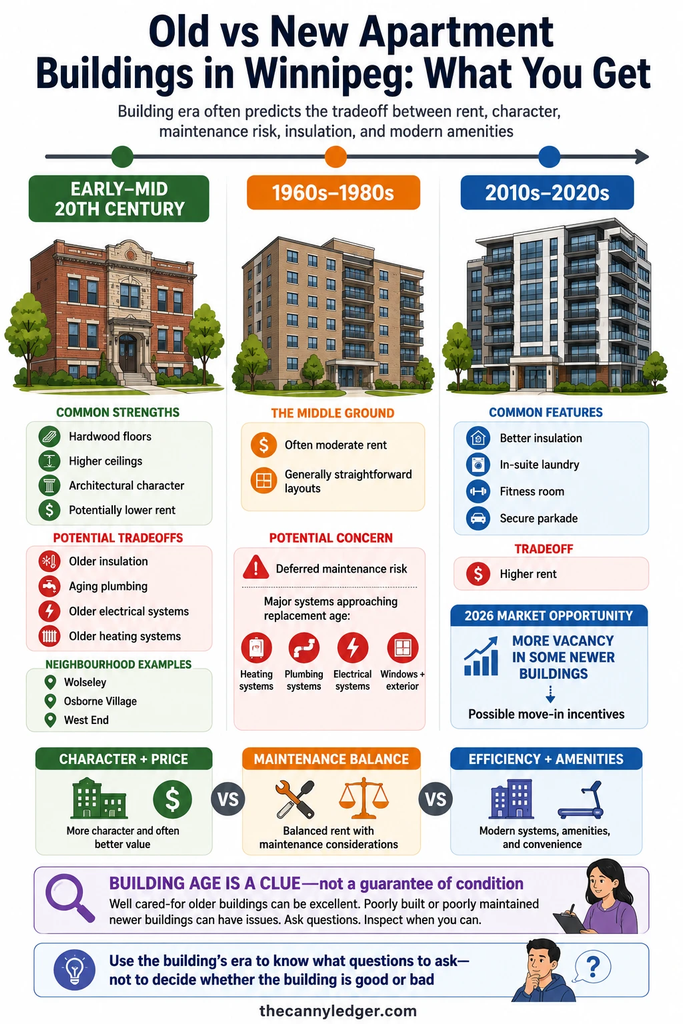
Winnipeg’s apartment stock spans nearly a century of construction, and the era a building was put up in correlates strongly with specific trade-offs worth knowing before you tour.
Character buildings from the early-to-mid 20th century, common in neighbourhoods like Wolseley, Osborne Village, and the West End, often come with genuine architectural charm, hardwood floors, higher ceilings, and rents that can undercut newer construction significantly. The trade-off tends to show up in insulation, aging plumbing and electrical systems, and a real chance of encountering knob-and-tube wiring or older heating systems that weren’t designed with modern energy efficiency in mind, worth asking about directly if a cold Winnipeg winter and a manageable hydro bill both matter to you.
Mid-century buildings from the 1960s through 1980s make up a large share of the city’s rental inventory and tend to offer a reasonable middle ground: generally solid construction, moderate rents, but often overdue for interior updates and sometimes carrying the highest deferred-maintenance risk of any era, since a building this age is old enough to need major systems replaced but not always new enough that an owner has already done it.
Newer construction from the 2010s onward tends to come with better insulation, in-suite laundry as a near-standard feature, and amenities like fitness rooms or secure parkades that older buildings simply don’t have room for, at a real rent premium that reflects all of that. Given what the vacancy data above suggests about this segment specifically, it’s also where you’re most likely to find a landlord willing to negotiate on move-in terms right now.
Running the real budget math, not just the sticker rent
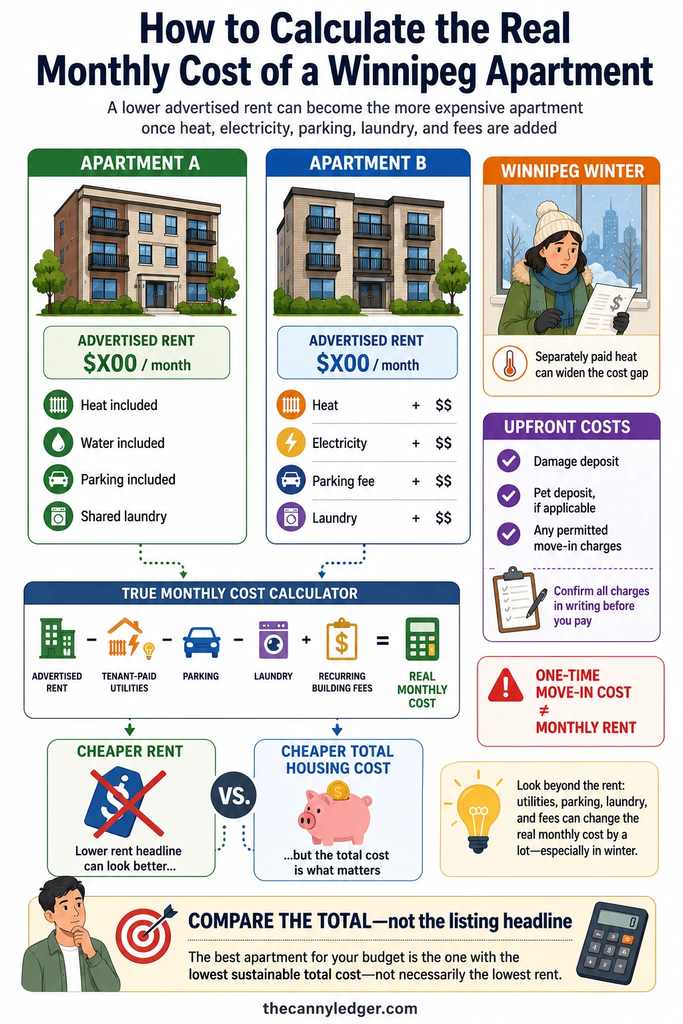
The advertised rent is rarely the whole cost of living in a specific building, and the gap between buildings on this point can be larger than people expect going in. Confirm directly whether heat, water, and electricity are included or billed separately, since a building with utilities bundled into rent can work out cheaper overall than a lower-rent building where you’re covering a Manitoba winter’s heating bill on top. Our all-utilities-included apartments in Winnipeg guide is worth comparing against any building you’re seriously considering, purely on the basis of total monthly cost rather than headline rent.
Parking is its own line item worth asking about directly, since some buildings include it, others charge a separate monthly fee that can run into real money over a year, and unheated outdoor parking in a Winnipeg winter is a meaningfully different experience than a heated underground stall. In-suite versus shared laundry, a refundable versus non-refundable move-in fee, and whether a damage deposit is required on top of first month’s rent are all worth confirming precisely rather than assuming based on the listing alone.
If your budget is genuinely tight, our Winnipeg apartments under $1,000 a month and cheap 1, 2, and 3 bedroom apartments in Winnipeg compared guides are worth reading alongside this one, and if you qualify for provincial rental assistance, our how to qualify for Rent Assist in Manitoba guide covers a program that can materially change what building tier is actually within reach.
What to actually look for on a tour
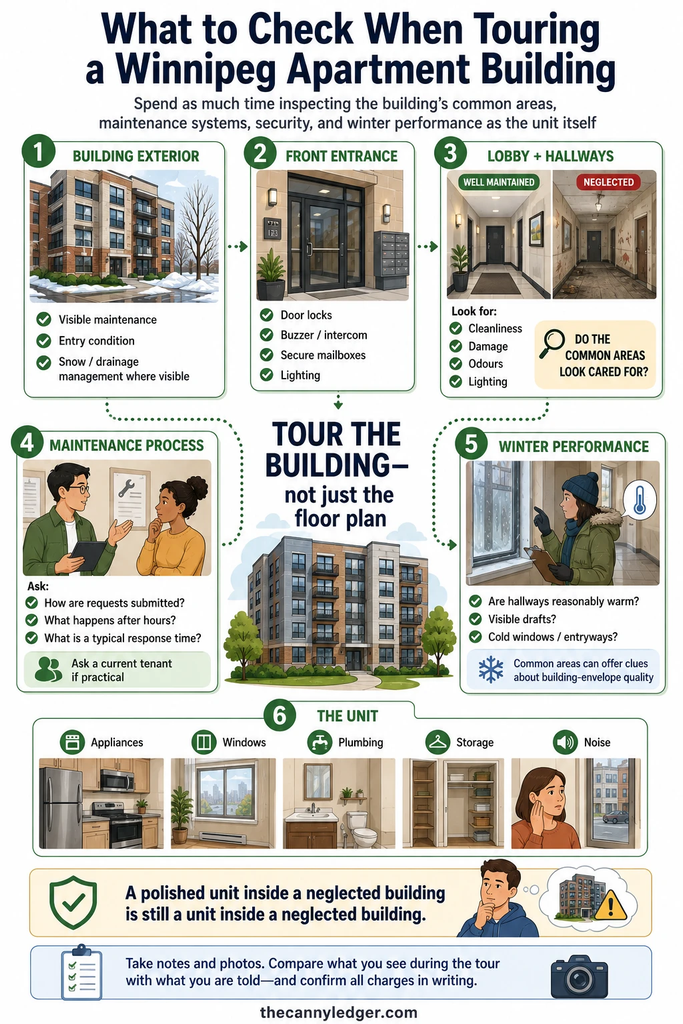
Beyond the unit itself, walk the common areas with real attention: a hallway or lobby that’s clean and well-lit tends to reflect broader management quality, while visible neglect in shared spaces is a reasonably reliable signal of how quickly your own maintenance requests will get handled. Ask specifically how maintenance requests are submitted and what the typical response time looks like, and if possible, ask a current tenant in passing rather than relying entirely on what a leasing agent tells you.
Check the state of the building’s exterior and entry security, whether that’s a functioning buzzer system, secure mailboxes, or a monitored entrance, since this matters considerably more in some Winnipeg neighbourhoods than others. And if you’re touring in winter specifically, pay attention to how well the building holds heat in common areas and stairwells, a genuinely practical test of the same insulation quality that will affect your own unit and hydro bill for the next year.
Matching the building to your specific situation
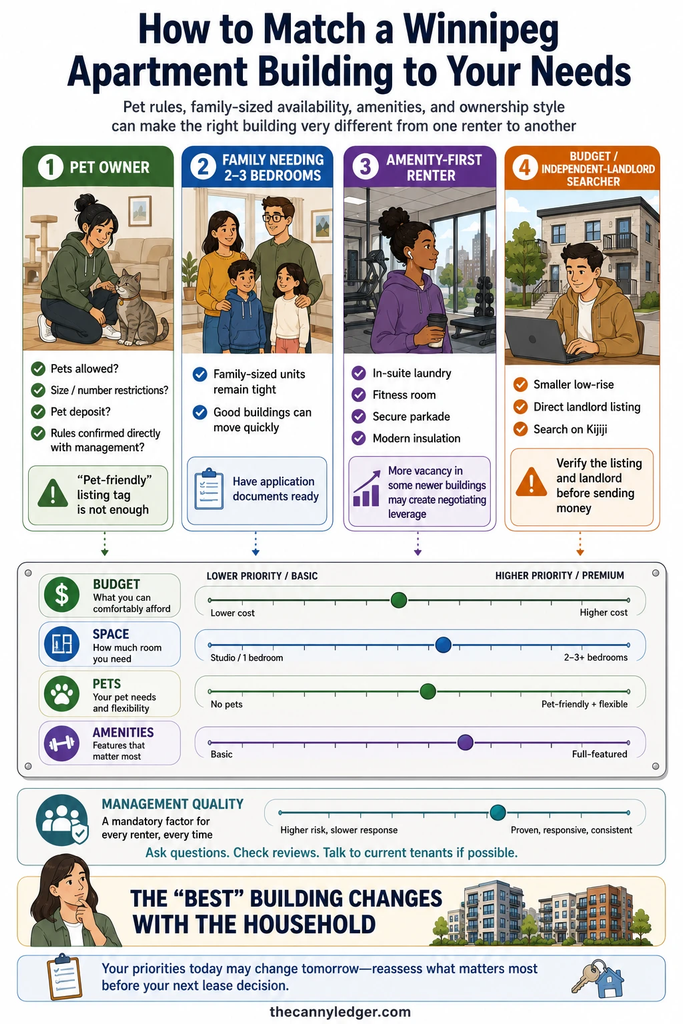
If you’re moving with pets, confirm the building’s actual pet policy directly with management rather than trusting a listing’s pet-friendly tag, since policies and any associated deposits vary building to building even within the same management company’s portfolio; our pet-friendly apartments in Winnipeg on a budget guide covers this in more depth. Families searching for more space should read our affordable family-sized rentals in Winnipeg guide alongside this one, since family-sized units are consistently the tightest segment of the market regardless of broader vacancy trends. And if newer construction with modern amenities is specifically what you’re after, our new apartments in Winnipeg guide profiles exactly the kind of recently built stock where the vacancy and negotiating dynamics described earlier are currently most in your favour.
Kijiji remains one of the most active listing sources for smaller, independently owned buildings specifically, since many of those landlords list directly rather than through a larger management platform’s own website, and our using Kijiji to find cheap apartments in Winnipeg guide covers both search strategy and how to spot a listing that isn’t legitimate.
Before you sign anything
Once you’ve narrowed things down to a specific building, get a clear written answer on total monthly cost including utilities and parking, confirm maintenance response expectations in writing where possible, and take the extra step of checking the landlord or management company’s name against the Residential Tenancies Branch’s Orders System or at least a basic online search before handing over a deposit. Tenant insurance is also worth arranging before move-in day rather than after, since it protects your belongings and your liability in ways a building owner’s own policy never covers; our tenant and renters insurance in Winnipeg guide walks through what that coverage typically costs and protects. The unit matters. The building, and the people running it, matter more, and they’re the part of this decision most worth slowing down for.