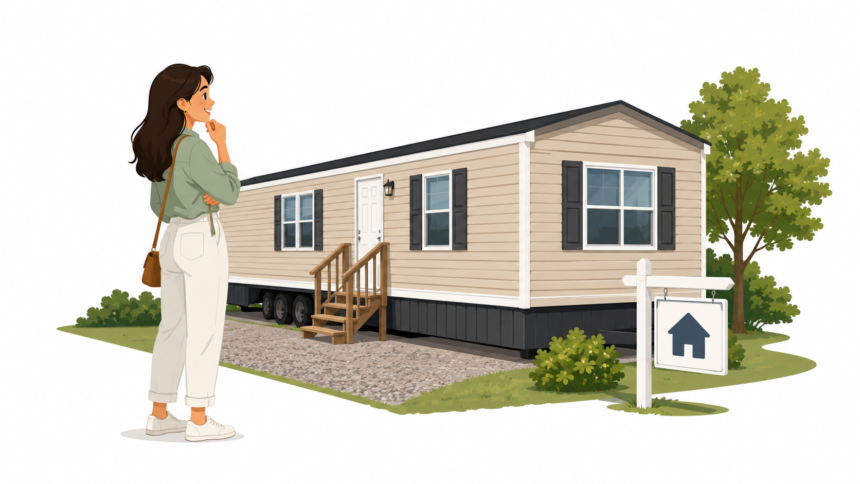
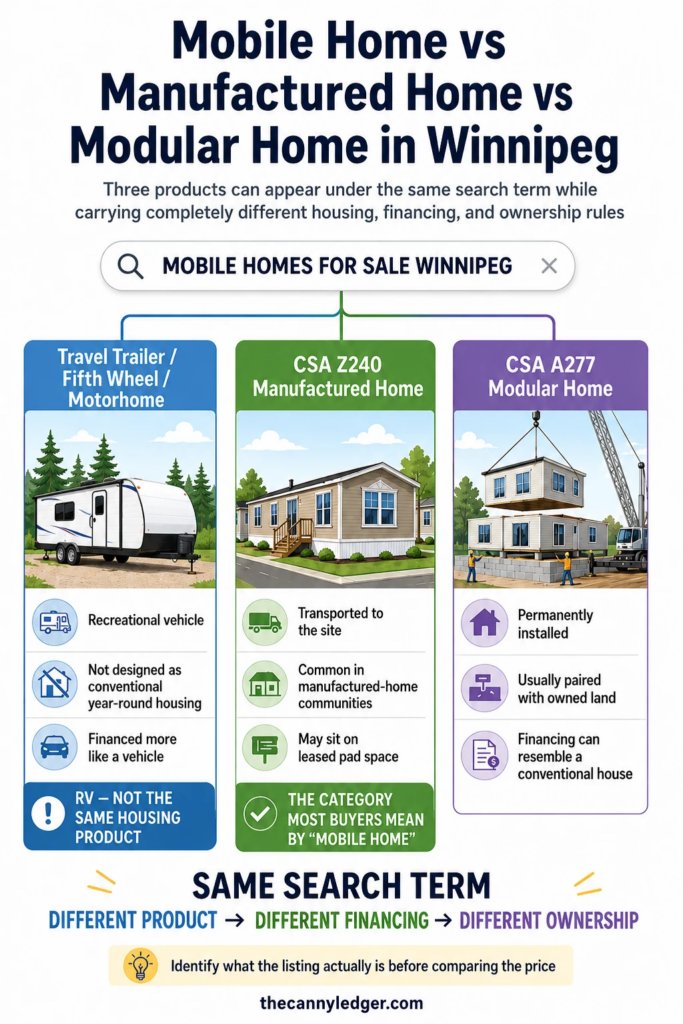
Search “mobile homes for sale Winnipeg” and you’ll get three genuinely different products mixed into one results page, and mistaking one for another is how people end up either overpaying for financing they didn’t need or getting blindsided by financing they can’t get at all. A vintage travel trailer parked at an RV dealership, a factory-built manufactured home sitting on a rented pad at a place like Rivergrove Estates, and a modular home permanently anchored on land you own are three different categories with three different price ranges, three different financing pathways, and three very different long-term ownership realities. This guide sorts out which is which before you fall in love with a listing that turns out to be a different animal than you thought.
- The three things hiding under one search term
- Why the certification label determines almost everything that follows
- How financing actually works for each category
- The land question: owning versus leasing the ground under your home
- What you’re actually getting for the money
- Insurance is its own separate conversation
- Who this actually makes sense for
- Before you make an offer on anything
The three things hiding under one search term
The first category isn’t housing in any real sense, it’s recreational: travel trailers, fifth wheels, and motorhomes that occasionally show up in searches for “mobile homes” simply because the terminology overlaps in casual use. These aren’t built or certified as year-round dwellings, financing for them works like vehicle financing rather than home financing, and they’re worth ruling out immediately if what you’re actually looking for is a genuine budget housing alternative rather than a recreational vehicle.
The second category, and the one most people actually mean when they search this term, is the CSA Z240-certified manufactured home: a factory-built house on a permanent steel chassis, single-wide or double-wide, designed to be transported to a site and then set up on blocks, piers, or a foundation. These make up the bulk of what you’ll find in Winnipeg-area mobile home parks like Rivergrove Estates and similar communities around the Interlake and southern Manitoba, and they represent the genuine affordability story this whole category is known for.
The third category is the CSA A277-certified modular home, built in a factory under third-party inspection to the same building codes that apply to a site-built house, then transported and permanently installed on a foundation on land the owner holds title to. This is a meaningfully different product from a legal and financing standpoint than the Z240 manufactured home, even though both start their life in the same kind of factory, and the distinction between them is the single most important thing to understand before you start shopping seriously.
Why the certification label determines almost everything that follows
Every legitimate factory-built home in Canada carries a compliance sticker, typically on the electrical panel or inside a kitchen cupboard, identifying it as either CSA Z240 or CSA A277. This isn’t a minor technical detail. A CSA A277 home installed on a permanent foundation on land you own is generally treated as real property, meaning it qualifies for conventional mortgage financing through banks and credit unions largely the same way a site-built house does. A CSA Z240 manufactured home, particularly one sitting on leased pad space in a mobile home park rather than owned land, is treated very differently by lenders, and that difference in classification is exactly why financing this category of home works so differently from financing a conventional house.
Before you make an offer on anything in this space, confirming which certification applies isn’t optional homework, it’s the single question that determines your entire financing pathway, and any seller or dealer unwilling or unable to produce that documentation clearly is a genuine warning sign.

How financing actually works for each category
A CSA A277 modular home on owned land with a permanent foundation qualifies for standard mortgage financing, including CMHC-insured mortgages for buyers putting down less than 20 percent, largely on the same terms as any conventional home purchase. This is the path that most closely resembles buying a regular house, and it’s worth reading alongside our current mortgage rates in Winnipeg and best mortgage rates in Winnipeg guides, since the lenders and rate-shopping process are essentially the same as for any other home purchase.
A CSA Z240 manufactured home on leased land, the more common situation in Winnipeg-area mobile home parks, typically requires what’s called a chattel loan rather than a conventional mortgage, since you’re financing the home as personal property rather than real estate you hold title to. Chattel loans generally carry higher interest rates than a conventional mortgage, shorter amortization periods, and a narrower pool of willing lenders, often specialty finance companies and select credit unions rather than the big banks. CMHC does offer mortgage loan insurance specifically for manufactured and prefabricated housing in some circumstances, which can help, but the reality is that financing costs for this category run higher than for a conventional home purchase of similar value, a trade-off that partially offsets the lower sticker price these homes are known for.
If a Z240-certified manufactured home has been permanently affixed to a foundation on land the owner holds title to, and the wheels, axles, and towing hitch have been formally removed through a deregistration process, it can sometimes be reclassified as real property for financing purposes, unlocking access to more conventional mortgage terms. This conversion isn’t automatic and involves specific paperwork, permits, and inspections, so it’s worth discussing directly with a mortgage broker familiar with manufactured housing before assuming a park-sited manufactured home is permanently locked into chattel financing terms.

The land question: owning versus leasing the ground under your home
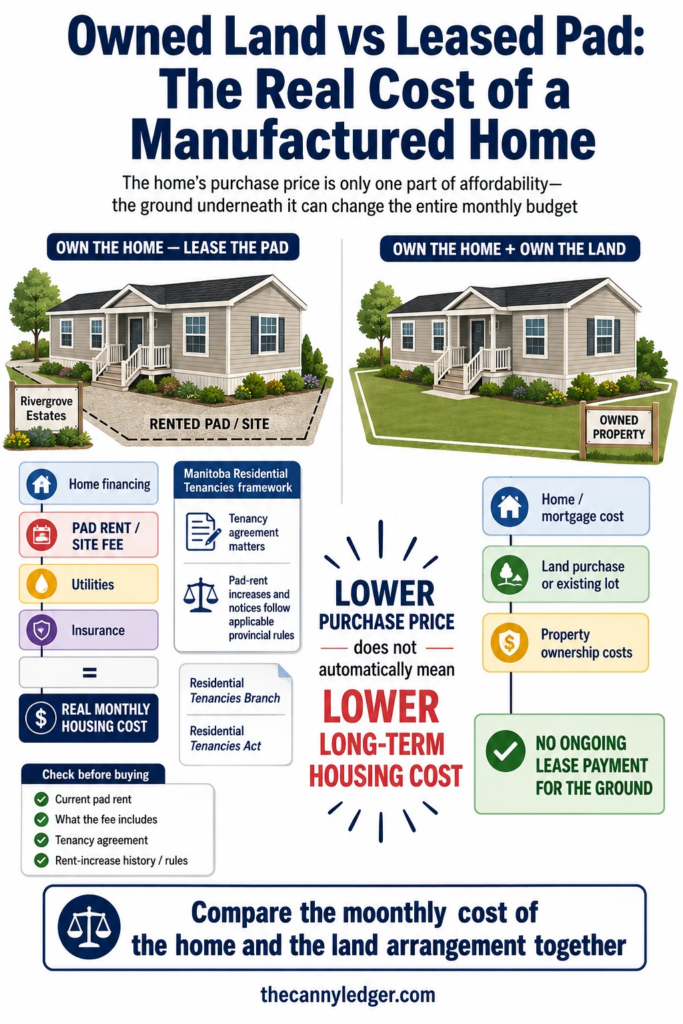
This is where the true affordability math of a manufactured home in Winnipeg gets complicated, and it’s worth working through honestly rather than comparing sticker prices alone. Buying a manufactured home at a park like Rivergrove Estates typically means you own the home itself outright but pay ongoing pad rent, sometimes called a site fee or lot rent, for the land underneath it. That monthly fee covers your spot in the community along with shared services and infrastructure, and it’s a genuine ongoing cost that needs to be added to whatever you’re paying on financing for the home itself when you’re comparing this option honestly against renting an apartment or buying a conventional house.
In Manitoba, this kind of tenancy, renting a pad while owning the structure on it, falls under the province’s Residential Tenancies Act and is overseen by the Residential Tenancies Branch, the same body that handles apartment rental disputes elsewhere in the province. That means pad rent increases, notice periods, and dispute resolution follow a regulated framework rather than being entirely at a park operator’s discretion, which is genuinely useful protection to understand if you’re considering this path. It’s worth requesting the specific tenancy agreement and current pad rent structure for any park you’re seriously considering before finalizing a purchase, since that ongoing cost is every bit as important to your long-term budget as the purchase price of the home itself.
Buying a CSA A277 modular home on land you own outright removes this ongoing pad rent question entirely, at the cost of needing to purchase or already own a lot to place it on, which is its own separate expense worth factoring in before comparing the two paths on price alone.
What you’re actually getting for the money
The affordability appeal of this category is real and worth taking seriously rather than dismissing as a compromise purchase. A manufactured home in a Winnipeg-area park can represent a genuinely lower total entry cost than a conventional starter home in the current market, particularly relevant given that Winnipeg’s housing market has been running in seller-favouring conditions with record average prices through much of 2026. For retirees looking to downsize, first-time buyers priced out of the conventional resale market, or anyone prioritizing a lower monthly cost over building equity in land, this category deserves serious consideration rather than being treated as a last resort.
It’s worth being honest about the trade-offs too. Manufactured homes on leased land generally don’t appreciate the way a conventional home on owned land tends to over time, since you’re not building equity in the underlying property, only in the structure itself, and that structure depreciates somewhat the way a vehicle does even as it remains a perfectly functional home. Resale can also take longer and attract a narrower pool of buyers than a conventional house listing, partly because of the financing complexities described above discouraging some potential purchasers.

Insurance is its own separate conversation
Insuring a manufactured or mobile home works differently than insuring a conventional house, and it’s worth getting a quote before you commit to a purchase rather than assuming your existing understanding of home insurance transfers directly. Our mobile home insurance in Winnipeg guide covers exactly how this coverage differs, what it typically costs, and what insurers specifically look for when underwriting this category of home, which can include the age of the unit, its tie-down or anchoring system, and its distance from a fire hall depending on which park or rural location it sits in.

Who this actually makes sense for
This path tends to suit retirees and downsizers looking for single-level living with lower ongoing costs than a conventional house, buyers genuinely priced out of the resale market who’ve done the full math on pad rent or land costs rather than comparing sticker prices alone, and anyone who values the lower entry cost enough to accept the different equity-building dynamics described above. Our 55-plus and affordable senior apartments in Winnipeg guide is worth reading alongside this one if you’re specifically comparing a manufactured home purchase against age-restricted rental options as part of a downsizing decision, and our low income and co-op housing options in Winnipeg guide covers a different set of alternatives worth knowing about if affordability, rather than a specific preference for ownership, is the primary driver.
If you’re weighing this purchase against the numbers on a rent-to-own arrangement instead, our rent-to-own homes in Winnipeg guide covers that alternative path to ownership, and a conversation with one of the professionals in our financial advisors in Winnipeg roundup is worth having before you commit to chattel financing at a materially higher rate than a conventional mortgage would carry, just to confirm the total cost genuinely works out in your favour over the timeline you’re planning to stay.

Before you make an offer on anything
Confirm the CSA certification and request the sticker or documentation directly rather than taking a listing’s word for it. If land is leased rather than owned, get the current pad rent, the tenancy agreement, and a clear sense of how rent increases are handled under Manitoba’s Residential Tenancies framework before you fall in love with a specific unit. And talk to a lender or mortgage broker who specifically handles manufactured housing financing before you assume the math works the same way it would for a conventional home purchase, since the gap between a chattel loan and a standard mortgage is exactly the kind of detail that changes whether this genuinely saves you money or simply defers the cost to a higher interest rate down the road.

